Kimchi Fermentation Stages Guide
Fresh, Young, Ripe, or Over-ripe — kimchi tastes completely different at each stage, and every KimchiGuide recipe is built around a specific one. Here’s exactly how to tell them apart, and which stage to reach for.


What Are Kimchi’s Fermentation Stages?
Kimchi passes through 4 identifiable stages as lactic acid bacteria break down its sugars: Fresh (0–3 days, pH ≈ 5.5, sweet and crunchy), Young (1–2 weeks, pH ≈ 4.8, a light tang), Ripe / Stage 3 (2–4 weeks, pH ≈ 4.2, complex sour-umami — the stage most fried rice recipes call for), and Over-ripe (4+ weeks, pH ≈ 3.8, sharply sour and soft). Which one you need depends entirely on what you’re cooking.
The 4 Kimchi Fermentation Stages — In Detail
Every stage below has a distinct taste, texture, smell, and ideal use. Get familiar with these and you’ll never second-guess a recipe’s kimchi requirement again.
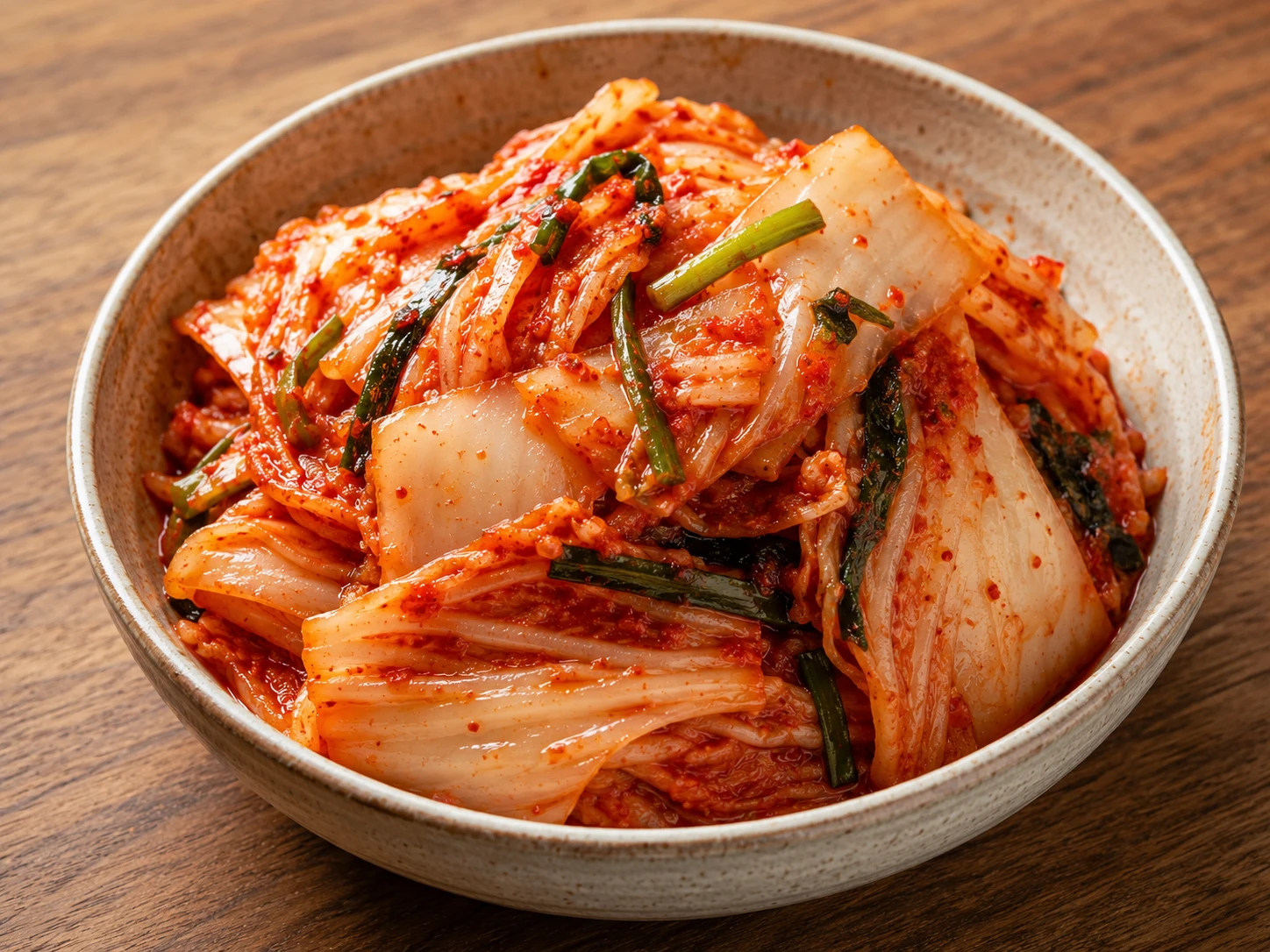
Bright red, sweet, crunchy, mildly salty — closer to seasoned raw cabbage than “kimchi” in the fermented sense. No sourness, no funk, no bubbles in the brine.
Best for: eating fresh as a crisp side dish (banchan). Fries flat with no caramelisation — avoid for fried rice.
✗ Not for fried rice — too flat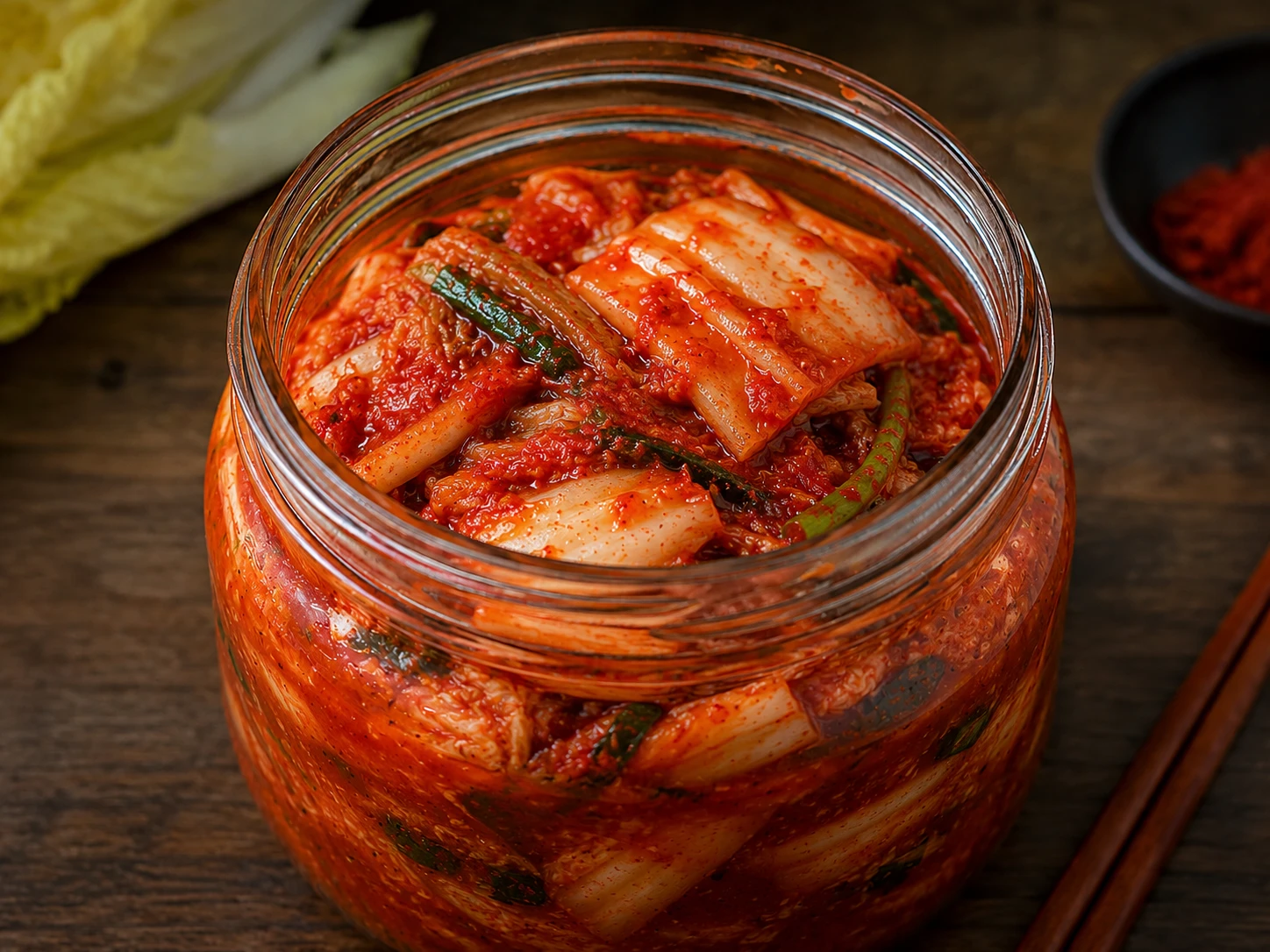
A light, developing tang starts to appear alongside the original sweetness. Brine may show the first small bubbles — early visible sign of active fermentation.
Best for: milder recipes where you don’t want kimchi to dominate — tofu-based dishes, breakfast bowls, or as a last-resort fried rice substitute with a splash of rice vinegar added.
△ Usable with adjustment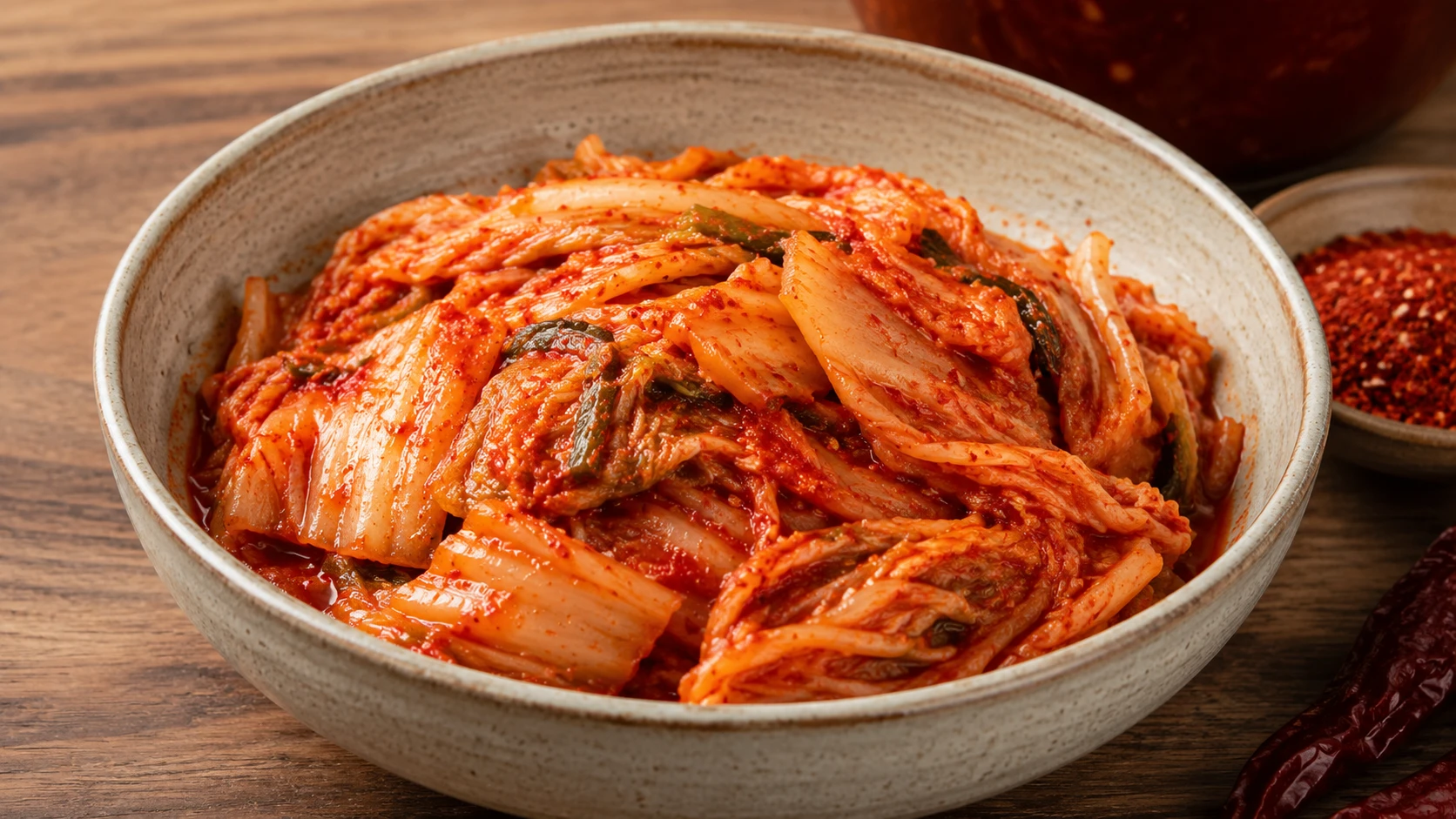
Deep red, softened texture, a rounded sour-umami flavour with visible bubbles and a pleasant vinegary-sour smell. This is peak lactic acid development.
Best for: the majority of KimchiGuide’s KFR variations — classic, tuna, cheese, vegan, cauliflower all call for this stage. It’s the caramelisation sweet spot.
★ The default choice for fried rice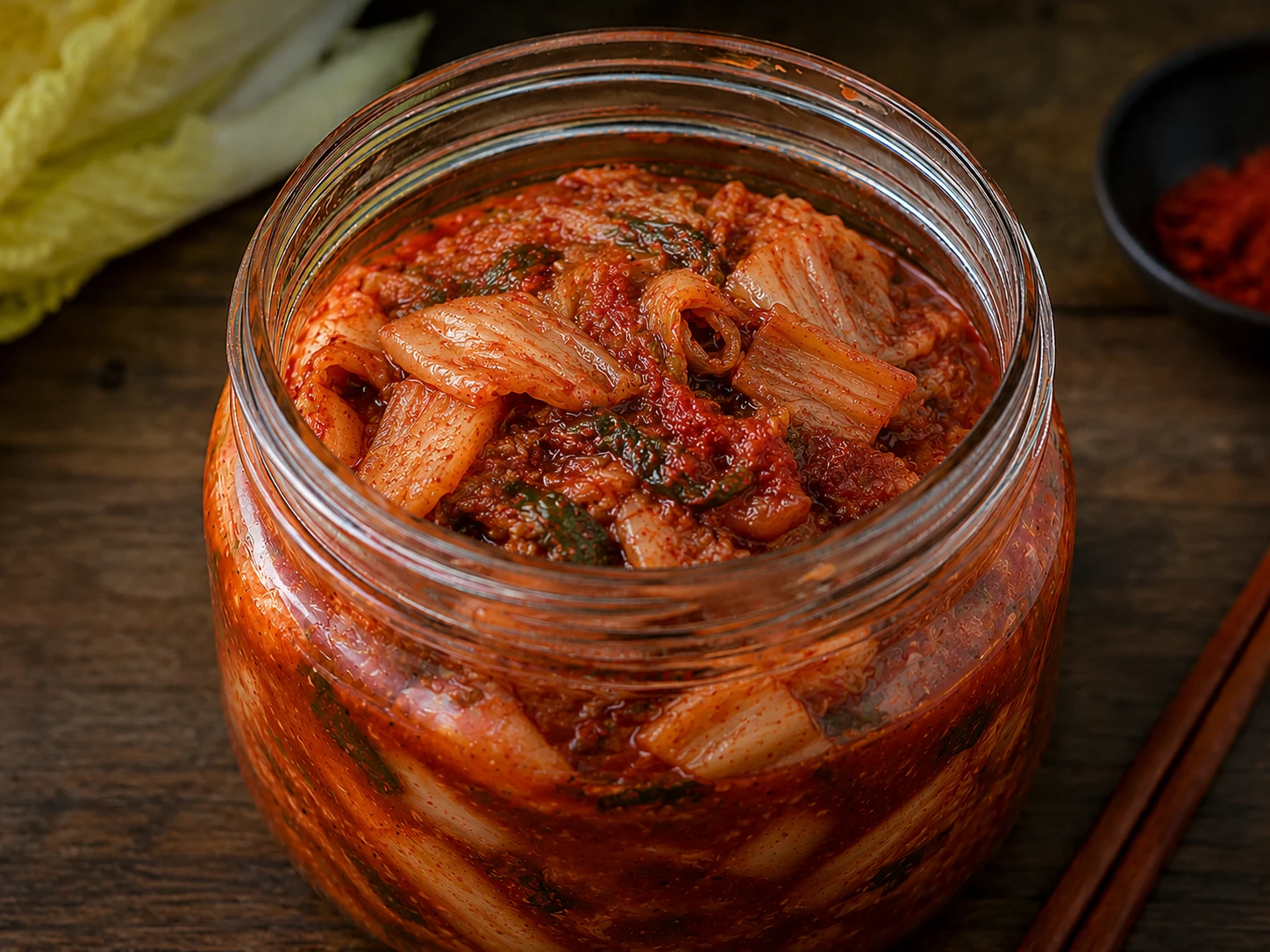
Sharp, intense sourness with a notably softened, almost silky texture. Smell is strong and distinctly funky rather than lightly tangy.
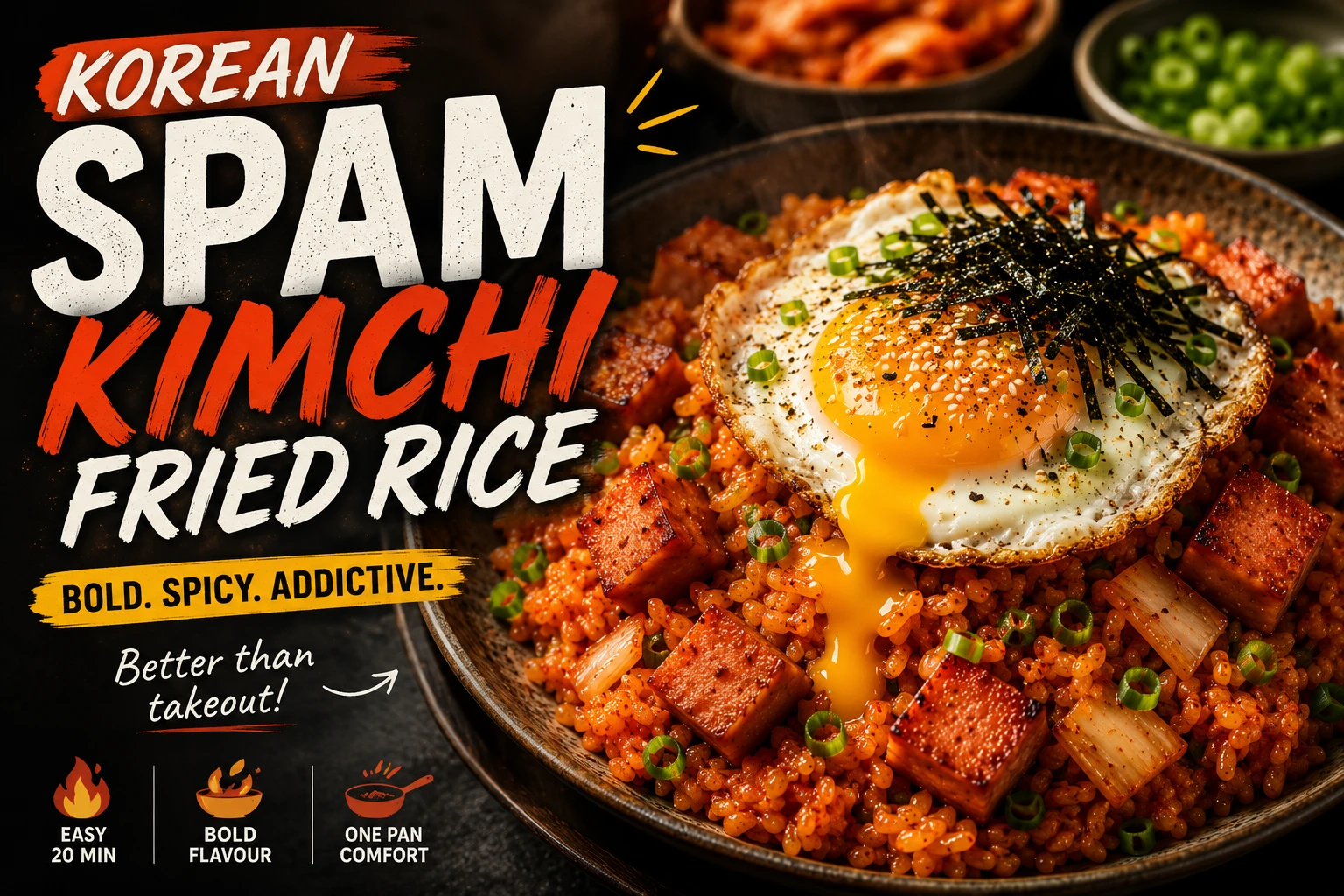
Best for: rich, fatty recipes that can stand up to the intensity — Spam and bacon-based fried rice, or long-simmered kimchi jjigae (stew), where the strong flavour deepens further with cooking.
△ Best paired with rich, fatty ingredientsThe Microbial Science Behind Each Stage
The 4 stages aren’t just “more sour over time” — they’re driven by an actual handover between different bacterial species, each with its own flavour signature.
| Fermentation Phase | Dominant Bacteria | What They Produce | Flavour Signature |
|---|---|---|---|
| Early (Fresh → Young) | Leuconostoc mesenteroides | CO₂ gas + mild lactic acid — the source of the first bubbles you see in the brine | Light fizz, gentle tang, still mostly sweet |
| Middle (Young → Ripe) | Weissella koreensis and related species | Continued acid production as oxygen in the brine depletes and conditions shift | Rounding out — tang deepens toward complexity |
| Late (Ripe → Over-ripe) | Lactobacillus plantarum and Lactobacillus kimchii | High volumes of lactic acid — these species tolerate the increasingly acidic, low-oxygen environment better than earlier colonisers | Deep sour-umami (Ripe) sharpening into intense sourness (Over-ripe) |
In practice: the bacteria that kick fermentation off aren’t the same ones responsible for peak Stage 3 flavour. Early species create the initial fizzy tang and consume the easy sugars, which changes the brine’s oxygen and acid levels enough that acid-tolerant species like Lactobacillus plantarum take over and drive the deeper sourness recipes like classic bokkeumbap depend on. This handover is also why kimchi’s flavour development isn’t perfectly linear — the character genuinely shifts, not just intensifies.
Salt’s Role in Fermentation Control
Bacteria alone don’t decide fermentation speed — salt concentration is the variable that decides which bacteria get to compete in the first place.
Probiotics & Health — Which Stage Wins?
Kimchi’s reputation as a health food is tied directly to its live bacterial cultures — but not every stage, and not every cooking method, delivers the same probiotic value.
Key Terms — Fermentation Science Entities
How to Test Your Kimchi’s Stage at Home
You don’t need any equipment — three quick checks tell you almost everything.
Open the jar and smell the brine. No sourness = Fresh. A light tang = Young. A pleasant, rounded sour-funky smell = Ripe. A sharp, strong sour smell = Over-ripe.
Look for bubbles rising through the brine, or listen for a faint hiss when opening the lid — both confirm active fermentation from Young stage onward.
Taste a small piece. Sweet and crunchy = Fresh. Mild tang = Young. Complex sour-umami = Ripe. Sharp, very sour, soft texture = Over-ripe.
This is an estimate based on typical fermentation speed — always confirm with the smell, sound, and taste test above, since factors like salt level, cabbage water content, and jar temperature fluctuation all affect actual speed.
Speeding Up or Slowing Down Fermentation
Fermentation speed comes down almost entirely to temperature.
| Goal | Method | Effect |
|---|---|---|
| Speed up (reach Ripe faster) | Leave jar at room temperature (not fridge) | Can push kimchi from Fresh toward Young in 1–2 days, and toward Ripe within another few days |
| Slow down (preserve current stage) | Refrigerate below 4°C consistently | Can take several extra weeks to move between stages compared to room temperature |
| Stop almost entirely | Keep tightly sealed, minimal air exposure, coldest part of fridge | Extends usable life at current flavour stage, though slow drift continues |
| Rescue kimchi that’s the wrong stage | Add rice vinegar (to mimic riper) or sugar (to soften over-ripe) | Approximates the flavour profile of an adjacent stage for a specific recipe |
Troubleshooting & Safety
Most “is my kimchi okay?” worries come down to telling harmless fermentation signs apart from actual spoilage.
| What You’re Seeing | What It Actually Is | What to Do |
|---|---|---|
| Thin white film on the brine surface | Kahm yeast — a harmless, wild yeast common in salt fermentation | Skim it off the surface. The kimchi underneath is fine to eat. |
| Fuzzy, raised, or coloured spots (green, black, pink, fuzzy white) | Actual mould | Discard the batch — don’t try to scoop around it in a liquid ferment. |
| Jar bulging, brine overflowing, hissing when opened | Normal CO₂ buildup from early fermentation (Leuconostoc activity) | Open slowly over a sink or bowl; “burp” the jar daily in the first week if sealed tightly. |
| Kimchi tastes very salty but not sour | Too much salt was used relative to cabbage, slowing bacterial activity | Give it more time at room temperature — fermentation will still happen, just more slowly. |
| Kimchi isn’t fermenting at all after a week+ | Usually too cold a storage spot, or salt level too high for the bacteria to get started | Move to a warmer spot (18–22°C) and check back in a few days. |
| Brine looks cloudy or milky (not mouldy) | Normal — cloudiness usually comes from active bacterial growth, not spoilage | Use the smell and taste test to confirm; cloudiness alone isn’t a red flag. |
| Strong ammonia-like or rotten smell (not sour) | A sign of actual spoilage, distinct from kimchi’s normal pungent-sour smell | Discard — this is not typical fermentation odour. |
Which Recipe Needs Which Kimchi Stage
Every KimchiGuide fried rice recipe is built around a specific stage. Use this map to check your kimchi against the recipe you’re making, or tap through to any recipe directly.
| Recipe | Recommended Stage | Why |
|---|---|---|
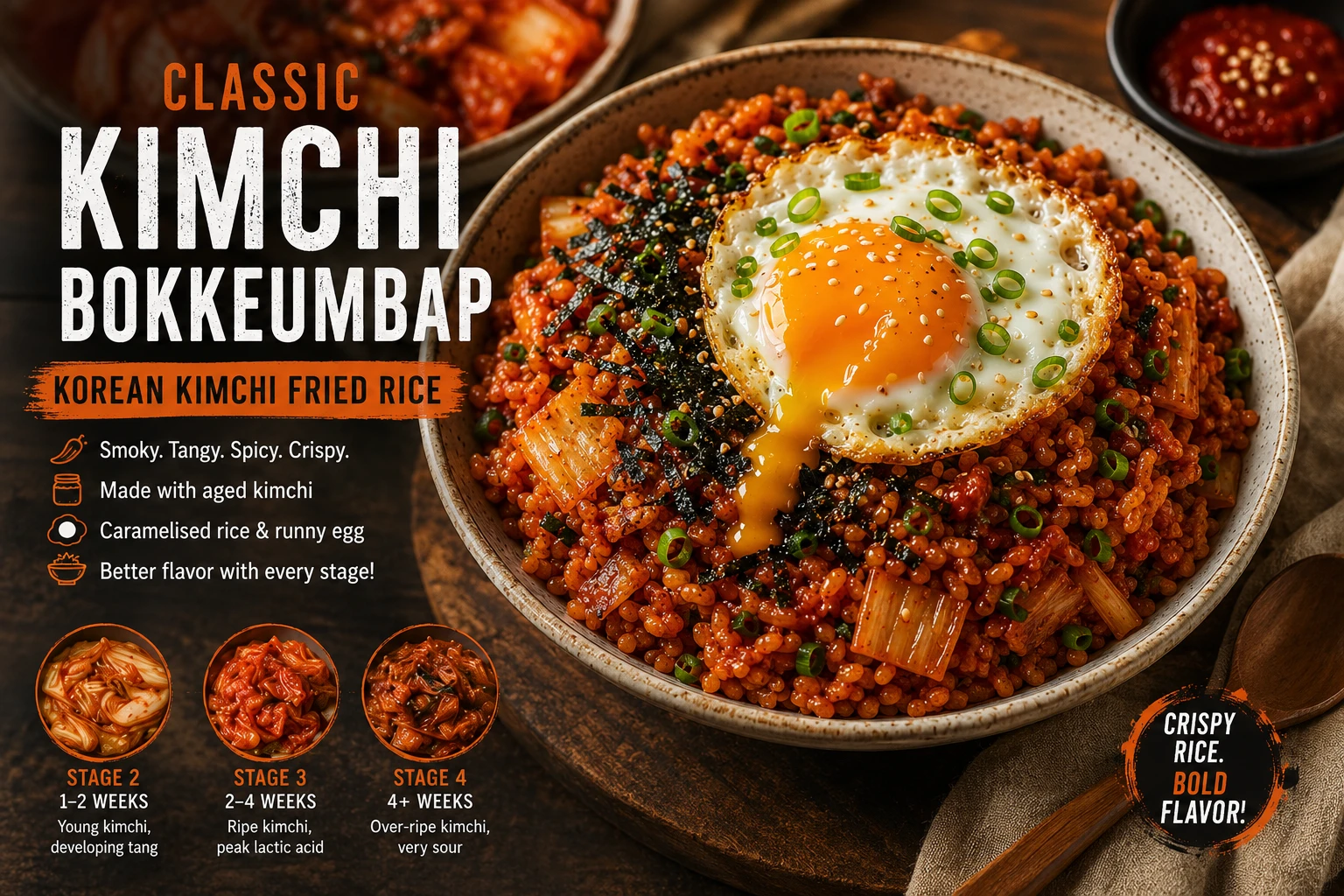
| Classic Kimchi Fried Rice | Stage 3 (Ripe) | No added protein to compensate — kimchi alone must carry full flavour |
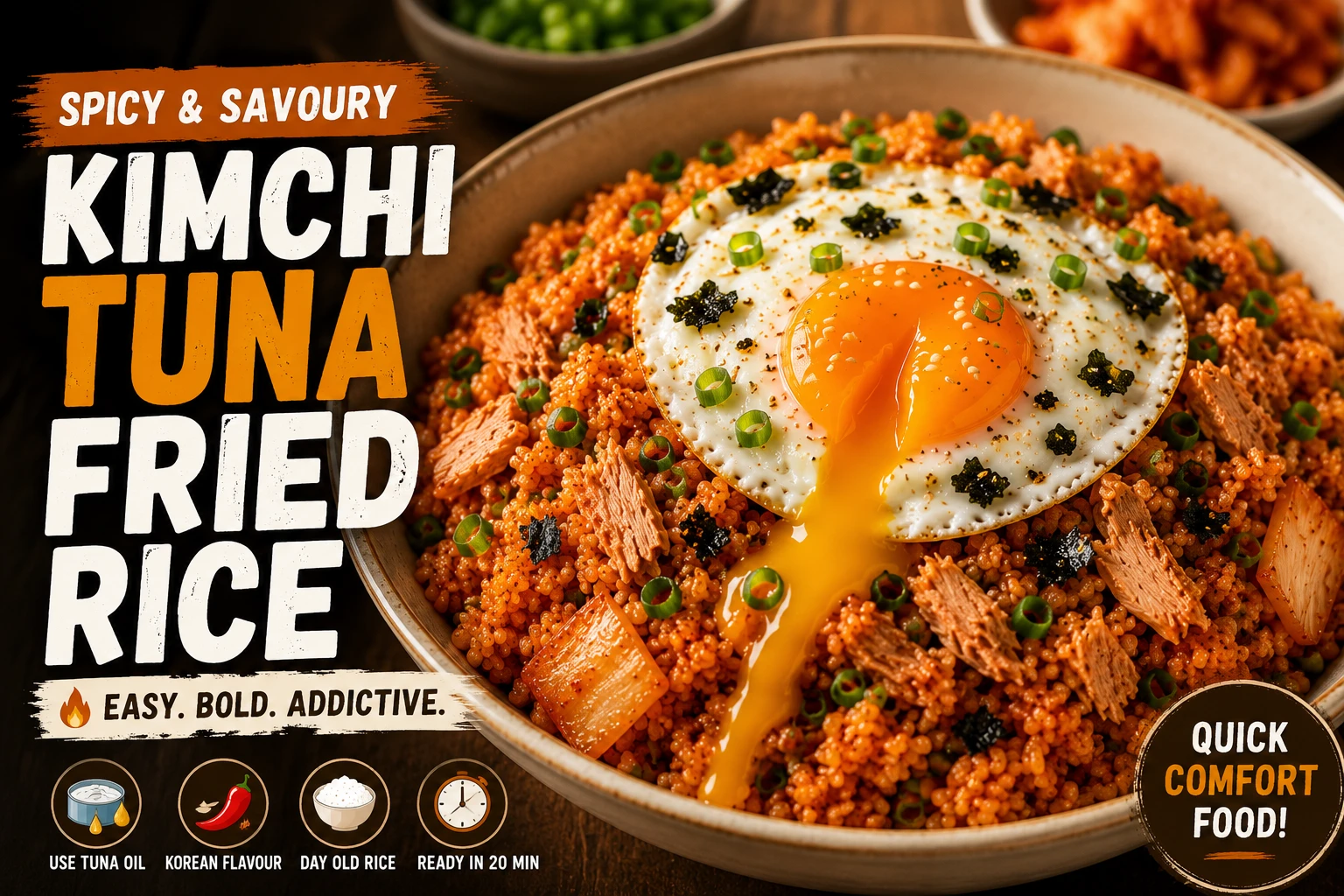
| Kimchi Tuna Fried Rice | Stage 3 (Ripe) | Balances the lean tuna without overwhelming it |
| Kimchi Spam Fried Rice | Stage 3–4 (Ripe to Over-ripe) | Spam’s saltiness and fat can stand up to more intense sourness |
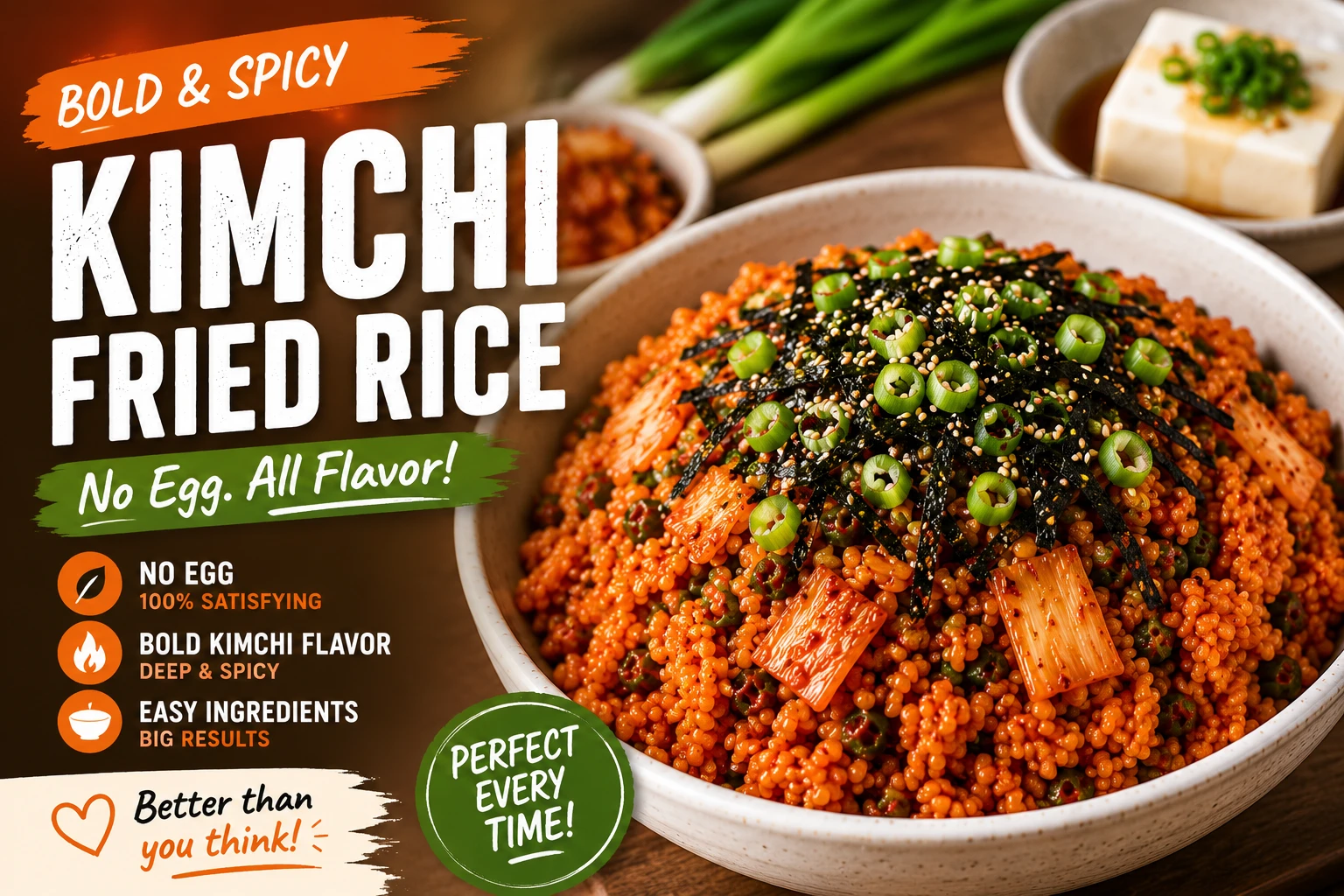
| Kimchi Fried Rice Without Egg | Stage 3 (Ripe) | Kimchi carries more of the flavour load with the egg removed |
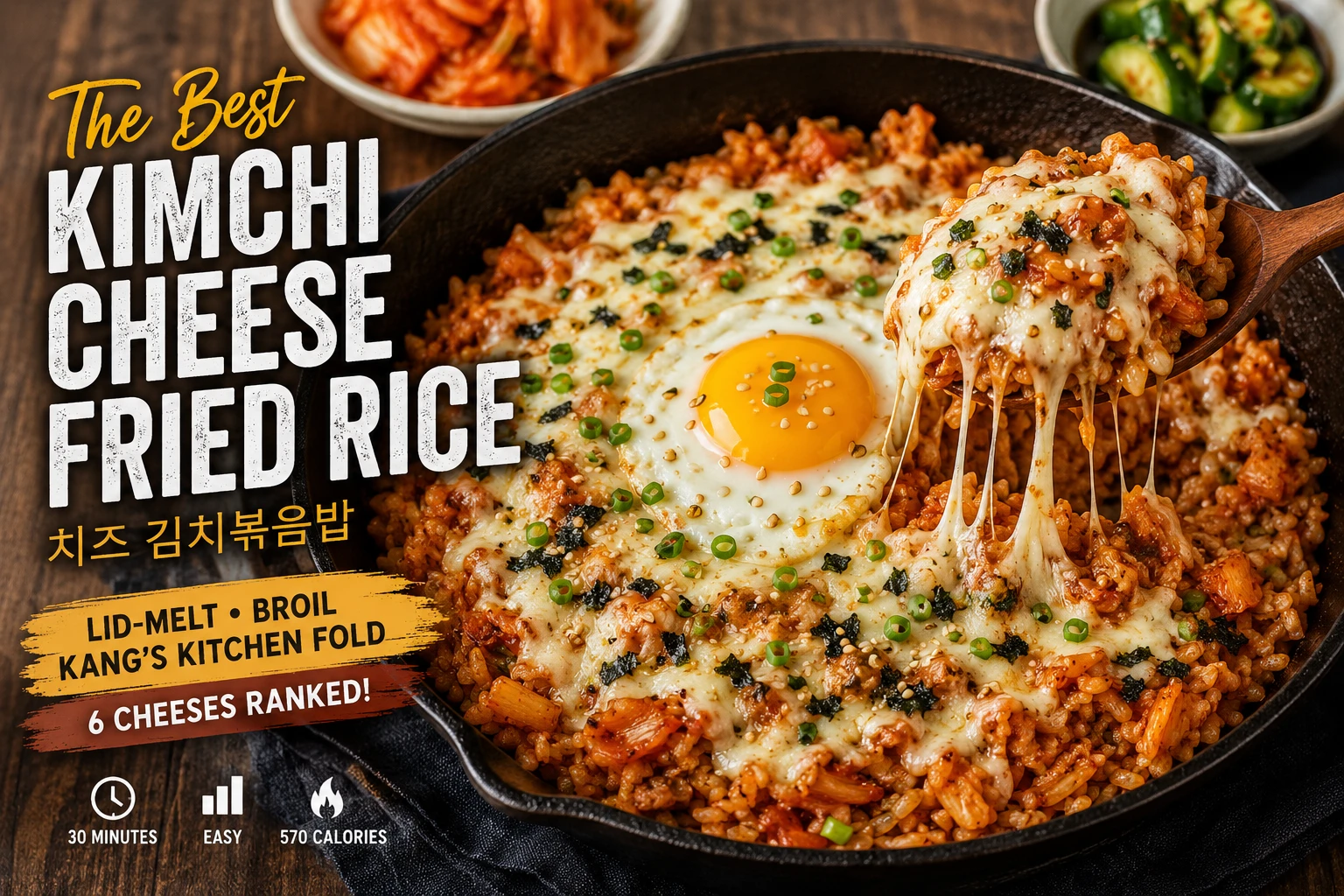
| Kimchi Cheese Fried Rice | Stage 3 (Ripe) | Cuts through the richness of melted mozzarella and butter |
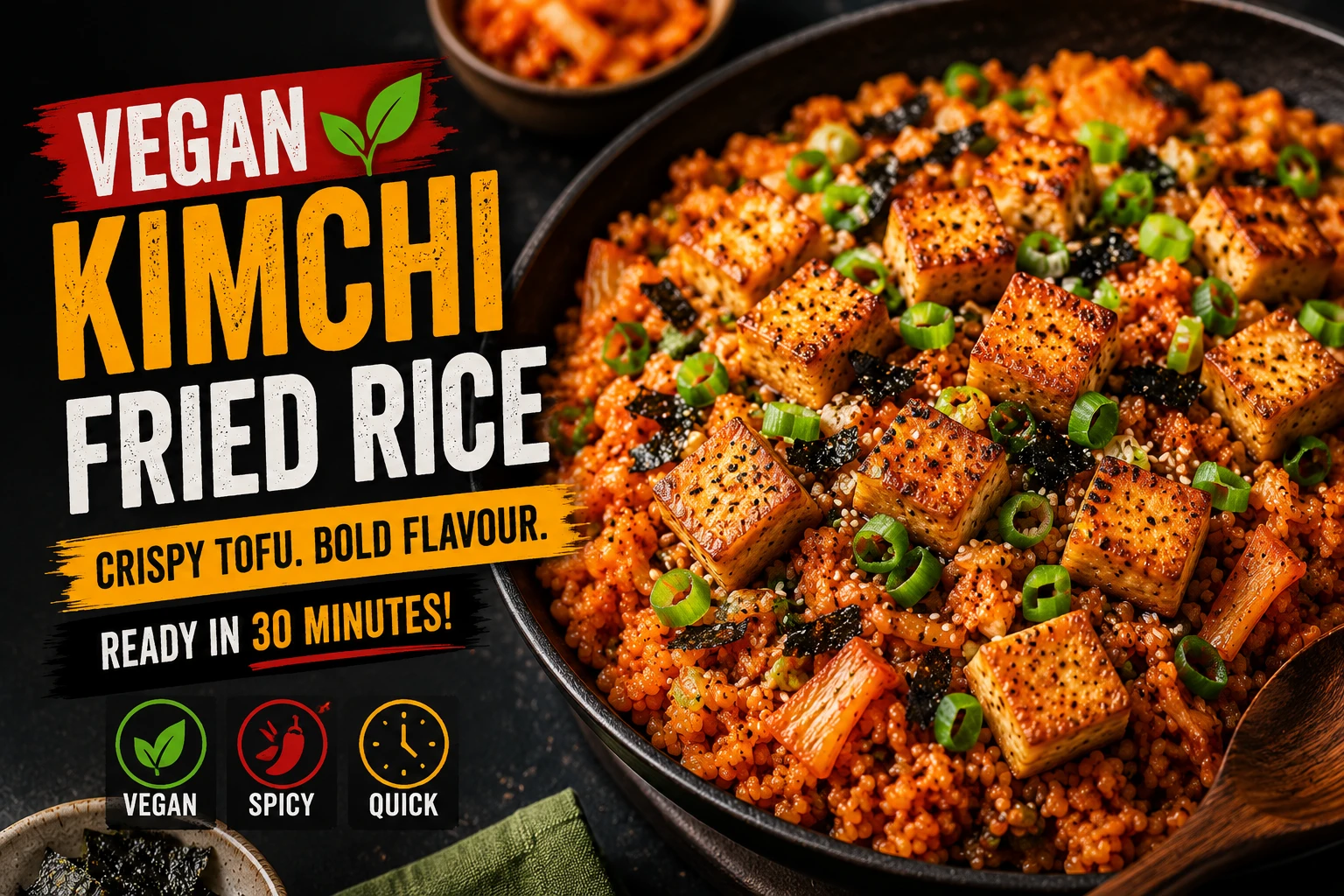
| Vegan Kimchi Fried Rice | Stage 3 (Ripe), fish-sauce-free | Full sour-umami depth needed since there’s no egg or animal protein |
| Kimchi Tofu Fried Rice | Stage 2–3 (Young to Ripe) | Milder stage lets the soft tofu’s texture and flavour come through |
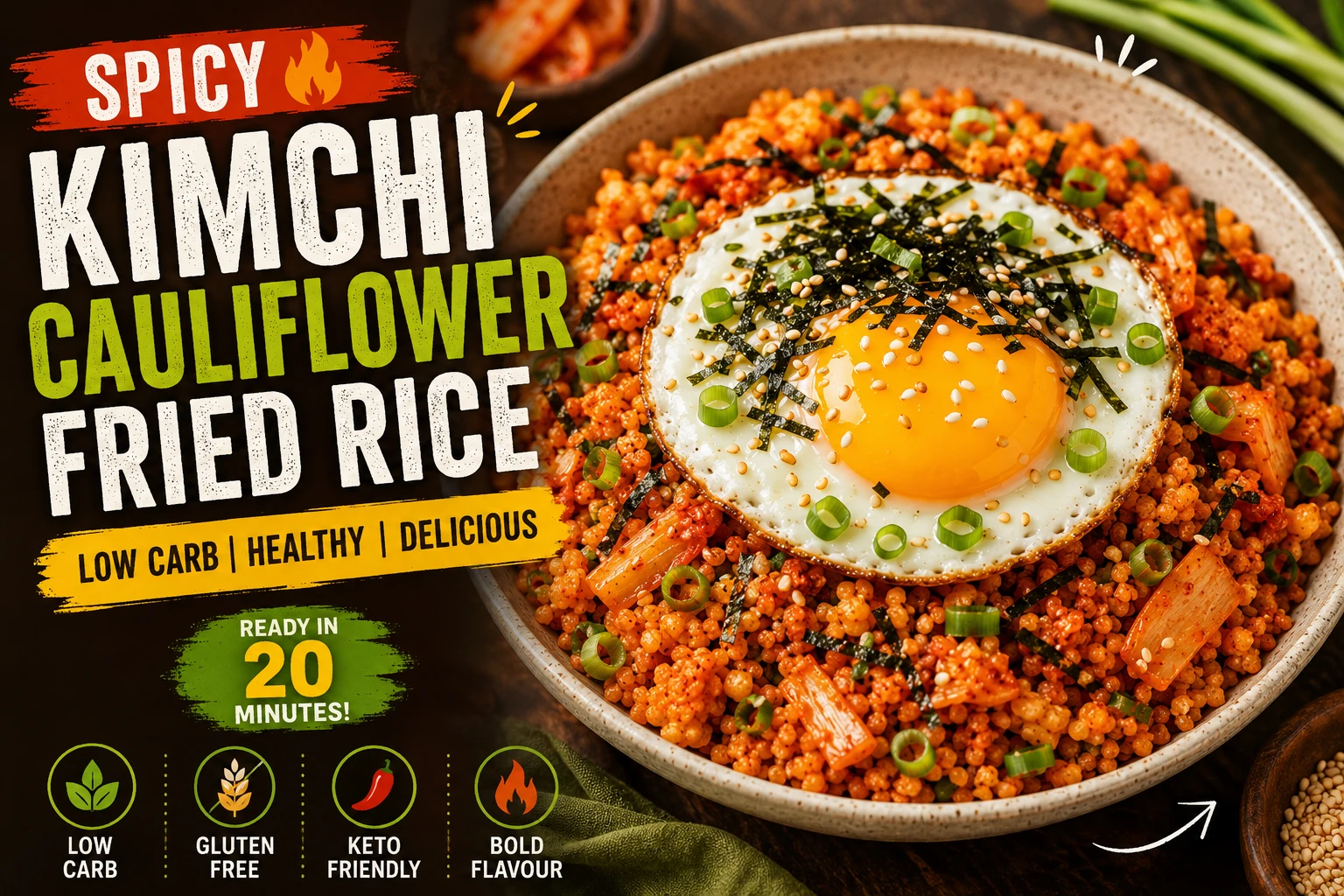
| Kimchi Cauliflower Fried Rice | Stage 3 (Ripe) | Adds needed depth to the naturally milder cauliflower base |
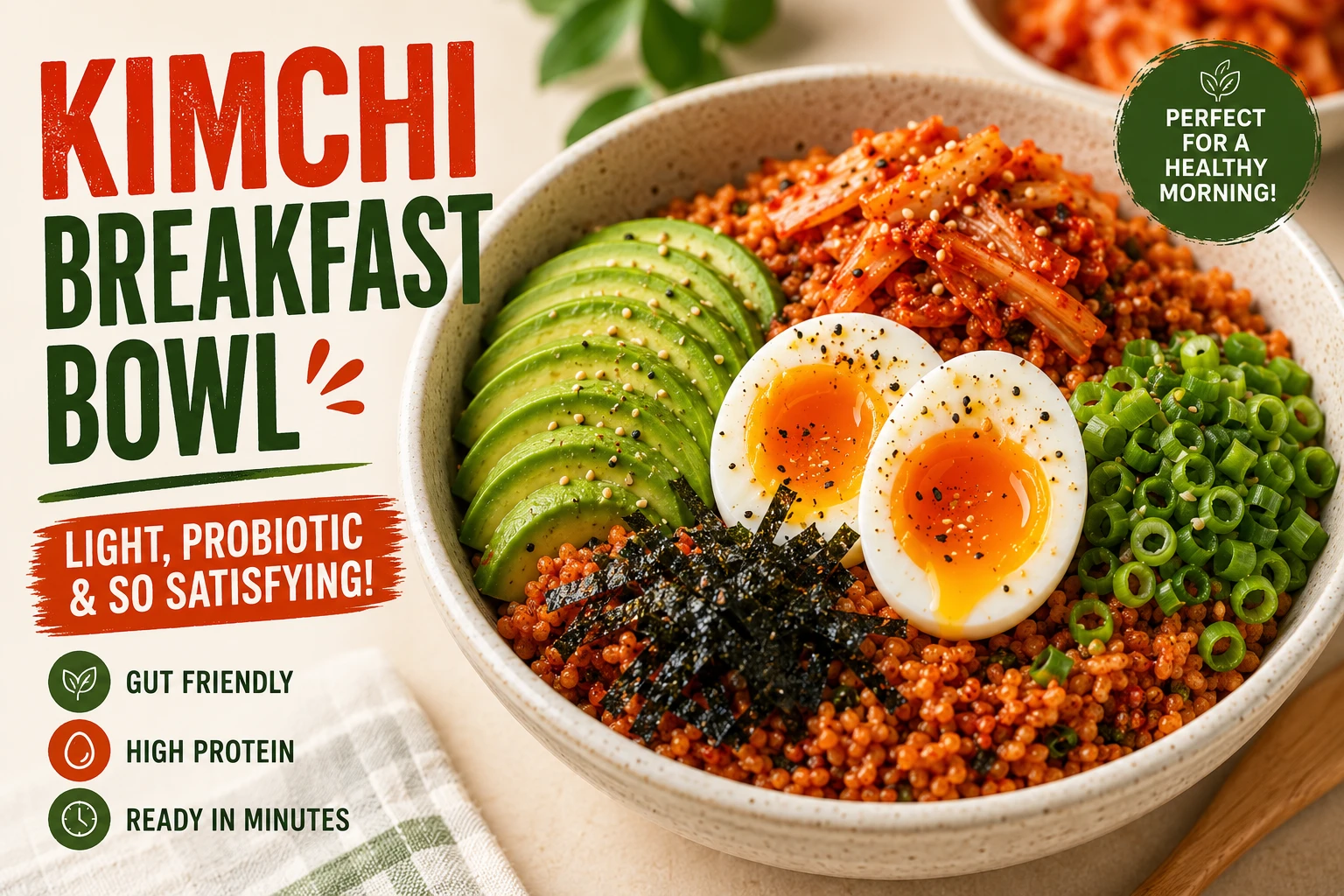
| Kimchi Breakfast Bowl | Stage 2–3 (Young to Ripe) | Gentler morning flavour pairs better with soft-boiled egg and avocado |
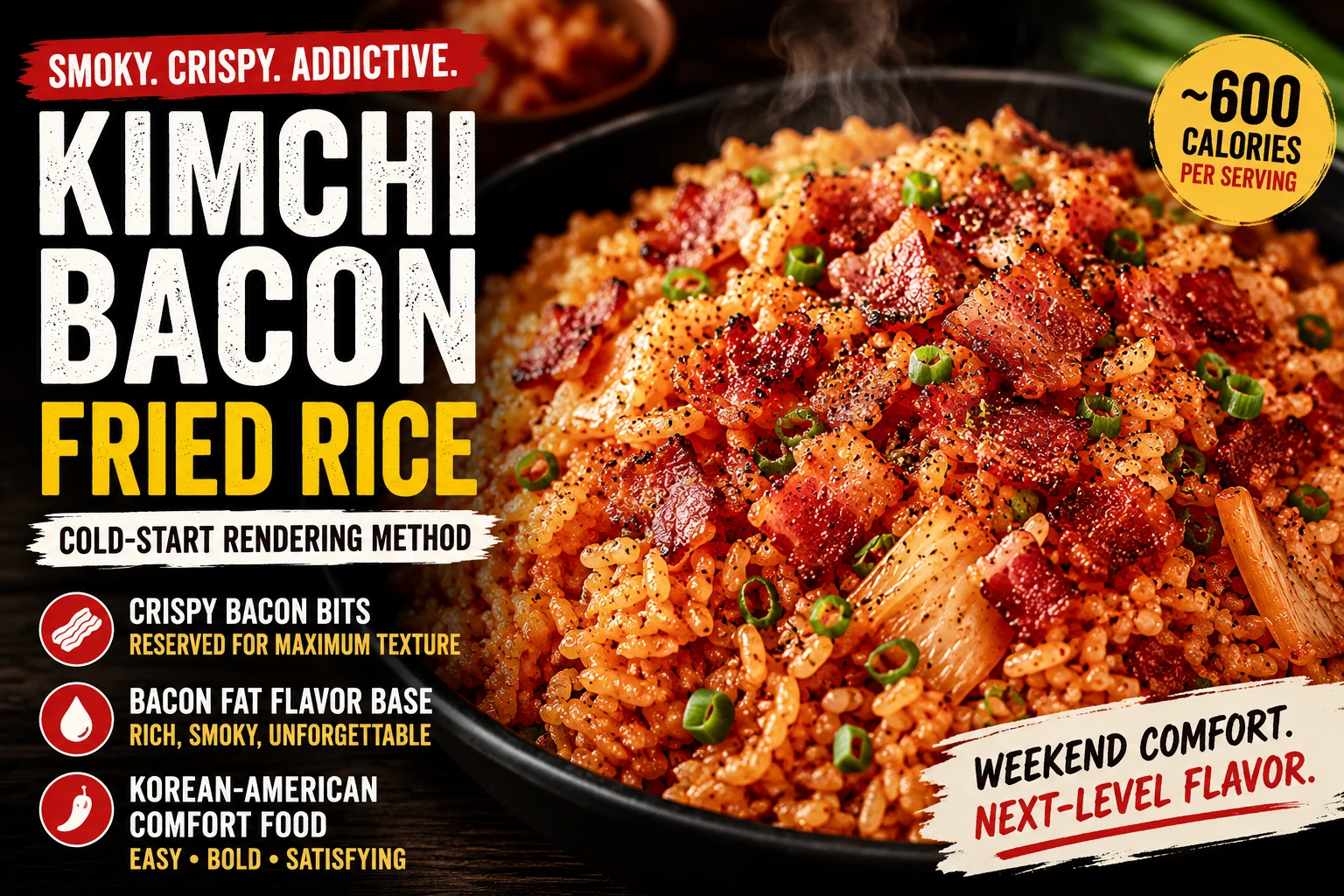
| Kimchi Bacon Fried Rice | Stage 3–4 (Ripe to Over-ripe) | Smoky, fatty bacon needs a bolder kimchi sourness to balance it |

Beyond Fried Rice — Other Dishes by Stage
Fermentation stage matters just as much outside of fried rice. Here’s how it maps across the rest of the Korean kimchi repertoire.
| Dish | Best Stage | Why |
|---|---|---|
| Kimchi Jjigae (stew) | Stage 4 — Over-ripe | Long simmering only deepens the already-intense sourness; older kimchi is traditionally saved specifically for this dish |
| Kimchi Jeon (pancake) | Stage 3 — Ripe | Needs enough sourness to balance the savoury batter, without the extreme funk of over-ripe kimchi overwhelming a quick-fried dish |
| Kimchi Mandu (dumplings) | Stage 2–3 — Young to Ripe | A milder stage keeps the filling balanced against pork, tofu, and other mix-ins rather than dominating the flavour |
| Kimchi Soup (kimchi-guk) | Stage 3–4 — Ripe to Over-ripe | Similar logic to jjigae — simmering time favours a more developed, sour base |
| Eaten fresh as banchan (side dish) | Stage 1–2 — Fresh to Young | Crisp texture and mild flavour are the point — no cooking involved to mellow an over-ripe funk |
The pattern holds across almost every kimchi dish: the longer and hotter the cooking method, the more forgiving — and often better-suited — an older, more fermented kimchi becomes. Quick, fresh, or uncooked preparations are where milder, younger kimchi shines instead.
Regional Kimchi Styles & Fermentation Speed
The 4-stage timeline on this page describes standard napa cabbage kimchi (baechu-kimchi) — but other common kimchi styles ferment at different speeds due to their water content and ingredients.
| Style | Main Ingredient | Fermentation Speed vs. Standard | Notes |
|---|---|---|---|
| Baechu-kimchi (standard) | Napa cabbage | Baseline — the 4-stage timeline on this page | What every recipe on this site assumes unless stated otherwise |
| Kkakdugi | Cubed Korean radish | Faster — radish’s higher water content speeds up early bacterial activity | Can reach a “Ripe” equivalent flavour a few days sooner than cabbage kimchi |
| Mul-kimchi (water kimchi) | Napa cabbage or radish in a thin, mild brine | Different profile entirely — brined and lightly fermented rather than paste-coated | Rarely aged to Stage 3–4; typically consumed Fresh to Young for its light, refreshing brine |
| Chonggak-kimchi | Whole young radish with greens | Similar to kkakdugi — slightly faster than cabbage due to radish water content | Often eaten at Young to Ripe rather than pushed to Over-ripe |
Traditional vs Modern Fermentation Methods
The 4-stage timeline on this page holds regardless of method, but how kimchi is actually stored has changed dramatically — and it affects how consistently that timeline plays out.
| Method | How It Works | Fermentation Consistency |
|---|---|---|
| Onggi (traditional clay jar) | Slightly porous earthenware, historically buried underground in winter to keep a stable, cool temperature | Highly consistent once buried, but dependent on soil temperature and the specific jar’s porosity |
| Modern kimchi refrigerator | A dedicated appliance (kimchi-naengjanggo) that holds a precise, very stable low temperature, typically 0–2°C, mimicking underground onggi conditions | Highly consistent and repeatable — the modern standard in most Korean households since yards for burying onggi are rare in apartment living |
| Regular kitchen refrigerator | Standard fridge temperature (typically 3–5°C) and frequent door-opening temperature swings | Less consistent — fermentation continues but at a less predictable rate than a dedicated kimchi fridge |
| Room-temperature counter fermentation | Ambient kitchen temperature, no refrigeration during the active fermentation window | Fast but least consistent — highly sensitive to room temperature, season, and time of day |
For home cooks without a dedicated kimchi fridge, the practical takeaway is simple: a regular fridge works fine, but expect more day-to-day variation in how quickly your kimchi moves between stages compared to what a Korean household with a kimchi-naengjanggo would experience.
Kimchi Fermentation FAQ
Kimchi generally passes through 4 identifiable stages: Fresh (0–3 days, pH ~5.5), Young (1–2 weeks, pH ~4.8), Ripe or Stage 3 (2–4 weeks, pH ~4.2), and Over-ripe (4+ weeks, pH ~3.8). Each has a distinct taste, texture, and best use.
Use the smell, sound, and taste method above: smell the brine’s sourness, look for bubbles or a hiss when opening the jar, and taste a small piece.
Fresh kimchi hasn’t developed lactic acid yet, so it fries flat and sweet with no depth. Aged Stage 3 kimchi’s developed acid caramelises through the Maillard reaction in a hot pan, producing the sour-umami flavour that defines the dish.
Yes — leaving a jar at room temperature instead of the fridge speeds things up considerably; a day or two can move Fresh kimchi toward Young, with a few more days reaching Ripe.
Yes — refrigeration below 4°C significantly slows the lactic acid bacteria, and can take several extra weeks to move between stages compared to room temperature.
It varies by brand and shelf time. Most refrigerated store-bought kimchi sits around Young to early Ripe, but checking smell and taste yourself is more reliable than the packaging date alone.
As bacteria ferment kimchi’s sugars, pH drops from around 5.5 (mild) to below 4.0 (very sour). Lower pH means more developed lactic acid, directly responsible for aged kimchi’s sour, complex flavour.
Over-ripe, Stage 4 kimchi is traditionally preferred — its intense sourness and softened texture hold up well to long simmering, and the flavour deepens further as the stew cooks.
Fresh to Young kimchi (0 days to 2 weeks) is generally preferred, since its milder flavour and crisp texture haven’t yet softened or turned strongly sour.
Over-ripe kimchi is still safe to eat as long as it’s been properly refrigerated and shows no mould or off odours beyond normal strong sourness — it’s simply more intensely fermented, not spoiled.
Properly refrigerated kimchi can remain safe to eat for several months, continuing to slowly ferment and sour — quality and crunch decline well before safety becomes a concern.
Yes, though it’s usually unnecessary. If your kimchi is between stages, a splash of rice vinegar (to mimic a riper stage) or a pinch of sugar (to soften an over-ripe stage) can help it match a recipe’s needs.
Each recipe is built around the flavour and texture a particular stage delivers — milder proteins like tofu or a soft-boiled egg breakfast bowl pair better with gentler Stage 2–3 kimchi, while rich, fatty ingredients like bacon or Spam can stand up to Stage 3–4 sourness.
Leuconostoc mesenteroides kicks things off, producing the early CO₂ bubbles and mild tang. As the brine grows more acidic, species like Lactobacillus plantarum and Lactobacillus kimchii take over and drive the deeper sourness of Ripe and Over-ripe kimchi.
Yes. The high heat used in dishes like kimchi fried rice kills live bacterial cultures. The flavour benefits remain, but the probiotic benefit is only preserved when kimchi is eaten raw and unheated.
A thin white film is usually kahm yeast — a harmless wild yeast common in salt fermentation. Skim it off; the kimchi underneath is fine. Fuzzy, coloured, or raised spots are different and mean actual mould — discard the batch.
No — kkakdugi and other radish-based styles generally ferment somewhat faster than standard napa cabbage kimchi, due to radish’s higher water content, so they can reach a comparable flavour stage a few days sooner.
Napa cabbage is typically brined at roughly 2–3% salt-to-water concentration — enough to suppress spoilage bacteria while still letting salt-tolerant lactic acid bacteria dominate and drive fermentation forward.
A dedicated kimchi refrigerator holds a very precise, stable low temperature around 0–2°C, closely mimicking traditional underground onggi storage. A regular fridge runs slightly warmer with more temperature swings, so fermentation continues but less predictably.
Was this guide helpful?
Your feedback helps us improve KimchiGuide for everyone.