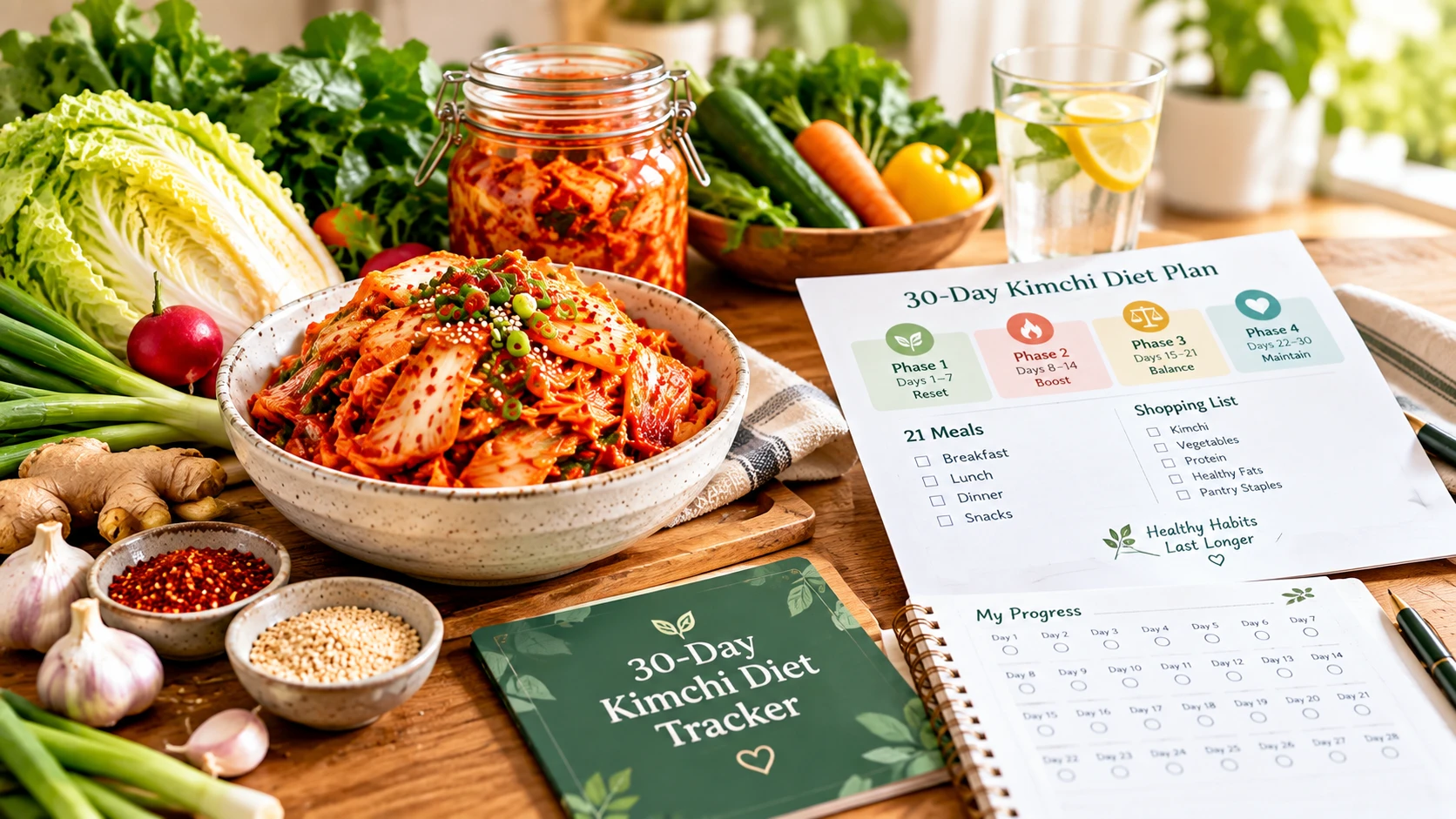
30-Day Korean Kimchi Diet Plan
This 30-day Korean kimchi diet plan is practical and kimchi-forward — 4 phases, 21 rotating meals, weekly shopping lists, and a downloadable PDF. Unlike most “kimchi diet” articles, this one is upfront about what the actual research does and doesn’t show — see the Research Reality Check before you start.


✅ Is This Plan Right for You Right Now?
What Is This 30-Day Korean Kimchi Diet Plan, Really?
This 30-day Korean kimchi diet plan is a practical 30-day eating plan built around making kimchi a genuine daily habit — not a replication of a specific clinical trial.
Real research links kimchi consumption (1-3 servings a day, where one serving is 50g) with modestly lower obesity rates, mainly in men, and small trials found kimchi lowered body fat and weight in overweight adults. None of them tested this exact plan, which builds from 50g up to 150g of kimchi a day inside a calorie-appropriate diet.
What this plan actually offers: sensible calorie targets, 21 kimchi-forward meals, weekly shopping lists, and a realistic, gradual way to build the habit.
The honest results you can expect come mainly from the calorie-appropriate, vegetable-and-protein-forward diet itself, with kimchi as a genuinely useful, low-calorie, gut-friendly part of it.
📅 What Do I Eat Today?
Research Reality Check — What’s Actually Proven
Most “kimchi diet” articles either invent a citation or vaguely wave at “studies show.”
Here’s what the real research actually says, so you know exactly what you’re working with.
| Study | What It Actually Was | What It Found |
|---|---|---|
| BMJ Open, Feb 2024 (Jung et al.) | Cross-sectional observational study — 115,726 Korean adults aged 40-69, food-frequency questionnaire. Not an experiment; can’t prove cause and effect. In the study, one serving of cabbage or radish kimchi = 50g. | Men eating 1-3 servings/day (50-150g) had roughly 11-13% lower odds of obesity than men eating <1 serving/day. No clear benefit found for women on total kimchi; kkakdugi (radish kimchi) was linked to less abdominal obesity in both sexes. The pattern was J-shaped: people eating 5+ servings a day weighed more and were more likely to be obese, so more is not better. |
| Nutrition Research, 2011 (Kim et al.) | A small randomized crossover trial — 22 overweight and obese adults ate fresh kimchi for 4 weeks and fermented kimchi for 4 weeks, with a 2-week washout between. | Body weight, BMI and body fat fell in both phases; the fermented-kimchi phase also improved waist-hip ratio and fasting glucose. Very small sample and short — promising, not proof. |
| Journal of Functional Foods, Aug 2024 (Lee et al.) | A randomized, double-blind, placebo-controlled trial — 90 enrolled, 83 completed, 12 weeks. | Participants took 3,000mg/day of encapsulated kimchi powder (not real kimchi) and were asked to avoid eating real kimchi during the trial. The powder groups had a significantly bigger reduction in body fat than placebo. |
| Mouse studies (various, 2023-2024) | Animal studies, not human trials. | Reported reductions in body fat (one figure cited in press coverage: 31.8%) — these results don’t reliably translate to humans and shouldn’t be quoted as human outcomes. |
- High blood pressure, kidney or heart conditions, or a low-sodium diet — kimchi is salty (see the sodium checker below).
- Warfarin — cabbage is rich in vitamin K; keep your intake steady rather than suddenly increasing it.
- MAOI antidepressants or histamine sensitivity — fermented foods contain tyramine and histamine.
- Pregnancy or a weakened immune system — ask about unpasteurized fermented foods.
- Long-term heavy intake of salted, fermented vegetables — some Korean studies, such as a 2005 case-control study, have linked very high kimchi intake with a higher risk of gastric cancer. That’s an association, not proof — but it’s another reason this plan stops at 150g a day rather than pushing higher.
Common Kimchi Myths vs. Reality
The 4-Phase 30-Day Structure
This 30-day Korean kimchi diet plan’s gradual ramp-up exists for a practical reason: jumping straight to a large daily amount causes real bloating and gas for most people — the single biggest reason people quit a “kimchi diet” in week 1.
It also keeps you inside the 1-3 servings a day the research actually looked at.
- One serving of kimchi, at dinner only
- No other diet changes yet
- Mild gas is normal — hold your dose if it’s uncomfortable
- Focus on building the habit
- Kimchi at lunch and dinner (50g each)
- Reduce refined carbs slightly
- Gas should be subsiding
- Record your starting weight now
- Kimchi at every meal (~50g each)
- Calorie targets tracked closely
- Digestion usually feels routine now
- Weekly waist measurement
- Settle into a sustainable level
- Mix fresh and well-fermented kimchi
- Plan to continue past day 30
- Final weigh-in and waist check
Daily Calorie & Macro Targets
These 30-day Korean kimchi diet plan calorie targets create a moderate 300-500 calorie deficit — enough for steady progress without the extreme restriction that backfires long-term.
Want the numbers for the kimchi itself? See our kimchi calories guide for calories, carbs and sodium per 100g and per 50g serving.
👩 Women
👨 Men
Get Your Exact Number
21 Kimchi Meals — 7 Breakfasts, 7 Lunches, 7 Dinners
Every 30-day kimchi diet plan meal rotates through the schedule below. Each meal is built around about one 50g serving of kimchi, so three kimchi meals a day adds up to 150g.
Cooking kimchi is delicious but kills the live bacteria, so where that matters we’ve flagged it.
30-Day Day-by-Day Schedule
Tap a week to expand it. Meals rotate through the 21 options above (B1-B7, L1-L7, D1-D7).
Week 1 — Introduction
| Day | Breakfast | Dinner |
|---|---|---|
| Mon | B1 (no kimchi yet) | D2 |
| Tue | B6 (no kimchi yet) | D7 |
| Wed | B1 (no kimchi yet) | D4 |
| Thu | B4 (no kimchi yet) | D6 |
| Fri | B1 (no kimchi yet) | D1 |
| Sat | B2 (no kimchi yet) | D3 |
| Sun | B7 (no kimchi yet) | D5 |
Week 2 — Escalation
| Day | Lunch | Dinner |
|---|---|---|
| Mon | L1 | D2 |
| Tue | L3 | D4 |
| Wed | L5 | D6 |
| Thu | L2 | D1 |
| Fri | L7 | D7 |
| Sat | L4 | D3 |
| Sun | L6 | D5 |
Week 3 — Full Habit
| Day | Breakfast | Lunch | Dinner |
|---|---|---|---|
| Mon | B2 | L1 | D2 |
| Tue | B3 | L5 | D4 |
| Wed | B7 | L3 | D6 |
| Thu | B4 | L2 | D1 |
| Fri | B1 | L7 | D7 |
| Sat | B5 | L4 | D3 |
| Sun | B6 | L6 | D5 |
Week 4 — Consolidation
| Day | Breakfast | Lunch | Dinner |
|---|---|---|---|
| Mon | B7 | L5 | D6 |
| Tue | B4 | L2 | D1 |
| Wed | B1 | L7 | D3 |
| Thu | B5 | L4 | D7 |
| Fri | B6 | L6 | D5 |
| Sat | B3 | L1 | D4 |
| Sun | B2 | L3 | D2 ✓ Final Day |
Shopping Lists — Never Run Out of Kimchi
This 30-day kimchi diet plan’s shopping quantities are for one person.
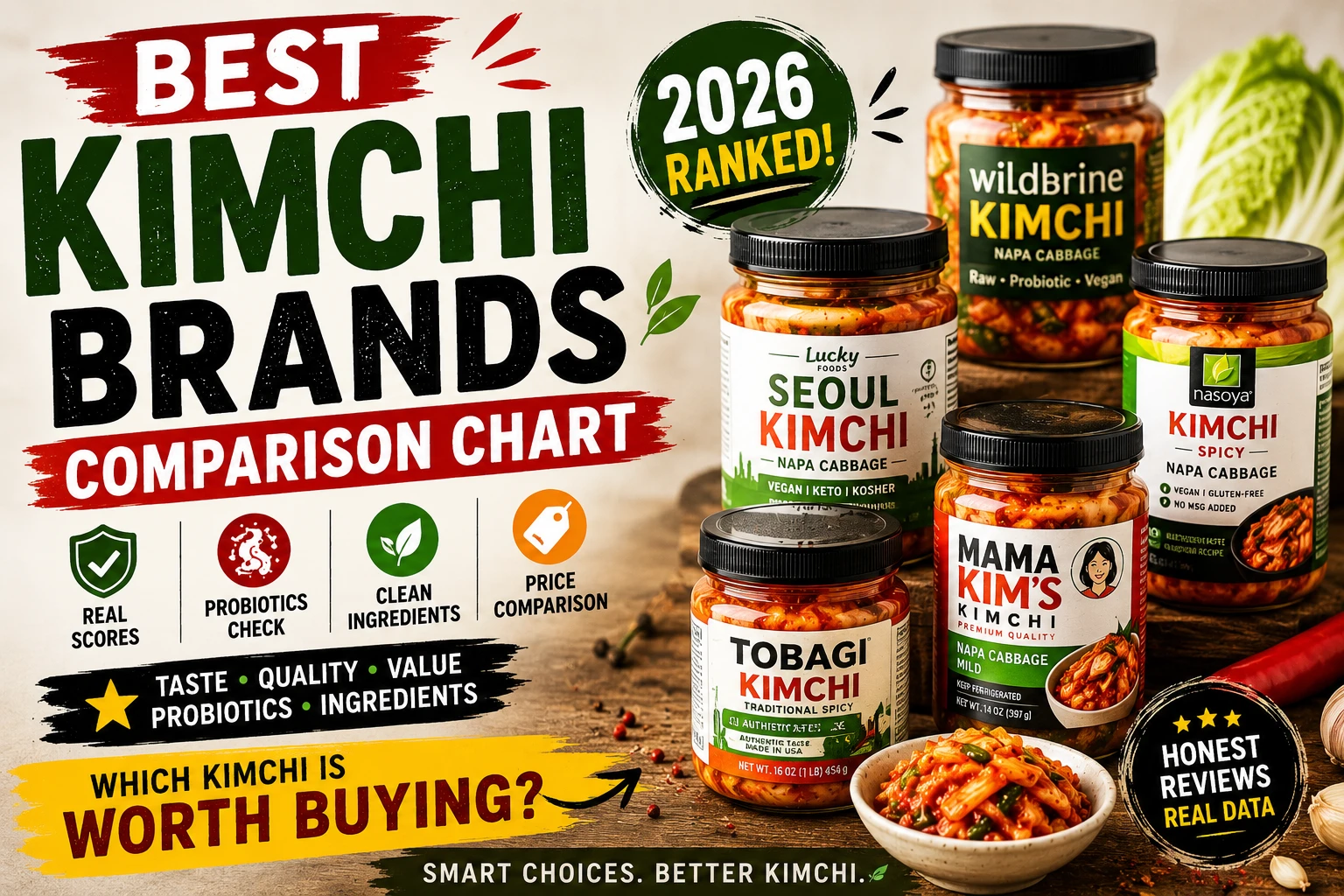
Always buy refrigerated, unpasteurized kimchi — see our best store-bought kimchi brands guide for specific recommendations, or make your own so it’s perfectly ripe by week 2-3.
🥬 Kimchi & Fermented
- Kimchi (wk1, 50g/day) 350g
- Kimchi (wk2, 100g/day) 700g
- Kimchi (wk3, 150g/day) 1.05kg
- Kimchi (wk4, 100-150g/day) 0.7-1.05kg
- Doenjang 200g
- Gochujang 200g
🍚 Grains & Carbs
- Brown rice 2kg
- Soba noodles 250g
- Rolled oats 500g
- Quinoa 500g
- Wholegrain bread 1 loaf
🥩 Protein
- Eggs 12/wk
- Firm tofu 3×400g
- Salmon 2×150g
- Chicken thighs 500g
- Chickpeas 2×400g
🥦 Vegetables
- Spinach 300g
- Cucumber 3-4
- Carrot 500g
- Avocado 3-4/wk
- Sweet potato 2-3
🧄 Korean Pantry
- Gochugaru 200g
- Sesame oil 250ml
- Sesame seeds 100g
- Soy sauce/tamari 500ml
- Rice vinegar 500ml
🧋 Other
- Oat milk 1L
- Chia seeds 200g
- Tahini 300g
- Edamame 400g
- Nori sheets 1 pack
Sunday Meal Prep — 90 Minutes, 5 Days of Meals
Meal prep is the biggest predictor of whether a plan like this actually sticks.
Common Mistakes That Derail This Plan
Most people who quit this 30-day kimchi diet plan don’t quit because of the food — they quit over one of these avoidable snags.
| Mistake | Why It Backfires | Do This Instead |
|---|---|---|
| Jumping straight to the top dose — or going above 150g/day | Causes real bloating and gas that feels discouraging within days, and more than 3 servings (150g) a day is beyond the range the research links to benefit, with a lot of extra sodium. | Follow the 4-phase ramp-up — it exists specifically to avoid this — and stop at 150g/day. |
| Only tracking scale weight | Water retention from kimchi’s sodium can mask real progress on the scale for days at a time — see the “does kimchi cause water retention” FAQ below for why. | Also track waist measurement, energy, and digestion — weigh in weekly, not daily. |
| Cooking all your kimchi | Heat kills the live lactic acid bacteria, so a fully-cooked kimchi dish alone won’t deliver the fermentation-related benefits. | Pair a cooked kimchi dish with a raw kimchi side where the meal card says so. |
| Buying pasteurized, shelf-stable kimchi | Pasteurization is often used to extend shelf life, but it also kills the bacteria this plan is partly built around. | Buy refrigerated, unpasteurized kimchi — see our store-bought brands guide. |
| Ignoring the calorie targets | Kimchi supports a good diet, but it doesn’t override a calorie surplus — the deficit is still what drives weight change. | Keep half an eye on the calorie/macro targets, especially at dinner where it’s easiest to overshoot. |
Eating Out and Social Situations
A 30-day plan that can’t survive a dinner out isn’t a realistic plan — here’s how to stay close to it without opting out of your social life.
Missed a Whole Week? Here’s How to Restart
Missing a few days on this 30-day kimchi diet plan is normal. Missing a whole week is also normal — and it’s not a reason to quit the other 23 days you’ve already built momentum on.

How to Track Your Progress
Scale weight alone misses most of what actually changes on this 30-day kimchi diet plan — track all four of these instead.
Kimchi Diet Before and After — What to Actually Expect
A lot of “kimchi diet before and after” searches are looking for a dramatic transformation photo. Here’s the honest version instead.
There’s no reliable “before and after” number this plan can promise, because weight change depends on your calorie deficit — not on kimchi specifically. Kimchi supports the process (low-calorie, filling, gut-friendly) rather than driving it directly.
What people following this plan most consistently report by day 30 isn’t a dramatic before/after photo — it’s a settled digestion, kimchi feeling like a normal part of meals rather than an effort, and steadier energy. Real, but not the kind of transformation a stock photo captures.
Customize the Plan
A rigid plan is easy to fall off. Here’s how to adapt this 30-day kimchi diet plan to your budget, dietary needs, and lifestyle.
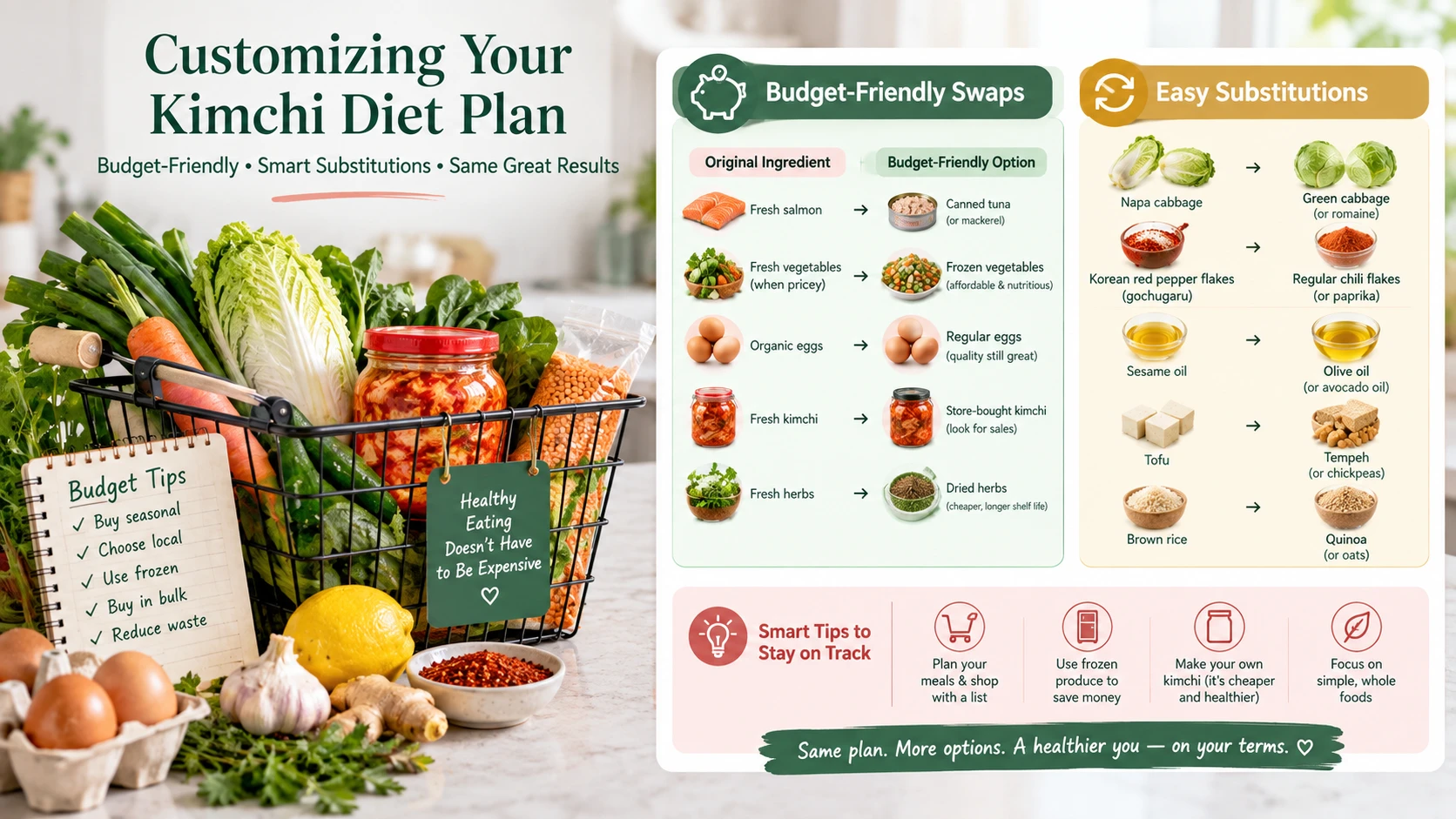
Dietary Substitutions
| If You Need… | Swap |
|---|---|
| Gluten-free | Use tamari instead of soy sauce; check kimchi labels (some brands use wheat flour in the paste — most use rice flour, which is fine). |
| Dairy-free | Already dairy-free throughout — no substitutions needed. |
| Nut-free | Skip tahini in the Chickpea Buddha Bowl (L7) — swap in a squeeze of lime and extra sesame oil instead. |
| Egg-free | Replace soft-boiled egg toppings with extra tofu or edamame for the protein. |
| Low-FODMAP | Use garlic-infused oil instead of raw garlic where it appears, and keep kimchi portions on the smaller end of each range. |
Roughly What It Costs
Costs vary a lot by location and store, but as a rough estimate: the weekly shopping list runs approximately $35-50/week for one person in a typical US grocery store.
Kimchi itself is the single biggest line item once you reach the 150g/day phase (roughly $4-6/week at that dose). Making your own kimchi cuts that cost significantly — a homemade 3kg batch typically costs less than buying the equivalent pre-made.
Combining With Exercise or Other Approaches
This plan works fine on its own, and also fine alongside a regular exercise routine — walking, resistance training, or whatever you already do. If you’re also considering intermittent fasting, this plan’s meals can simply be compressed into your eating window without changing the meals themselves.
As with any combination of eating approaches, introduce one change at a time rather than starting several new habits simultaneously, and check with a doctor if you have any underlying health condition.
Where to Find Kimchi & Korean Ingredients by Region
| Region | Where to Look |
|---|---|
| UK | Refrigerated section of larger Waitrose/Sainsbury’s stores, or Korean grocers (H Mart branches, Centre Point Food, local Koreatown shops in London/Manchester). |
| US | H Mart, Korean grocers in most major cities, and increasingly the refrigerated aisle of Whole Foods, Trader Joe’s, and Target. |
| Australia | H Mart, Korean grocers in Sydney/Melbourne/Brisbane Koreatowns, and the international aisle of Coles/Woolworths in larger stores. |
| No Korean grocer nearby? | Order gochugaru and kimchi online, or make your own — see our from-scratch guide, which only needs napa cabbage, salt, and pantry staples. |
How This Plan Compares to Other Approaches
| Approach | How It’s Different From This Plan |
|---|---|
| Keto | Restricts carbs heavily; this plan keeps moderate carbs (rice, grains) and instead focuses on adding a fermented food and controlling total calories. |
| Intermittent Fasting | Restricts eating windows, not food choices; fully compatible with this plan if you compress the same meals into a shorter window. |
| Mediterranean Diet | Emphasizes olive oil, fish, and Mediterranean staples; this plan swaps in Korean staples (sesame oil, kimchi, gochujang) with a similar vegetable-forward, moderate-protein structure. |
| Whole30 / Elimination diets | Much stricter, short-term exclusion diets; this plan is a long-term sustainable habit, not a strict elimination protocol. |
Sodium Quick-Check
Kimchi is salty — at 150g/day it can add roughly 600-900mg of sodium on its own (brands vary a lot, so check your label), which matters most if you have hypertension or are sodium-sensitive. That sodium is also the main driver behind short-term water retention (see the FAQ below).
The American Heart Association recommends most adults stay under 2,300mg of sodium a day total. Our low-sodium kimchi brands guide can help if you need to bring it down.
For sodium per 50g, 100g and 500g portions, use the calculator in our kimchi calories guide.
After Day 30 — What’s Next?
Day 30 isn’t a finish line — it’s the point where kimchi should feel like a normal part of how you eat, not a temporary experiment.
Download This 30-Day Korean Kimchi Diet Plan (Printable PDF)
Download this 30-day kimchi diet plan as a single printable PDF — phase overview, shopping lists, and a weekly tracking log included — or print this whole page directly.
30-Day Kimchi Diet Plan — Printable PDF
4-phase overview, all 6 shopping list categories, and a fill-in weekly tracking log (weight, waist, energy, notes) — 4 pages, ready to print or keep on your phone.
More Kimchi Health & Recipe Guides



How This Compares to Other Kimchi Diet Plans Online
Most articles on this topic either invent a scientific citation or repeat vague “studies show” claims with nothing backing them up.
| Most Kimchi Diet Articles | This Page |
|---|---|
| Cite a vague or fabricated “clinical trial” | Names the real studies, what they actually tested, and where they fall short of the claims made about them |
| Give one flat meal list with no structure | 4-phase ramp-up, 21 rotating meals, and full weekly shopping lists |
| No way to track or follow along | Interactive daily lookup tool, calorie/sodium calculators, and a downloadable PDF + calendar file |
| Dead-ends at “day 30” | A clear “what’s next” path, restart guidance, and cost/substitution options for the long term |
Frequently Asked Questions
Search or tap any question below.
No single study has proven that eating kimchi by itself causes weight loss. A large 2024 observational study (115,726 people) found men who ate 1-3 servings of kimchi a day (a serving is 50g) had somewhat lower rates of obesity, and a separate small clinical trial found concentrated kimchi powder reduced body fat versus placebo over 12 weeks. Neither tested this exact plan of 50-150g of real kimchi a day inside a full diet — this 30-day kimchi diet plan is a practical, research-informed eating pattern, not a replication of a clinical result.
This depends almost entirely on your calorie deficit, not on kimchi specifically. If you follow the calorie targets consistently, expect the same general rate of loss as any moderate, sustainable deficit. Kimchi’s role is supportive — low-calorie, filling, digestion-friendly — rather than being the mechanism of weight loss on its own.
This plan ramps up from 50g/day (one serving) in week 1 to 150g/day (three servings) by weeks 3-4. That range follows the 1-3 servings/day pattern in the 2024 BMJ Open observational study, where one serving is 50g. It is not a dose tested in a clinical trial, and the same study found people eating 5 or more servings a day did not look better off — more kimchi is not automatically better, and it adds a lot of sodium.
Yes — every meal has a plant-based option, and using vegan kimchi (made without fish sauce or shrimp) keeps the whole plan fully plant-based without losing any of the fermentation benefits.
For most healthy adults, yes — it’s calorie-sufficient and nutritionally balanced, not a crash diet. Check with a doctor or dietitian first if you have high blood pressure or kidney disease (kimchi is salty), take warfarin (cabbage is rich in vitamin K), take an MAOI antidepressant or are sensitive to histamine (fermented foods contain histamine and tyramine), are pregnant or immunocompromised (unpasteurized fermented foods), or have IBS (a low-FODMAP approach may suit you better).
Always buy refrigerated, unpasteurized kimchi — pasteurized, shelf-stable kimchi has no live bacteria left. See our full guide to the best store-bought kimchi brands for specific recommendations.
Yes, and it’s a great option — making a large batch at the start means it reaches a well-fermented, flavorful stage right around week 2-3 when the plan’s kimchi portions increase. See our complete guide to making kimchi from scratch.
Yes — a printable PDF with the phase overview, shopping lists, and a simple weekly tracking log is available to download further up this page, and the whole page can also be printed directly using the print button.
Plateaus are normal and don’t mean the plan has stopped working. Double-check your portions haven’t crept up, make sure you’re still hitting your calorie target, and remember that non-scale progress (waist, energy, digestion) often continues even when the scale pauses.
For most people bloating eases within the first 1-2 weeks. If it’s still significant by week 2, try holding at your current dose for a few extra days before increasing further, and make sure you’re drinking enough water — everyone adjusts at a different pace.
Yes — our Kimchi and Boiled Egg Bowl guide breaks down the fastest, most low-effort version of the egg-and-kimchi combination used across this plan, with exact calories and a 15-minute method.
Yes — many people use the structure again as a reset, though after your first 30 days you can likely start straight at the 150g/day dose (three servings) since your gut has already adjusted, skipping the ramp-up phases.
It can, short-term, because of its sodium content — not because of fermentation itself. At 150g/day kimchi can add roughly 600-900mg of sodium, and sodium pulls water into your bloodstream, which can show up as a temporary uptick on the scale or mild puffiness, especially in week 1-2 before your intake settles into a routine. This isn’t fat gain and it isn’t a sign the plan is failing — it’s exactly why this page recommends weighing in weekly rather than daily, and tracking waist measurement alongside the scale.
Realistically: no dramatic transformation photo, because kimchi doesn’t drive weight change on its own — your calorie deficit does. What people most consistently report by day 30 is calmer digestion, kimchi feeling like a normal part of meals rather than an effort, steadier energy, and modest weight or waist change if they’ve stayed in a calorie deficit throughout. Be skeptical of any kimchi diet content that promises a specific number of pounds lost in 30 days — that goes beyond what the research supports.
Trying the Plan?
Tell us how it’s going, or ask a question — Ji-Young reads every comment.