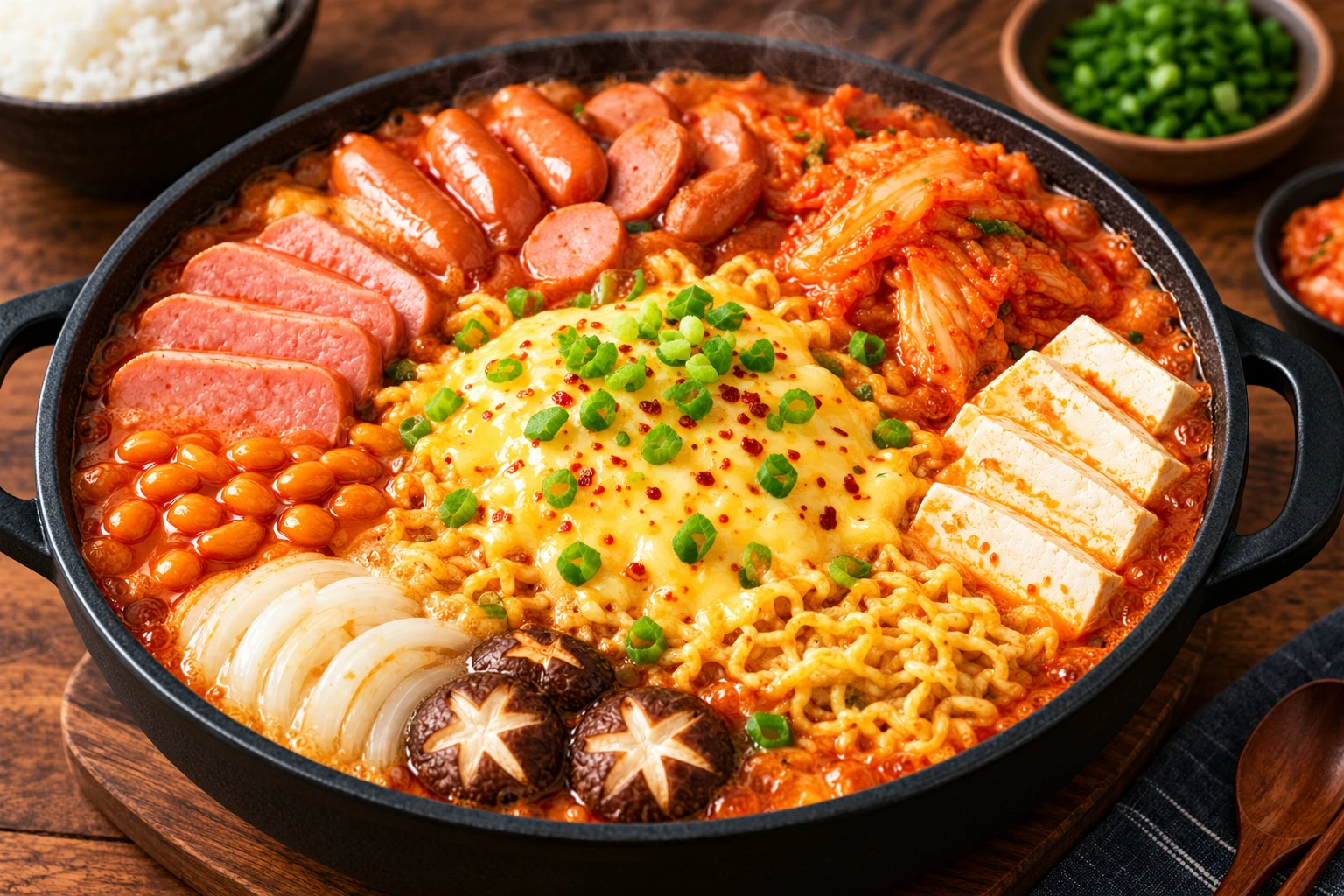
Budae Jjigae (부대찌개 — Korean Army Base Stew)
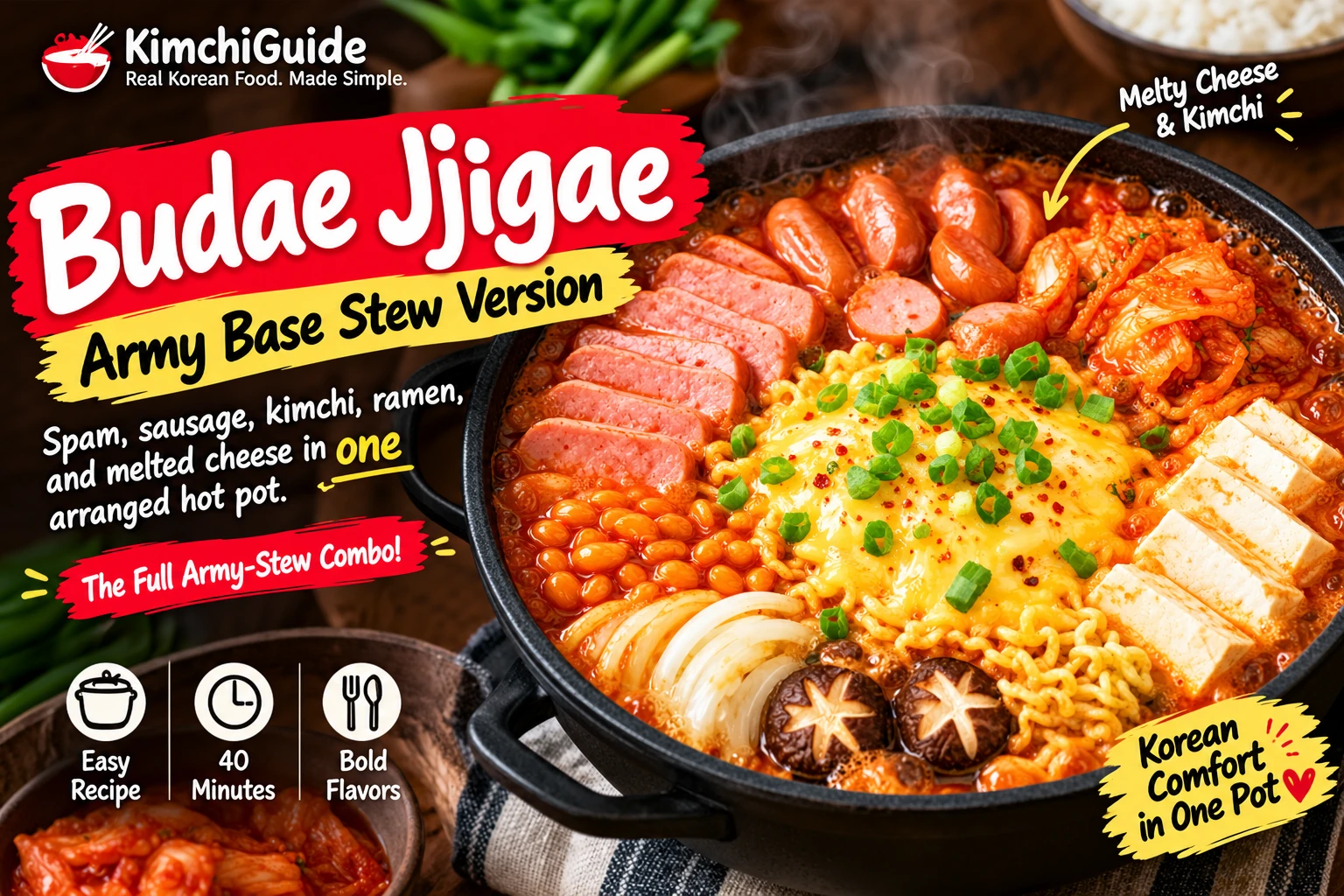
The maximalist, multi-protein member of the family — Spam, sausage, kimchi, and baked beans arranged in sections in a wide pot, simmered in real anchovy-kelp stock, and finished with instant ramen noodles and melted American cheese. Born near Uijeongbu after the Korean War from surplus US army-base rations, with a second, richer Songtan style that added the cheese and beans this recipe follows.
What Is Budae Jjigae?
Budae jjigae — 부대찌개, literally “army base stew” — is the maximalist, multi-protein member of the kimchi jjigae family, born near Uijeongbu after the Korean War when surplus foods from US army bases got combined with Korean kimchi and gochujang. A second, richer style later developed near the Songtan base, adding cheese and baked beans — this recipe follows that Songtan-leaning combo, with both marked optional if you’d rather make the lighter original. The three things that separate a good one from a mediocre one: real anchovy-kelp stock, not just water, to balance the processed meats’ saltiness; ramen noodles added near the end so they don’t turn mushy; and cheese melted from residual heat, not direct cooking, so it stays smooth instead of separating. Serves 4 in about 40 minutes at approximately 480 calories and 24g protein per serving — the richest, most filling recipe in the published family.
Why This Version Works — Four Details That Matter
Budae jjigae looks like “throw everything in a pot,” but the versions that actually taste right get four specific things right that have nothing to do with which processed meats you use.
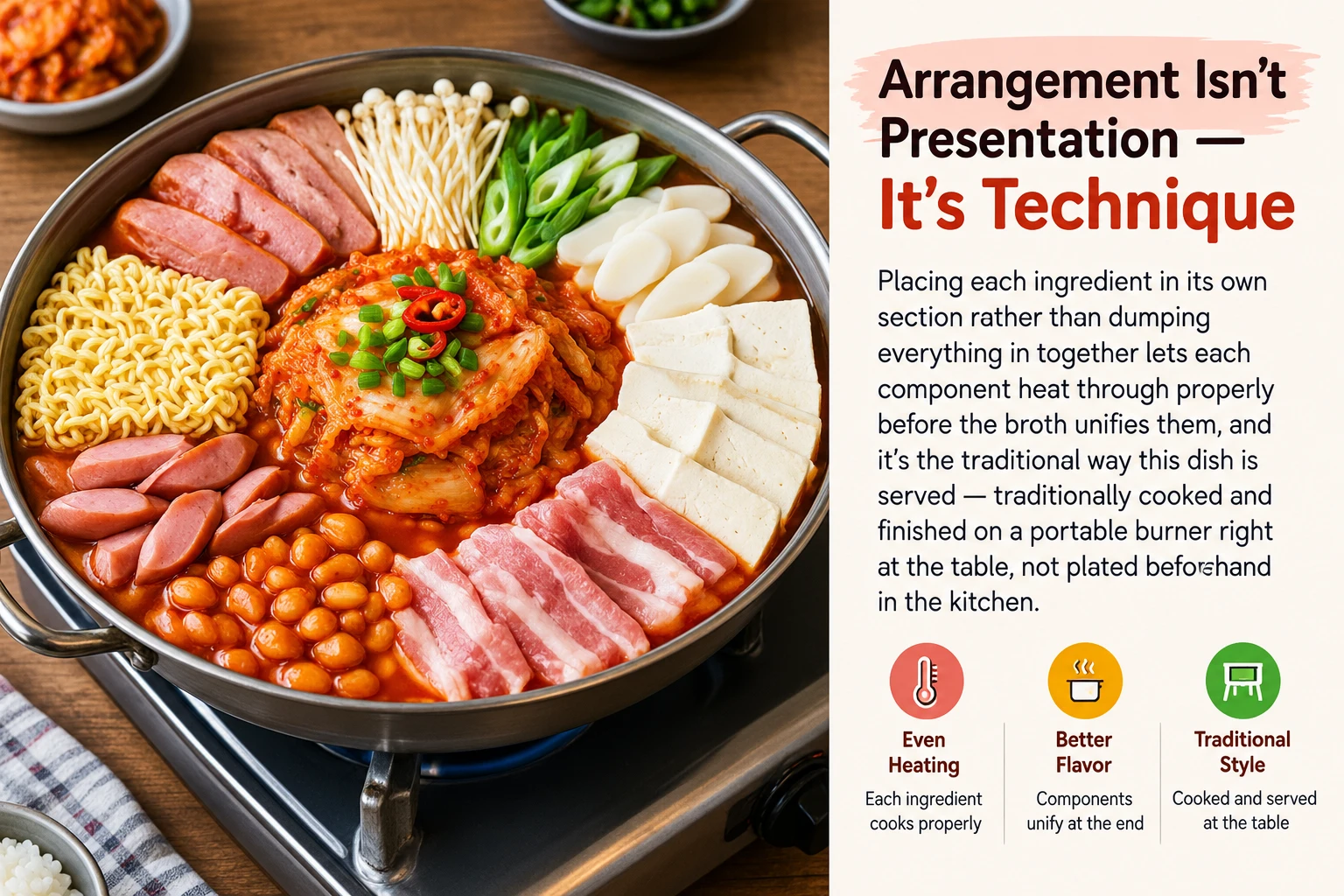
Placing each ingredient in its own section rather than dumping everything in together lets each component heat through properly before the broth unifies them, and it’s the traditional way this dish is served — traditionally cooked and finished on a portable burner right at the table, not plated beforehand in the kitchen.
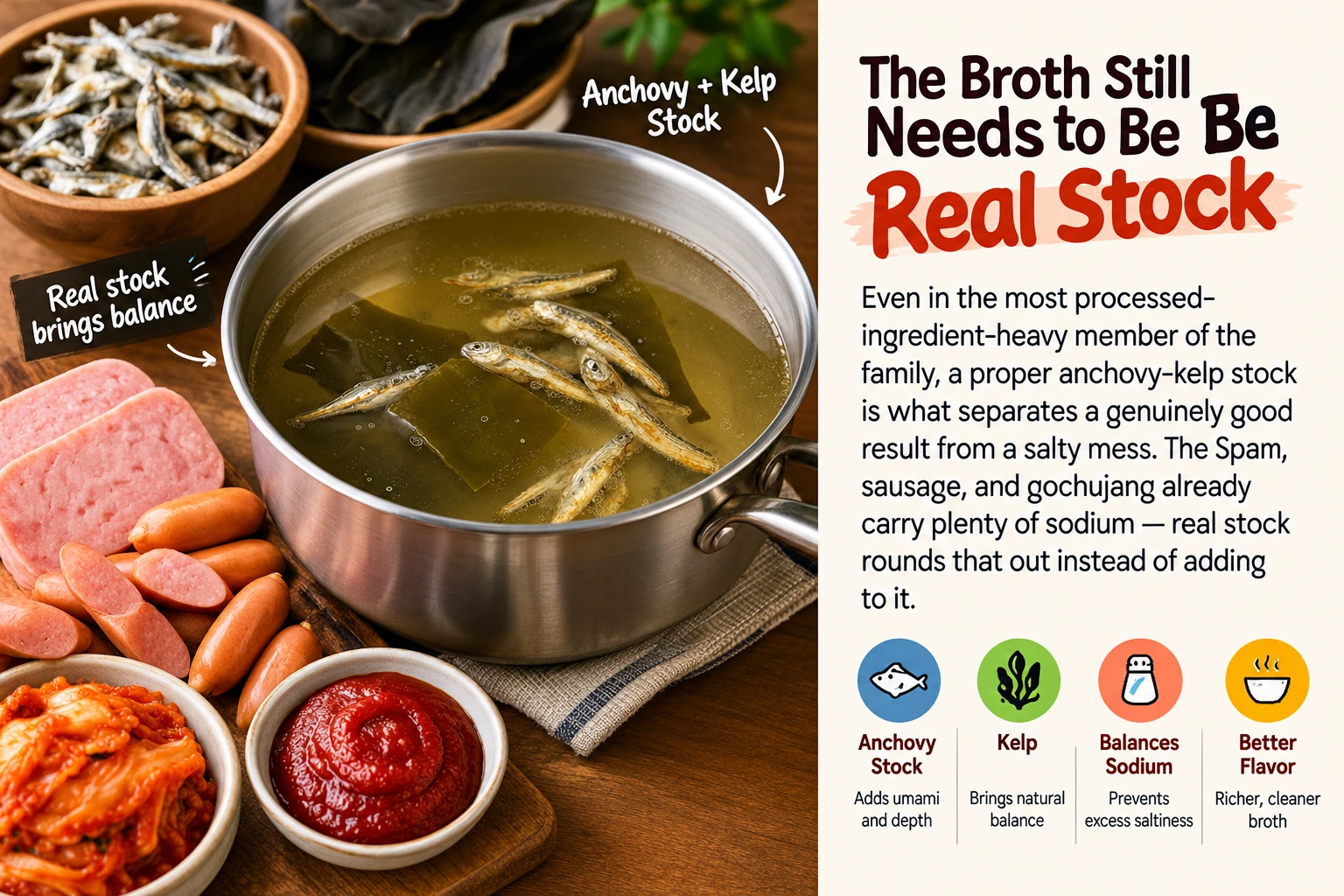
Even in the most processed-ingredient-heavy member of the family, a proper anchovy-kelp stock is what separates a genuinely good result from a salty mess. The Spam, sausage, and gochujang already carry plenty of sodium — real stock rounds that out instead of adding to it.
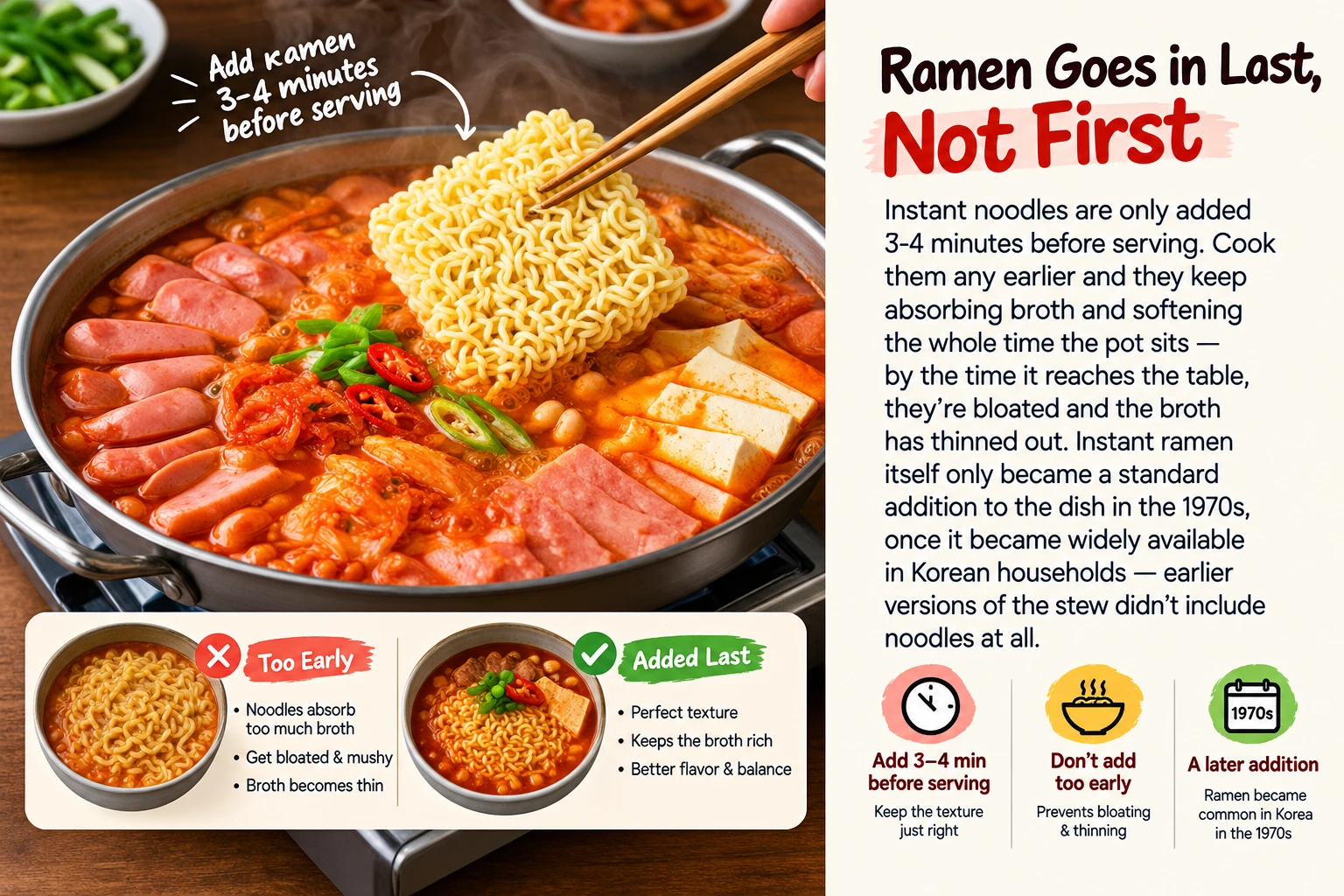
Instant noodles are only added 3-4 minutes before serving. Cook them any earlier and they keep absorbing broth and softening the whole time the pot sits — by the time it reaches the table, they’re bloated and the broth has thinned out. Instant ramen itself only became a standard addition to the dish in the 1970s, once it became widely available in Korean households — earlier versions of the stew didn’t include noodles at all.
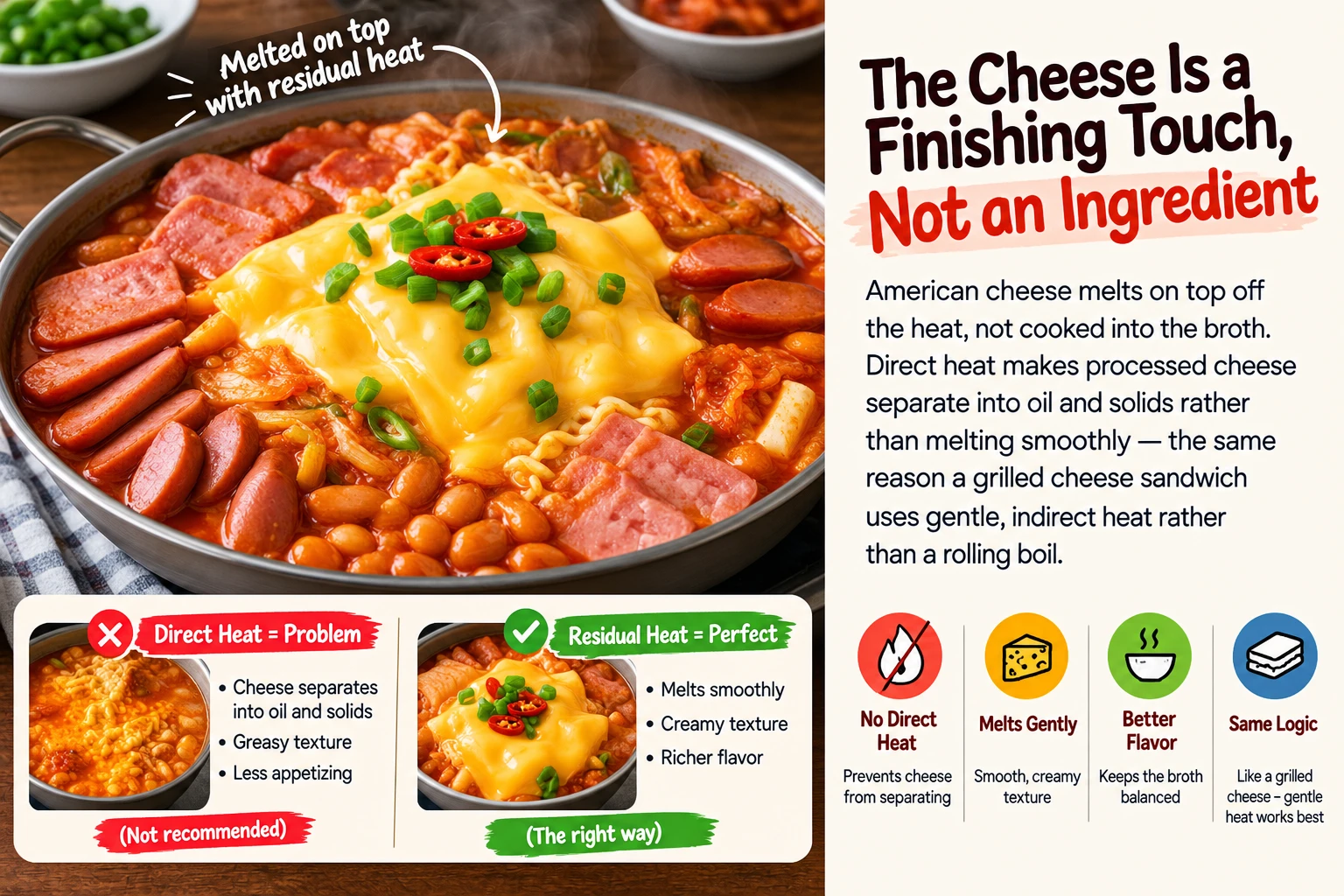
American cheese melts on top off the heat, not cooked into the broth. Direct heat makes processed cheese separate into oil and solids rather than melting smoothly — the same reason a grilled cheese sandwich uses gentle, indirect heat rather than a rolling boil.
Simple Spam Jjigae vs Full Budae Jjigae
These two are related but genuinely different dishes — knowing which one you actually want before you shop makes a real difference.
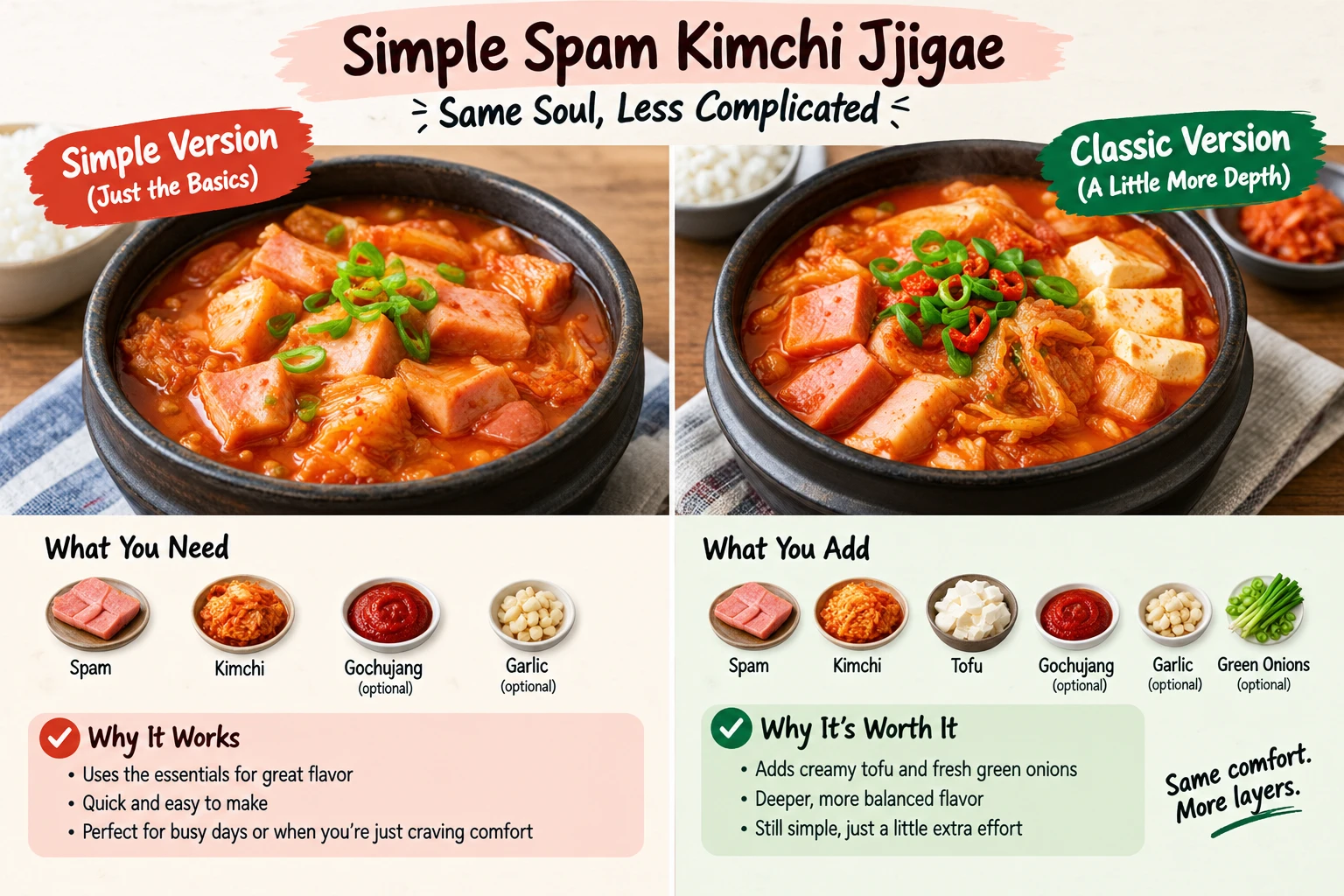
- Single processed protein — Spam only
- Standard jjigae format, kimchi-forward
- No noodles, beans, or cheese
- Closer to the classic family recipe
Result: A quick, familiar kimchi jjigae — see the dedicated Spam Kimchi Jjigae page for this simpler version.
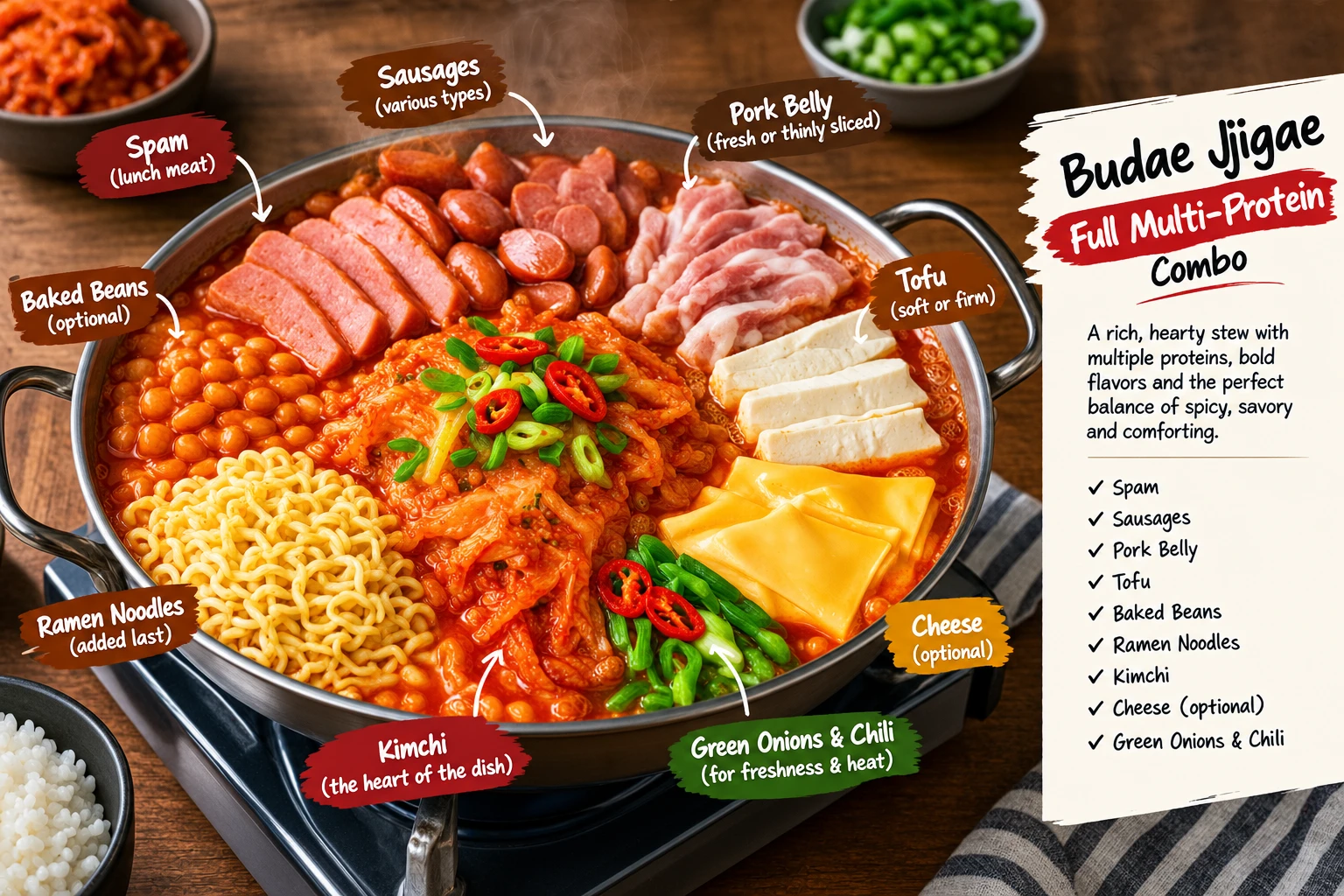
- Multi-protein — Spam, sausage, often beef or pork
- Baked beans, instant ramen, American cheese
- Arranged hot-pot format, richer and heavier
- The genuine restaurant/sharing-dish experience
Result: The full, traditional army-stew experience — richer, more filling, and meant for sharing at the table.
Format Comparison at a Glance
| Format | Proteins | Extras | Total Time | Verdict |
|---|---|---|---|---|
| Simple Spam | Spam only | None | ~25 min | Quick weeknight jjigae |
| Full Budae ⭐ | Spam + sausage (+ beef/pork) | Beans, ramen, cheese | ~40 min | The complete army-stew experience |
Uijeongbu vs Songtan — Two Regional Styles
Budae jjigae isn’t one fixed recipe even within Korea — two distinct regional styles developed near two different US army bases, and this recipe deliberately combines elements of both rather than picking a side.
- Clearer, lighter broth
- Kimchi, tofu, sausage, and ham forward
- No cheese, no baked beans
- The style most historically tied to the dish’s 1950s origin
Result: A lighter, kimchi-forward stew where the fermented tang balances the processed meats without cheese or beans in the mix.
- Thicker, richer broth
- Adds American cheese and baked beans
- Often more sausage and ham than the Uijeongbu version
- Developed later, near a different US base
Result: A bolder, richer bowl — this is the style most people picture when they think “budae jjigae,” and why this recipe lists cheese and beans as core (if optional) components.
Key Terms — Language & Food Science Entities
These terms define the technique, history, and vocabulary specific to budae jjigae — see the full silo glossary on the Kimchi Jjigae Hub for terms shared across the whole family.
Which Components to Use — Four Options Ranked
Budae jjigae is defined by its combination of components more than any single ingredient — here’s how the traditional and common additions compare.
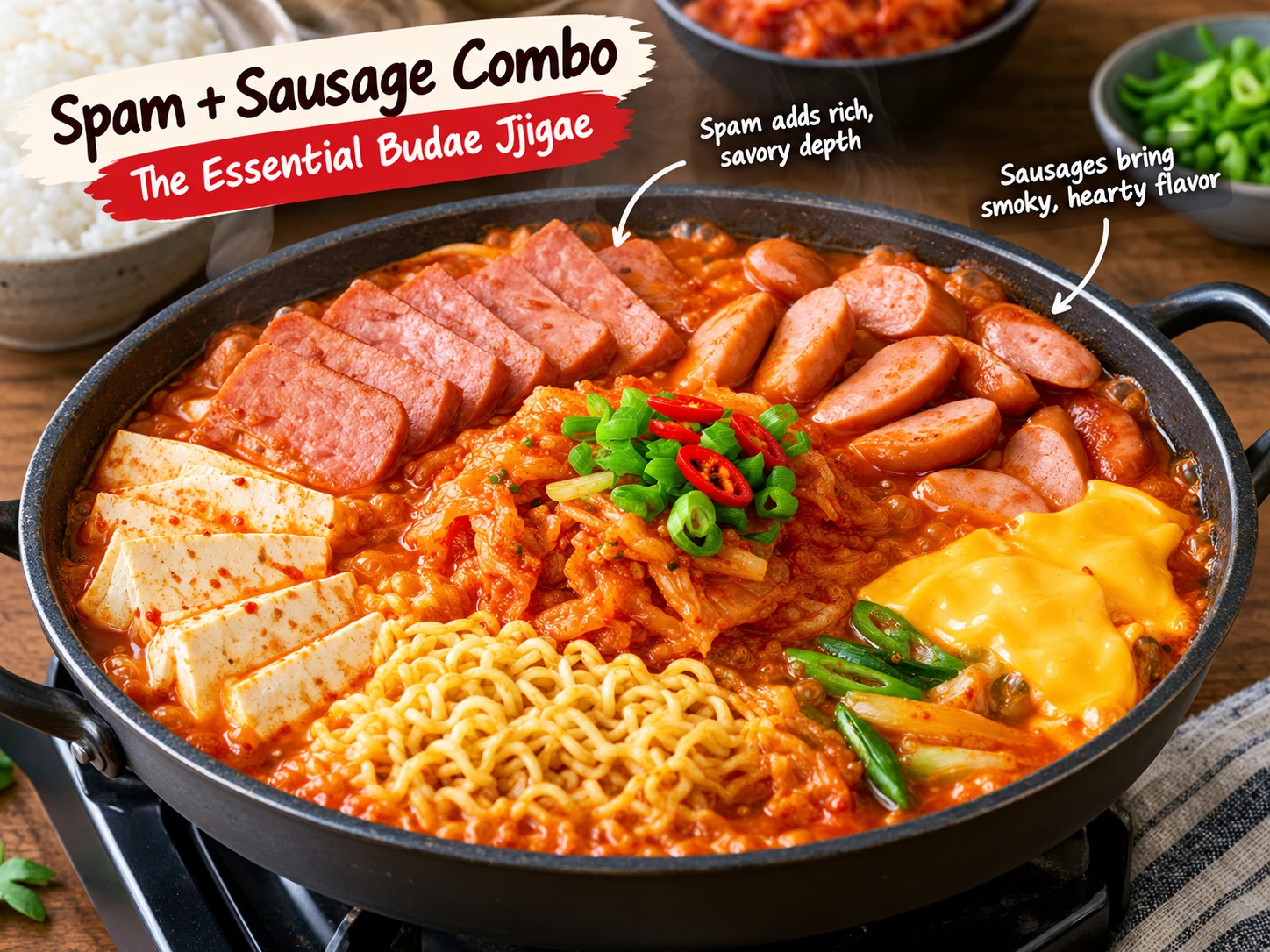
The non-negotiable core of the dish — the recipe as written. Sliced and arranged together in the pot.
⭐ Essential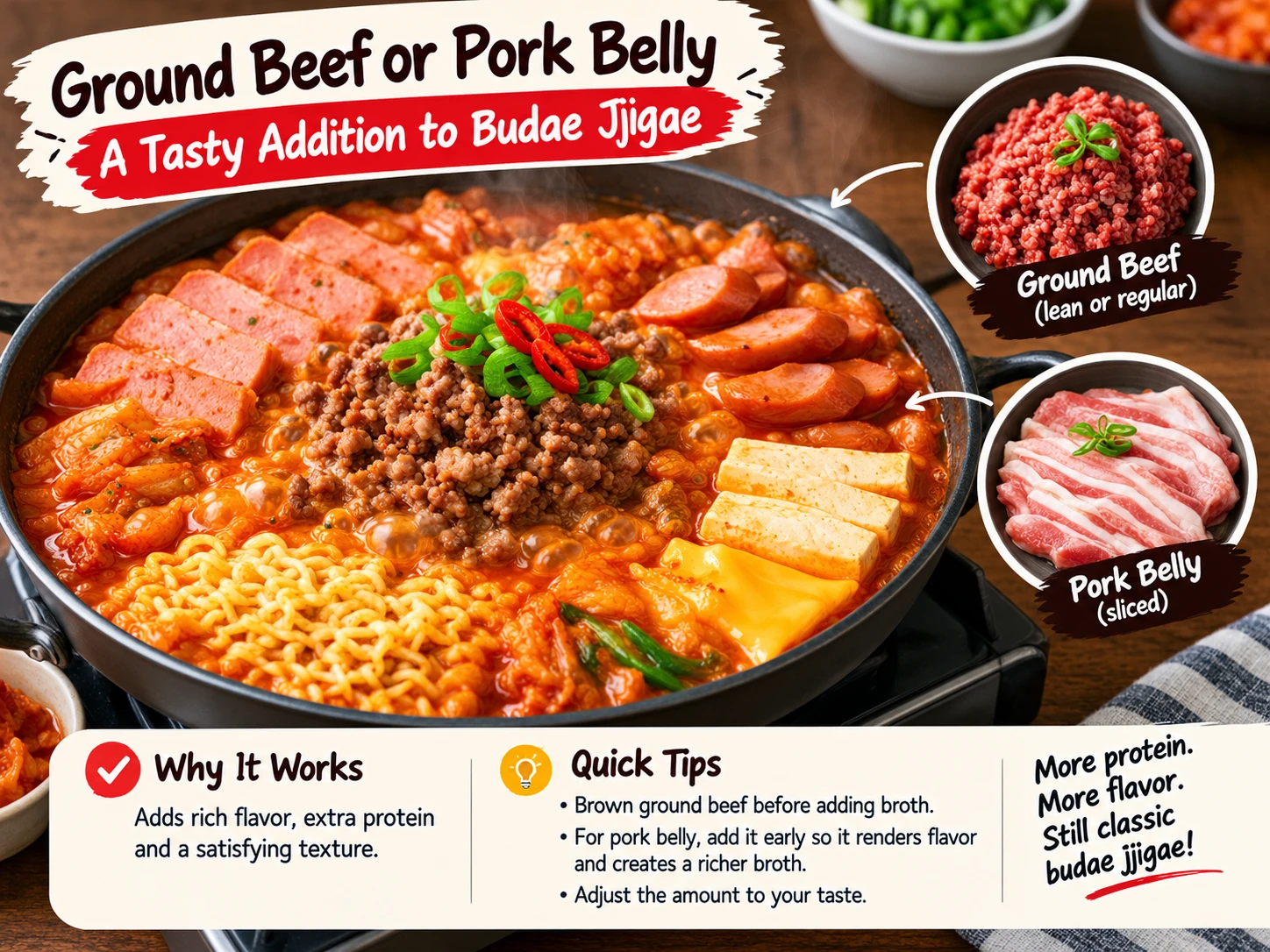
A common, richer addition alongside the Spam and sausage — adds depth without replacing the core combo.
✅ Good Addition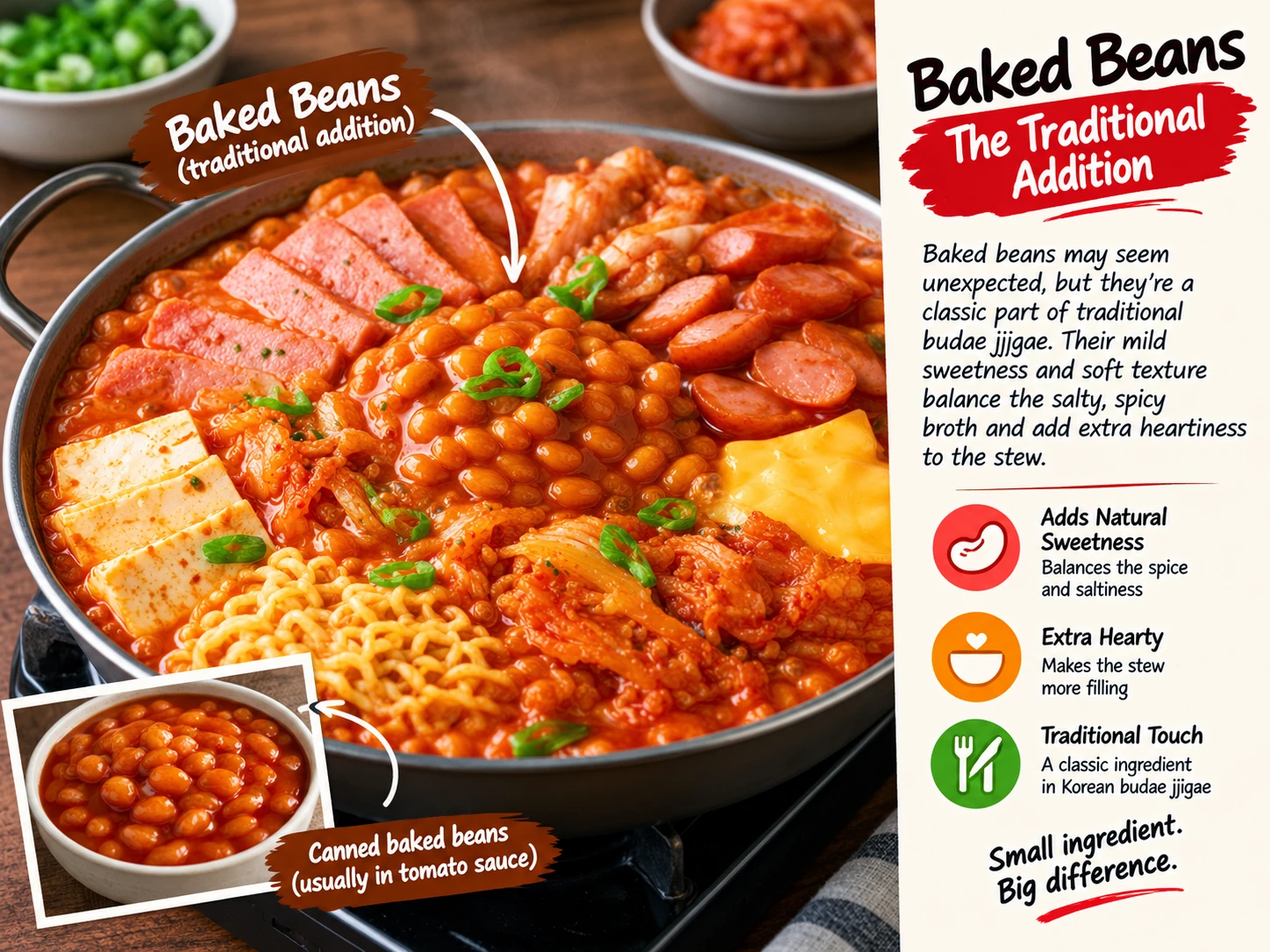
Songtan-style and optional, but genuinely authentic to that version of the dish, adding a subtle sweetness.
Songtan-Style, Optional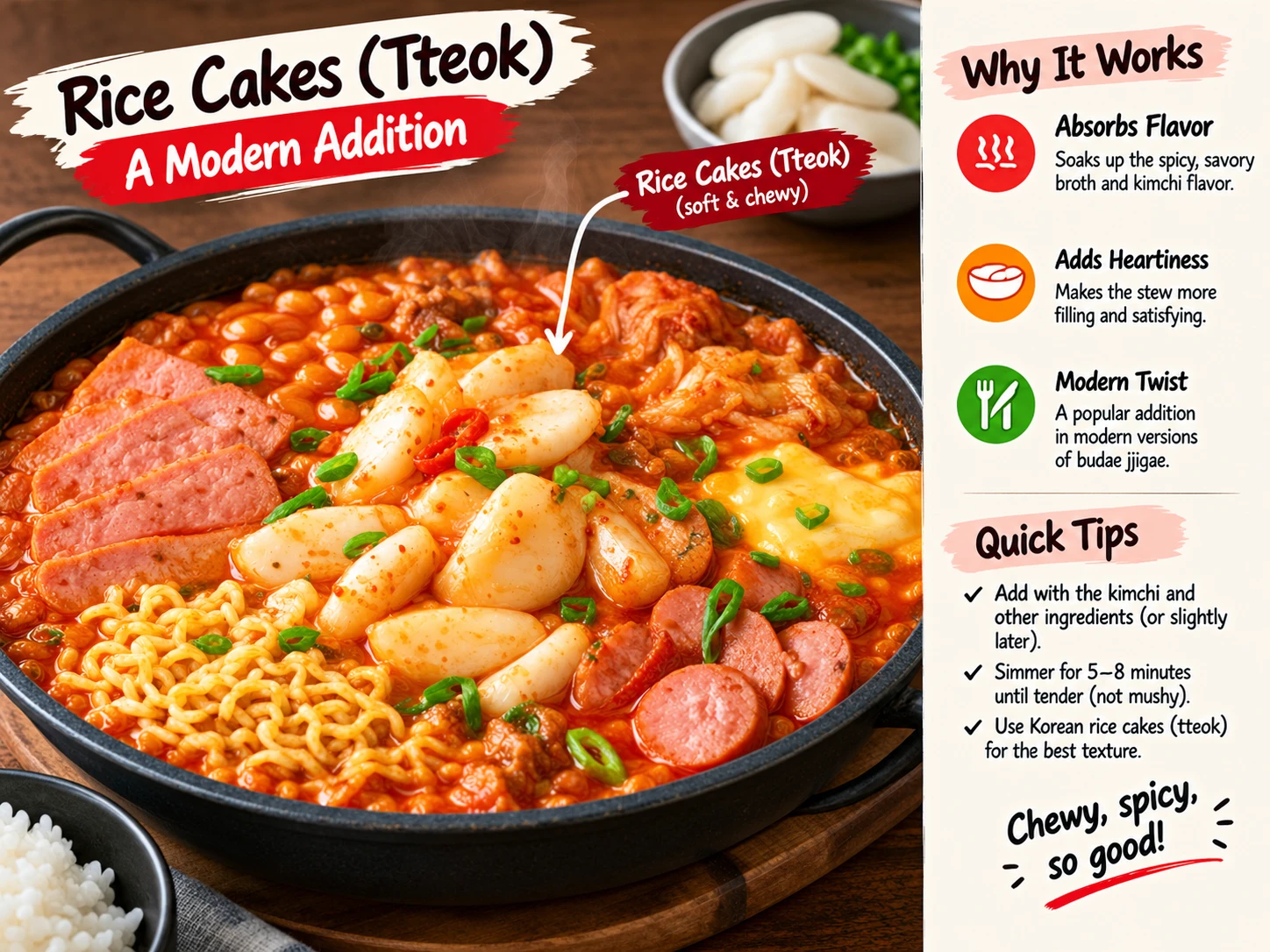
Two popular modern additions, not part of the original dish — add sliced tteok with the ramen noodles near the end; a soft or runny-yolk egg goes on top right before serving, alongside or instead of the cheese.
Popular Modern Add-Ins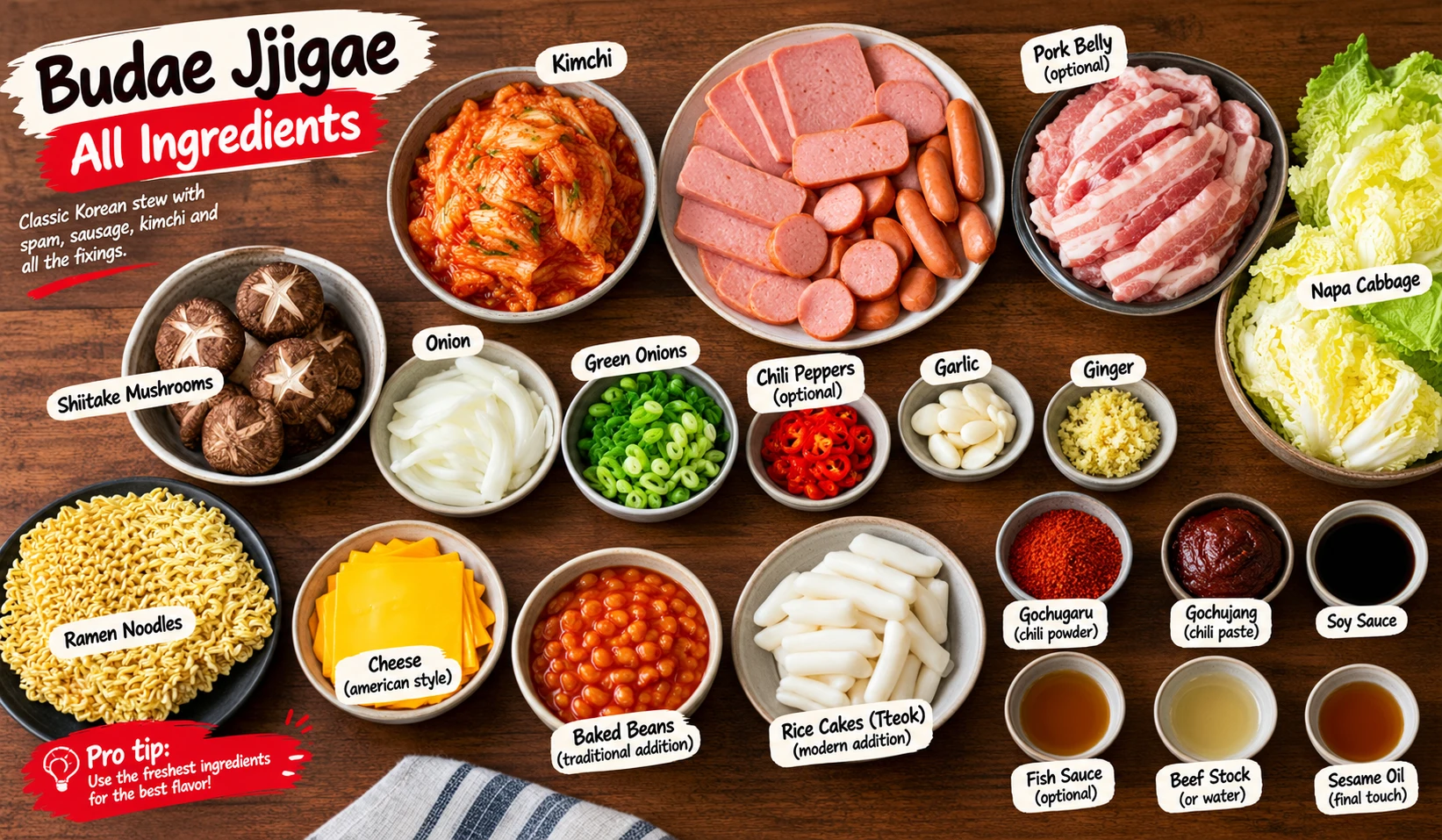
A restaurant-style vegetable addition seen across many household versions — added with the tofu and onion, it rounds out the pot without diluting the core Spam-and-sausage flavor.
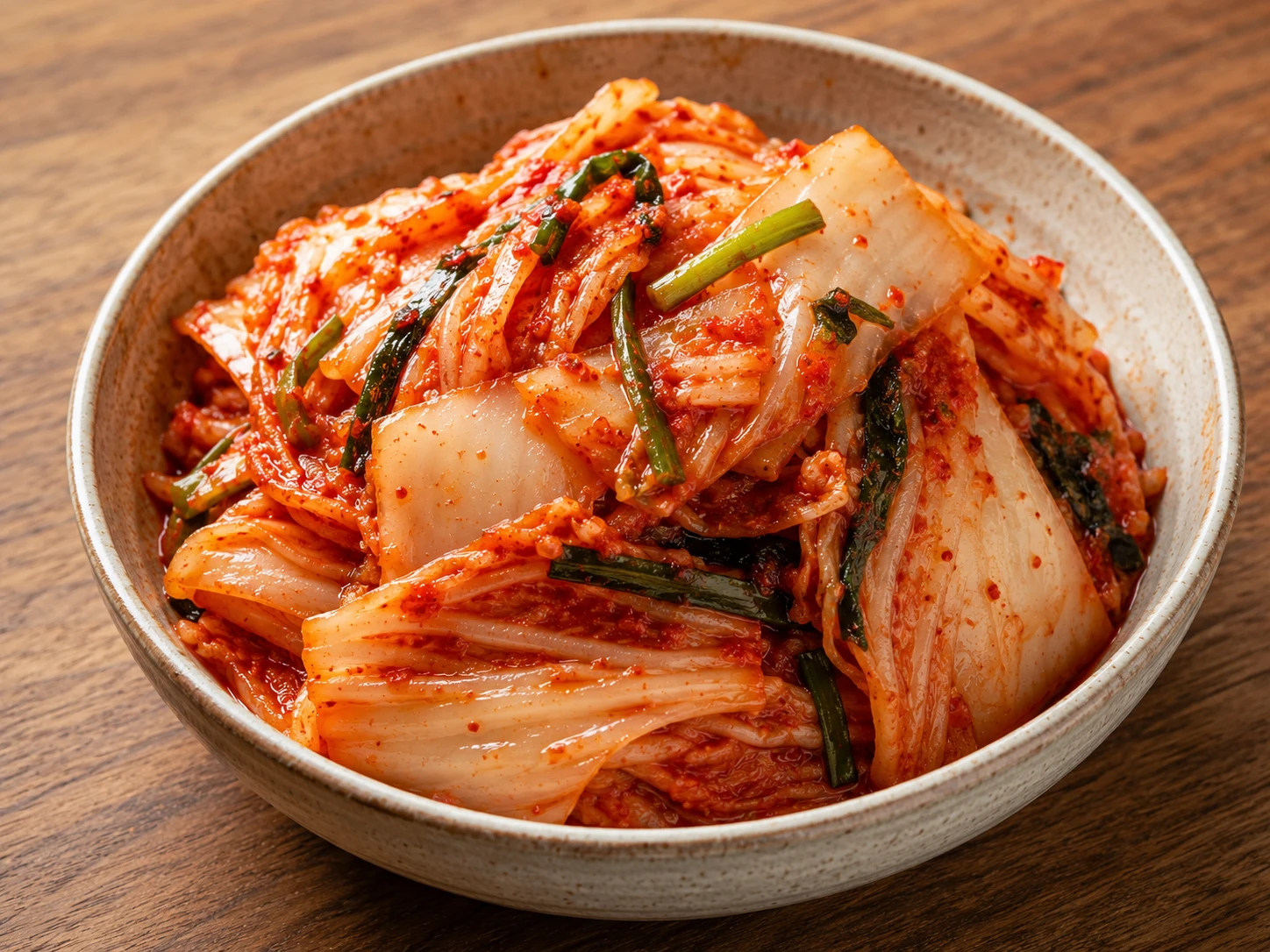
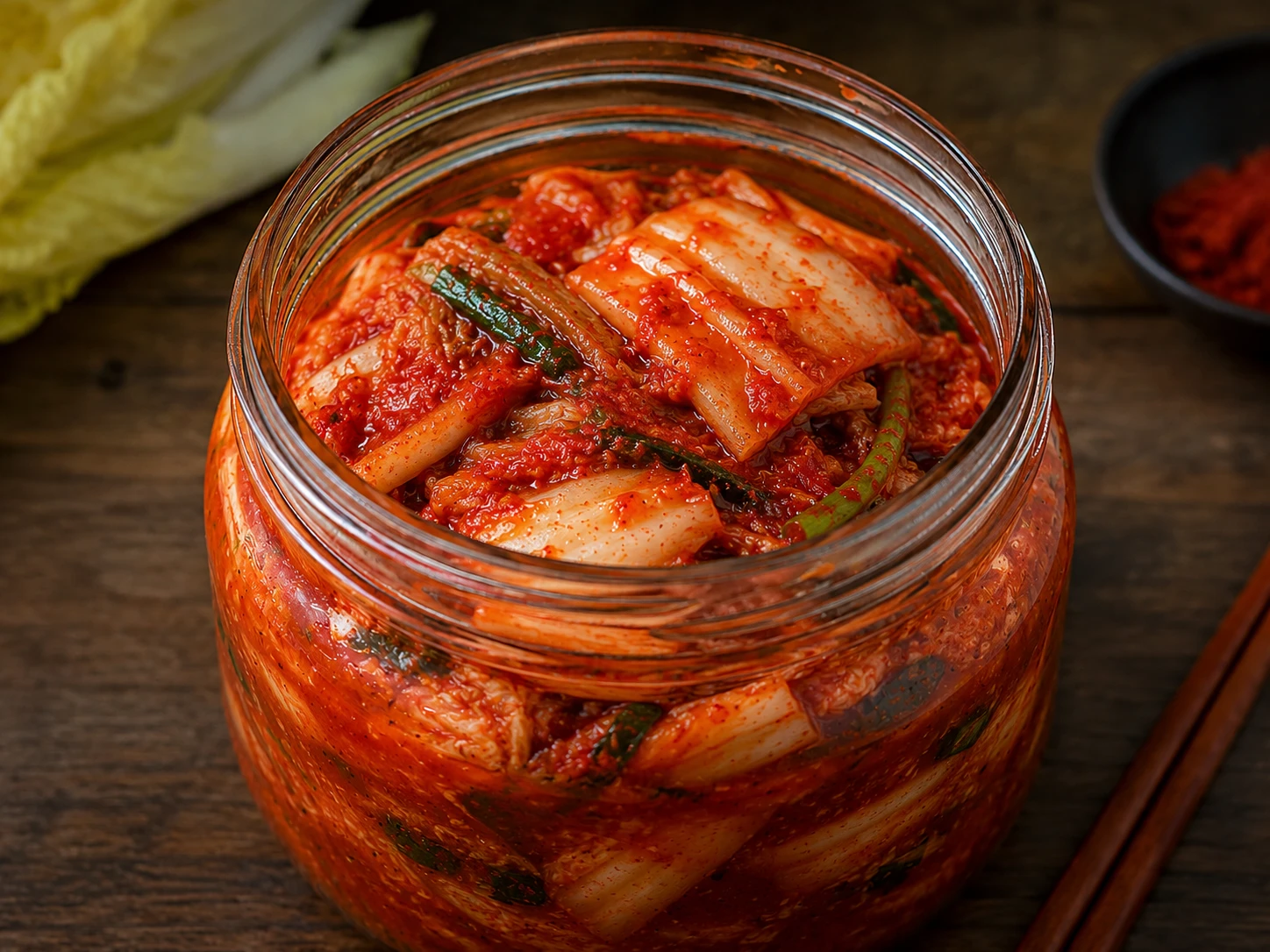
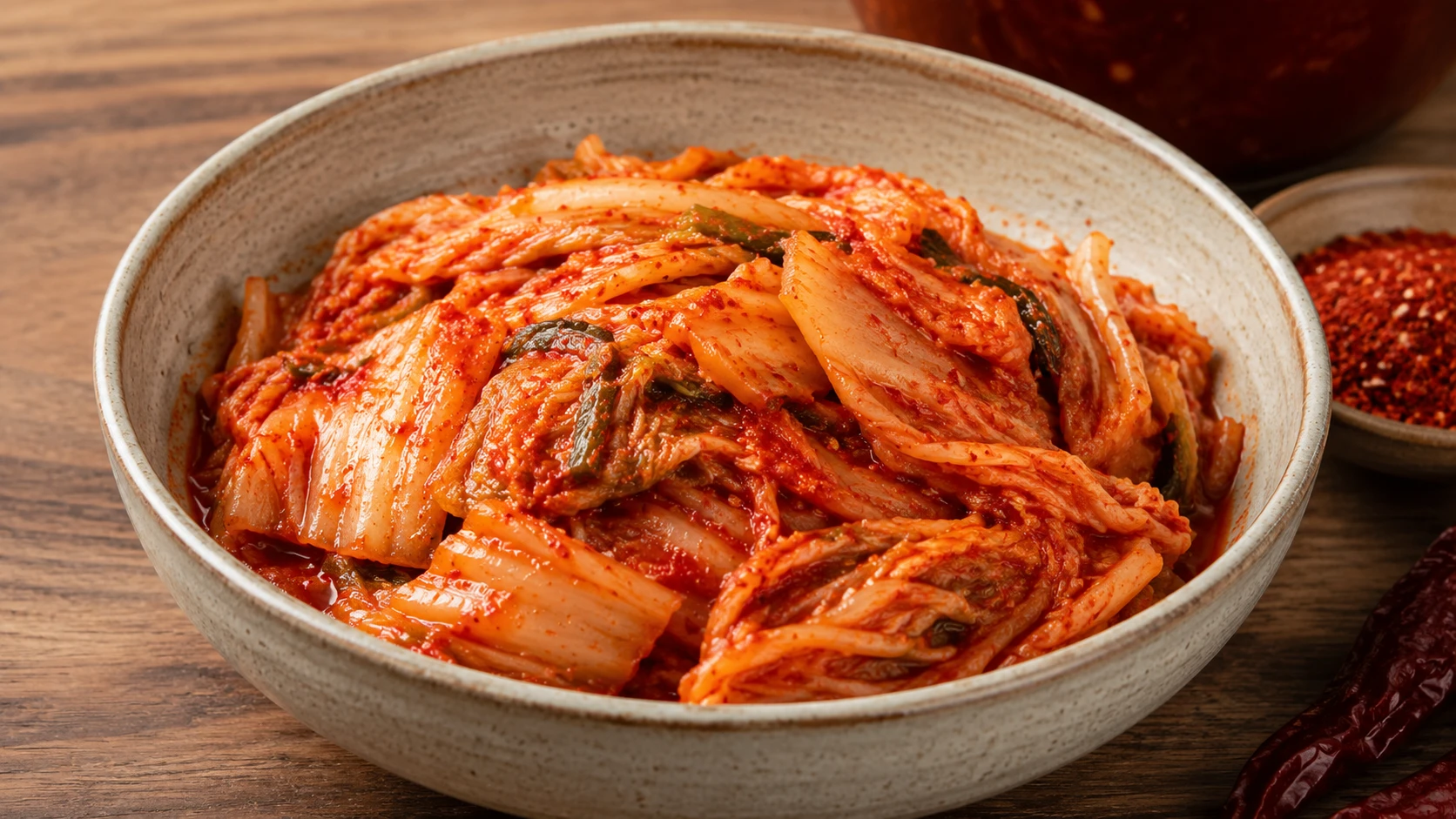
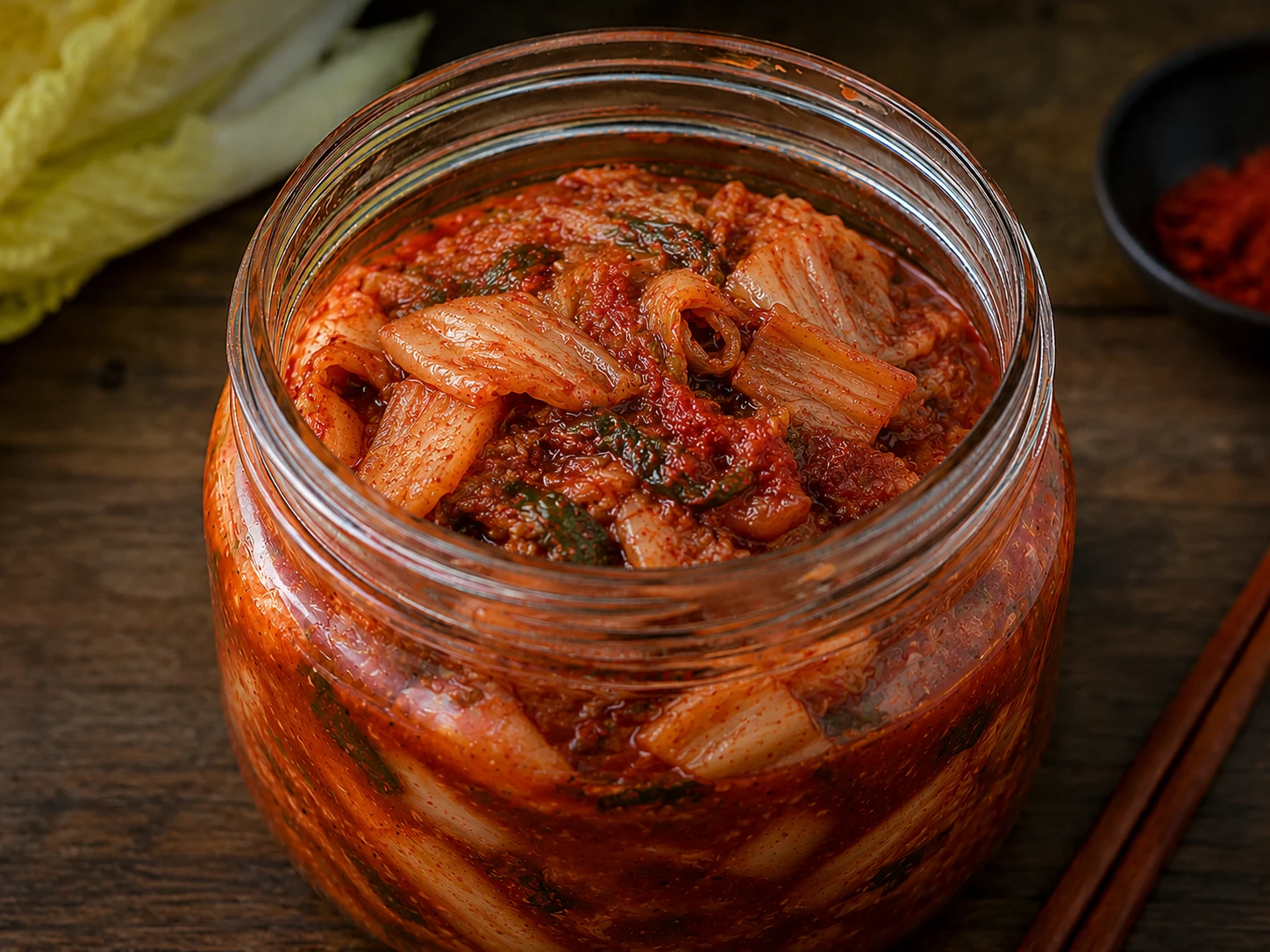
Common Restaurant AdditionWhich Kimchi Stage to Use — Budae Jjigae Guide
Fermentation stage and protein choice are independent variables — Stage 3 remains the correct default here too, even with all the processed meats sharing the pot.
How Difficult Is Budae Jjigae?
Slightly more involved than the rest of the family — not because any single step is hard, but because there are more components to slice, arrange, and time correctly.
Ingredients + Scaler
More components than the rest of the family, but each one is simple — mostly slicing and arranging rather than active cooking technique.
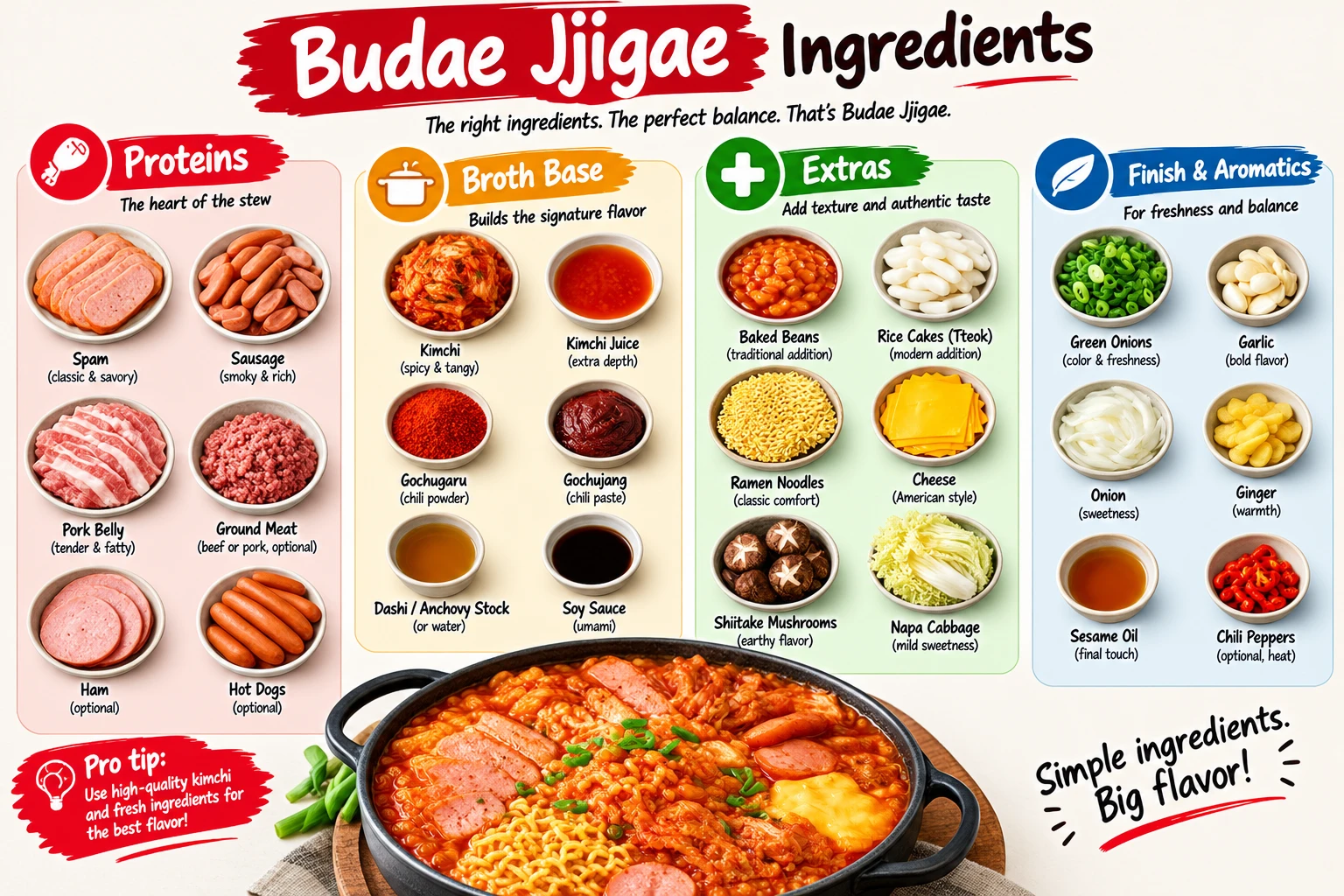
At-a-glance ingredient breakdown by category — proteins, broth base, extras, and finishing touches.
How to Make Budae Jjigae — 5 Steps
Five steps, mostly assembly rather than active cooking. The two moments that matter most: adding the ramen noodles only near the end, and melting the cheese off-heat.
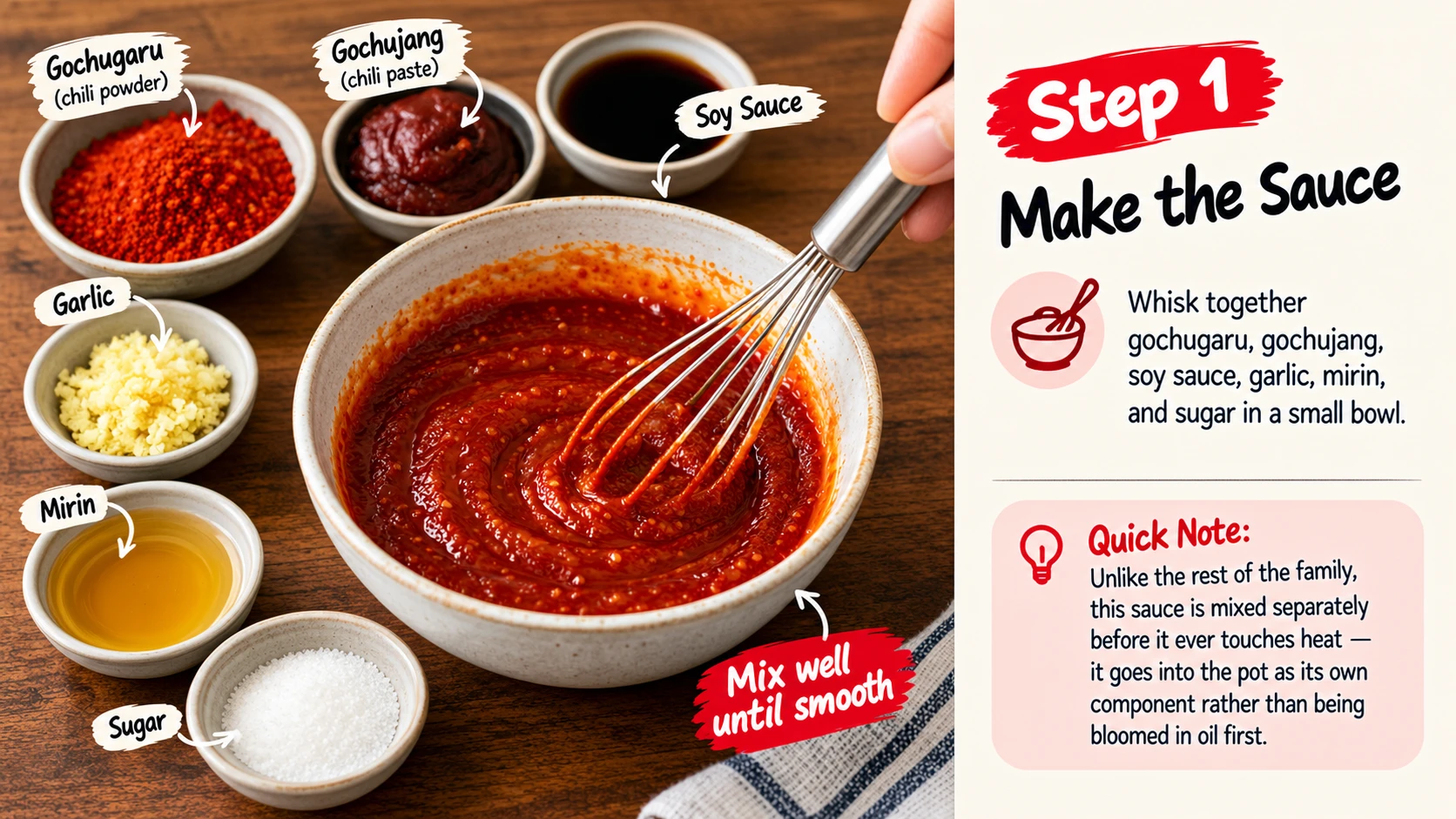
Whisk together gochugaru, gochujang, soy sauce, garlic, mirin, and sugar in a small bowl.
Unlike the rest of the family, this sauce is mixed separately before it ever touches heat — it goes into the pot as its own component rather than being bloomed in oil first.
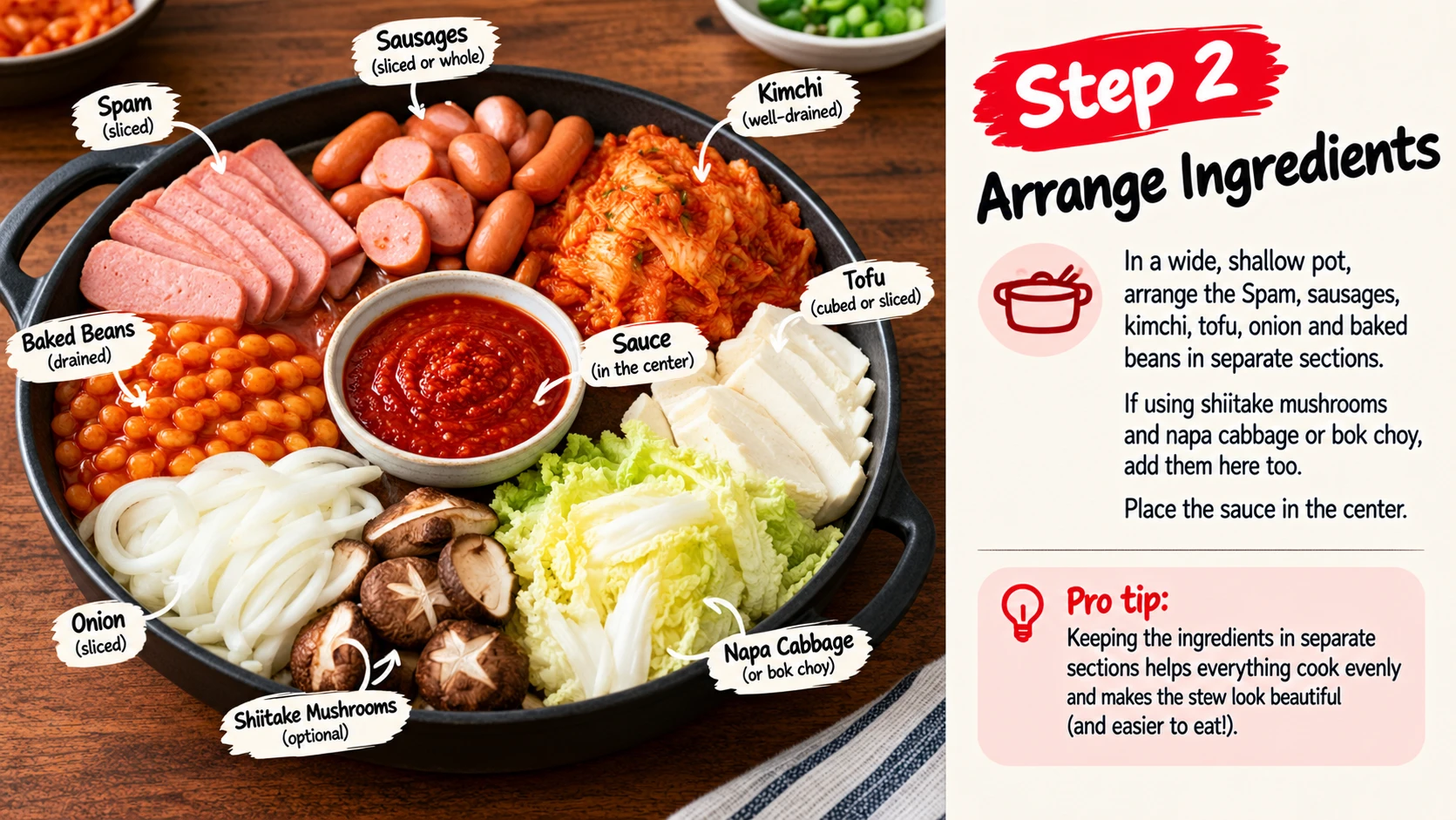
In a wide, shallow pot, arrange the Spam, sausages, kimchi, tofu, onion, and baked beans in separate sections. If using shiitake mushrooms and napa cabbage or bok choy, add them here too. Place the sauce in the center.
This arrangement is the traditional presentation, not just for looks — a wide pot with room to keep ingredients separated lets each one heat through evenly once the stock goes in. If you have a portable burner, this is the traditional point to move the pot to the table and finish cooking in front of your guests.
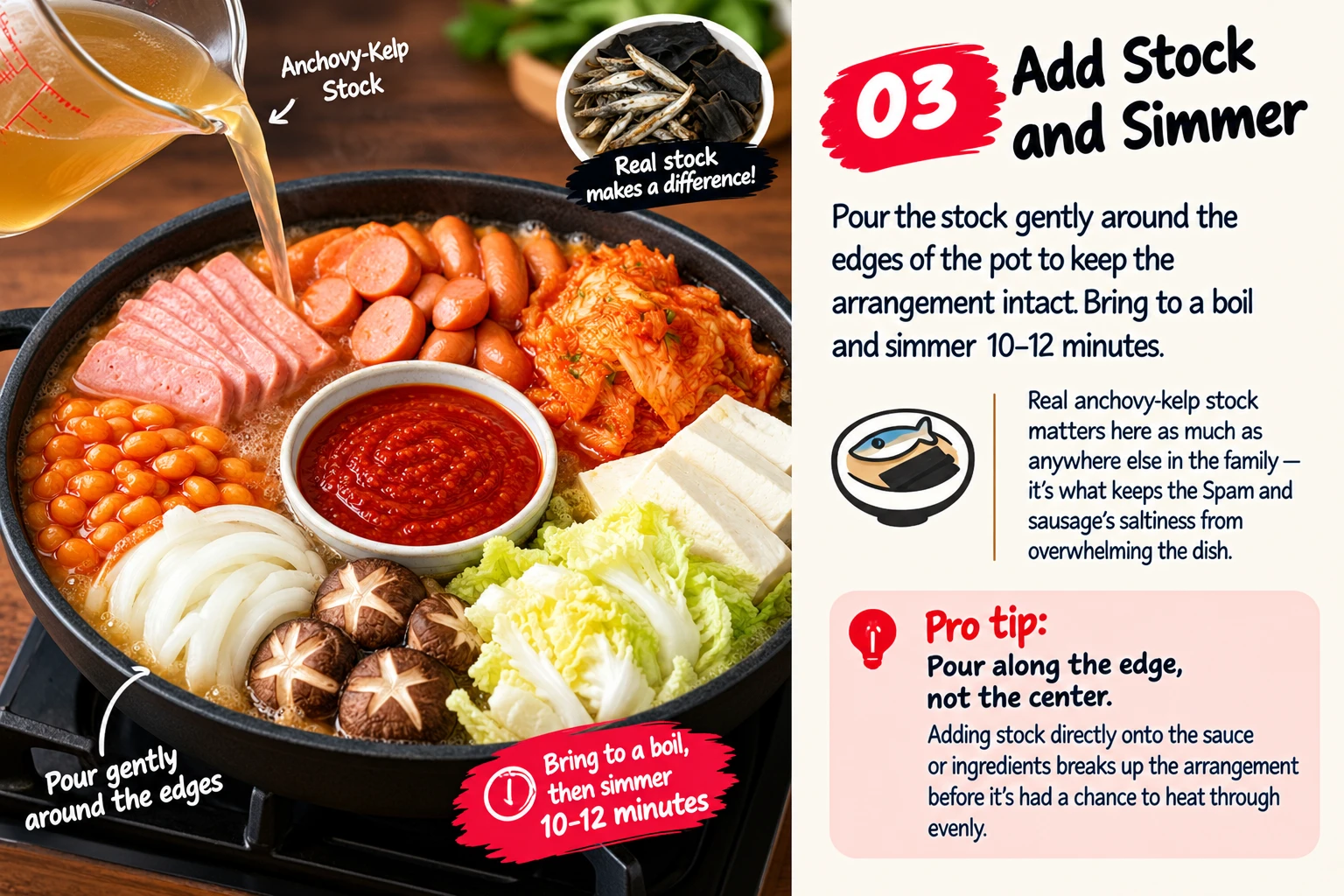
Pour the stock gently around the edges of the pot to keep the arrangement intact. Bring to a boil and simmer 10-12 minutes.
Real anchovy-kelp stock matters here as much as anywhere else in the family — it’s what keeps the Spam and sausage’s saltiness from overwhelming the dish.
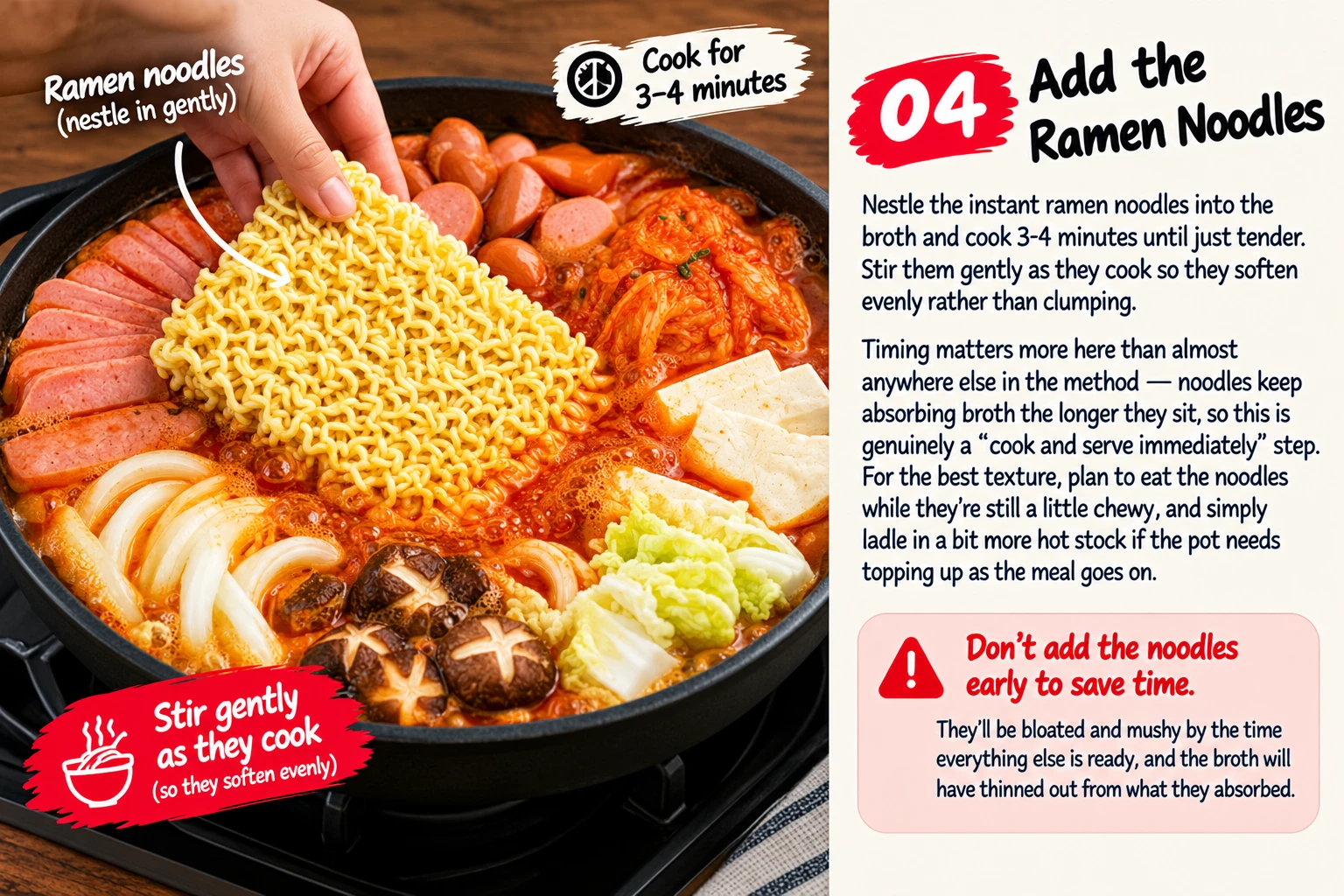
Nestle the instant ramen noodles into the broth and cook 3-4 minutes until just tender. Stir them gently as they cook so they soften evenly rather than clumping.
Timing matters more here than almost anywhere else in the method — noodles keep absorbing broth the longer they sit, so this is genuinely a “cook and serve immediately” step. For the best texture, plan to eat the noodles while they’re still a little chewy, and simply ladle in a bit more hot stock if the pot needs topping up as the meal goes on.
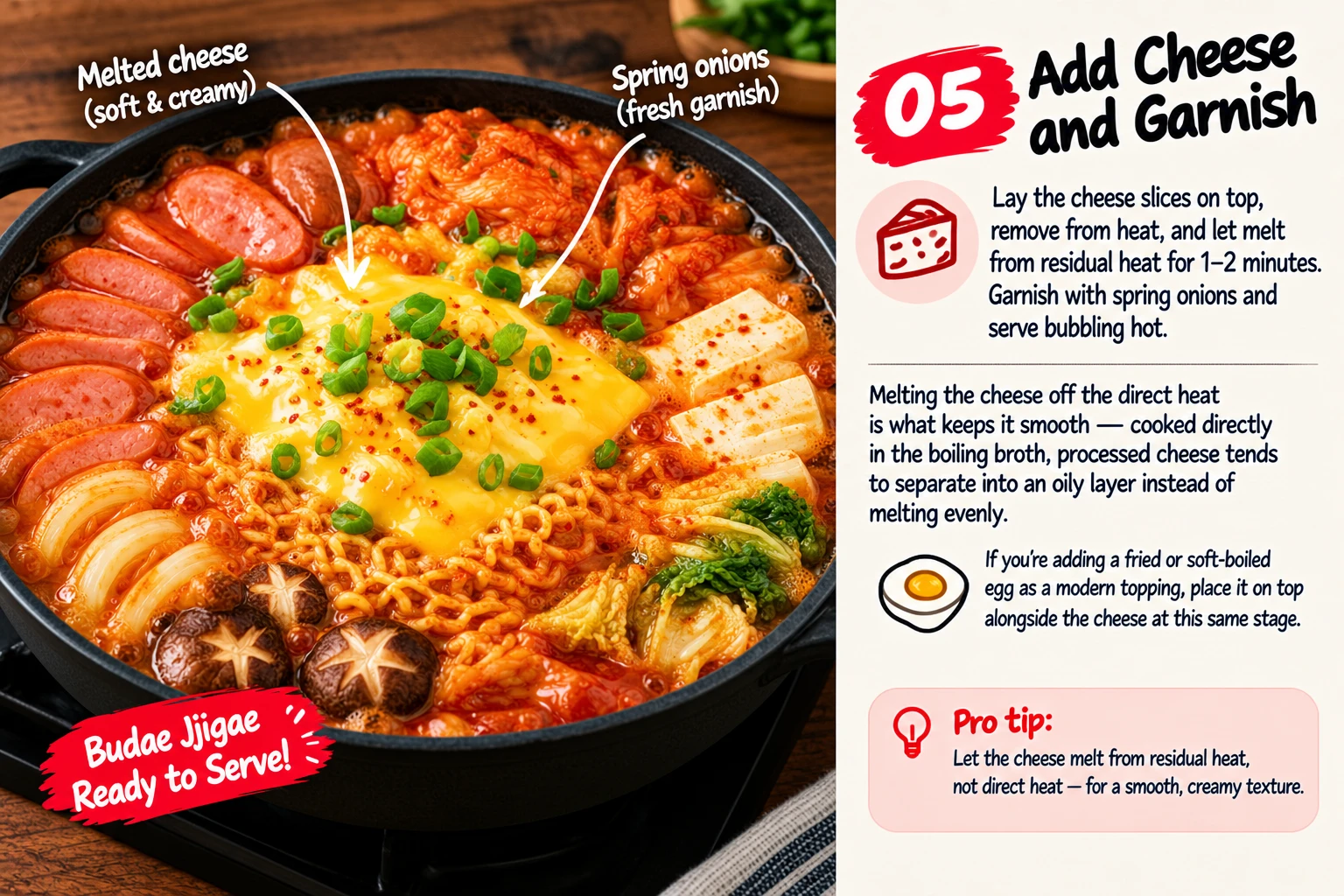
Lay the cheese slices on top, remove from heat, and let melt from residual heat for 1-2 minutes. Garnish with spring onions and serve bubbling hot.
Melting the cheese off the direct heat is what keeps it smooth — cooked directly in the boiling broth, processed cheese tends to separate into an oily layer instead of melting evenly. If you’re adding a fried or soft-boiled egg as a modern topping, place it on top alongside the cheese at this same stage.
What We Tested for Budae Jjigae
Three variables decide whether this recipe tastes like a proper army stew or an overly salty mess of processed meat. Here’s what we found.
Every individual component of budae jjigae is genuinely simple to prepare — the entire skill of this dish is sequencing: stock first, noodles near the end, cheese last of all. Get the order right and even a first attempt tastes like the real thing.
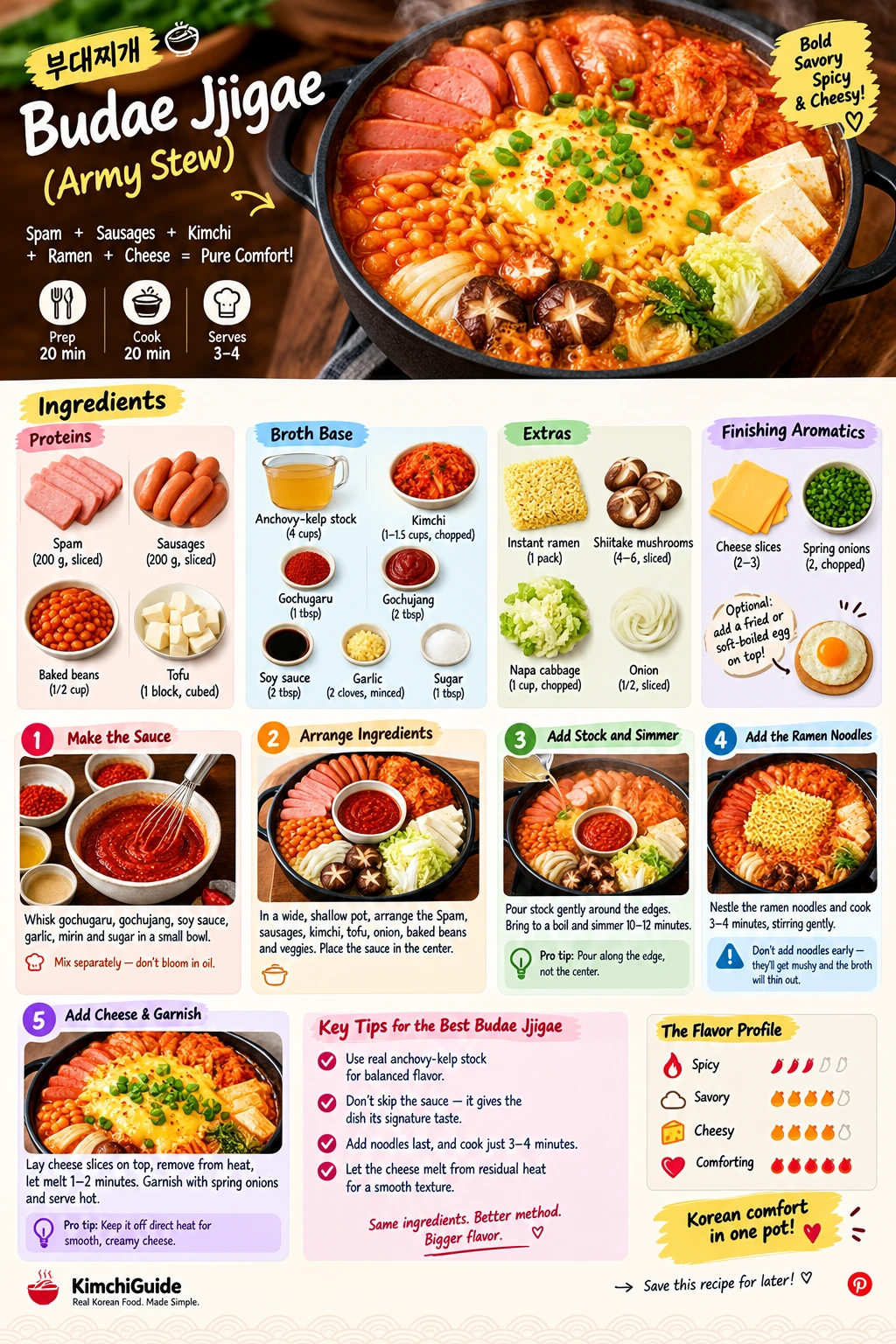
Budae Jjigae (부대찌개)
Arranged-pot method · real anchovy stock · 40 min · ~480 calories, 24g protein
- 2 tbsp gochugaru, 2 tbsp gochujang
- 2 tbsp soy sauce, 1 tbsp garlic, 1 tbsp mirin, 1 tsp sugar
- 4 cups anchovy-kelp stock
- 1 cup aged kimchi (Stage 3), chopped
- 200g Spam, sliced
- 150g sausages or hot dogs, sliced
- 150g firm tofu, sliced
- ½ onion, ½ cup baked beans (optional, Songtan-style)
- 1 portion instant ramen noodles
- 2 slices American cheese (optional, Songtan-style)
- Spring onions, salt to taste
- Optional: 1 egg, fried or soft-boiled, added just before serving
- Whisk gochugaru, gochujang, soy sauce, garlic, mirin, sugar for the sauce.
- Arrange Spam, sausage, kimchi, tofu, onion, beans in sections; sauce in center.
- Pour stock around the edges, boil, simmer 10-12 min.
- Add ramen noodles, cook 3-4 min until just tender.
- Off heat, lay cheese (and egg, if using) on top, melt 1-2 min. Top with spring onions, serve hot.
🛒 Shop the Ingredients & Equipment
The exact-type ingredients and equipment used for this recipe, plus what to use if you’re starting from scratch.
Not making your own kimchi? See our guides on where to buy kimchi and the best store-bought kimchi brands — either works for the aged Stage 3 kimchi this recipe calls for.
Prefer a single-serving traditional pot instead? See our ttukbaegi buying guide.
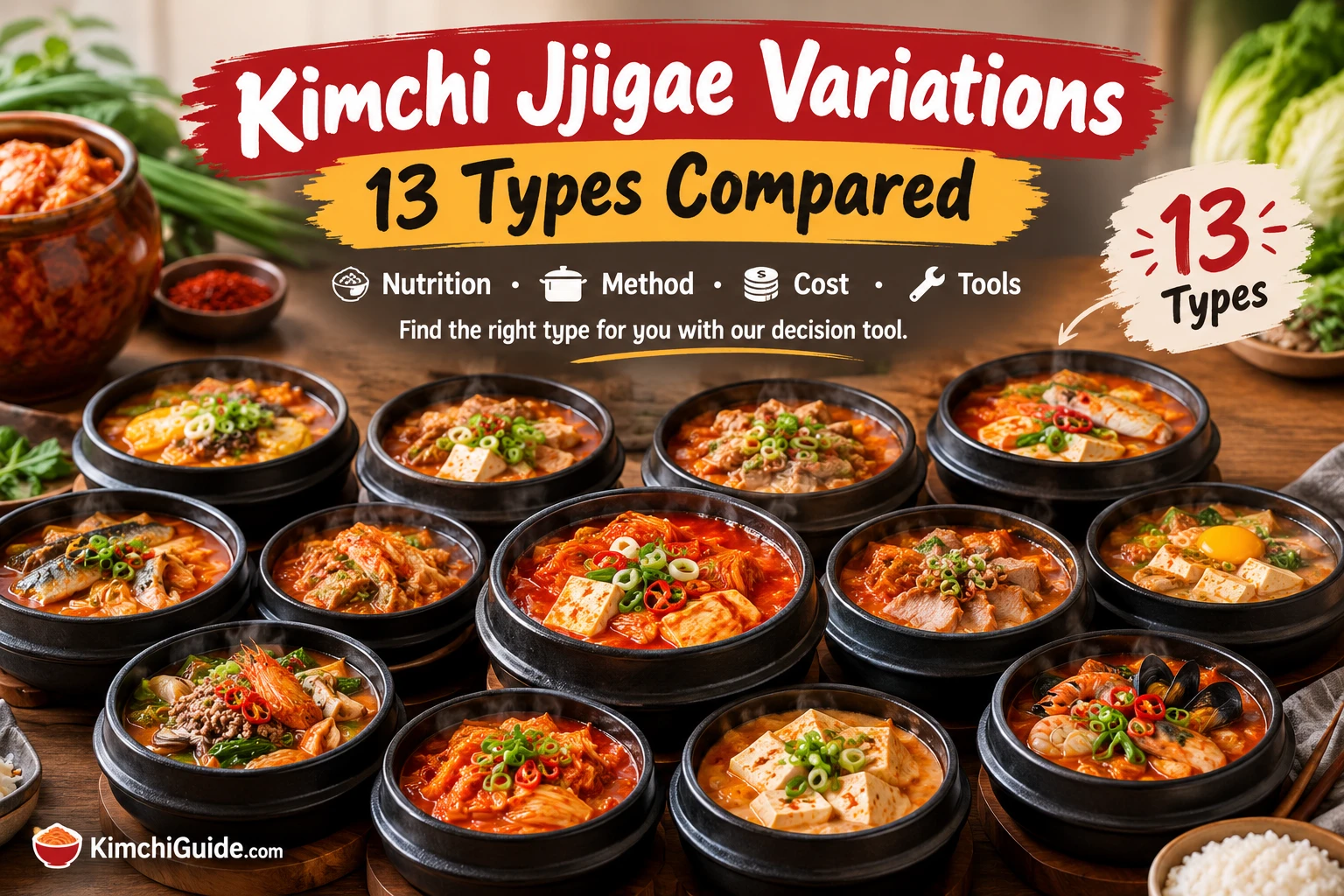
The Kimchi Jjigae Family — 13 Variations
This is page 6 of a growing 13-recipe family, all built on the same aged-kimchi base. The Kimchi Jjigae Ultimate Guide → compares every variation as it’s published.





Pairing Guide — Budae Jjigae
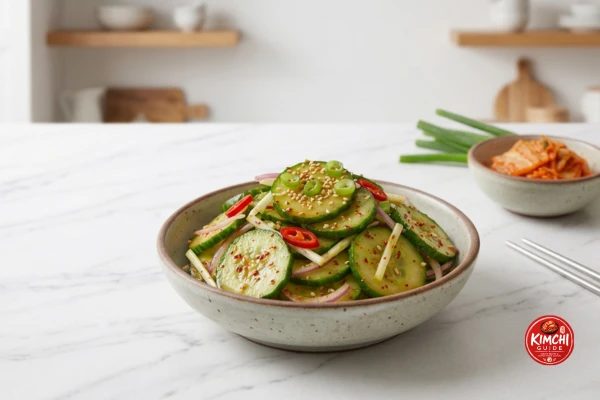
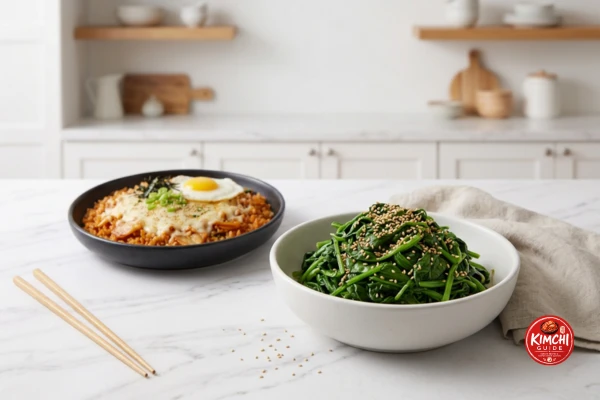
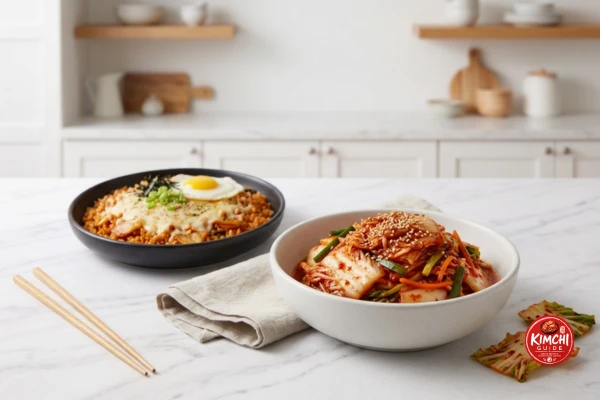
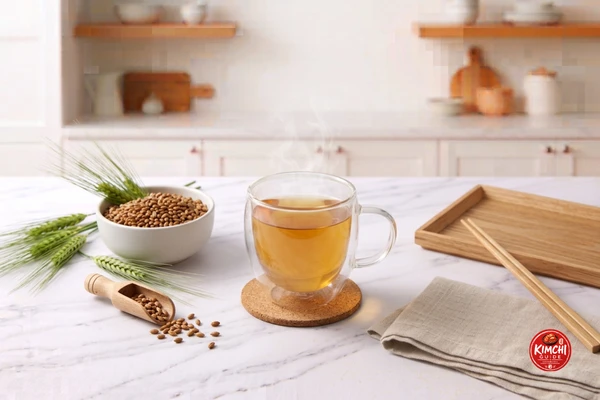
This is already a rich, filling, complete meal on its own — pairings here work best when they’re light and refreshing rather than adding more richness.
Storage & Reheating — Budae Jjigae
The meat-and-broth base stores well; the noodles and cheese are the two components genuinely best made fresh each time.
Detailed Nutrition Comparison — Budae Jjigae
A complete per-serving breakdown, reviewed by Dr. Sarah Mitchell RD, PhD, alongside how this recipe compares to the rest of the kimchi jjigae family.
Nutrition Facts
Per serving — recipe makes 4 servings
How Budae Jjigae Compares to the Rest of the Family
| Variation | Calories | Protein | Sat. Fat | Best For |
|---|---|---|---|---|
| Kimchi Guk | 130 | 9g | 1g | Lightest, lowest-sodium option in the family |
| Seafood Jjigae | 210 | 20g | 1.5g | Leanest jjigae-format option |
| Vegan | 200 | 12g | 1.5g | Lowest saturated fat in the family |
| Vegetarian | 220 | 13g | 2.5g | Meatless without going fully vegan |
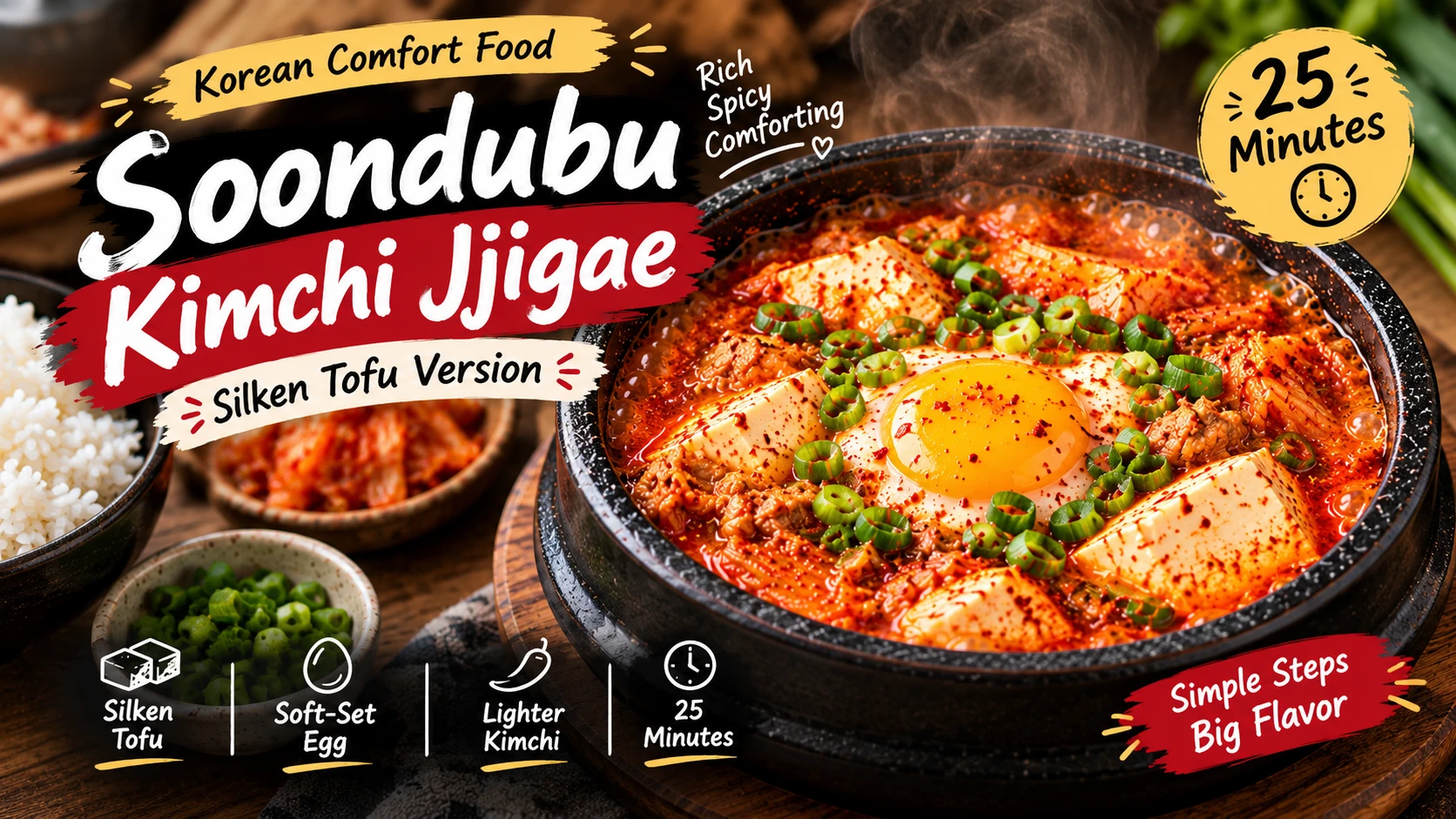
| Soondubu | 260 | 18g | 5g | Fastest to cook, lowest carb, restaurant-familiar |
| Tuna (Chamchi) | 260 | 24g | 2g | Fastest, highest protein-to-calorie ratio |
| Chicken | 280 | 25g | 3g | Highest protein, leanest meat-based option |
| Instant Pot/SC | 310 | 19g | 6g | Same profile as Classic, adapted for appliances |
| Mackerel | 310 | 22g | 4g | Highest omega-3, most traditional and budget-friendly |
| Classic (Pork) | 320 | 18g | 7g | The family’s pillar recipe |
| Beef | 340 | 24g | 8g | Richest, most indulgent option in the family |
| Spam | 380 | 16g | — | Simple single-protein comfort food |
| Budae Jjigae ← This page | 480 | 24g | Richest, most filling, party/sharing-dish option |
Budae Jjigae FAQ — 18 Questions
Budae jjigae — literally “army base stew” — originated in the 1950s near Uijeongbu, South Korea, after the Korean War, when surplus processed foods from nearby US army bases like Spam, sausages, and baked beans were combined with Korean kimchi and gochujang out of scarcity and creativity.
Uijeongbu-style, the original, has a clearer, lighter broth built around kimchi, tofu, sausage, and ham. Songtan-style, which developed later near a different US base, is thicker and richer, adding cheese and baked beans along with more sausage and ham. This recipe leans Songtan-style since it includes both cheese and beans, though both are listed as optional if you prefer the lighter original.
Spam kimchi jjigae is a simpler, single-protein dish closer to the standard jjigae format. Budae jjigae is the maximalist version — Spam plus sausage plus often ground beef or pork, baked beans, instant ramen noodles, and melted cheese, arranged in a wide pot.
Real anchovy-kelp stock is strongly recommended — we tested it against water and the difference is significant. The processed meats already carry a lot of salt; real stock rounds that out into a balanced broth instead of a flat, overly salty one.
Near the very end, 3-4 minutes before serving. Added too early, they turn mushy and absorb too much of the broth by the time the dish is ready.
You can stir in the noodle packet’s seasoning for extra flavor, but reduce the salt and soy sauce elsewhere in the recipe to compensate, since the packet is concentrated sodium. Most tested authentic recipes rely on their own seasoning sauce instead and treat the packet as optional.
American cheese is traditional — it melts into a smooth, even layer from residual heat. Other cheeses can separate or go oily when melted this way.
Yes — swap in plant-based Spam and sausage alternatives, use mushrooms in place of any beef, choose a vegan cheese, and skip or substitute the fish sauce if your stock recipe includes it.
The processed meats, gochujang, and soy sauce all carry real sodium. Use an unsalted anchovy-kelp stock as the base and taste before adding extra salt or soy sauce.
They’re a direct callback to the dish’s Songtan-style origin — canned baked beans were part of the US army-base surplus rations that got incorporated into the recipe, and they add a subtle sweetness that balances the spice and salt.
Yes — sliced rice cakes are a popular modern addition. Add them along with the ramen noodles near the end so they don’t overcook.
Yes — shiitake mushrooms and napa cabbage or bok choy are a common restaurant-style addition. Add them alongside the tofu and onion in Step 2; they round out the pot without changing the core Spam-and-sausage flavor.
It goes by a few names, including the historical nickname Jonseun-tang (“Johnson soup”), referencing a US president’s visit to Korea — the dish itself is the same.
A wide, shallow pot rather than a tall, narrow one — the traditional presentation arranges each ingredient in its own section before the broth goes in, which needs surface area to work. It’s also traditionally finished on a portable burner right at the table. For a single-serving version, some home cooks use a ttukbaegi (traditional Korean earthenware pot) instead — see our ttukbaegi buying guide if you want one.
The broth and meat components can be prepped ahead, but add the ramen noodles and cheese fresh right before serving — both are best added at the very last stage.
The base of meats and broth freezes reasonably well without the noodles or cheese. Once those are added, it’s best eaten fresh, since noodles turn mushy and cheese doesn’t reheat cleanly.
Moderately, from the standard gochugaru and gochujang combination — adjustable up or down like the rest of the family.
Yes to both — bacon is a common substitute or addition, sliced and arranged in the pot the same way as the sausage. A soft or runny-yolk fried egg on top just before serving is a popular modern topping some home cooks add alongside the cheese, though it’s not part of the traditional recipe.


Questions & Comments
Did you add baked beans or rice cakes? Leave a question below — Ji-Young reads and responds to every comment.
Your email will not be published. All comments are reviewed before appearing.