Best Rice for Fried Rice — Day-Old Rice Science, Types & Fixes
Every kimchi fried rice recipe on this site tells you to use “day-old rice” and moves on — this is the page that actually explains why, which rice variety to reach for, the exact cooking and cooling method that gets you there, and a fast freezer fix if all you have is rice you just cooked tonight.


What Rice Should I Use for Fried Rice?
Cooked rice that’s at least a day old is the single biggest factor — fresher matters less than drier. Short or medium-grain rice (Korean or Japanese style) or jasmine rice both work well once properly cooled and dried out in the fridge or freezer. Freshly cooked, hot rice is the actual problem, not the variety — its extra moisture makes it clump and steam instead of frying into separate grains. No day-old rice on hand? A 15-minute freezer trick below gets close to the same result in a fraction of the time.
- Dryness matters more than rice variety. Short-grain, jasmine, and even brown rice all fry well once day-old — fresh rice of any variety tends to turn mushy.
- It’s a real, testable science — starch retrogradation and moisture evaporation, not an old wives’ tale about “letting rice rest.”
- No day-old rice? Use the freezer, not the counter. 15 minutes in a thin layer in the freezer gets surprisingly close to the overnight-fridge result.
- Kimchi fried rice needs it even more than a plain fried rice, since kimchi and its juice already add extra moisture to the pan.
- Cook rice slightly firmer than usual — about 10% less water than the standard ratio — for a base that holds up better once fried.
- A screaming-hot pan matters as much as the rice does. Even perfect day-old rice turns soft if the pan isn’t hot enough to fry rather than steam it.
🍚 Which Rice Do I Actually Need?
Tap your situation — the tool below points you straight to the right move instead of making you read the whole guide first.
Why Day-Old Rice Matters — The Actual Science
“Use day-old rice” is one of the most repeated pieces of fried-rice advice anywhere, but most recipes state it as folklore rather than explaining what’s actually happening to the grain — it’s genuine, testable food science, not a superstition.
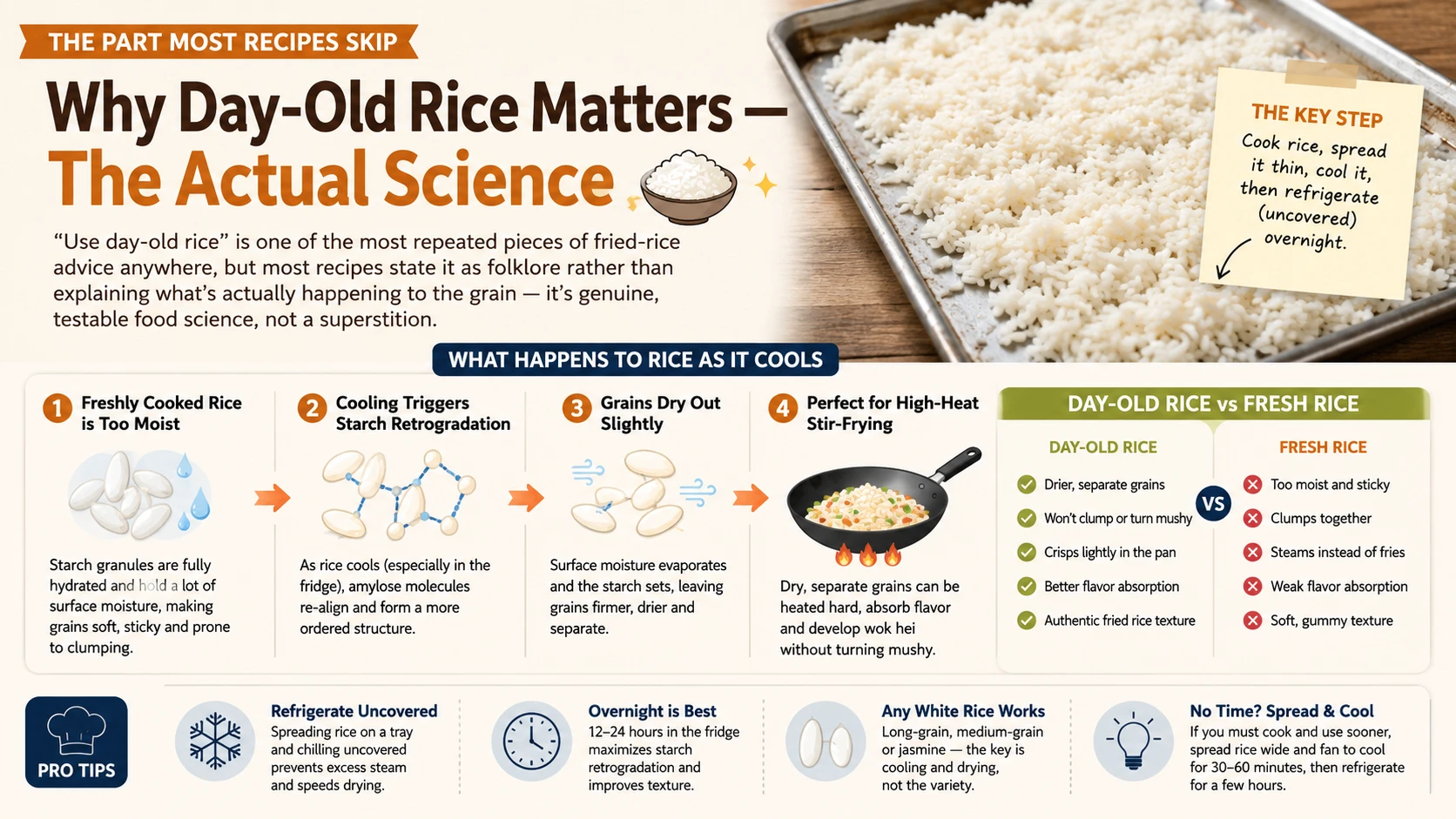
The practical takeaway: “day-old” isn’t a magic number — it’s shorthand for “moisture has had time to drop and starch has had time to firm up.” Which is exactly why the freezer shortcut below works even though it takes 15 minutes instead of 8 hours: it’s speeding up the same physical process, not skipping it.
Best Rice Varieties Compared
Once rice is properly day-old, several varieties work well for frying — the right pick depends more on the dish and personal texture preference than any one variety being objectively “best.”
| Rice Type | Starch Level | Texture When Fried | Best For |
|---|---|---|---|
| Short/medium-grain (Korean or Japanese) | Higher | Slightly chewy, holds seasoning and sauce well, a bit stickier even once dried out | Kimchi fried rice and most traditional Korean fried rice — the most common choice in Korean home kitchens |
| Jasmine rice | Lower | Light, fragrant, separates very easily once day-old | An excellent all-purpose choice, especially for readers who already keep it stocked for other Asian cooking |
| Basmati rice | Lowest | Very separate, long individual grains, less sticky than any other option here | A drier-textured fried rice, though its distinct aroma is a bigger flavor departure from traditional Korean fried rice |
| Generic long-grain white rice | Low-medium | Separates reasonably well, more neutral flavor than jasmine or basmati | A practical, widely available default if nothing more specific is on hand |
| Brown rice | Medium (different starch structure) | Chewier and nuttier, holds its shape very well once day-old | Readers wanting more fiber — needs a longer initial cook time, so plan a day ahead |
| Cauliflower rice (low-carb) | None — not a grain | Watery unless pre-drained; needs its own moisture-removal step, not day-old resting | The low-carb KFR variation — see the Kimchi Fried Rice section below for the specific prep it needs |
Why Some Rice Sticks More Than Others
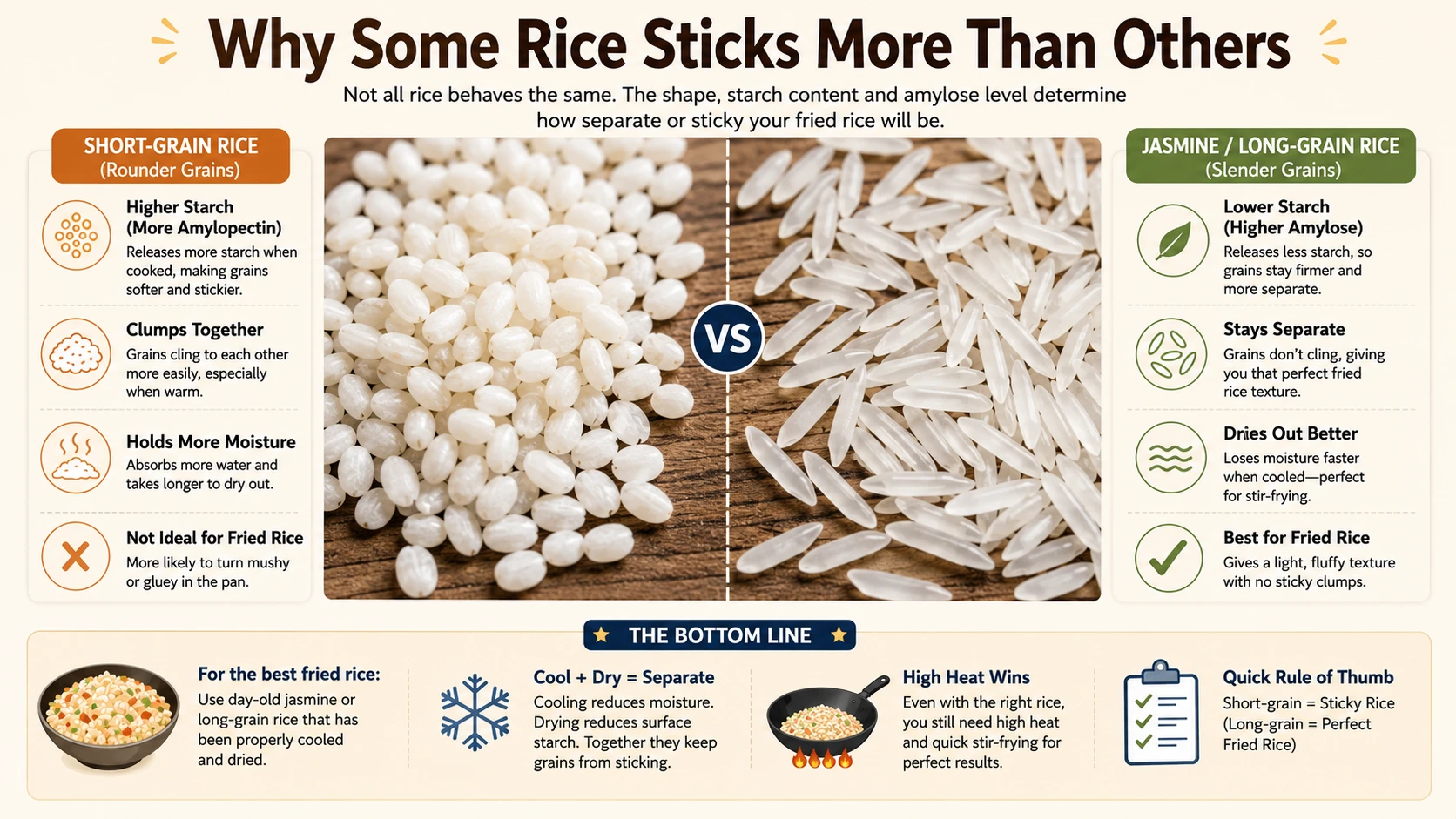
The “starch level” column above isn’t just a texture note — it maps to a specific, measurable difference between rice varieties: the ratio of two starch molecules, amylose and amylopectin, that make up every rice grain.
How Much Rice Do You Need?
A quick reference for scaling a batch, since under- or over-cooking the amount needed is its own common source of frustration.
| Servings | Raw Rice (Uncooked) | Cooked Rice (Approx.) |
|---|---|---|
| 1 serving | ~½ cup (100 g) | ~1½ cups (240 g) |
| 2 servings | ~1 cup (185 g) | ~3 cups (475 g) |
| 4 servings | ~2 cups (370 g) | ~6 cups (950 g) |
| Meal-prep batch (6-8 servings) | ~3-4 cups (555-740 g) | ~9-12 cups (1.4-1.9 kg) |
Rice Cooker, Instant Pot, or Stovetop — Does It Matter?
| Method | Result for Frying | Notes |
|---|---|---|
| Rice cooker | Excellent — most consistent water ratio control | If it has a “sushi rice” or firmer setting, use it — it under-adds water slightly, which helps here |
| Stovetop pot | Very good, with practice | Easiest method to deliberately under-water by about 10% for a firmer result |
| Instant Pot / pressure cooker | Good, slightly stickier by default | Pressure cooking tends to add a bit more moisture; reduce liquid slightly more than the stovetop adjustment if using this method |
Reheating & Storing Leftover Fried Rice
This is a different question from storing raw day-old rice covered above — this is about the already-fried, finished dish, which has its own best practices for staying good the second time around.
Let finished fried rice cool to room temperature, no more than about an hour, before sealing it in an airtight container — sealing it while still hot traps steam and speeds up sogginess.
Finished fried rice keeps about as long as the raw day-old rice it was made from — 3 to 4 days refrigerated in an airtight container is the practical window for best quality and safety.
A hot skillet with a small splash of oil re-crisps the grains the same way the original frying did. A microwave works in a pinch but tends to steam the rice soft again, undoing the texture this whole guide is about.
How to Cook Rice for Frying
The cooking step matters just as much as the cooling step — rice cooked too wet starts the process at a disadvantage no amount of fridge time fully corrects.
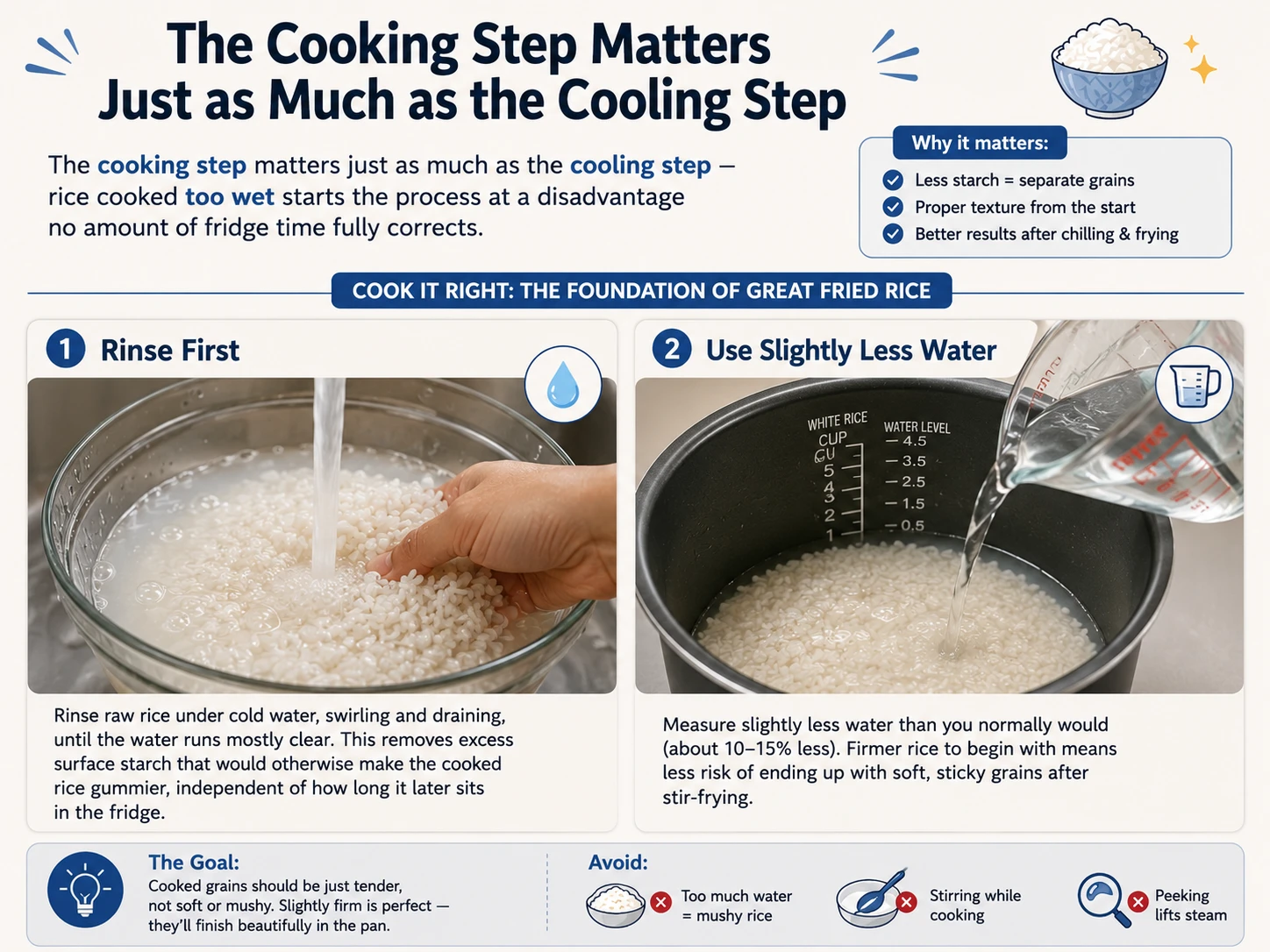
Rinse raw rice under cold water, swirling and draining, until the water runs mostly clear. This removes excess surface starch that would otherwise make the cooked rice gummier, independent of how long it later sits in the fridge.
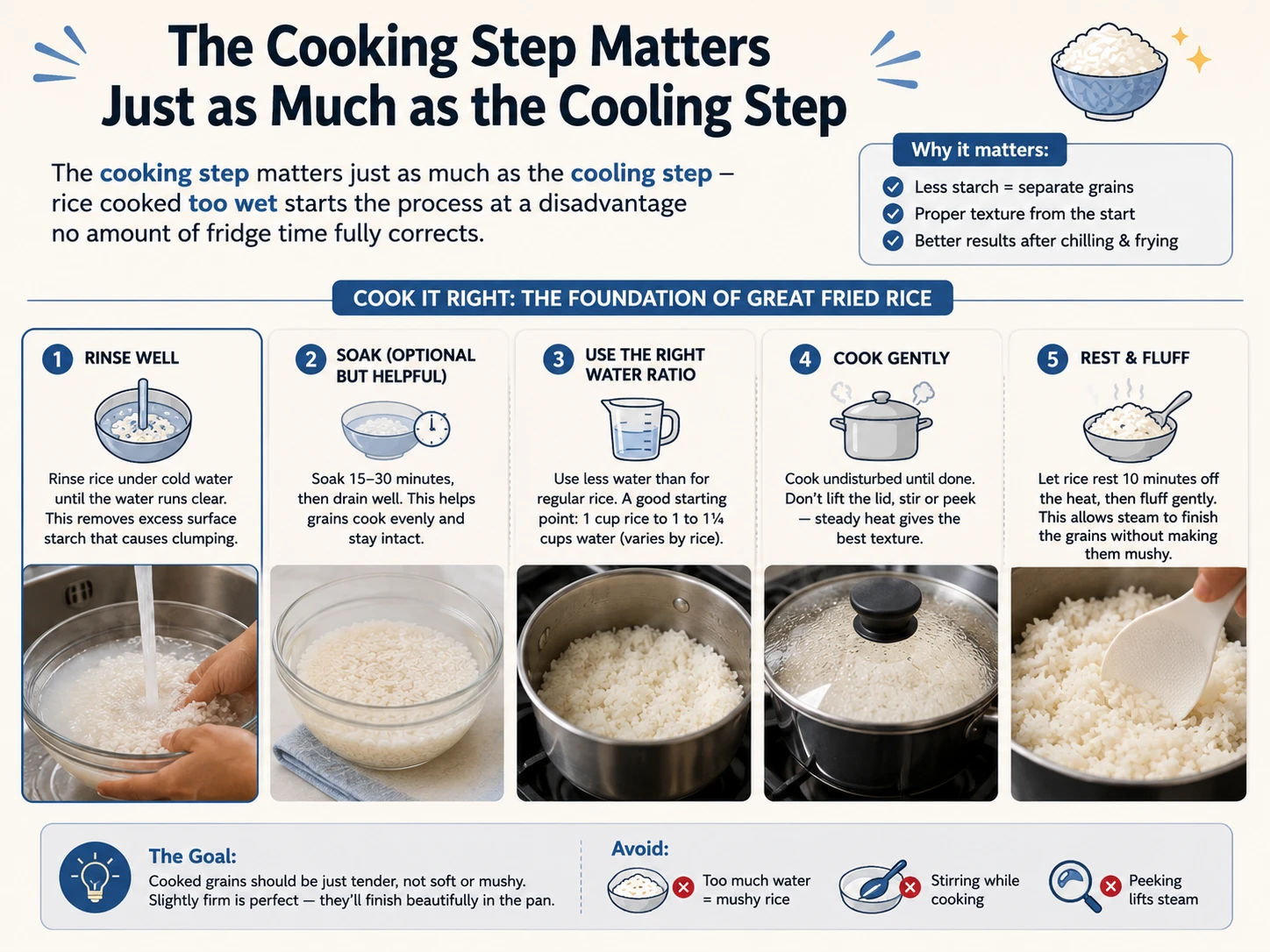
Cook with roughly 10% less water than the standard ratio on the package. The result is a slightly firmer grain to begin with, which holds its structure better once it goes through cooling, storage, and frying.
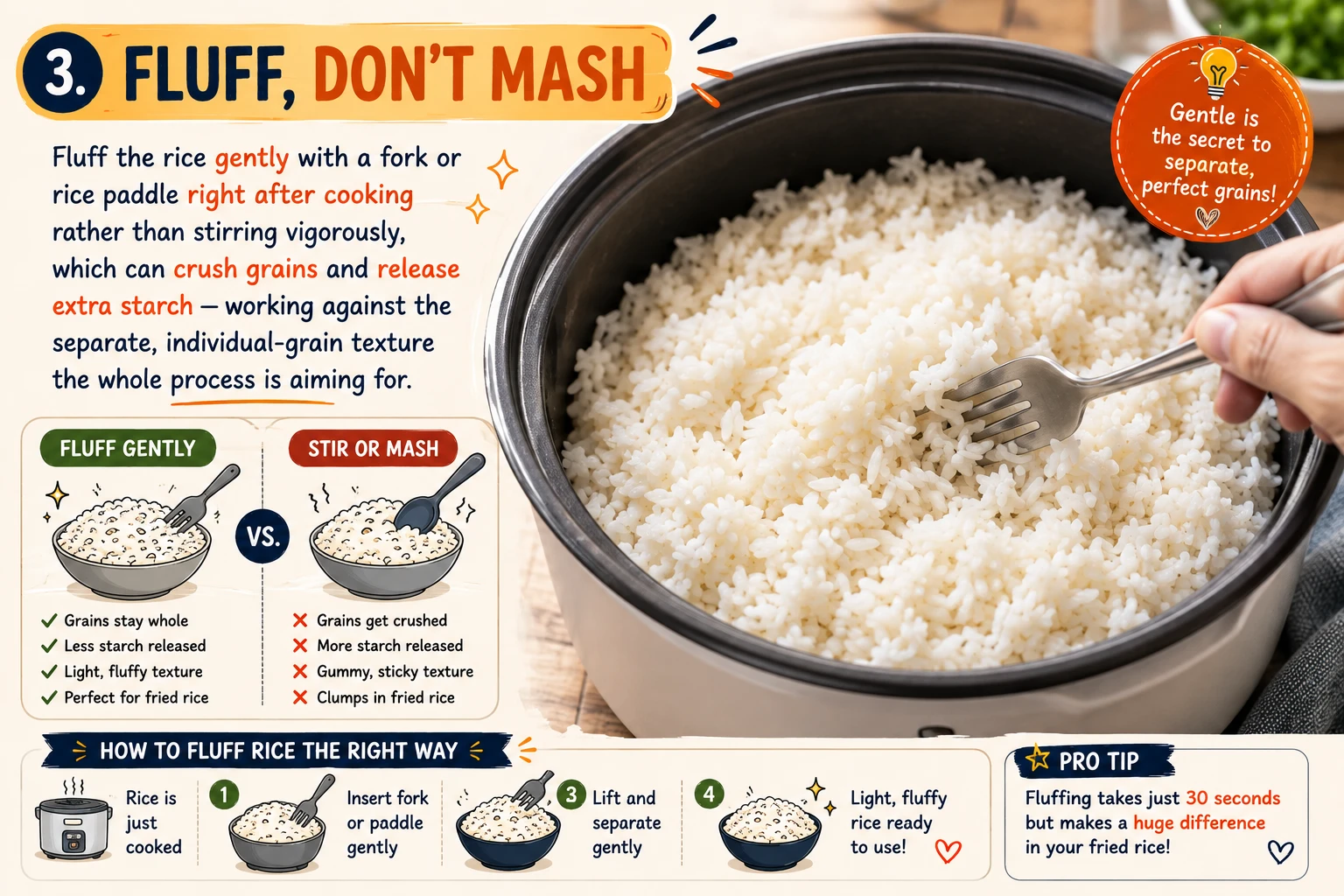
Fluff the rice gently with a fork or rice paddle right after cooking rather than stirring vigorously, which can crush grains and release extra starch — working against the separate, individual-grain texture the whole process is aiming for.
How to Cool & Dry Rice Properly
How rice cools matters almost as much as how long it cools — rice left to cool in a covered pot traps steam and moisture right back into the grains, undoing much of the benefit.
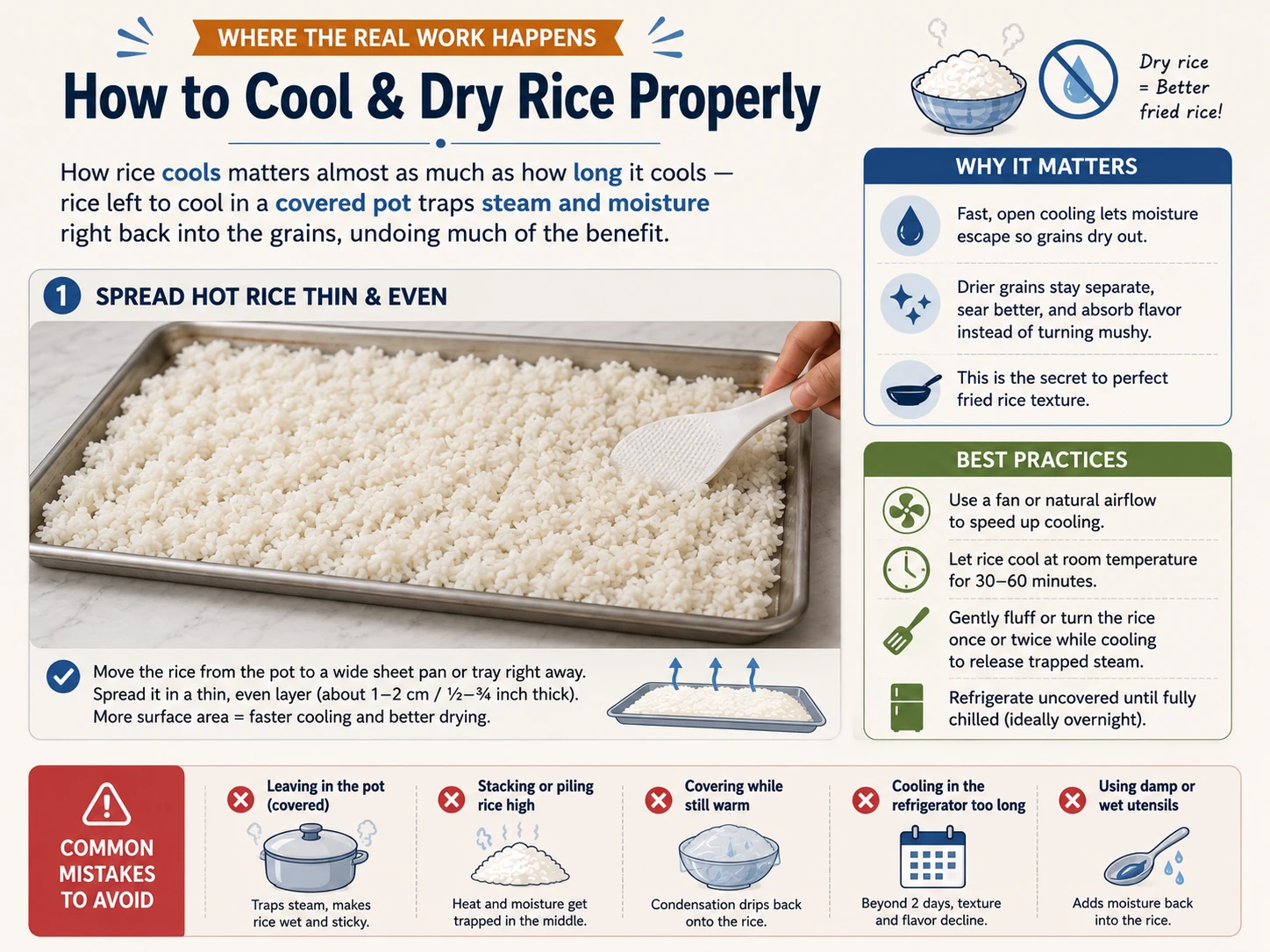
Spread hot rice in a thin, even layer on a sheet pan or wide platter immediately after cooking, rather than leaving it piled in the pot. A thin layer lets steam escape quickly instead of condensing back onto the grains.
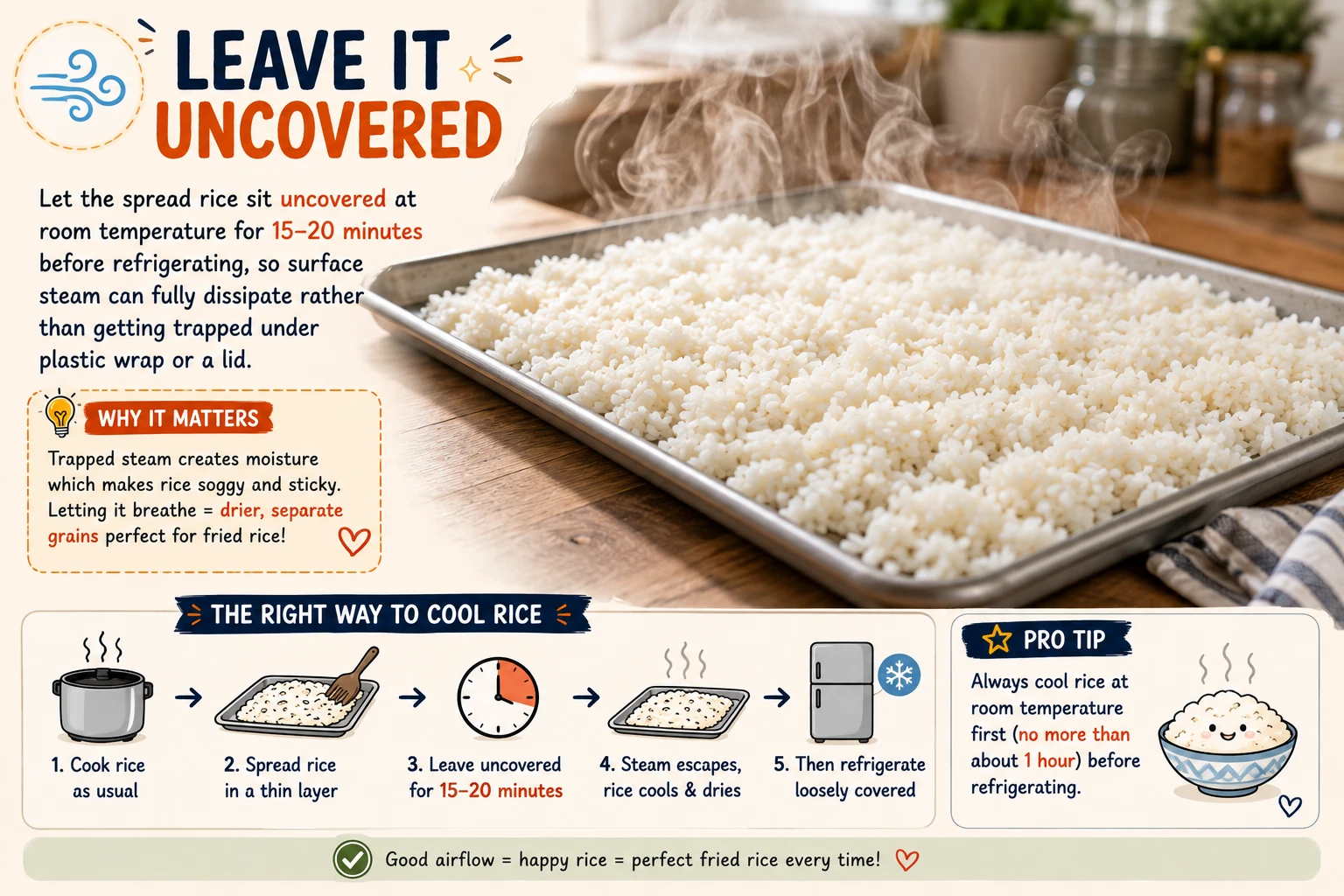
Let the spread rice sit uncovered at room temperature for 15-20 minutes before refrigerating, so surface steam can fully dissipate rather than getting trapped under plastic wrap or a lid.
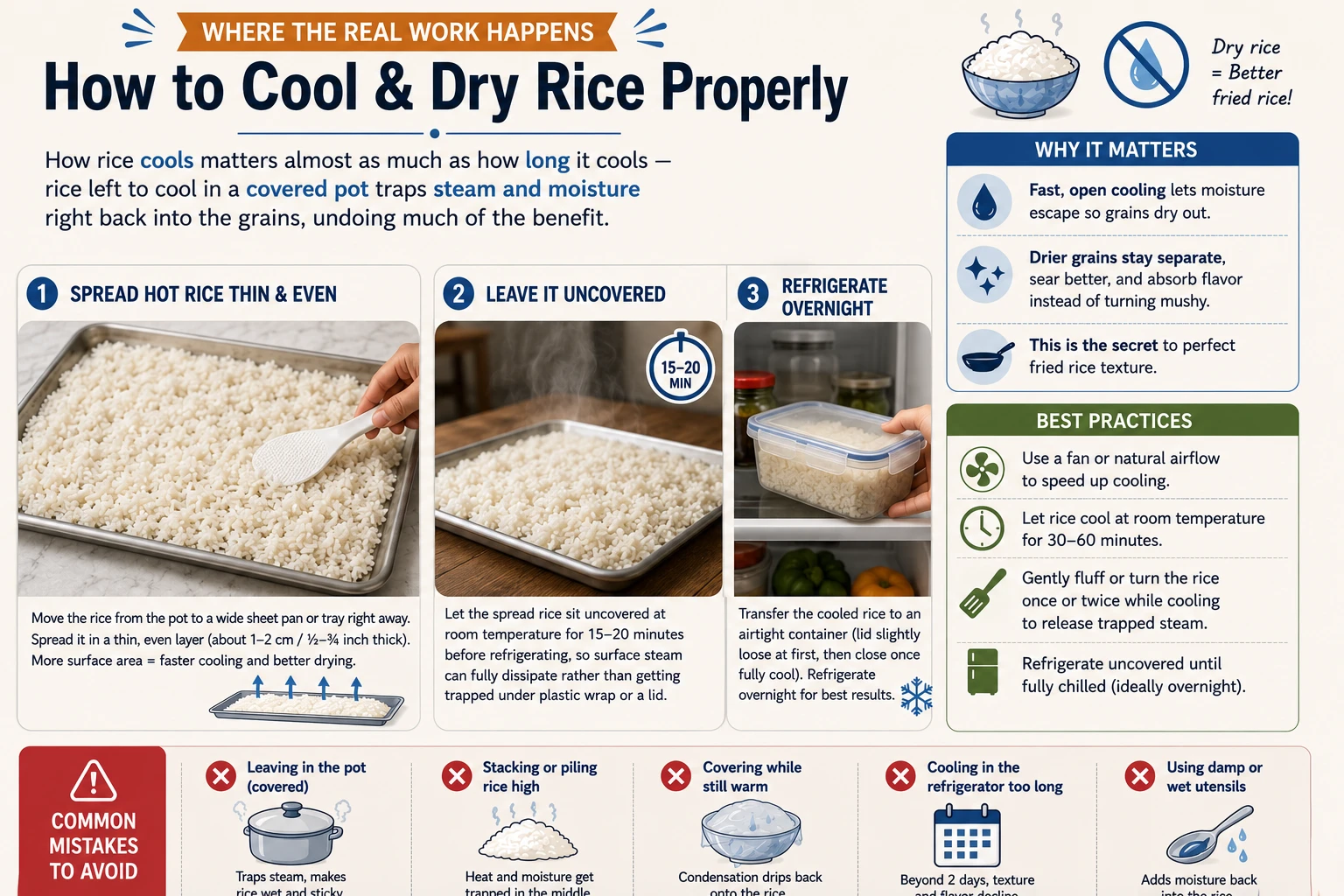
Once mostly cool, transfer to the fridge loosely covered (a paper towel or a lid left slightly ajar works well) for at least 8 hours, ideally overnight, to let retrogradation and moisture loss fully take effect.
No Day-Old Rice? Fast Fixes
Real life doesn’t always include a spare day — these methods speed up the same moisture-loss and firming process in well under an hour.
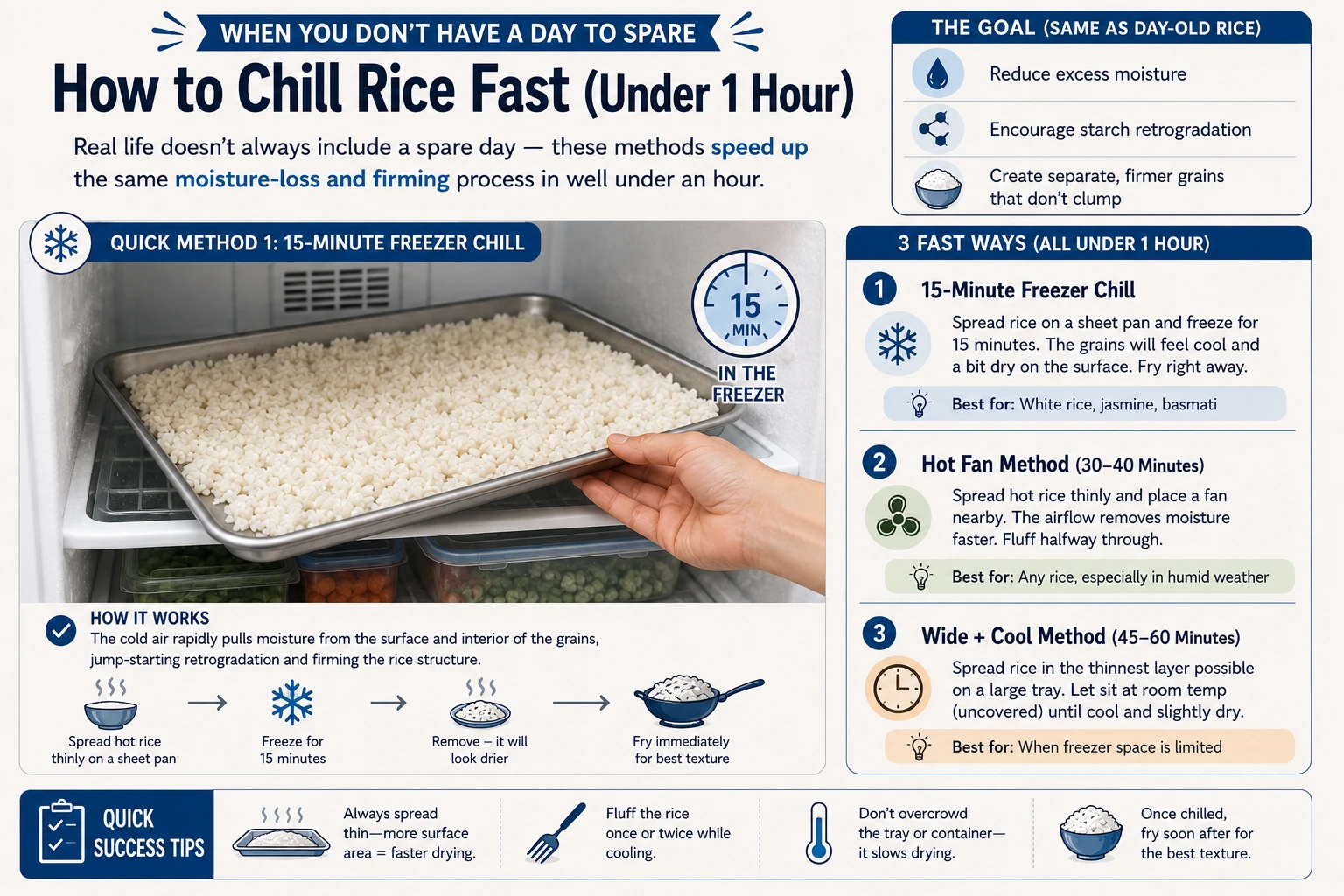
Spread freshly cooked rice thin on a sheet pan, let it cool at room temperature for 5-10 minutes, then freeze uncovered for about 15 minutes. Ice crystal formation further disrupts surface stickiness, getting surprisingly close to the overnight-fridge result.
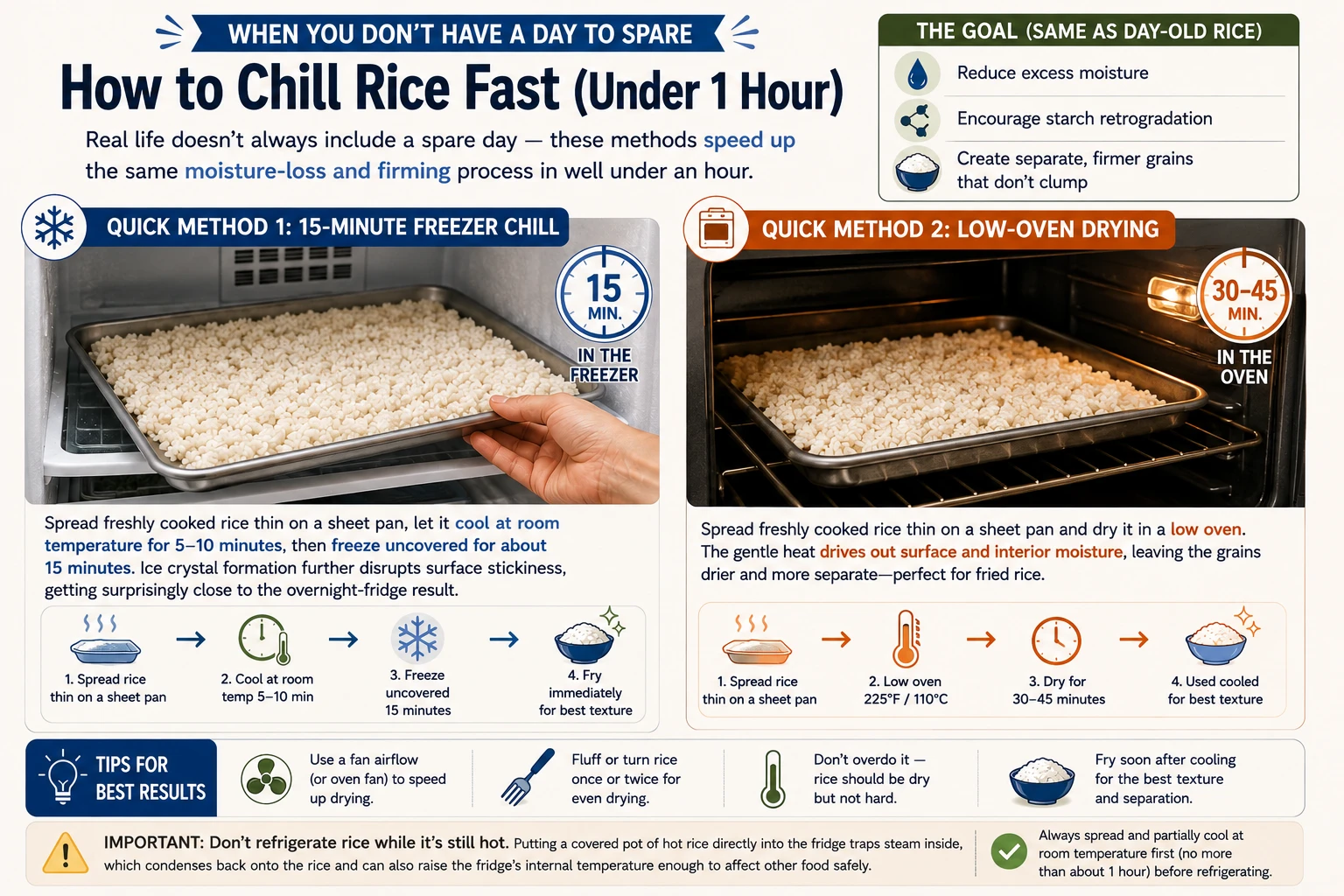
Spread rice on a sheet pan and place in a low oven (around 200°F/95°C) for 15-20 minutes to actively drive off surface moisture. Slower than the freezer method but works well when the freezer is already full.
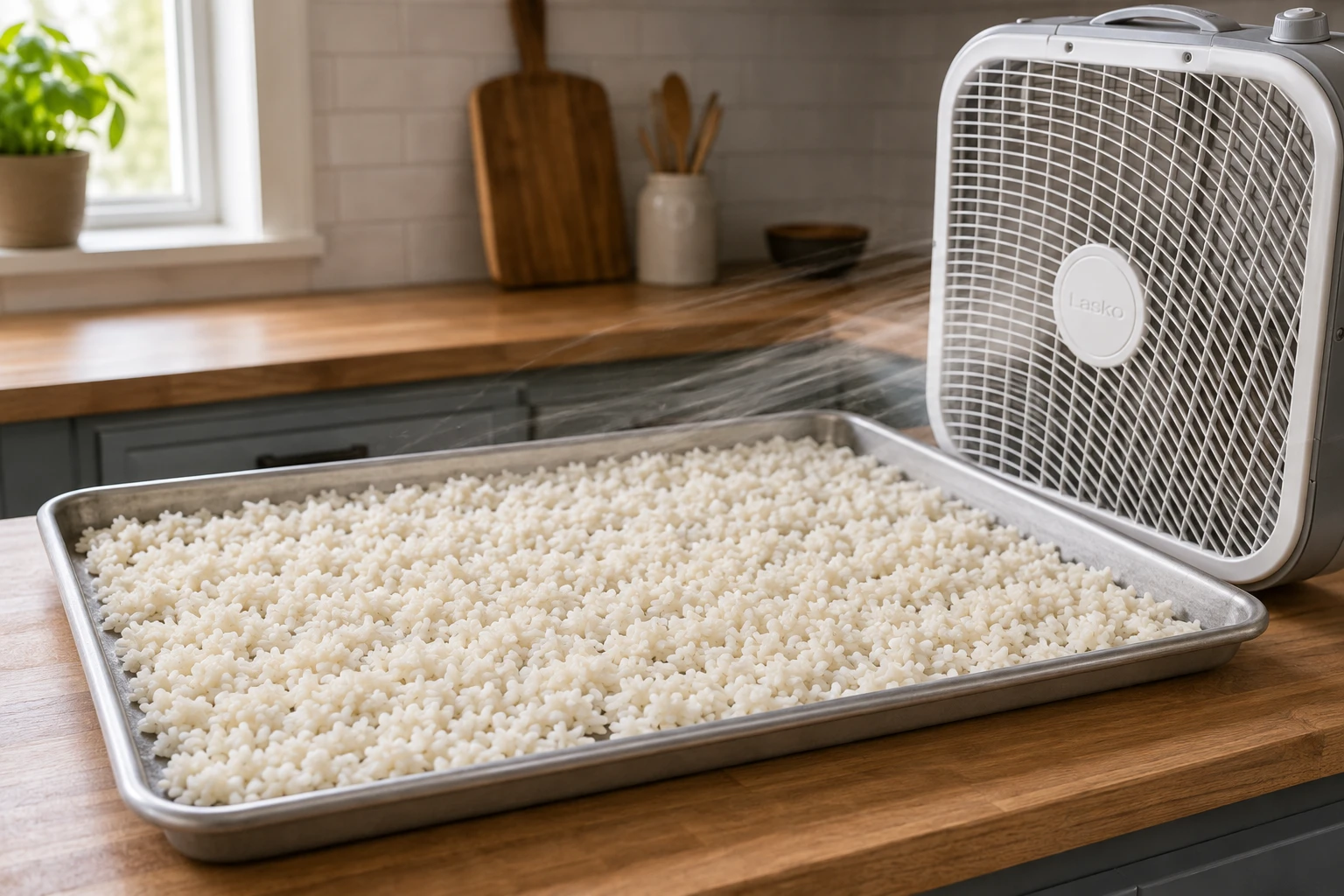
Spread rice thin and let a kitchen or box fan blow across it for 10-15 minutes. Moving air speeds up surface evaporation the same way it speeds up drying laundry — a low-tech option if neither the oven nor extra freezer space is available.
The Kimchi Fried Rice Factor
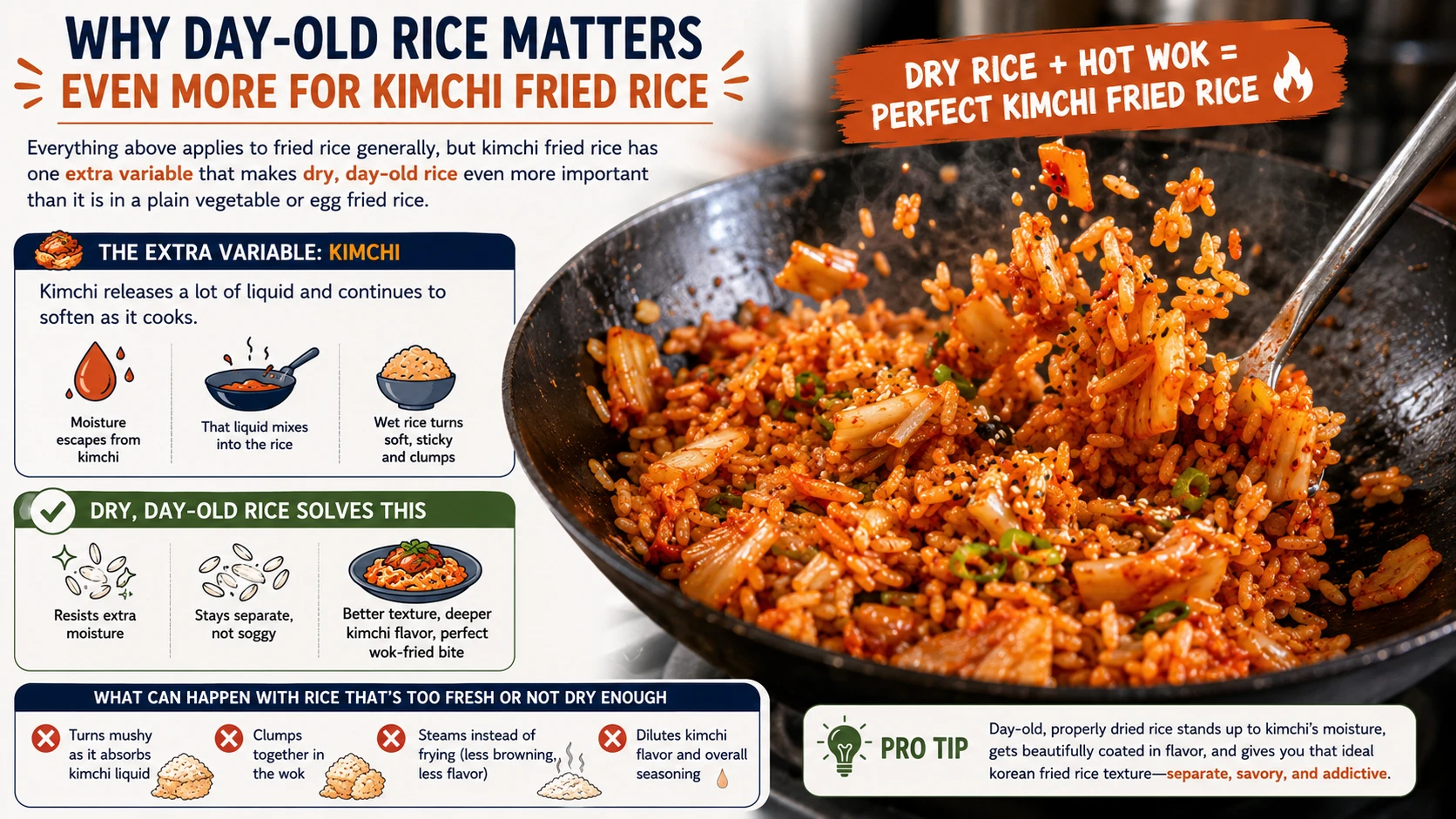
Everything above applies to fried rice generally, but kimchi fried rice has one extra variable that makes dry, day-old rice even more important than it is in a plain vegetable or egg fried rice.
Common Mistakes
| Mistake | Why It Causes Problems | Do This Instead |
|---|---|---|
| Frying rice straight out of the pot | Too much surface moisture turns the pan into a steamer instead of a fryer, producing a clumpy, soft result no matter how hot the pan is | Use day-old rice, or one of the fast-fix methods above if there’s no time to wait |
| Refrigerating rice while it’s still hot and covered | Trapped steam condenses back onto the grains, undoing much of the drying benefit fridge time is supposed to provide | Spread and partially cool at room temperature first, then refrigerate loosely covered |
| Cooking rice with the normal (or extra) amount of water | Softer, wetter rice to begin with has less margin before it turns mushy once fried, even after a day in the fridge | Cook with roughly 10% less water than the standard ratio for a firmer starting point |
| Adding too much oil or sauce all at once | A sudden flood of liquid drops the pan’s temperature and re-introduces the exact steaming problem dry rice was meant to avoid | Add oil and liquid ingredients gradually, keeping the pan as hot as possible throughout |
| Not draining kimchi before it goes in the pan | Kimchi juice adds moisture on top of whatever the rice already carries, which is especially risky if the rice itself isn’t fully dried out | Squeeze kimchi lightly and reserve the juice for the sauce, as covered in the Kimchi Fried Rice Factor above |
Myths vs. Facts
A handful of claims about fried rice and day-old rice circulate widely enough to be worth directly correcting.
Sources & Further Reading
The starch-science claims in this guide are grounded in the sources below, cross-checked against each other rather than relied on individually.
One-Page Cheat Sheet
Every core decision from this guide, condensed onto a single printable reference — good for the fridge or a quick check before frying.
| Situation | Rice | Prep Method | Time Needed |
|---|---|---|---|
| Planned ahead | Short-grain or jasmine | Spread, cool, refrigerate loosely covered | 8+ hours (overnight) |
| Forgot to plan ahead | Whatever’s cooked | Spread thin, freeze uncovered | ~15 minutes |
| No freezer space | Whatever’s cooked | Spread on a tray, low oven (200°F/95°C) | 15-20 minutes |
| Making kimchi fried rice | Short-grain, rested 1-2 days if possible | Standard method + drain kimchi juice before adding | 8+ hours, longer preferred |
| Low-carb / cauliflower rice | Grated cauliflower, not real rice | Salt, rest, squeeze dry before cooking | 15-20 minutes |
| Storing leftover fried rice | Any variety, already fried | Cool to room temp, seal airtight, reheat in a hot pan (not microwave) | Keeps 3-4 days |
🧠 Quick Knowledge Check
Five questions pulled straight from the guide above — see how much stuck.
Frequently Asked Questions
Cooked, cooled rice that’s at least a day old, ideally short or medium-grain rice (Korean or Japanese style) or jasmine rice. Freshly cooked, hot rice is too moist and clumps together in the pan instead of frying into separate grains.
As cooked rice cools and sits, its starches firm up in a process called retrogradation and surface moisture evaporates. This makes each grain firmer and less sticky, so it separates and crisps in a hot pan instead of steaming into a mushy clump the way fresh, moist rice does.
Yes, with a fix: spread hot rice in a thin, even layer on a sheet pan so steam can escape, then chill it uncovered in the refrigerator for 20 to 30 minutes, or in the freezer for about 15 minutes, before frying. This mimics the moisture loss that normally happens overnight.
Day-old short or medium-grain rice is the preferred choice, and getting the rice properly dry matters even more here than in a plain fried rice, since kimchi and its juice already add significant extra moisture to the pan.
Both work well once day-old. Jasmine is a fragrant, drier long-grain rice that separates especially easily, while short-grain Korean or Japanese rice is stickier and more traditional in Korean cooking, holding sauces and seasoning slightly better. Either is a reasonable default for kimchi fried rice.
Yes, brown rice dries out and fries well once day-old, and adds a nuttier flavor along with more fiber than white rice. It takes longer to cook initially, so plan on cooking it a day ahead along with any white rice being used.
Slightly less water than a normal steaming ratio, roughly 10 percent less liquid than the package instructions call for. Firmer, slightly undercooked rice holds its shape better once fried, whereas rice cooked with extra water turns mushy faster in the pan.
At least overnight, roughly 8 hours, for the starch and moisture changes to fully take effect. Properly stored rice keeps well in the fridge for 3 to 4 days, so cooking a larger batch ahead for multiple fried rice meals works well.
Yes, and it often works even better than the fridge. Spread cooked rice in a flat layer on a tray, freeze until solid, then transfer to a bag. Ice crystal formation further breaks down surface stickiness, and the rice can go straight from freezer to hot pan without fully thawing first.
The most common causes are rice that’s too fresh and moist, too much oil or sauce added all at once instead of gradually, or a pan or wok that isn’t hot enough, which steams the rice instead of frying it. Day-old, dry rice fried in a very hot pan solves most mushy fried rice problems.
Yes, rinsing raw rice under cold water until it runs mostly clear removes excess surface starch that would otherwise make the cooked rice gummier and more prone to clumping, which works against the separate-grain texture fried rice needs.
It works for a low-carb version, but cauliflower rice has no day-old starch structure to rely on, so it needs its own moisture prep — salting grated cauliflower and letting it sit to draw out water, then squeezing it dry, before it goes anywhere near the hot pan.
Roughly half a cup of raw, uncooked rice per serving, which yields about 1 to 1.5 cups of cooked rice once it’s fried with other ingredients. Raw rice roughly triples in volume once cooked, so a 1-cup batch of raw rice makes about 2 servings — see the quantity guide above for larger batches.
No. Short-grain Korean or Japanese rice is higher in the starch amylopectin than long-grain rice, which is why it’s stickier, but it still dries out and separates properly once day-old. True glutinous (sticky) rice is almost pure amylopectin and stays sticky even after resting, which is why it’s used for dishes like tteok rather than fried rice.
About 3 to 4 days in an airtight container in the refrigerator, the same window as plain day-old rice. Reheat it in a hot, lightly oiled pan rather than the microwave — a hot pan re-crisps the grains, while a microwave tends to steam them soft again. See the reheating section above for a food-safety note too.
Keep Exploring KimchiGuide
Now that the rice is sorted, here’s where most readers go next.
Which Method Worked for You? Questions?
Tried the freezer shortcut, or found a timing that works better for your kitchen? Ji-Young reads every comment.