Leftover Kimchi Juice? Here’s What To Do With It
Kimchi juice isn’t a byproduct to pour down the sink — it’s concentrated kimchi flavor, still alive with the same fermentation that made the kimchi itself so good. Here’s every real use for leftover kimchi juice: in cooking, in drinks, as a fermentation starter for your next batch, and how to tell when it’s actually gone bad.


What Do I Do With Leftover Kimchi Juice?
Don’t pour it out — kimchi juice is essentially concentrated kimchi flavor, plus the same live fermentation byproducts as the kimchi it came from. It’s a genuine ingredient in its own right: use it in soups and stews (especially kimchi jjigae), marinades, fried rice, pancake batter, dressings, quick pickles, and even drinks like a kimchi Bloody Mary or a straight probiotic shot. A splash of it also jumpstarts a fresh batch of kimchi fermenting faster, and a spoonful can even help soak grains or beans. The only time to skip all of this is if the juice itself shows spoilage signs — covered in full below, along with what to do with it even then.
What Exactly Is Kimchi Juice?
Kimchi juice (also called kimchi brine) is the liquid left behind in the jar, bag, or container once the solid vegetables have been eaten — and it’s not filler.
It’s made of the same salt, gochugaru, garlic, ginger, and fish sauce or saeujeot that seasoned the kimchi in the first place, combined with the liquid the vegetables released as they fermented. That means it carries essentially all of kimchi’s flavor — sour, salty, savory, and spicy — in concentrated liquid form, along with the live lactic acid bacteria responsible for the fermentation itself (in unpasteurized, refrigerated kimchi). For a wider look at how different vegetables get turned into kimchi in the first place, see our types of kimchi guide.
Different base vegetables produce noticeably different brine. Napa cabbage kimchi (the most common type) gives a balanced, medium-bodied juice; radish kimchi (kkakdugi) gives a sharper, more peppery one; and cucumber kimchi (oi-sobagi) gives a lighter, more delicate one that doesn’t keep quite as long. Less common bases produce their own distinct brine too — buchu (garlic chive) kimchi gives a pungent, oniony-sharp juice good in stir-fries, while gat (mustard leaf) kimchi gives a brine with a distinct mustardy bite. The brine pairing chart below breaks down which type suits which use.
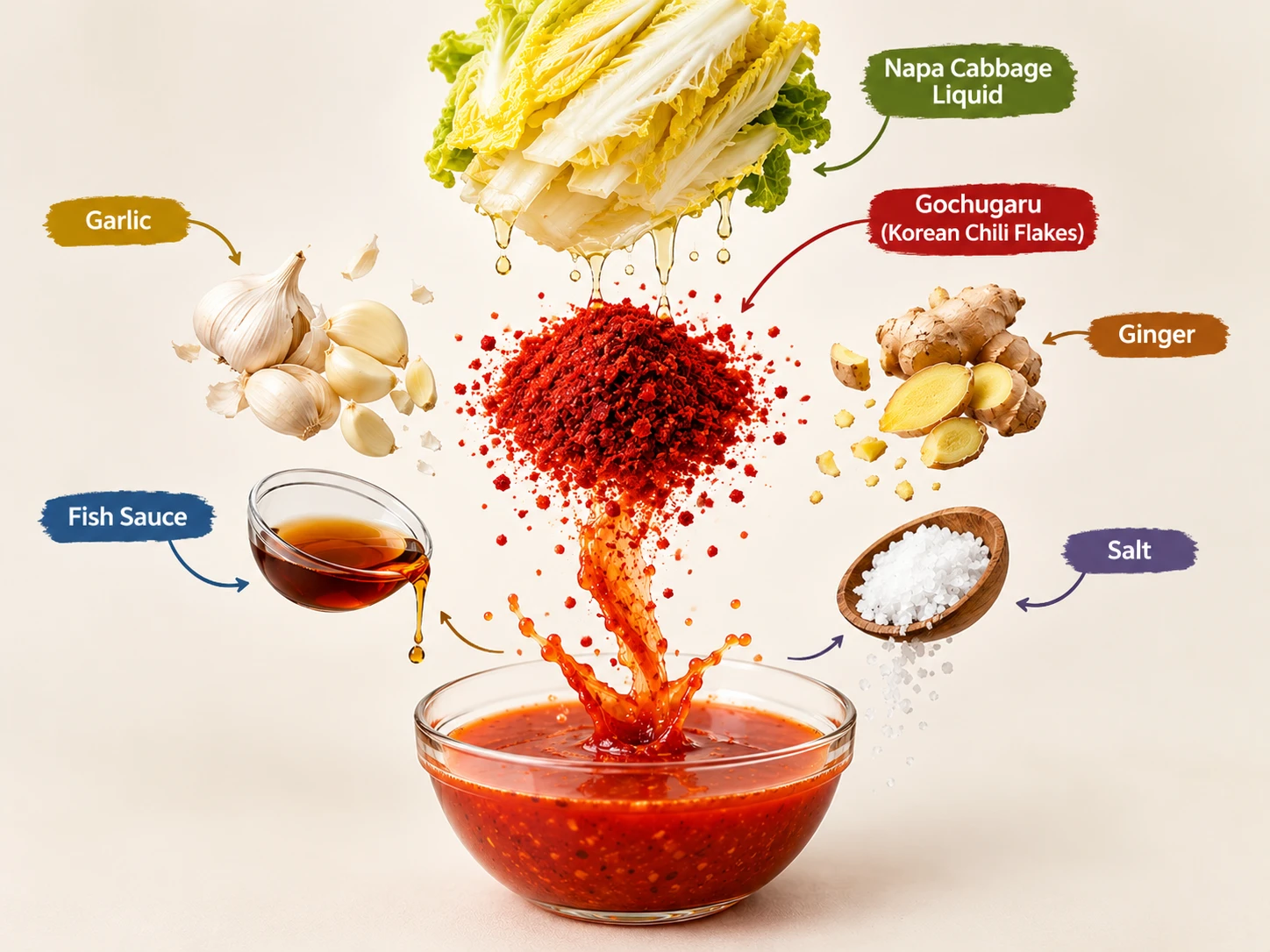
Every component floating in a spoonful of kimchi juice — pulled apart so you can see exactly what’s in there.
Scientifically, this liquid is the medium where the actual fermentation happens. Salt draws water out of the cabbage through osmosis, creating the brine; naturally occurring lactic acid bacteria (LAB) then convert the sugars in that liquid into lactic acid, which is what gives both kimchi and its juice their sour tang and their preservative, food-safe acidity. Research from Korea’s World Institute of Kimchi has traced most of these bacteria back to the cabbage and garlic themselves — three species in particular, Leuconostoc mesenteroides, Weissella koreensis, and Lactobacillus sakei, tend to dominate at different points: Leuconostoc species get going first and produce the mild, mannitol-tinged sourness of young kimchi, while Lactobacillus (technically now Lactiplantibacillus plantarum) takes over as the ferment ages, pushing acidity higher and flavor sharper. Weissella species tend to persist throughout. The garlic, ginger, gochugaru, and fish sauce or saeujeot don’t just add flavor — several of these ingredients also carry their own sugars and amino acids that feed the same bacterial succession.
How Long Does It Last & How to Store It
Kimchi juice is just as fermented and acidic as the kimchi it came from, so it keeps a similarly long time.
- Sealed in a clean glass jar in the fridge, kimchi juice typically keeps for several months, continuing to slowly ferment and become more sour the same way kimchi itself does.
- Its low pH and high salt content make it a genuinely hostile environment for most spoilage organisms, which is part of why it lasts so long.
- Always use a clean spoon or pour directly — never a utensil that’s touched your mouth or other food — to avoid introducing anything that could compete with the existing culture.
- Freezing works, but it pauses live fermentation activity. That’s fine if you only plan to cook with it later, but skip freezing any portion you want to keep as a live starter or probiotic shot.
Nutrition, Sodium & Probiotics: What’s Actually In It
Kimchi juice isn’t a health food or a health risk on its own — it’s a concentrated, salty, fermented liquid, and the numbers below help put it in context.
Because kimchi juice is essentially all the liquid parts of kimchi with none of the fiber-rich vegetable solids, it runs at least as salty as the kimchi itself, spoonful for spoonful — often more, since there’s no fiber diluting it. As a benchmark, solid kimchi eaten as a condiment typically runs about 75–150mg of sodium per tablespoon (roughly 500mg per 100g), and the straight liquid tends to sit at or above the top of that range. Exact numbers vary a lot recipe to recipe depending on how much salt, fish sauce, and saeujeot went into the original batch — there’s no single “correct” figure. That sodium content is also exactly why it works so well as a seasoning — a little goes a long way, and it’s easy to over-salt a dish if you’re not tasting as you go.
| Liquid | Sodium (per tbsp, typical range) | Live Probiotics? | Typical Use |
|---|---|---|---|
| Kimchi juice | ~75–200mg+ (varies by recipe) | Yes, if unpasteurized & refrigerated | Soups, marinades, drinks, backslopping |
| Sauerkraut brine | ~100–200mg | Yes, if unpasteurized | Dressings, gut-shot drinks |
| Dill pickle juice | ~200–350mg | Rarely (usually vinegar-based, not fermented) | Brining, marinades, post-workout drinks |
| Plain rice vinegar | ~0mg | No | Dressings, quick pickles |
Figures are typical ranges, not lab-tested values for a specific product — brine hasn’t been studied as thoroughly as the solid vegetable, so these are reasonable estimates built from published solid-kimchi sodium data, not direct measurements of juice. If you’re tracking sodium closely, see our low-sodium kimchi brands guide for lower-salt options.
The Probiotic Angle
Only raw, unpasteurized, refrigerated kimchi juice carries live lactic acid bacteria — the same strains responsible for fermenting the kimchi in the first place. Shelf-stable, pasteurized kimchi (heated during packaging to extend shelf life) no longer contains live cultures, even though it still tastes fermented. Research on fermented vegetables generally shows the effect on gut bacteria is real but modest — measurable shifts in specific bacterial populations rather than a dramatic overhaul — and it depends entirely on the product actually being unpasteurized, live-culture kimchi. If the probiotic angle matters to you, our pasteurized vs. live-culture kimchi brands guide breaks down which store-bought options still have active cultures, and our halal & kosher kimchi brands guide is a good next stop if you also need a fish-sauce-free option.
The Big List: Savory Cooking Uses
This is where kimchi juice earns its keep — as a seasoning ingredient in its own right, not just a flavor accent.
Soups & Stews
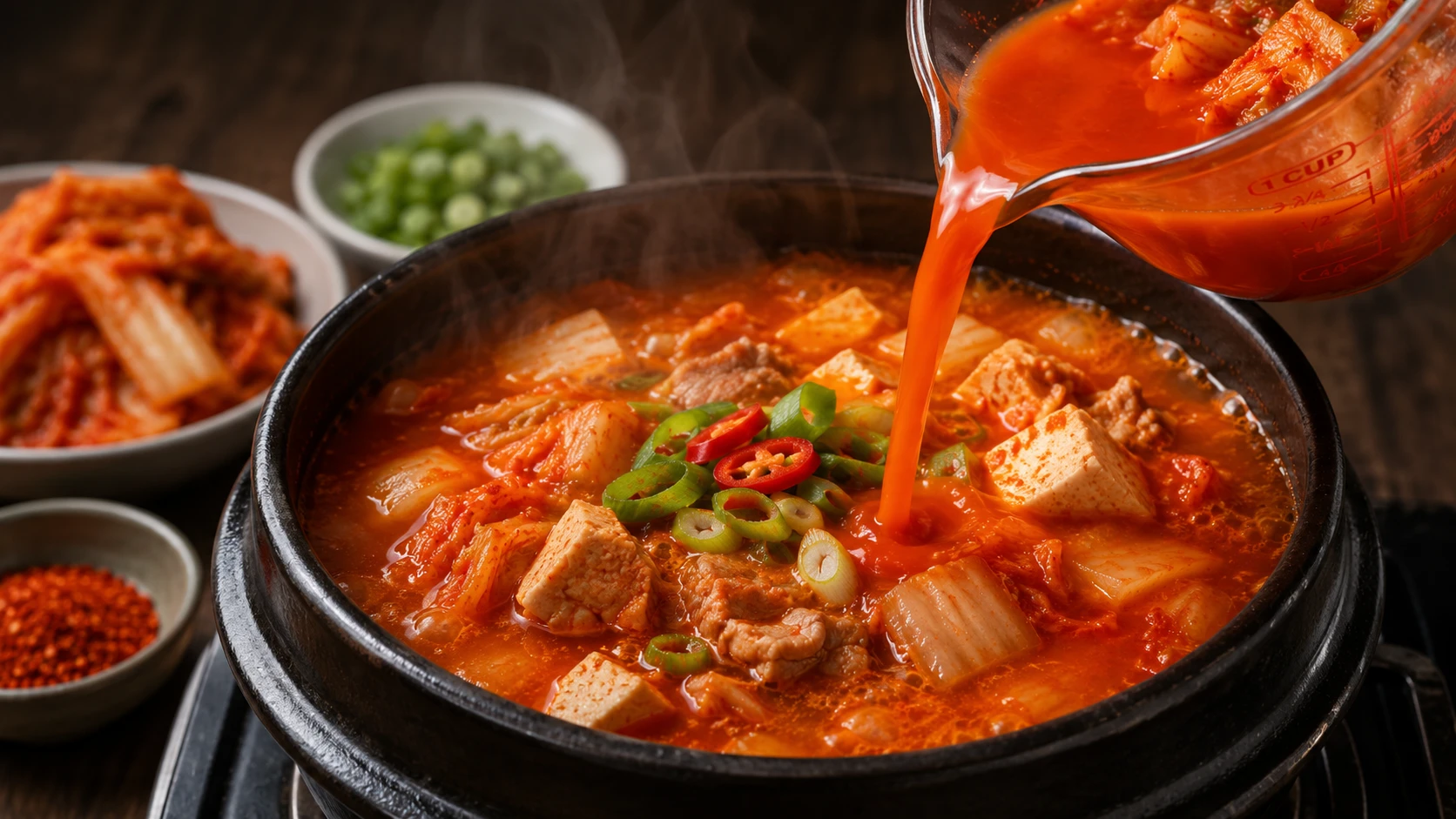
This is the single best use for kimchi juice. A splash added to kimchi jjigae partway through cooking deepens the sourness and body of the broth beyond what the solid kimchi alone provides — especially good if your broth base is a proper anchovy-kelp stock, or if you’re bulking the stew out with the right kind of tofu. It works the same way stirred into kimchi ramen broth — including kimchi egg ramen or a creamy kimchi udon — or into any soup that could use a tangy, savory boost — even ones with no other Korean ingredients in them. It also works in cream-based dishes: add the kimchi juice to the pan first and let it cook down slightly before the milk or cream goes in, so the sauce doesn’t split, and you get an extra layer of umami-rich flavor underneath the richness.
Marinades & Braising Liquid
Kimchi juice tenderizes and seasons meat at the same time, thanks to its acidity and salt. It’s especially good with pork belly, chicken thighs, or short ribs — marinate for a few hours to overnight, or use it as part of the braising liquid for a low-and-slow dish. It also makes an excellent wet rub base for grilled meats or a mix-in for burger patties destined for a kimchi burger. If pork belly is what you have on hand, our kimchi pork belly fried rice recipe already builds this exact marinade in.
Fried Rice & Grains
A tablespoon or two stirred into kimchi fried rice right alongside the chopped kimchi adds extra tang and helps the rice take on more color and flavor than the solids alone. It works the same trick in fried grains more broadly — quinoa, farro, or a rice-and-egg bowl all benefit from the same splash. For the best texture underneath that flavor, see our best rice for fried rice guide — day-old, cold rice fries up far better than fresh.
Kimchi Pancake (Kimchijeon) Batter
Traditional kimchi pancakes (kimchijeon) are usually made with chopped kimchi and a splash of its juice mixed right into the flour-and-water batter — the juice adds sourness and a reddish tint that plain water can’t. Whisk a tablespoon or two into your batter along with the chopped kimchi, then pan-fry as usual; the extra acidity also helps the pancake crisp up nicely at the edges.
Dressings, Dips & Salsa
Kimchi juice is a ready-made substitute for vinegar in a vinaigrette — whisk it with oil and you have an instant dressing with built-in umami. Stirred into hummus or guacamole, it adds a spicy, savory edge; mixed with finely chopped onion, pepper, garlic, and cabbage, it becomes a fast, unusual take on salsa or pico de gallo. It also livens up a mayo-based dip — a spoonful whisked into our gochujang mayo adds extra tang on top of the usual sweet-spicy base.
Quick-Pickling Other Vegetables
Kimchi juice is already a seasoned pickling liquid. Submerge thinly sliced cucumber, radish, or carrot in it for a day or two in the fridge, and you get fast, kimchi-flavored quick pickles without starting a whole new ferment.
Seasoning Meat
Beyond marinating, kimchi juice works mixed directly into ground meat — burger patties, meatballs, or meatloaf — for a built-in savory, tangy seasoning that’s hard to get from dry spices alone.
Soaking Grains, Legumes & Flour (Reduces Phytic Acid)
A less common but genuinely useful trick: add a couple of tablespoons of kimchi juice to the soaking water for rice, oats, beans, or flour before cooking. Grains and legumes naturally contain phytic acid, a compound that can bind to minerals like iron and zinc and make them harder for your body to absorb. The acidity and live lactic acid bacteria in unpasteurized kimchi juice help break phytic acid down during a long soak (roughly 12 hours or more), the same way other acidic, fermented soaking liquids do. It’s a small effect, not a health cure, but it’s a smart way to put a spoonful of brine to work when you don’t need it for flavor.
Drinks: Shots, Cocktails & Spritzers
Kimchi juice as a drink sounds unusual until you remember pickle juice shots are already a thing — this is the same idea, spicier.
Use It As a Fermentation Starter
This is the one use most kimchi-juice articles mention only in passing — it deserves more detail, because it genuinely changes how your next batch turns out.
The technique is called backslopping: adding a small amount of liquid from an already-finished ferment to a fresh batch, to introduce an established, healthy population of lactic acid bacteria right from the start, instead of waiting for wild bacteria on the vegetables to build up a colony on their own.
Why it actually works, microbiologically: a fresh batch of kimchi starts out with whatever bacteria happen to already be living on the cabbage and garlic — a random, low-density mix that has to multiply from scratch before fermentation really gets moving. Leftover kimchi juice, by contrast, already contains a dense, proven community of the exact species that do this job well — chiefly Leuconostoc and Weissella early on, with Lactobacillus (Lactiplantibacillus plantarum) building up as things sour further. Seeding a new batch with that established population skips the slow “wild colonization” phase entirely, which is the mechanical reason it ferments visibly faster.
In practice: stir in roughly 2–3 tablespoons of leftover kimchi juice per average-size batch when you mix your seasoning paste into the salted, drained cabbage in the how to make kimchi from scratch recipe. You’ll typically notice visible bubbling and a developed sour smell a day or so sooner than an unseeded batch — useful if you’re short on time, or want more consistent results batch to batch.
The Brine Pairing Chart
Not all kimchi juice is the same — matching the base vegetable to the use gets noticeably better results.
Match the Brine to the Job
3 Full Recipes Using Kimchi Juice
The uses above are the overview — here are three of them written out as actual, followable recipes.
2 oz vodka
4 oz tomato juice
1 tbsp kimchi juice
1 tsp lemon juice
2–3 dashes Worcestershire sauce
Pinch of black pepper
Ice, celery stalk to garnish
- Fill a tall glass with ice.
- Add vodka, tomato juice, kimchi juice, lemon juice, and Worcestershire sauce.
- Stir well, taste, and adjust — add a touch more kimchi juice for extra heat and depth.
- Garnish with a celery stalk and a pinch of black pepper. Serve immediately.
3 tbsp kimchi juice
3 tbsp neutral oil (or sesame oil for a nuttier version)
1 tsp honey or sugar
1 small garlic clove, grated
1/2 tsp toasted sesame seeds
- Add kimchi juice, oil, honey, and garlic to a small jar with a lid.
- Shake vigorously for 15–20 seconds until emulsified.
- Stir in sesame seeds. Taste — add a splash more oil if it’s too sharp, or more kimchi juice if it needs more punch.
- Store in the fridge up to a week; shake again before each use.
1 cup thinly sliced cucumber, radish, or carrot
1/2 cup leftover kimchi juice
1/4 cup water (if the juice is very strong)
- Pack the sliced vegetables into a clean jar.
- Pour kimchi juice over the top until fully submerged, diluting with water first if it tastes especially salty or spicy.
- Seal and refrigerate for at least 24 hours before eating.
- Keeps up to 1–2 weeks in the fridge — a fast side dish any time.
Tools & Products That Make This Easier
None of this is required — you can do everything above with a mason jar and a spoon. These are the specific things that make it noticeably less messy.
Prices and availability shown on Amazon at the time of your visit. We only link to categories of product we’d actually use for these exact tasks.
Is My Kimchi Juice Still Good? Safety Signs
The same rules that apply to the kimchi itself apply here, since it’s the same fermentation.
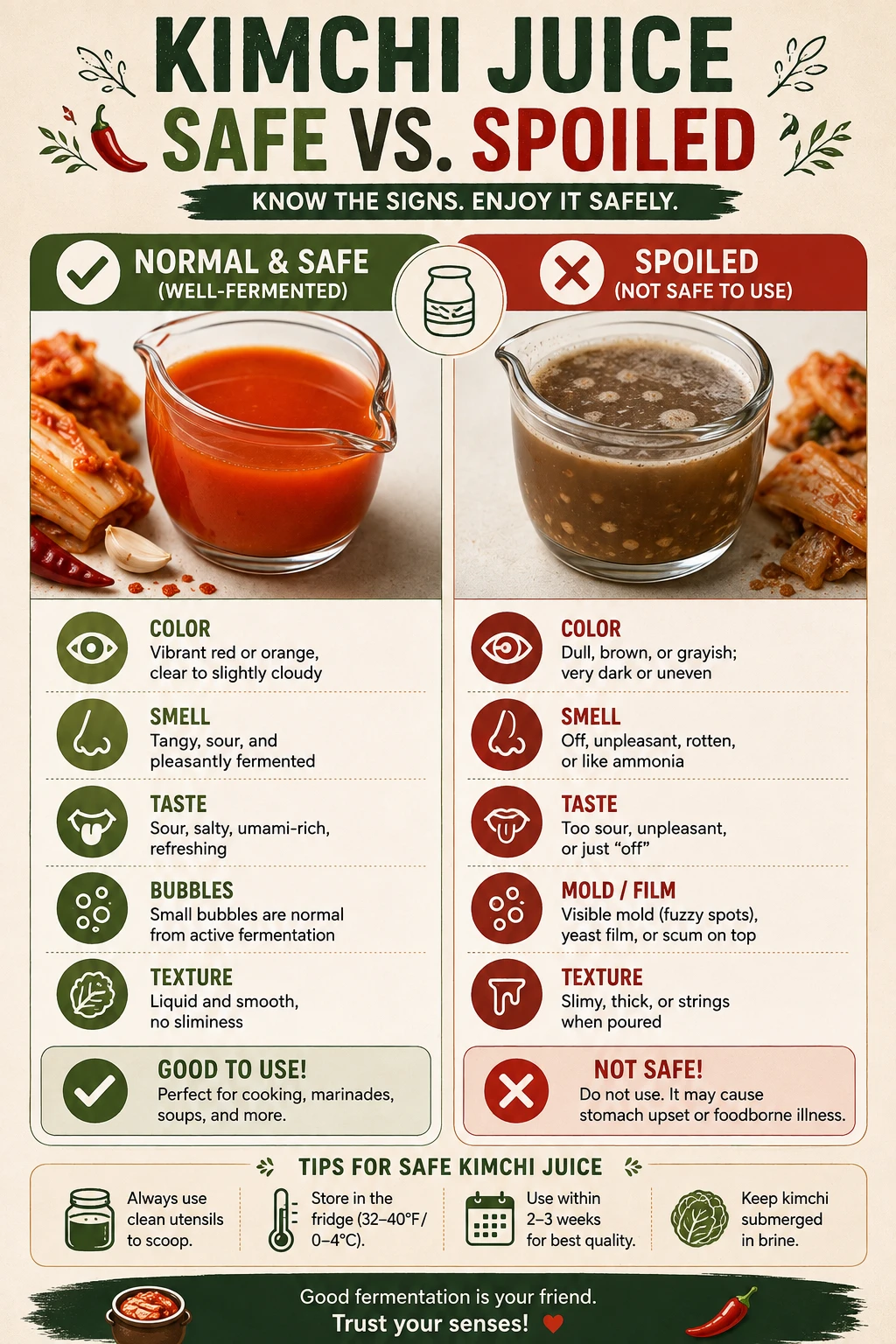
| Sign | What It Means | Verdict |
|---|---|---|
| Cloudy, fizzy, sharply sour | Normal — the same active fermentation that makes the kimchi itself taste sour over time. | ✅ Safe to use |
| Gets more sour the longer it’s stored | Expected — lactic acid bacteria keep working in the liquid, just like in the solid kimchi. | ✅ Safe to use |
| Floating fuzzy mould | Contamination, usually from an unclean utensil or the jar sitting unsealed too long. | ❌ Discard it |
| Rotten or sulfurous smell — not sour | Spoilage from unwanted bacteria, distinct from the normal fermented-sour smell. | ❌ Discard it |
| Unusually thick or slimy texture | A sign of spoilage rather than normal fermentation. | ❌ Discard it |
More Recipes That Use Kimchi Juice
Every one of these either calls for a splash of kimchi juice directly, or benefits from one added in.







Frequently Asked Questions
Search or tap any question below.
Yes — kimchi juice works well as a swap for vinegar in dressings and marinades, since it brings the same acidity plus extra umami and a little heat. Start with less than the vinegar amount called for, since kimchi juice is also salty.
Yes, in small amounts — a straight shot or a splash mixed into a drink is a common way people enjoy kimchi juice, as long as the batch it came from smelled and tasted normally sour rather than spoiled.
Kept sealed in the fridge, kimchi juice typically lasts several months, similar to the kimchi it came from, since it’s just as fermented and acidic.
You can, but freezing pauses the live fermentation activity, so frozen-and-thawed kimchi juice is best used for cooking rather than as a fermentation starter or a probiotic drink.
Yes, though it’s rare given how acidic and salty it is — the same warning signs as spoiled kimchi apply: a rotten rather than sour smell, floating mould, or an unusually thick, slimy texture.
Yes, unpasteurized kimchi juice carries the same live lactic acid bacteria as the kimchi itself, which is why it’s used both as a probiotic shot and as a starter to jumpstart new batches.
Yes — this technique is called backslopping. Adding a couple of tablespoons of old kimchi juice to a fresh batch introduces an established population of lactic acid bacteria, which typically gets visible fermentation going a day or two sooner. See the fermentation starter section above for the exact method.
Napa cabbage kimchi juice tends to be milder and more balanced, good for soups and everyday cooking, while radish (kkakdugi) kimchi juice is often sharper and more peppery, and suits quick pickles and bolder marinades better.
Absolutely — it works well in dishes that already call for something acidic and savory, like a Bloody Mary, a vinaigrette, hummus, guacamole, or a quick salsa, well beyond Korean cooking specifically.
As a starting ratio, use roughly 2–3 tablespoons per 1.5kg (3.3lb) batch of vegetables — use the backslopping calculator above to scale that to your exact batch size.
Yes, relative to its volume — typically around 250–400mg of sodium per tablespoon. It’s meant to be used as a concentrated seasoning rather than sipped in large amounts. See the nutrition section above for a full comparison against sauerkraut brine and pickle juice.
A sealed, wide-mouth glass jar kept in the fridge works best — it keeps odors contained and makes pouring a measured amount into a recipe much easier. See the tools we use section above for specific product picks.
Yes — adding a few tablespoons of kimchi juice to the soaking water for grains, legumes, or flour is a niche but genuinely useful trick. The acidity and live bacteria help reduce phytic acid, which can make the soaked food easier to digest and its minerals easier to absorb. See the cooking uses section above for the full explanation.
If it shows real spoilage signs (rotten smell, floating mould, sliminess) it’s no longer food-safe, but it doesn’t have to go straight down the drain — it can go into a bokashi composting bin instead, where its salt and acidity actually help the process along. See the safety section above for the full breakdown.
What Do You Do With Your Kimchi Juice?
Tell us your favorite use, or ask a question — Ji-Young reads every comment.