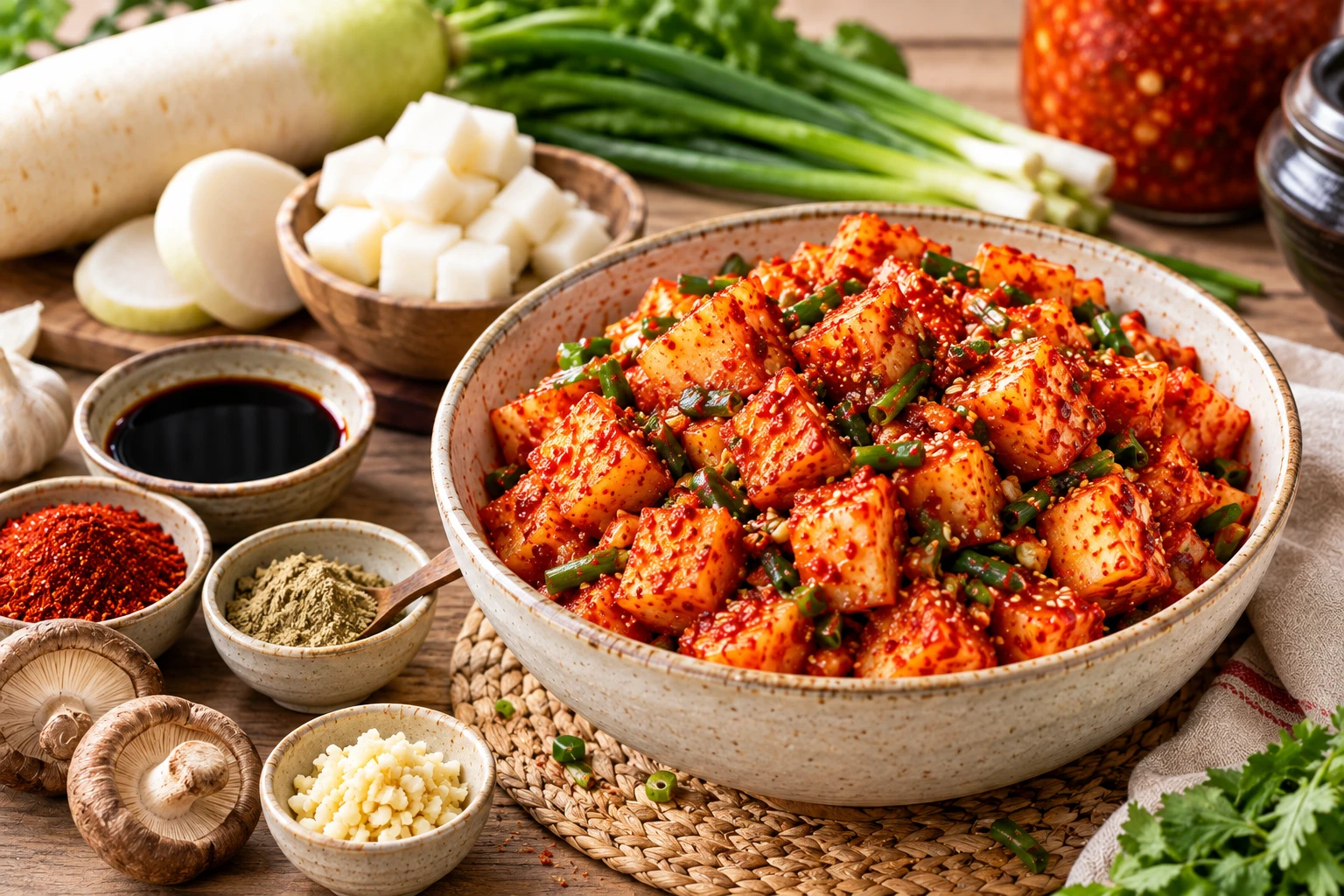
Vegan Kkakdugi Recipe No Fish Sauce, No Saeujeot — Tested 1:1 Swaps
Traditional kkakdugi almost always contains fish sauce and salted shrimp. This guide swaps both out with soy sauce and shiitake or kelp powder, tested side-by-side against the traditional paste, so you get the same crunchy, sweet-spicy radish kimchi with zero animal products.

Is Kkakdugi Vegan?
Not by default. Traditional kkakdugi almost always uses fish sauce and often salted shrimp (saeujeot) for savory depth. To make it fully vegan, swap the fish sauce for soy sauce (1:1) and replace the salted shrimp with finely chopped shiitake mushroom or a pinch of kelp (dashima) powder. Everything else — the radish cubing, salt cure, gochugaru amount, garlic, ginger and the full fermentation timeline — stays exactly the same as the traditional recipe.
How to Make Vegan Kkakdugi
Vegan kkakdugi takes about 25 minutes of hands-on time plus fermenting: salt-cure the radish, build a vegan paste with soy sauce and shiitake or kelp powder, toss and pack, then ferment.
- Salt: toss cubed radish with salt and sugar, rest 45–60 minutes.
- Drain: reserve the liquid the radish releases, don’t rinse.
- Paste: bloom gochugaru in the liquid, stir in soy sauce, shiitake or kelp powder, sugar, garlic, ginger.
- Toss & pack: coat radish and spring onion, pack tightly into a jar.
- Ferment: 1–2 days at room temperature, then 1–3 weeks refrigerated.
Substitution Check — What to Swap for Vegan Kkakdugi
Kkakdugi looks like a plant dish at a glance — radish, chili flakes, garlic — but two ingredients in the traditional paste come from animals. Swap these two and everything else in the recipe stays identical.
What Changes When You Go Vegan
Beyond the two ingredient swaps, going vegan changes very little about how the recipe actually behaves in the jar — fermentation doesn’t care whether the umami came from a fish or a mushroom.
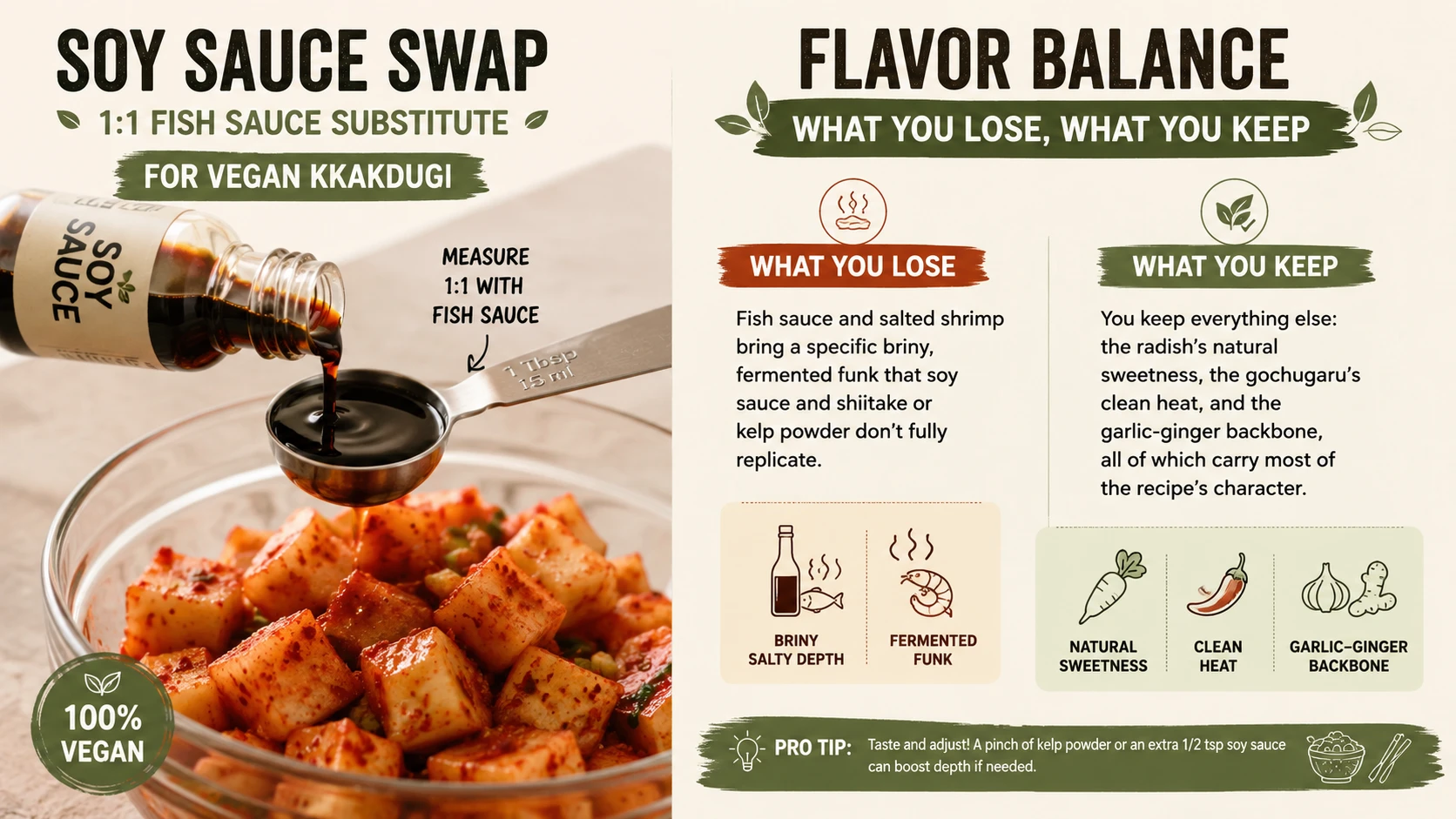
Fish sauce and salted shrimp both bring a specific briny, fermented funk that soy sauce and shiitake or kelp powder don’t fully replicate — that’s the honest trade-off. What you keep is everything else: the radish’s natural sweetness, the gochugaru’s clean heat, and the garlic-ginger backbone, all of which carry most of the recipe’s character anyway.
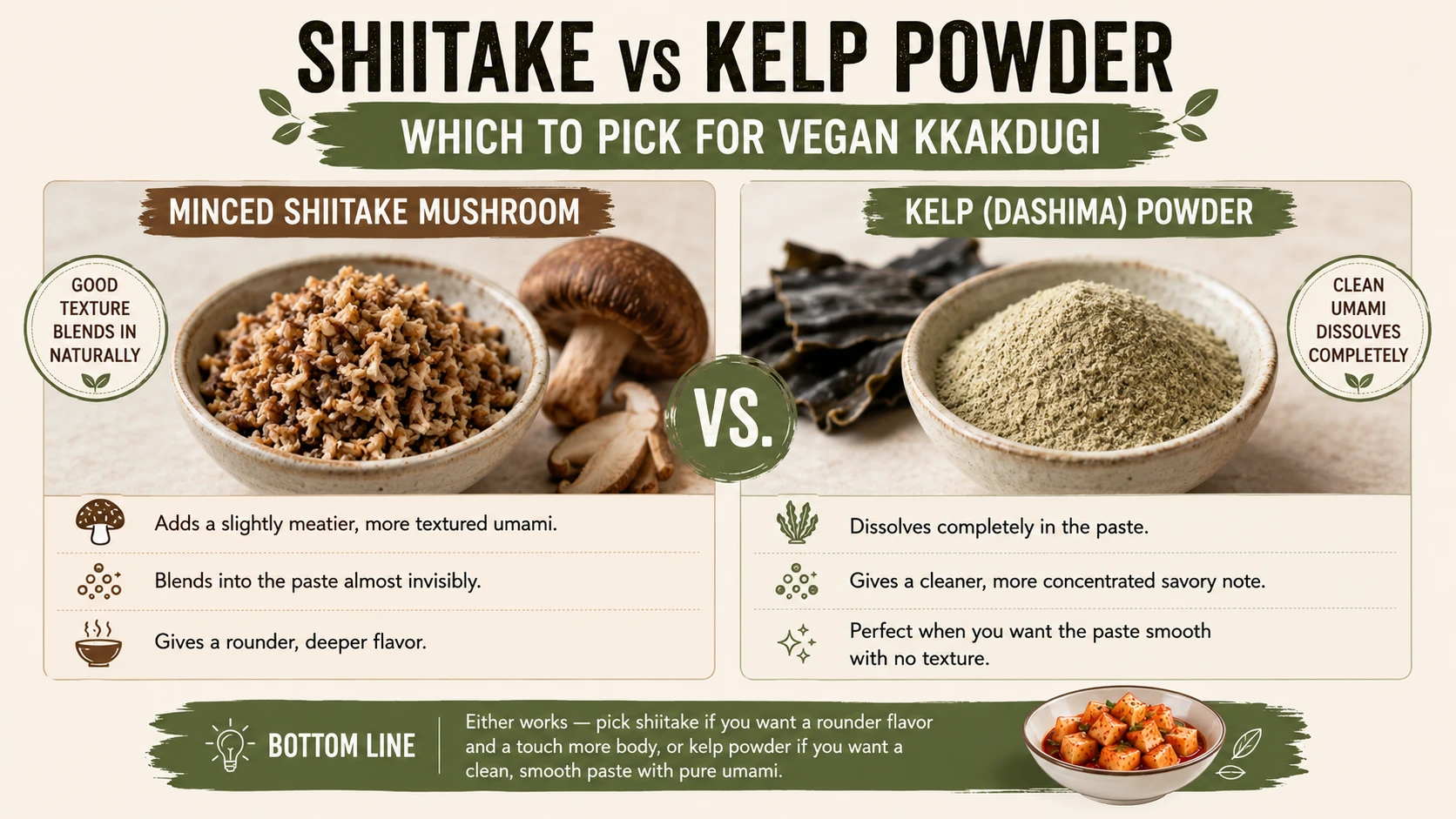
Minced shiitake mushroom adds a slightly meatier, more textured umami and blends into the paste almost invisibly. Kelp (dashima) powder dissolves completely and gives a cleaner, more concentrated savory note without adding any texture. Either works — pick shiitake if you want a rounder flavor, kelp powder if you want the paste perfectly smooth.
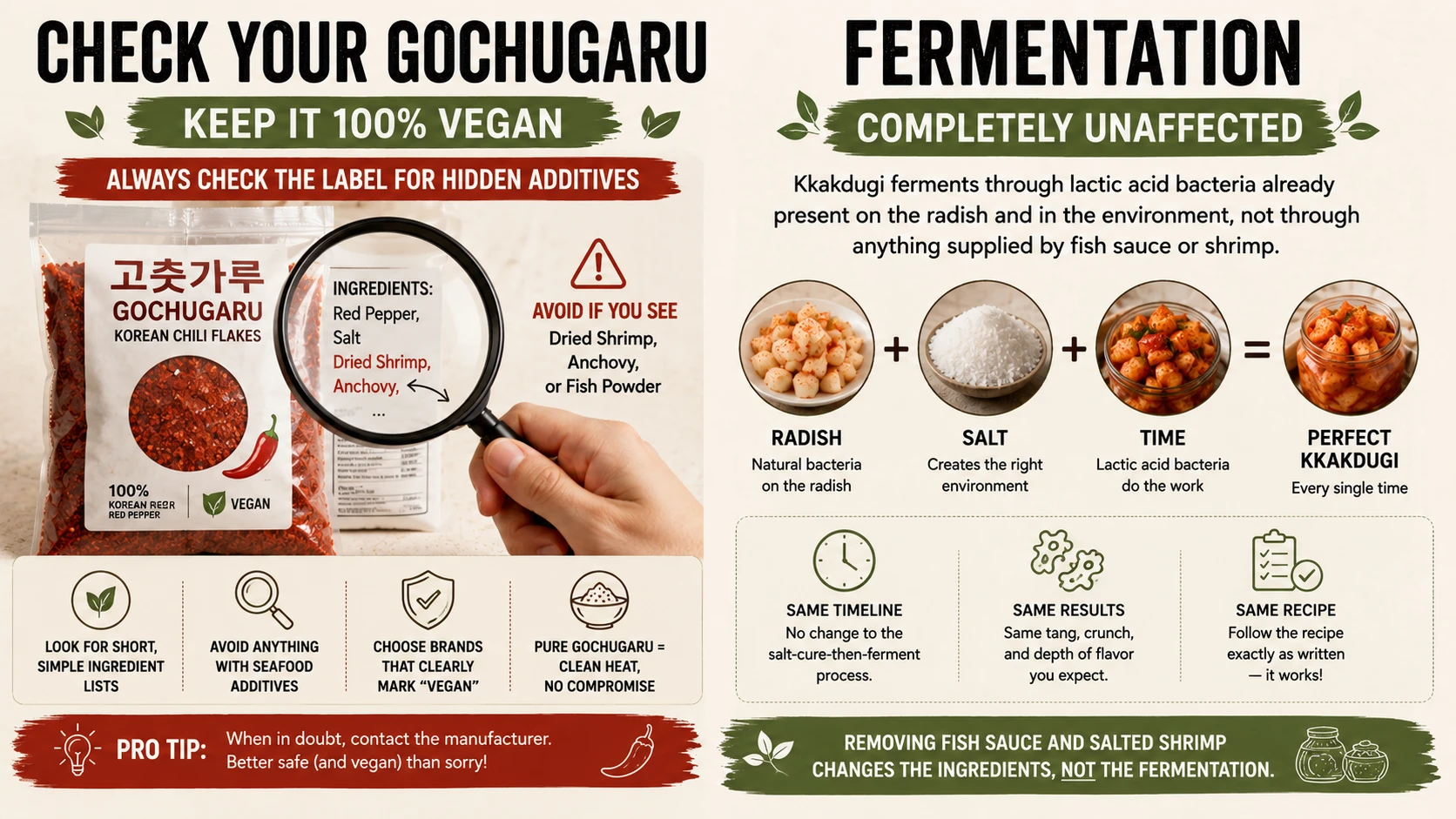
Kkakdugi ferments through lactic acid bacteria already present on the radish and in the environment, not through anything supplied by fish sauce or shrimp. Removing both ingredients doesn’t slow, speed up, or change the fermentation process in any measurable way — the same salt-cure-then-ferment timeline applies exactly as written.
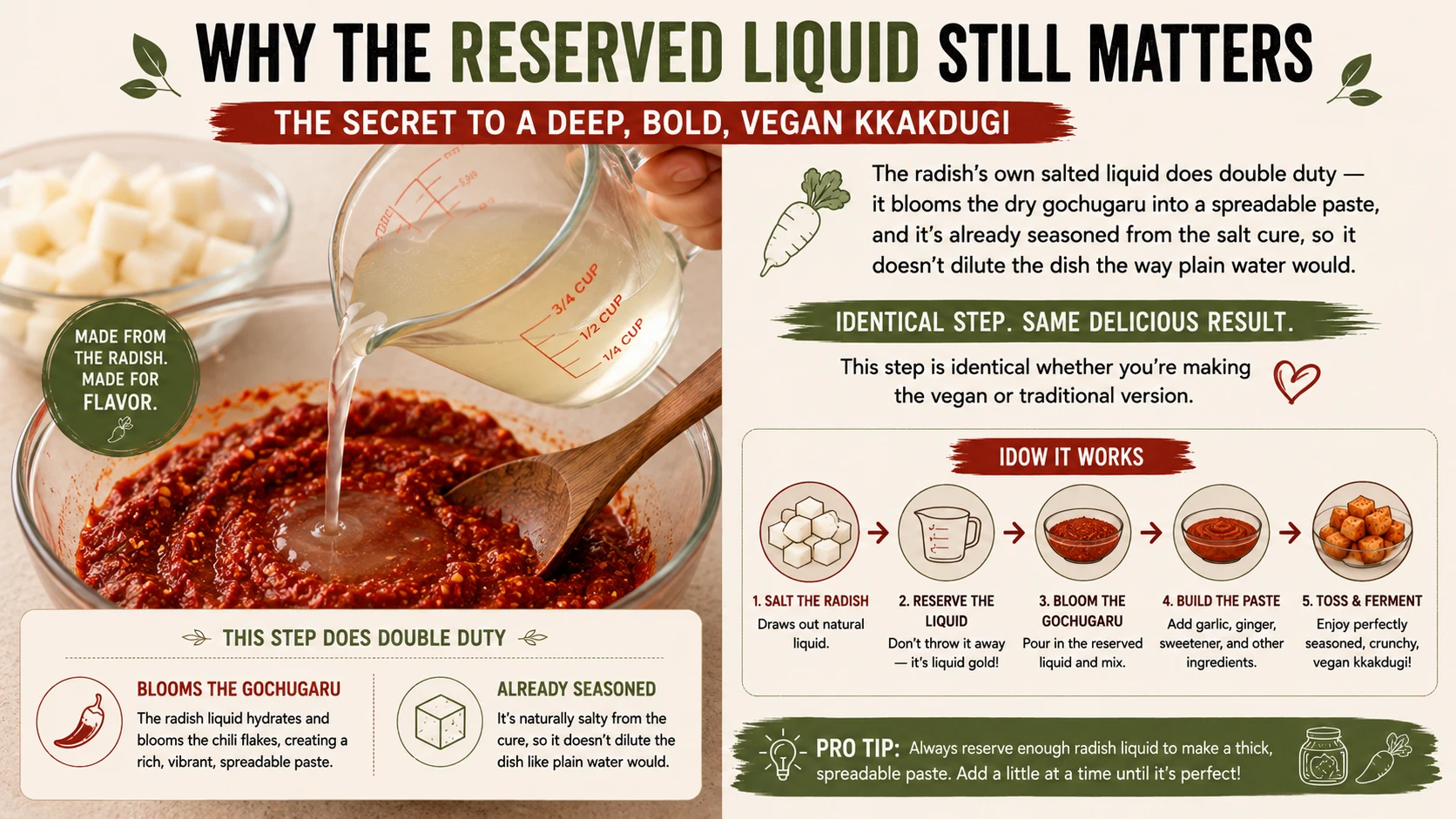
The radish’s own salted liquid does double duty — it blooms the dry gochugaru into a spreadable paste, and it’s already seasoned from the salt cure, so it doesn’t dilute the dish the way plain water would. This step is identical whether you’re making the vegan or traditional version.
Beyond Vegan: Gluten-Free, Low-Sodium & Whole30
“Vegan” only answers the animal-product question. Here’s where this recipe does and doesn’t clear a few other common dietary frameworks, and what to change if you need more than one at once.
Key Terms — Kkakdugi & Fermentation Entities
Understanding these terms clarifies exactly what’s being swapped, and why, in this specific recipe.
How Difficult Is Vegan Kkakdugi?
The technique is identical to the traditional recipe — the only new step is measuring two substitute ingredients instead of the originals.
← This Recipe
Fermentation Stage Guide — What to Expect When
Vegan kkakdugi ferments on exactly the same timeline as the traditional version — the soy sauce and shiitake or kelp powder don’t speed up or slow down lactic acid fermentation. For the science behind these stages, see our Kimchi Fermentation Stages Guide, and for how the flavor keeps changing past this window, see Fresh vs Aged Kimchi.
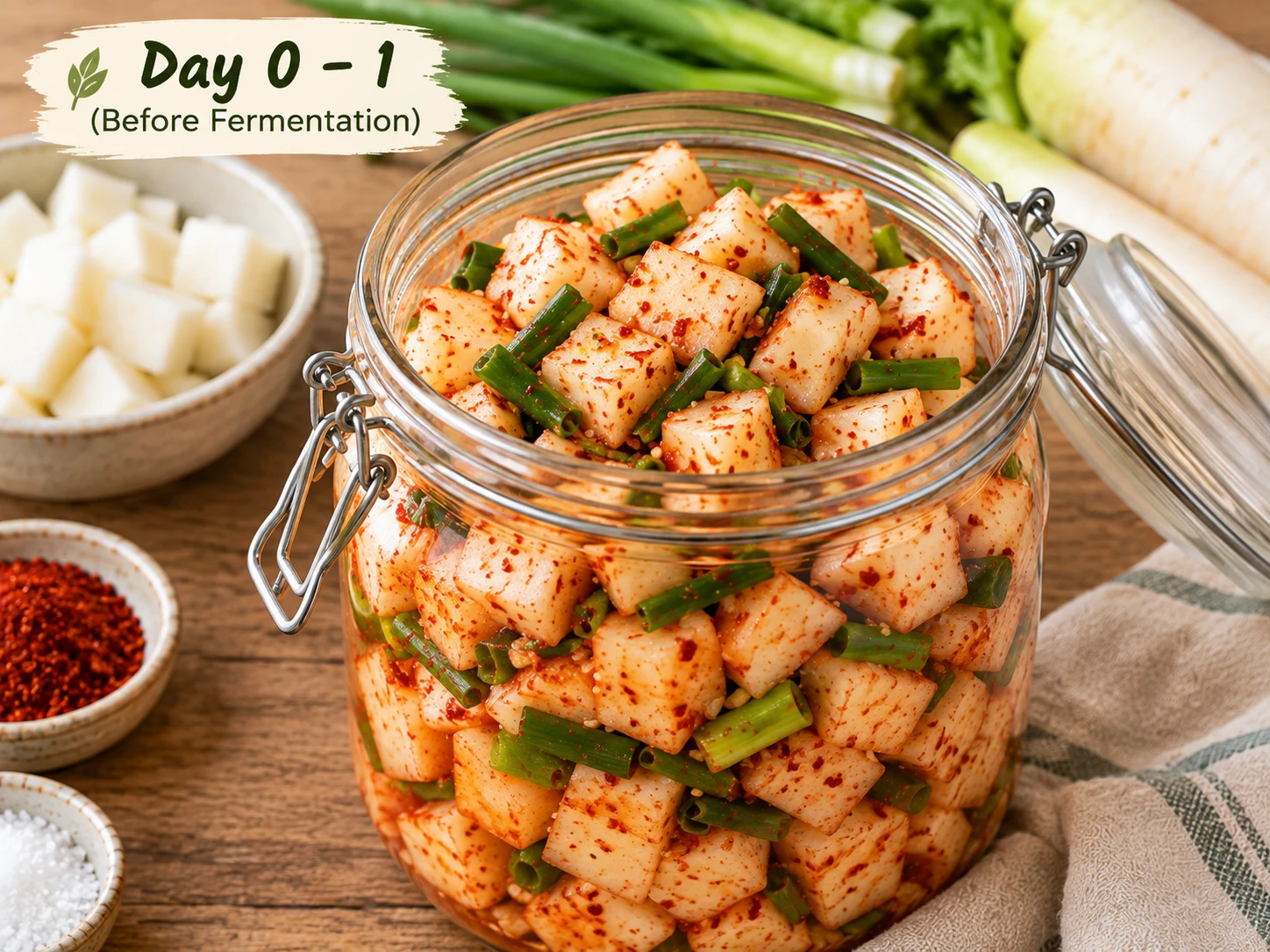
Tastes mostly like seasoned raw radish — crunchy, salty and spicy, but flat and without the tang fermentation will bring.
✗ Too Early to Eat as Kimchi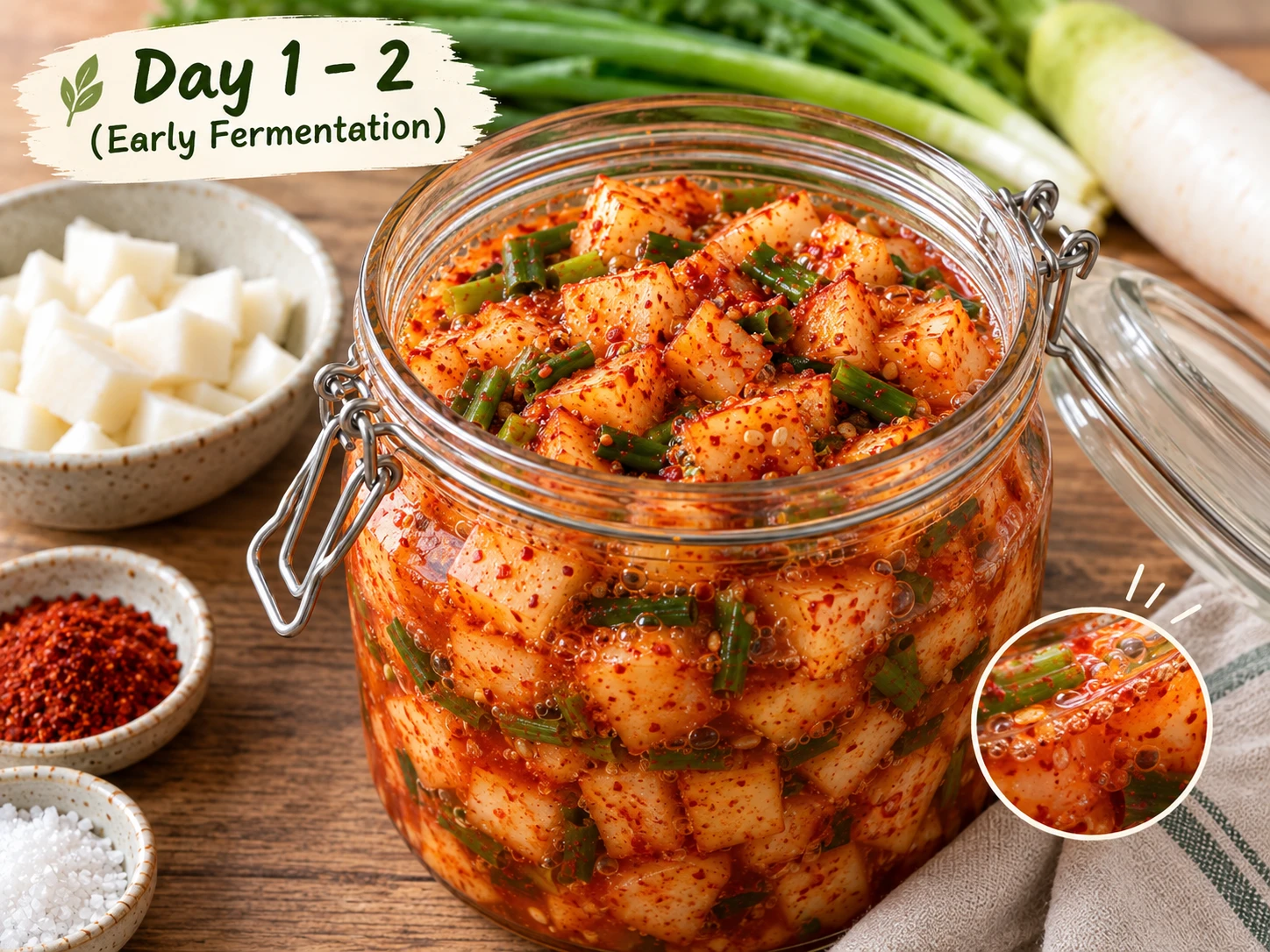
This is the required room-temperature window before refrigerating — you’ll notice small bubbles and a first hint of sourness developing.
△ Required Step, Not Ready Yet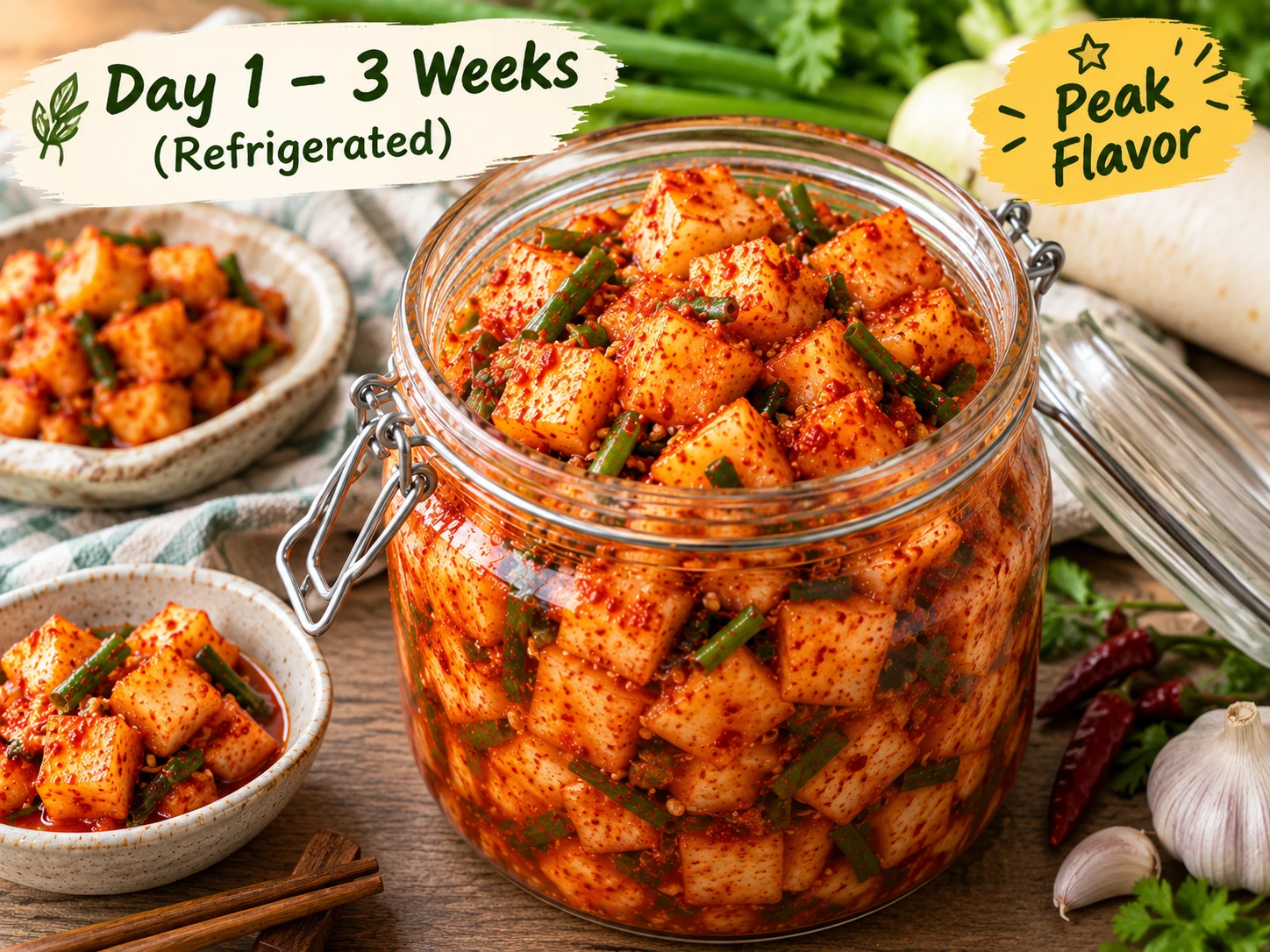
The full flavor this recipe is built around — crunchy texture holding, sourness balanced against the gochugaru’s heat and the radish’s natural sweetness.
★ Correct — the target stage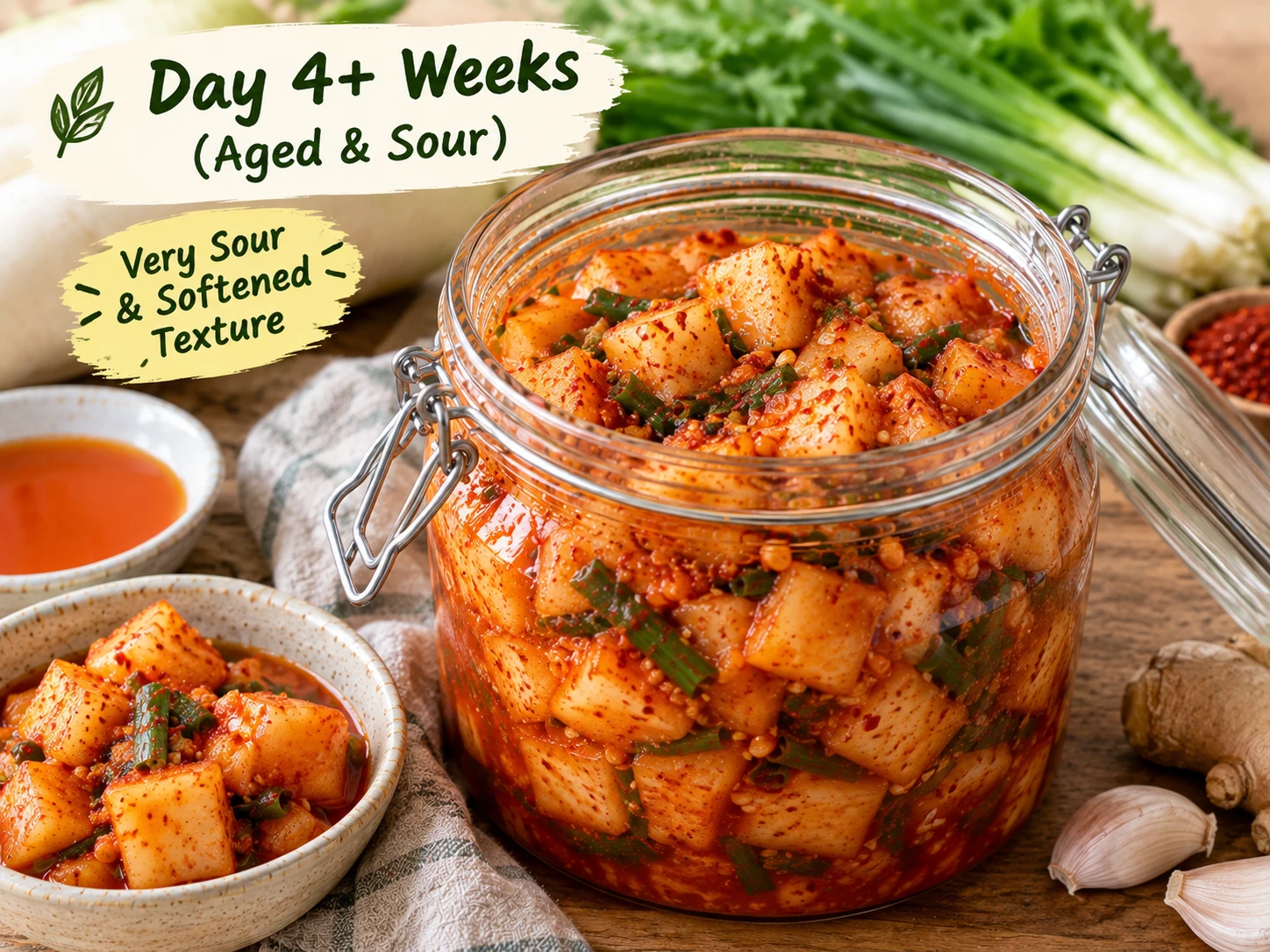
Still perfectly edible and great for cooking into soups or stews, but the radish softens and the sourness intensifies well past the fresh-eating sweet spot. See what to do with sour kimchi for ideas.
△ Best Used in Cooking, Not RawIngredients
Substitution Guide — What Works, What Doesn’t
| Ingredient | Best Substitute | Ratio | Vegan? | Taste/Texture Impact |
|---|---|---|---|---|
| Fish sauce | Soy sauce | 1:1 | ✓ Fully vegan | Best structural match for salt/umami — loses fish sauce’s specific briny funk but keeps the seasoning balance intact. |
| Fish sauce (alt) | Tamari or coconut aminos | 1:1 | ✓ | Tamari also covers gluten-free; coconut aminos is milder and slightly sweeter, may need a touch more salt. |
| Salted shrimp (saeujeot) | Minced shiitake mushroom | 1 tbsp per recipe | ✓ | Rounder, slightly meatier umami; blends into the paste almost invisibly. |
| Salted shrimp (alt) | Kelp (dashima) powder | 1 tsp per recipe | ✓ | Cleaner, more concentrated savory note with zero added texture. |
| Korean radish (mu) | Daikon radish | 1:1 by weight | ✓ | Milder and more watery — drain extra thoroughly and expect a softer bite. |
| Gochugaru | Gochugaru (no real substitute) | — | ✓ | Crushed red pepper flakes are a last-resort stand-in but taste noticeably different — sharper heat, less fruity depth. |
🛒 Shop This Recipe
The three ingredients most worth buying a good version of — the soy sauce, the kelp powder or shiitake, and gochugaru sized right for kimchi.
| Item | Why You’d Want It Here | |
|---|---|---|
| Sempio Naturally Brewed Soy Sauce | A well-balanced Korean soy sauce — the fish sauce swap this recipe is built around. | View on Amazon → |
| Sempio Gluten-Free Soy Sauce | For the vegan-and-gluten-free combo mentioned in the FAQ above — certified GF, same 2 tbsp swap ratio. | View on Amazon → |
| K-Herb Korean Kelp (Dasima) Powder | The cleaner, no-texture umami swap for salted shrimp — dissolves fully into the paste. | View on Amazon → |
| Whole Dried Shiitake Mushrooms | The rounder, meatier umami swap — mince after a quick rehydration soak. | View on Amazon → |
| Coarse Gochugaru (Korean Red Pepper Flakes) | Coarse-cut flakes made for kimchi and kkakdugi specifically — the texture this paste is built around. | View on Amazon → |
As an Amazon Associate, KimchiGuide earns from qualifying purchases. Links go to Amazon.com; prices and availability may change.

“The mistake I see most often isn’t the swap itself — it’s assuming ‘vegan’ automatically covers gluten-free or low-sodium too. Soy sauce carries both wheat and a meaningful amount of sodium, so if you’re managing more than one dietary need at once, check each one separately rather than assuming they all clear together.”
How to Make Vegan Kkakdugi
Four steps, identical in technique to the traditional recipe. The only genuinely new decision is choosing shiitake or kelp powder in Step 3.
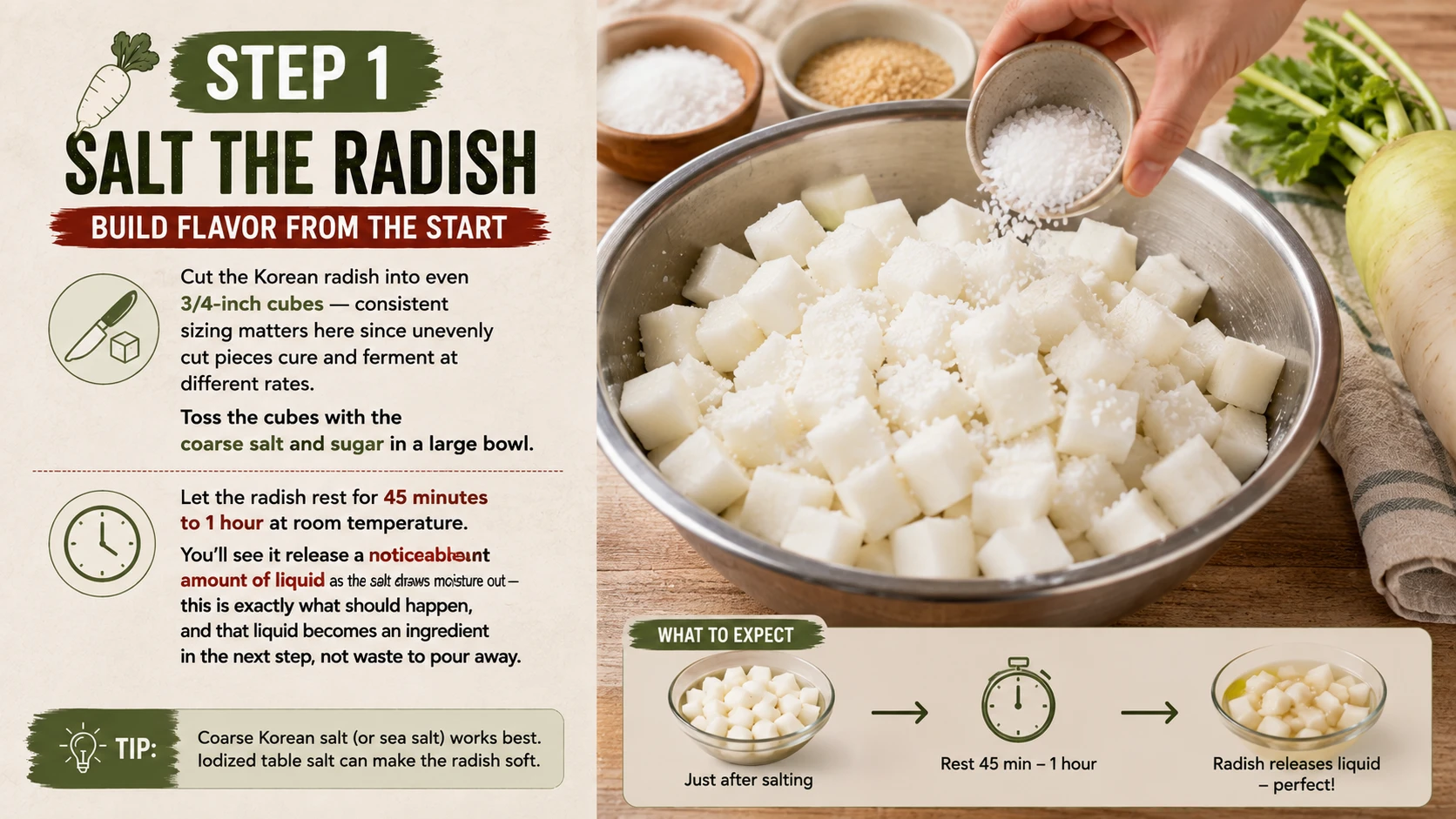
Cut the Korean radish into even 3/4-inch cubes — consistent sizing matters here since unevenly cut pieces cure and ferment at different rates. Toss the cubes with the coarse salt and sugar in a large bowl.
Let the radish rest for 45 minutes to 1 hour at room temperature. You’ll see it release a noticeable amount of liquid as the salt draws moisture out — this is exactly what should happen, and that liquid becomes an ingredient in the next step, not waste to pour away.
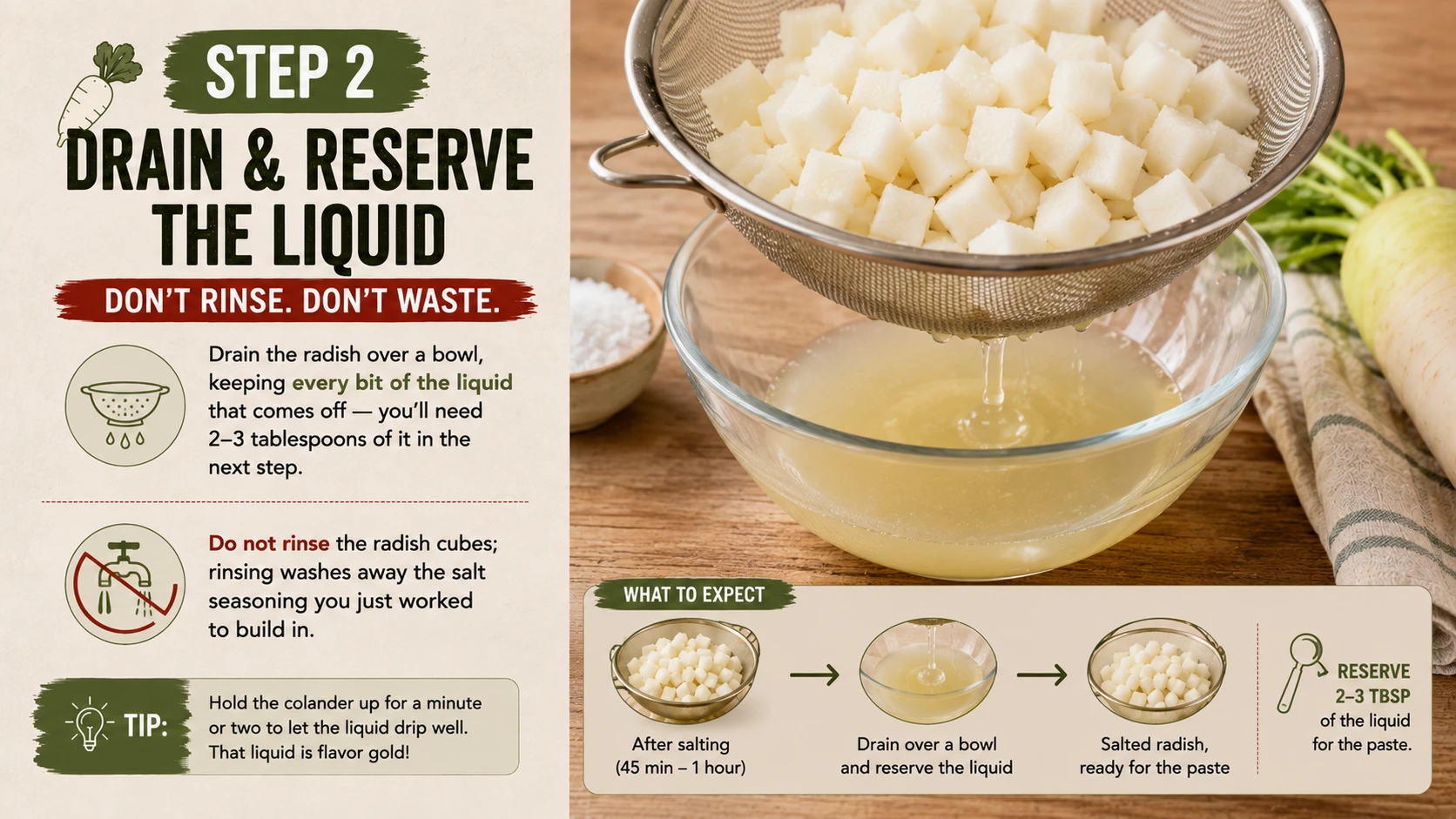
Drain the radish over a bowl, keeping every bit of the liquid that comes off — you’ll need 2–3 tablespoons of it in the next step. Do not rinse the radish cubes; rinsing washes away the salt seasoning you just worked to build in.
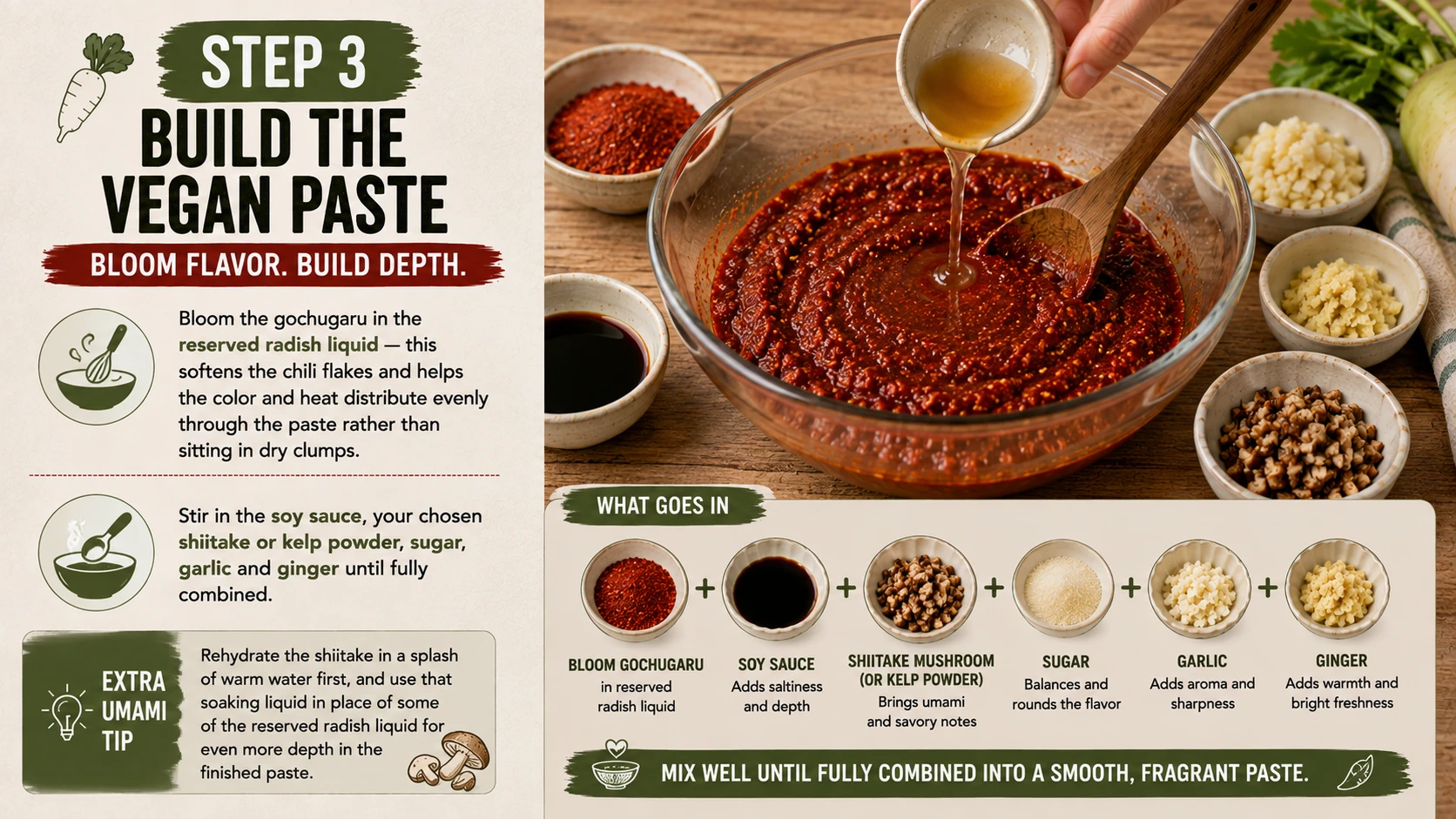
Bloom the gochugaru in the reserved radish liquid — this softens the chili flakes and helps the color and heat distribute evenly through the paste rather than sitting in dry clumps. Stir in the soy sauce, your chosen shiitake or kelp powder, sugar, garlic and ginger until fully combined.
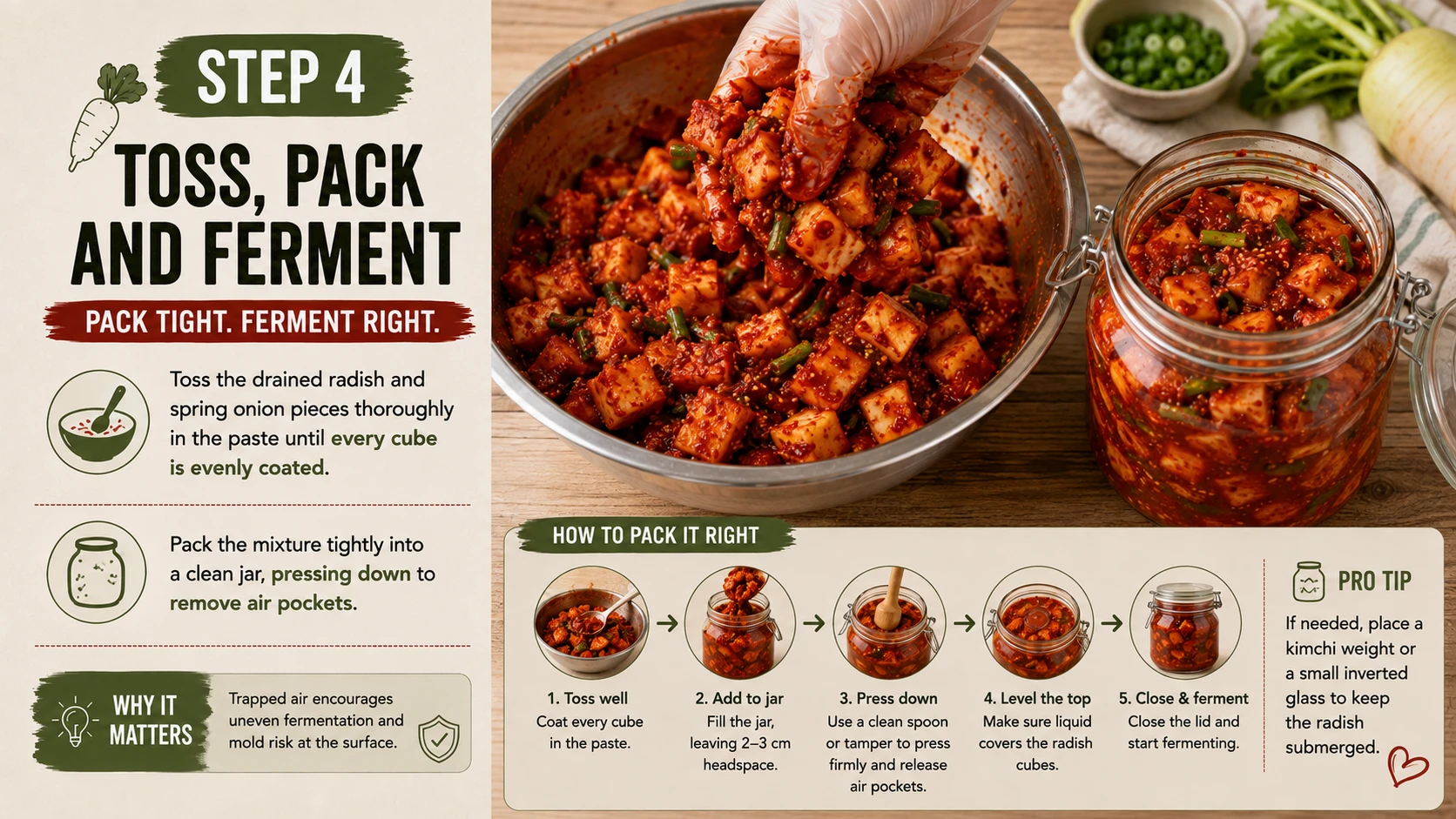
Toss the drained radish and spring onion pieces thoroughly in the paste until every cube is evenly coated. Pack the mixture tightly into a clean jar, pressing down to remove air pockets — trapped air encourages uneven fermentation and mold risk at the surface.
Rest the jar at room temperature for 1–2 days to kickstart fermentation, then move it to the refrigerator. It’s ready to eat lightly fermented after about a week, but reaches its full balanced sour-sweet-spicy flavor between 1 and 3 weeks refrigerated.
Test Kitchen Results
Every batch below was tested against a traditional fish-sauce-and-saeujeot control batch. Here’s what the testing showed specifically for the vegan swap.
The full 1:1 swap matched the traditional recipe’s salt level closely. Reducing soy sauce by more than 25% left the paste noticeably underseasoned without a compensating salt addition.
Keep the 1:1 ratioShiitake gave a rounder, slightly meatier depth and blended in almost invisibly. Kelp powder dissolved completely for a cleaner, more concentrated umami with zero added texture — both were rated close to the traditional saeujeot version.
Either works — texture preference decidesBoth batches reached the same visible fermentation markers — light fizz at day 1–2, balanced sourness at week 1–3 — on identical timelines side by side.
No fermentation timing difference45–60 minutes released enough liquid for the paste while keeping the radish’s crunch. Extending past 90 minutes drew out noticeably more water without an additional textural benefit.
45–60 minutes is the sweet spotDaikon held noticeably more water and produced a softer final texture with a milder, less peppery bite compared to Korean radish, even with an extended drain time.
Korean radish (mu) preferred where availableSubstituting part of the reserved radish liquid with the water used to rehydrate dried shiitake added a noticeably deeper umami layer to the finished paste.
Worth the extra step for depthVegan kkakdugi succeeds or fails on the umami swap, not on any change to technique or timing. Get the soy sauce ratio and the shiitake-or-kelp choice right, and every other step — the salt cure, the fermentation window, the final texture — behaves exactly like the traditional recipe.
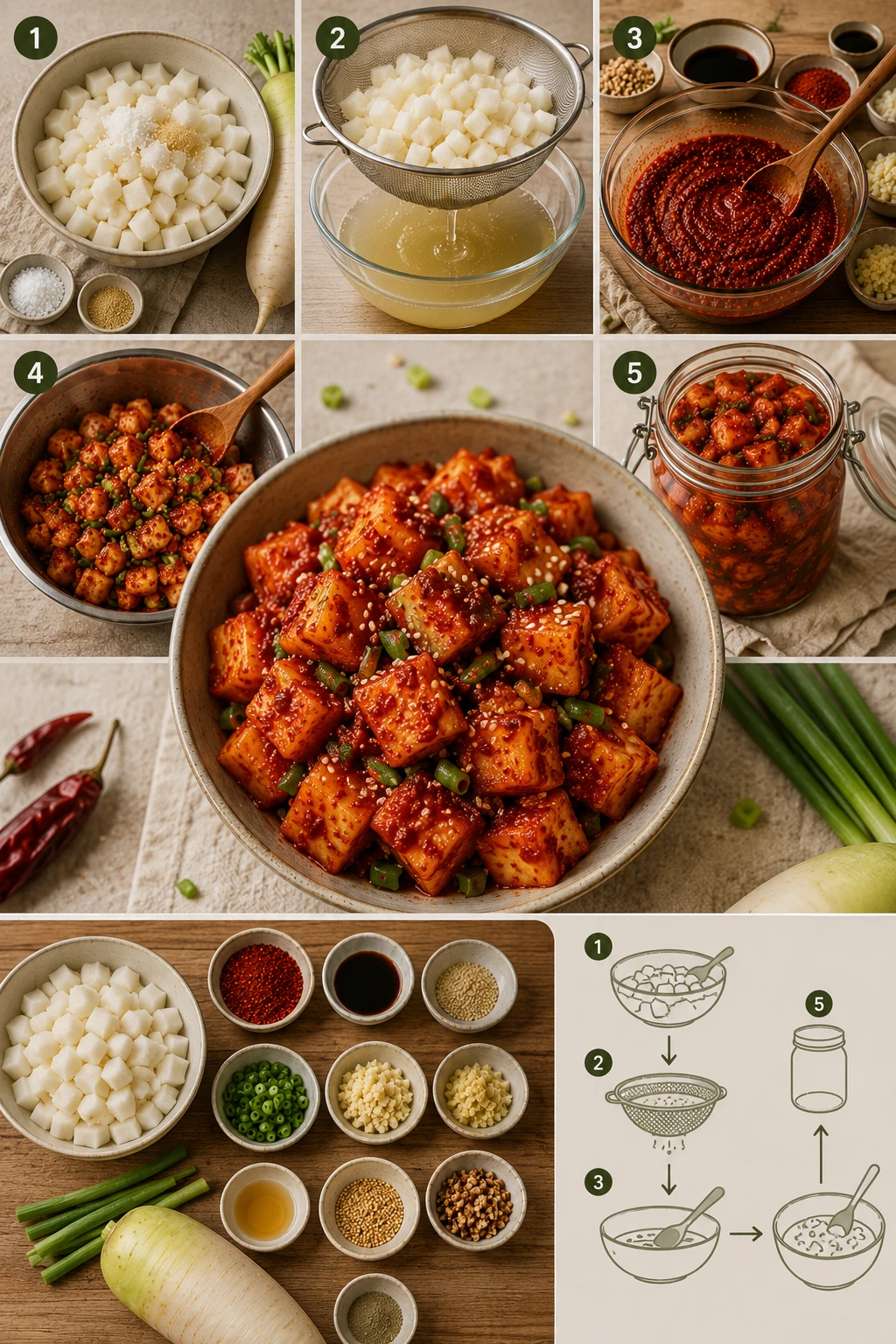
Vegan Kkakdugi
No fish sauce · No saeujeot · 100% plant-based · 1h10m total
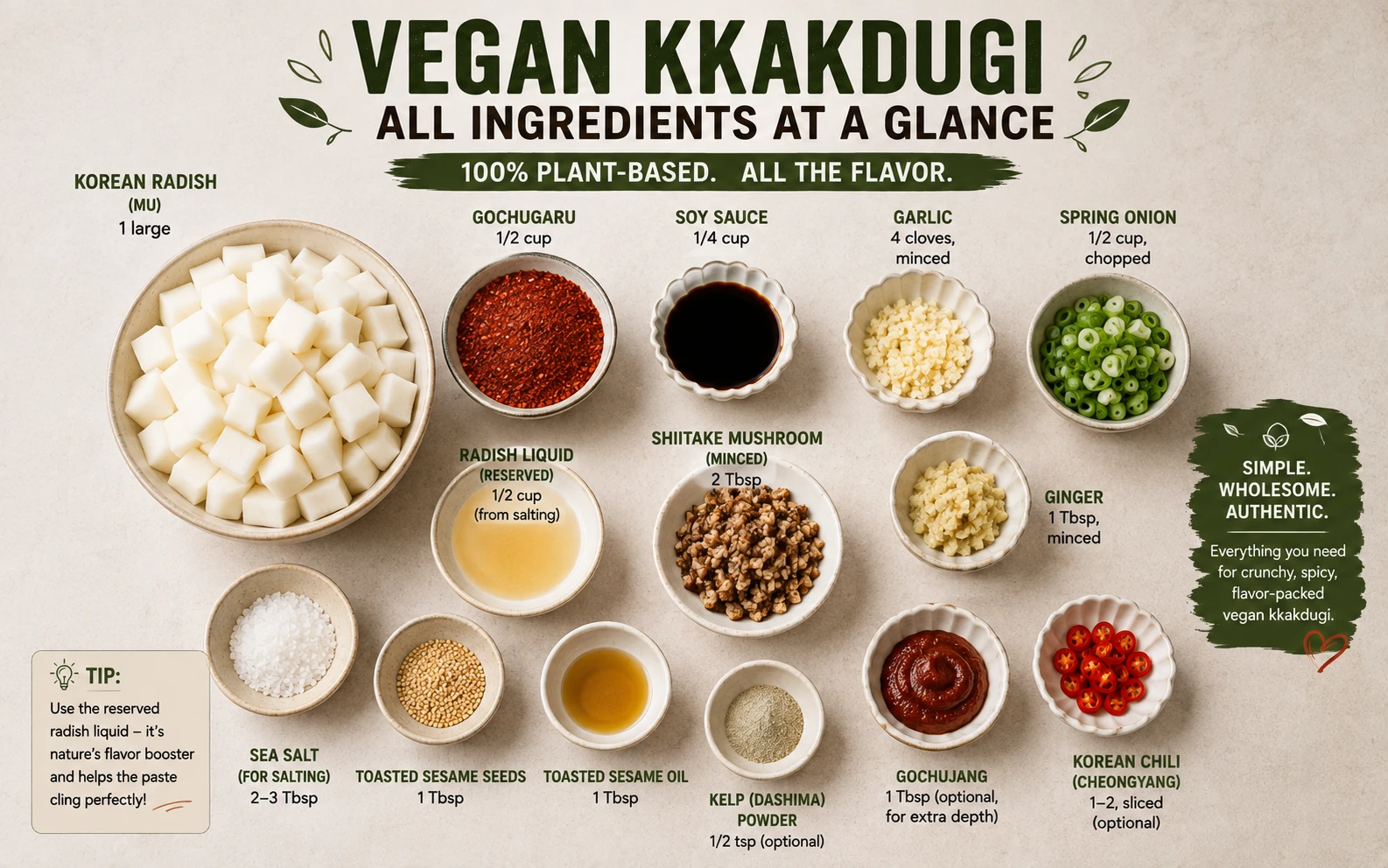
- 900g Korean radish (mu), cut into 3/4-inch cubes
- 2 tbsp coarse salt + 1 tbsp sugar (salt cure)
- 1/3 cup gochugaru
- 2 tbsp soy sauce (replaces fish sauce)
- 1 tbsp minced shiitake OR 1 tsp kelp powder (replaces saeujeot)
- 1 tbsp sugar (seasoning)
- 4 cloves garlic, minced + 1 tsp fresh ginger, minced
- 3 spring onions, cut into 1-inch pieces
- 2–3 tbsp reserved radish liquid
- 1Cube the radish, toss with salt and sugar, rest 45–60 min.
- 2Drain over a bowl, reserving the liquid. Don’t rinse.
- 3Bloom gochugaru in reserved liquid; stir in soy sauce, shiitake or kelp powder, sugar, garlic, ginger.
- 4Toss radish and spring onion in the paste, pack tightly, ferment 1–2 days at room temp then refrigerate 1–3 weeks.
Per 1/2-cup serving (6 servings total). Reviewed by Dr. Sarah Mitchell RD, PhD · Updated September 3, 2026
Per serving (1/2 cup). Every ingredient is listed with an explicit value for every column — including 0g/0mg where an ingredient contributes nothing — so calorie-counters can see exactly where every number comes from, not just the totals above.
| Ingredient (per serving) | Cal | Protein | Carbs | Fat | Fiber | Sugar | Sodium |
|---|---|---|---|---|---|---|---|
| 150g Korean radish, cubed | 18 | 0.5g | 4g | 0g | 1g | 2g | 10mg |
| 1 tsp coarse salt (cure, absorbed portion) | 0 | 0g | 0g | 0g | 0g | 0g | 380mg |
| 1/2 tsp sugar (cure, absorbed portion) | 4 | 0g | 1g | 0g | 0g | 1g | 0mg |
| 1 tsp gochugaru | 3 | 0.1g | 0.5g | 0g | 0.2g | 0g | 0mg |
| 1 tsp soy sauce | 1 | 0.2g | 0.1g | 0g | 0g | 0g | 75mg |
| 1/2 tsp minced shiitake or kelp powder | 0 | 0.1g | 0.1g | 0g | 0g | 0g | 5mg |
| 1/2 tsp sugar (seasoning) | 4 | 0g | 1g | 0g | 0g | 1g | 0mg |
| 2/3 clove garlic, minced | 1 | 0g | 0.2g | 0g | 0g | 0g | 0mg |
| 1/6 tsp fresh ginger, minced | 0 | 0g | 0g | 0g | 0g | 0g | 0mg |
| 1/2 spring onion, sliced | 1 | 0g | 0.3g | 0g | 0g | 0g | 1mg |
| 1/2 tbsp reserved radish liquid | 0 | 0g | 0g | 0g | 0g | 0g | 9mg |
| Total per serving | 26 | 1g | 6g | 0g | 1g | 3g | 480mg |
Values are per-ingredient estimates rounded for readability; brand-specific products (soy sauce, gochugaru) will vary slightly — check your own packaging for exact figures if you are managing a strict sodium target. See the Beyond Vegan section above for a lower-sodium adaptation.
Kkakdugi Guide Cluster
This is 1 of 3 guides in the KimchiGuide Kkakdugi cluster. Full recipe + origin story: Kkakdugi — The Complete Guide →

The traditional recipe, royal origin story, and soup pairings.
Full Guide →
Tested soy sauce and kelp-powder swaps, full vegan recipe.
Currently viewing
How long kkakdugi lasts and how to fix texture and salt issues.
Storage Guide →Vegan Kkakdugi — Pairing Guide
Kkakdugi’s crunchy sourness is classically served alongside rich, warming dishes — here are a few pairings that work well with the vegan version specifically.

The crunchy, cooling radish cuts through tteokbokki’s sticky-spicy sauce between bites.

A fully plant-based bowl meal that keeps the whole spread vegan alongside the kkakdugi.

Kkakdugi is traditionally paired with rich soups; use a plant-based broth to keep the whole meal vegan.

A naturally caffeine-free, plant-based drink that cleanses the palate between bites.
Storage and Serving Notes
Rest the packed jar at room temperature to kickstart fermentation before refrigerating — skipping this slows the whole process down.
Sealed container, clean utensils each time. This is the window for the best balanced sour-sweet-spicy flavor and crunch.
Texture softens and sourness intensifies — best folded into soups, stews or fried rice rather than eaten raw at this stage.
If you have extra reserved liquid beyond what the paste needs, refrigerate it and use it to season soup broths or future batches.
How Vegan Kkakdugi Compares Nutritionally
| Version | Calories | Sodium | Vegan? | Best For |
|---|---|---|---|---|
| Vegan (This Page) | 26 | 480mg | ✅ Fully vegan | Plant-based diets, shellfish allergies |
| Traditional (Fish Sauce + Saeujeot) | ~28 | ~510mg | No | Deepest, most traditional flavor |
| Low-Sodium Vegan Adaptation | ~24 | ~350mg | ✅ | Sodium-restricted diets — see Beyond Vegan section |
Vegan Kkakdugi FAQ
Sourced from real reader questions about vegan Korean food, answered with the detail of someone who actually tested the swaps.
Not by default. Traditional kkakdugi almost always uses fish sauce and often salted shrimp (saeujeot) for savory depth, so it isn’t vegan or vegetarian unless those two ingredients are specifically swapped out. See the Substitution Check above for the full breakdown.
Soy sauce is the simplest one-to-one swap for fish sauce in kkakdugi. It won’t taste identical, but it brings the same salty, umami backbone the paste needs.
Finely chopped shiitake mushroom or a pinch of kelp (dashima) powder both add savory depth without any seafood, standing in well for the salted shrimp’s role in the paste.
It’s close but not identical — you lose some of the deep, briny funk that fish sauce and salted shrimp bring. The radish’s natural sweetness and the gochugaru’s heat still come through clearly, and it still ferments the same way.
Yes. Removing fish sauce and salted shrimp doesn’t change the fermentation process — the same salt-cure, 1–2 days at room temperature, then 1 to 3 weeks refrigerated timeline applies.
No. Traditional kkakdugi almost always contains fish sauce and often salted shrimp (saeujeot), so it isn’t vegetarian or vegan unless those are specifically swapped out.
Not automatically — standard soy sauce contains wheat. For a vegan and gluten-free version, use a certified gluten-free soy sauce or tamari in the same 2 tbsp amount, and double-check your gochugaru brand for any added wheat flour filler.
Yes, with a few adjustments. Reduce the soy sauce slightly and lean more on the kelp powder for umami, since kelp adds savoriness without matching soy sauce’s sodium load; shortening the salt-cure rest time slightly also reduces overall salt uptake, though it may soften the radish’s crunch a little.
Radish releases a lot of liquid during the salt cure, and if that liquid isn’t drained off before mixing in the paste, the finished kimchi can taste diluted and turn soupy fast. Drain thoroughly and use only 2–3 tablespoons of the reserved liquid to loosen the paste, not the full amount that came off the radish.
Daikon works as a substitute but is noticeably milder and holds more water than Korean radish, so expect a softer texture and a less peppery bite. If using daikon, cut the salt-cure rest time slightly and drain even more thoroughly.
Stored in a sealed container in the refrigerator, vegan kkakdugi keeps well for 3 to 6 weeks, continuing to ferment and sour gradually the whole time — the same shelf life as the traditional version. See the Kkakdugi Storage Guide for troubleshooting.
You can, but the paste will taste noticeably flatter and less savory without either one — they’re doing real umami work, not just decorative flavor. If you have neither on hand, a small pinch of nutritional yeast is a rougher stand-in.
The small amount of sugar used to balance the salt cure and the paste is standard in kkakdugi and isn’t a large amount per serving, but strict Whole30 followers typically avoid added sugar in any form; a scant reduction or omission is possible but will shift the flavor balance toward saltier and less rounded.
Only two ingredients change — fish sauce becomes soy sauce, and salted shrimp becomes shiitake or kelp powder. The radish cubing, salt cure, gochugaru amount, garlic, ginger, spring onion and full fermentation timeline are identical to the traditional recipe. See the full Kkakdugi guide for that version.
Was this guide helpful?
Your feedback helps us improve KimchiGuide for everyone.
💬 Leave a Comment & Rating
Made this vegan kkakdugi? Tell us whether you used shiitake or kelp powder and how it turned out, and rate the recipe.