Fried Rice Syndrome Is Kimchi Fried Rice Actually Safe to Reheat?
What Bacillus cereus is, how fried rice syndrome actually works, and whether kimchi’s fermentation acidity really changes the risk when you reheat leftover kimchi fried rice.
What Is Fried Rice Syndrome?
Fried rice syndrome is the nickname for food poisoning caused by Bacillus cereus, a spore-forming bacterium that survives cooking and multiplies rapidly when cooked rice is left at room temperature. It got its name because rice — day-old, cooled, then fried — is one of the classic ways this bacterium gets a chance to grow. Kimchi’s fermentation does not make kimchi fried rice immune to this risk. Well-aged kimchi is meaningfully more acidic than plain rice, and that acidity can slow bacterial growth in the kimchi itself, but kimchi fried rice is still mostly rice by volume — the same 2-hour cooling rule, refrigeration, and reheating temperature apply in full. The good news: fried rice syndrome is almost entirely preventable with basic time-and-temperature habits, covered step by step below.
Fried Rice Syndrome — At a Glance
Everything in this guide condensed into five lines you can act on right now.
- Cause: Bacillus cereus, a bacterium that survives cooking as a heat-resistant spore.
- Trigger: Cooked rice left at room temperature for more than 2 hours.
- Symptoms: Nausea, vomiting, and/or watery diarrhea, appearing 30 minutes to 15 hours after eating.
- Kimchi’s role: Its acidity can slow bacterial growth in the kimchi portion, but doesn’t protect the rice portion.
- Prevention: Refrigerate rice within 2 hours, reheat to 165°F (74°C), and don’t repeat the cool-and-reheat cycle more than once.
What Is Fried Rice Syndrome?
Fried rice syndrome is a nickname, not an official medical diagnosis — the underlying illness is food poisoning caused by Bacillus cereus, a bacterium that lives naturally in soil and is commonly found on raw grains, rice, and other starchy foods. Unlike many foodborne bacteria that die during cooking, Bacillus cereus forms heat-resistant spores that survive the boiling or steaming process. Those spores stay dormant in the cooked rice — completely harmless — right up until the rice is left at room temperature for too long, at which point the spores germinate and the bacteria multiply rapidly, in some cases producing a toxin along the way.
The “fried rice” part of the name comes from how the dish is typically made: rice is cooked, cooled, left out or refrigerated, and then reheated and fried later — sometimes the same day, sometimes days afterward. That cool-down-then-reheat pattern is exactly the sequence that gives Bacillus cereus spores their opening. It’s worth noting that the illness isn’t specific to fried rice as a dish — the same risk applies to any cooked starch (pasta, potatoes, other grains) handled the same way. Fried rice just became the household name because the cooking method makes the risk especially visible.
Diarrheal vs Emetic Illness
Bacillus cereus actually causes two distinct types of illness, and it’s worth understanding the difference. The emetic form — the one most associated with fried rice syndrome specifically — is driven by a toxin called cereulide, produced while the bacteria are still in the food, before you even eat it. Cereulide is unusually heat-stable, meaning it survives reheating even at temperatures that would kill the bacteria themselves. The diarrheal form is caused by a different, heat-sensitive toxin produced after the bacteria are already inside your digestive system, and tends to be linked more often to meat, dairy, and vegetable dishes than starchy ones.
Key Terms — Food Safety & Fermentation Entities
These terms come up throughout this guide and explain the science behind both the risk and the kimchi-specific question everyone asks.
Symptoms & Timeline
Symptoms and onset time differ depending on which of the two illness forms is involved.
Emetic form begins
Nausea and vomiting appear first, driven by the heat-stable cereulide toxin already present in the food. This is the form most associated with fried rice syndrome.
Diarrheal form begins
Watery diarrhea and abdominal cramping, driven by a different toxin produced after bacteria are already in the digestive tract.
Most cases resolve
The large majority of Bacillus cereus food poisoning cases are self-limiting and clear up within a day with rest and fluids.
Severe complications
A small number of documented cases involving the emetic toxin have resulted in serious complications, including liver failure. These are rare but the reason proper storage matters.
Does Kimchi’s Acidity Change the Risk?
This is the genuinely interesting part — and where a straight yes-or-no answer would be misleading either way.
Why Kimchi Is More Acidic Than Plain Rice
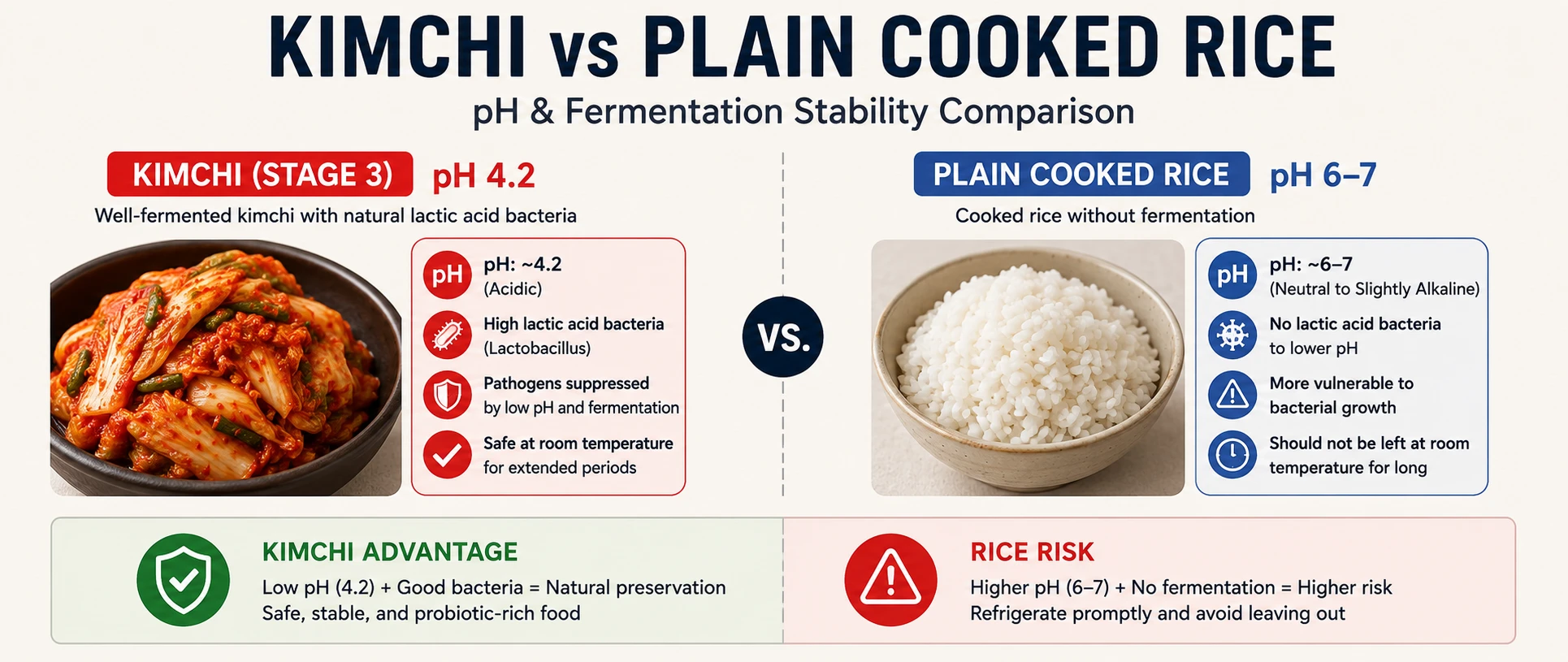
Well-fermented kimchi is significantly more acidic than plain cooked rice. Stage 3 kimchi — fermented roughly 2 to 4 weeks, the stage recommended across every recipe on this site — sits around pH 4.2, driven by lactic acid produced by Lactobacillus kimchii during fermentation. Plain cooked rice, by comparison, sits closer to a neutral pH 6 to 7. Most bacteria, Bacillus cereus included, grow far less readily in environments below roughly pH 4.8 — acidic conditions slow their metabolism and reproduction.
What the pH Difference Actually Means — and Doesn’t
This is where nuance matters. Kimchi’s acidity is a real, measurable property of the kimchi itself — but kimchi fried rice is a mixed dish, and rice makes up the majority of the volume in every version on this site, from the classic recipe to all nine variations. A quick stir-fry doesn’t meaningfully acidify the rice grains sitting alongside the kimchi; the rice largely keeps its own near-neutral pH throughout cooking. In other words, the presence of acidic kimchi in the pan doesn’t create a uniformly acidic environment protecting every grain of rice from bacterial growth once the dish is left out.
There’s no published evidence that kimchi’s lactic acid bacteria or acidity actively kill Bacillus cereus spores once present in cooked rice. What the pH difference likely does is slow bacterial growth specifically within the kimchi portion of the dish — a real but limited effect, not a food-safety guarantee for the whole plate. The honest takeaway: kimchi’s fermentation is a genuinely interesting piece of food science, but it is not a substitute for standard cooling, refrigeration, and reheating practices. Treat kimchi fried rice with exactly the same storage discipline you’d use for any other rice dish.
Kimchi Fried Rice vs Plain Fried Rice — Risk Comparison
A practical breakdown of what actually differs between the two, and what doesn’t.
| Factor | Plain Fried Rice | Kimchi Fried Rice |
|---|---|---|
| Base ingredient | Cooked rice (majority of volume) | Cooked rice (still majority of volume) |
| Overall dish pH | Near neutral (~pH 6-7) | Mildly lower overall, but rice grains stay close to neutral |
| Bacillus cereus spore risk in rice | Present if mishandled | Same risk — kimchi doesn’t neutralize rice-borne spores |
| 2-hour room-temperature rule | Applies fully | Applies fully — no exception for kimchi content |
| Safe reheat temperature | 165°F (74°C) | 165°F (74°C) — identical |
| Genuine kimchi advantage | — | Slower growth within the kimchi portion specifically, due to its lower pH |
Safe Storage & Reheating Rules
Six steps, all evidence-based, that prevent the overwhelming majority of fried rice syndrome cases.
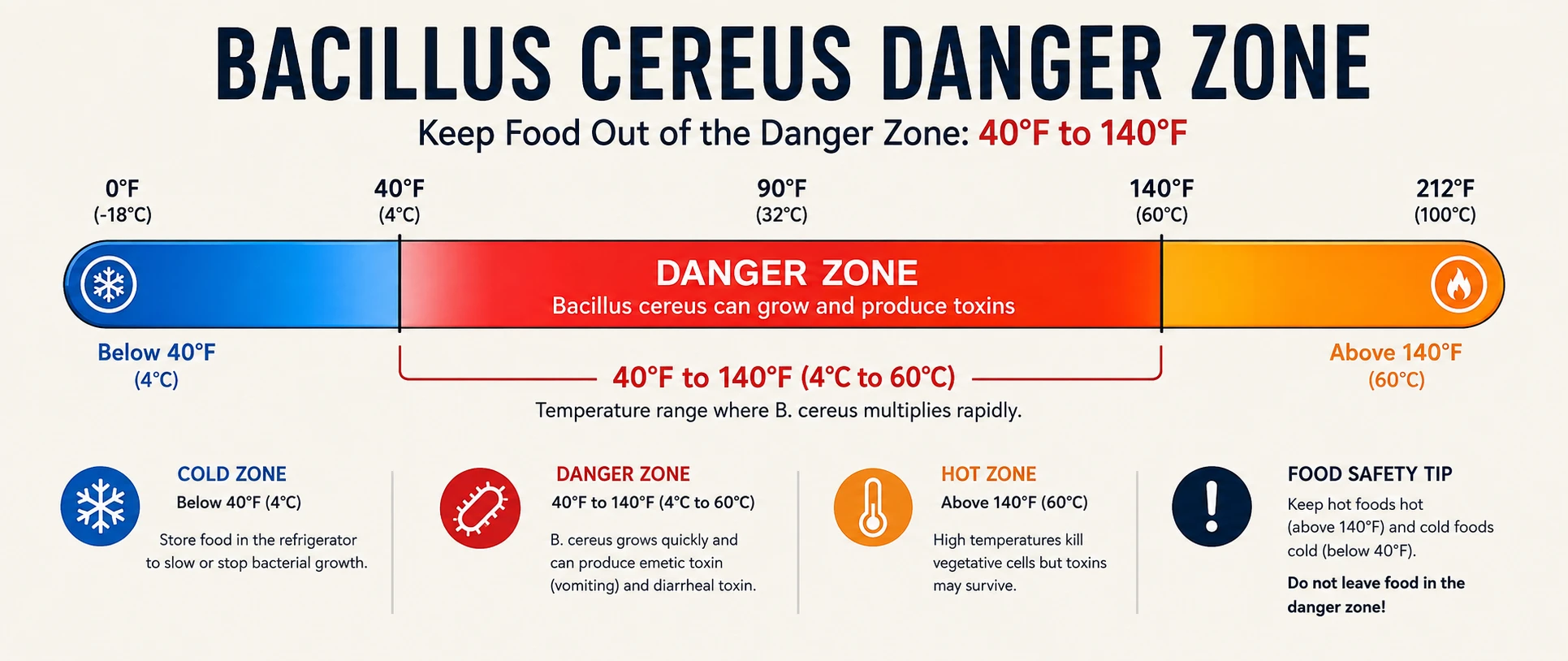
Spread leftover rice in a shallow container instead of leaving it in a deep pot. A thin layer cools far faster, minimizing time spent in the 40°F-140°F danger zone.
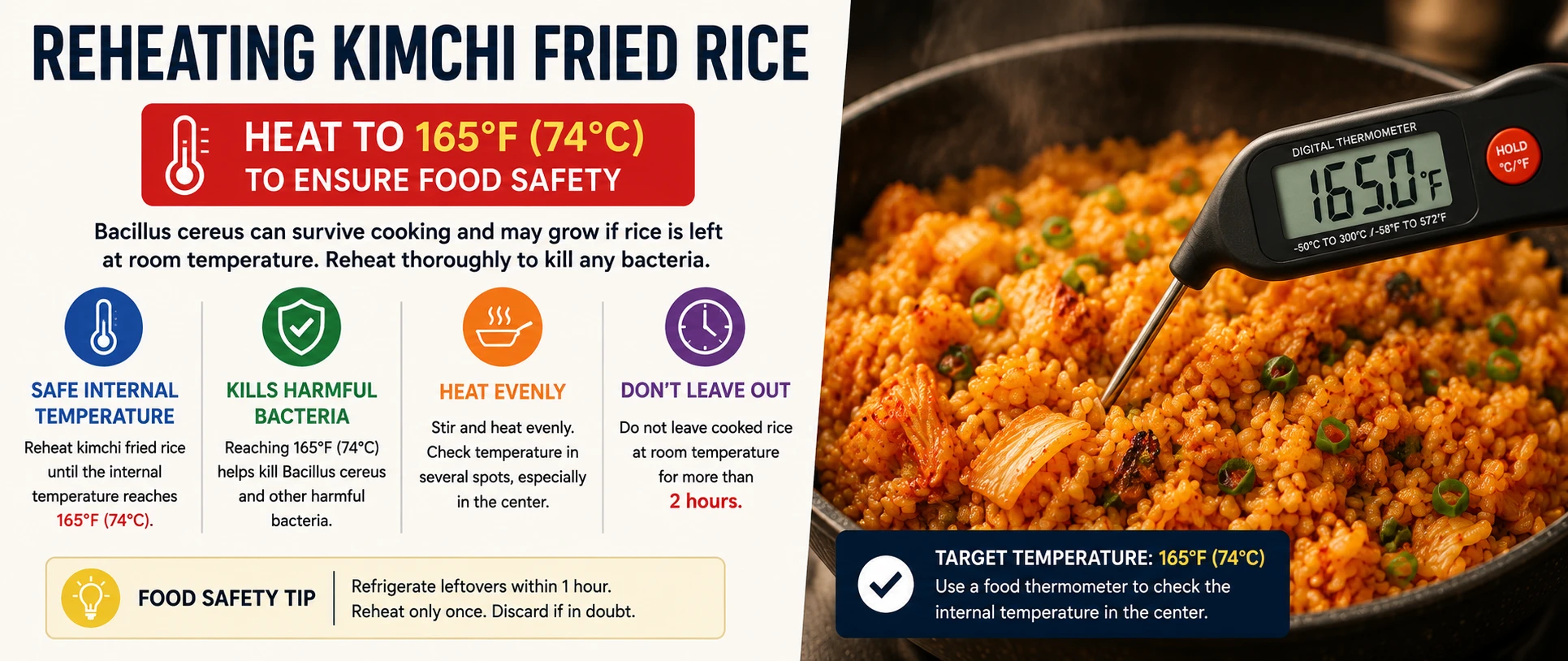
Get cooked rice or kimchi fried rice into the fridge within 2 hours of cooking. If the room is above 90°F (32°C), that window shrinks to 1 hour.
Store at or below 40°F (4°C). Avoid overpacking the fridge, which can raise internal temperature and slow the cooling of newly added leftovers.
Eat refrigerated rice or kimchi fried rice within 3 to 4 days. Freeze it if you need longer storage — freezing halts further bacterial growth, though it doesn’t undo earlier mishandling.
Reheat a single portion at a time rather than the whole batch repeatedly. Each additional cool-and-reheat cycle adds more opportunity for bacterial growth.
Heat to an internal temperature of at least 165°F (74°C), stirring partway through — especially in the microwave, where uneven heating leaves cold spots.
Common Mistakes That Cause Fried Rice Syndrome
These four habits account for nearly every real-world case — and every one of them is fully preventable.
When to Seek Medical Help
Most cases of fried rice syndrome are mild and self-limiting, resolving within 24 hours with rest and fluids at home. This section is general food-safety education, not personal medical advice — if you have specific health concerns, a healthcare provider is best placed to assess your situation.
Mild nausea, vomiting, or diarrhea that resolves within a day, with normal fluid intake and no high fever, typically doesn’t require medical intervention beyond rest and hydration.
Symptoms last more than 24-48 hours, you can’t keep fluids down and show signs of dehydration, you develop a high fever, or you notice blood in vomit or stool.
Related Guides
Put safe storage into practice across the full Kimchi Fried Rice family.


Fried Rice Syndrome FAQ — 20 Questions
Fried rice syndrome is the common nickname for food poisoning caused by Bacillus cereus, a spore-forming bacterium naturally found in soil and on raw starchy foods like rice. It got its name because rice is often cooked, left at room temperature, and reheated later — exactly the conditions that let the bacteria multiply and produce toxin.
No. Bacillus cereus can grow on any starchy food handled the same way, including pasta, potatoes, and other grains. The nickname comes from rice specifically because fried rice recipes so often start with day-old, previously cooled rice, but the underlying risk applies to leftover starches in general.
Symptoms typically include nausea, vomiting, watery diarrhea, and abdominal cramping. There are two illness types: an emetic (vomiting) form that appears within 30 minutes to 6 hours, and a diarrheal form that appears within 6 to 15 hours. Most cases resolve within 24 hours.
Most cases resolve on their own within 24 hours as the body clears the toxin. Severe or prolonged cases are rare but possible, particularly with the emetic toxin form, which has been linked to serious complications in isolated cases.
Death from Bacillus cereus food poisoning is very rare, but not impossible — a small number of documented cases involving the emetic toxin have resulted in liver failure. The overwhelming majority of cases are self-limiting and resolve within a day without lasting harm.
Cooked rice should not sit at room temperature for more than 2 hours. If the room is above 90°F (32°C), that window shrinks to 1 hour. Bacillus cereus spores that survive cooking can multiply rapidly once rice sits in this temperature danger zone.
Not meaningfully safer in practice. Well-fermented kimchi is more acidic (roughly pH 4.2) than plain cooked rice (roughly pH 6-7), and Bacillus cereus generally struggles to grow well below pH 4.8. However, kimchi fried rice is still mostly rice by volume, and the rice itself is not acidified by sitting next to kimchi during a quick stir-fry — so standard cooling and storage rules still apply in full.
No. There’s no evidence that kimchi’s lactic acid bacteria or acidity actively kill Bacillus cereus spores once they’re present in cooked rice. The lower pH can slow bacterial growth in the kimchi itself, but this doesn’t extend meaningfully to protect the rice portion of a mixed dish like kimchi fried rice.
Normal cooking and reheating temperatures (above 165°F / 74°C) kill the active bacteria, but Bacillus cereus produces heat-resistant spores and, in its emetic form, a heat-stable toxin called cereulide that survives reheating even at high temperatures. This is why reheating alone cannot make already-mishandled rice safe again.
Reheating kills the active bacteria but does not destroy the heat-stable cereulide toxin if it has already formed. If rice was left out too long and toxin has developed, reheating will not make it safe — this is why proper cooling and storage in the first place matters more than reheating temperature.
Cool it quickly by spreading it in a shallow container rather than a deep pot, refrigerate within 2 hours of cooking, and keep it at or below 40°F (4°C). Use within 3 to 4 days and reheat only the portion you plan to eat immediately to an internal temperature of at least 165°F (74°C).
The emetic form produces a heat-stable toxin called cereulide and causes vomiting within 30 minutes to 6 hours; it is most associated with starchy foods like rice. The diarrheal form produces a different, heat-labile toxin and causes watery diarrhea and cramping within 6 to 15 hours; it is more often linked to meat, dairy, and vegetable dishes.
The topic resurfaces periodically online after individual case reports get shared, since the idea of ordinary leftover rice causing serious illness is a compelling, shareable warning. It’s not a new or emerging illness — Bacillus cereus food poisoning has been documented in medical literature for decades.
Freezing prevents further bacterial growth once rice is already safely stored, but it doesn’t undo mishandling that happened before freezing. Cool and refrigerate rice properly first — freezing is a good next step for longer storage, not a substitute for the initial 2-hour cooling rule.
Day-old rice is not inherently dangerous — it’s actually preferred for kimchi fried rice because its dried-out texture fries better. It’s dangerous only if it wasn’t cooled and refrigerated properly after the first cooking. Rice cooked, refrigerated within 2 hours, and used within 3-4 days is the standard safe practice.
No. Rice contaminated enough to cause fried rice syndrome usually looks, smells, and tastes completely normal. This is what makes proper time and temperature handling more important than relying on your senses to judge whether leftover rice is safe.
The CDC estimates Bacillus cereus causes tens of thousands of foodborne illness episodes annually in the United States, though it is likely underdiagnosed since most cases resolve quickly without a doctor visit or lab testing to confirm the specific bacterium.
Most cases resolve within 24 hours with rest and fluids. Seek medical attention if symptoms last more than 24-48 hours, if you can’t keep fluids down and show signs of dehydration, if you have a high fever, or if you see blood in vomit or stool.
Bacillus cereus can affect anyone, but people with weaker or developing immune systems — including young children, pregnant women, older adults, and immunocompromised individuals — are generally more vulnerable to more severe symptoms from any foodborne illness, including this one.
Refrigerate cooked rice within 2 hours of cooking (1 hour if the room is hot), and don’t leave it out again for long stretches afterward. This one habit prevents the vast majority of Bacillus cereus food poisoning cases, regardless of what the rice is eventually cooked into.


💬 Leave a Comment
Questions about storing or reheating your own kimchi fried rice? Ask below.