Vegetarian Kimchi Jjigae (채식 김치찌개 — No Meat, Egg & Dairy OK)
The same aged-kimchi base as the classic recipe, with sauteed mushrooms and a soft-set egg replacing the meat, and a kelp-and-dried-shiitake stock replacing the anchovy-kelp stock. Distinct from the fully plant-based Vegan version — egg and dairy are allowed here — and a reminder that most kimchi itself needs a jeotgal-free label check to actually be vegetarian.


What Is Vegetarian Kimchi Jjigae?
Vegetarian kimchi jjigae — 채식 김치찌개 — is the same Stage 3 aged-kimchi stew as the classic recipe, with sauteed mushrooms and firm tofu replacing the meat, and a soft-set egg cracked in at the end for richness and protein. The two things that make this version work: using a kelp-and-dried-shiitake stock instead of the classic anchovy-kelp stock (mushroom’s meaty flavour still needs a strong umami base to lean on), and confirming your kimchi is genuinely jeotgal-free — most store-bought kimchi is seasoned with fish sauce or salted shrimp, which quietly disqualifies an otherwise “vegetarian” recipe. Get both right and you get a satisfying, egg-finished jjigae distinct from the fully plant-based Vegan version. Serves 4 in 30 minutes at approximately 220 calories and 13g protein per serving.
Why This Version Works — Umami Without Meat
Dropping the meat sounds like it should risk a thin, one-note stew — in practice, mushroom’s natural glutamates, a proper sear, and an egg finish keep this version genuinely satisfying, not just a broth with vegetables floating in it.

Shiitake and king oyster mushrooms carry naturally high levels of free glutamate — the same amino acid responsible for savoury depth in meat and aged cheese. Dried shiitake concentrates this even further, which is exactly why it goes into the stock as well as the stew itself.

Mushrooms contain enough natural sugar and protein to undergo their own Maillard reaction — searing them hard before adding liquid builds a genuine fond, the same browning logic used for meat elsewhere in this family. Adding raw mushrooms straight to the broth skips this step entirely and produces a flatter result.

Removing the anchovies from the classic anchovy-kelp stock takes out a major umami source, so dried shiitake steps in to close most of that gap. Plain kelp stock or water alone leaves this version tasting noticeably thinner than any other recipe in the family.

Cracked directly into the simmering broth and covered until softly set, the egg adds richness and a complete protein source without meat — the exact fork in the road between this recipe and the fully plant-based Vegan version, which omits it and leans entirely on mushroom and tofu instead.
The Origin of Meatless Kimchi Jjigae
A meat-free jjigae isn’t a modern invention grafted onto an old dish — Korea has a genuine, centuries-old tradition of meatless stews, though it comes from a different lineage than “vegetarian” as an international dietary label.
The word 찌개 (jjigae) comes from a verb root meaning “to stew” or “to simmer down,” describing thick communal stews served bubbling in the pot they were cooked in. Kimchi-jjigae’s classic form is built on pork, the historically dominant protein in inland Korean households, prized for the way its fat rounds out the kimchi’s acidity.
Korea’s oldest meat-free cooking tradition comes from Buddhist temple cuisine (사찰음식, sachal eumsik), which has relied on mushrooms, tofu, and fermented vegetables for umami and protein for well over a thousand years — long before “vegetarian” existed as a modern dietary framing. This home-style version borrows that same mushroom-and-tofu logic but stays closer to everyday household cooking than to strict temple practice, which is why it keeps garlic, onion, and an optional egg that temple food traditionally avoids. Today it’s a genuine underserved middle ground — for readers who want to skip meat without going as far as the fully plant-based Vegan version.
Vegetarian vs Vegan — Two Approaches Compared
“Meatless” isn’t one single thing — readers searching for a vegetarian jjigae and readers searching for a vegan one often want genuinely different results. Here’s exactly where this recipe sits, and where the fully plant-based version differs.

- Egg cracked directly into the broth for richness and protein
- A small pat of butter off-heat is an optional, non-traditional finish some households add
- Still requires jeotgal-free (vegetarian-labeled) kimchi
- Mushroom and tofu still carry most of the umami and bite
Result: Richer and slightly higher in protein than the vegan version, thanks to the egg — the recommended choice unless you need a strictly plant-based result.

- No egg, no dairy, no animal products at all
- Relies entirely on mushroom and tofu for protein and richness
- Requires the exact same jeotgal-free kimchi check as this recipe
- A slightly lighter, less rich result than the egg-finished version
Result: The right choice for a strictly plant-based diet. See the Vegan Kimchi Jjigae recipe for that version’s specific technique.
Comparison at a Glance
| Factor | Vegetarian ⭐ | Vegan |
|---|---|---|
| Egg Allowed | Yes | No |
| Dairy Allowed | Yes | No |
| Kimchi Requirement | Jeotgal-free (vegetarian-labeled) | Jeotgal-free (vegan-labeled) |
| Primary Protein Source | Tofu + egg + mushroom | Tofu + mushroom only |
| Protein per Serving | ~13g | Lower — no egg contribution |
Key Terms — Language & Food Science Entities
These terms define the technique and vocabulary specific to the vegetarian version — see the full silo glossary on the Kimchi Jjigae Hub for terms shared across the whole family.
Which Mushroom to Use — Four Options Ranked
Not all mushrooms carry the same umami weight — here’s how the common options compare for this specific recipe.

The recipe as written. Best balance of umami depth from shiitake and meaty chew from king oyster (eryngii).
⭐ Best Choice
A solid single-mushroom option if king oyster isn’t available — strong umami, slightly less textural contrast.
✅ Good Alternative
Genuinely meaty texture when sliced thick, though milder umami on its own than shiitake — works best paired with a strong stock.
Good Alternative Texture
Widely available, but noticeably milder — used alone, it leaves the stew tasting thinner than the recipe intends.
❌ Not Recommended AloneHow Meatless Kimchi Jjigae Varies by Household
Because temple cuisine and home-style vegetarian cooking are separate traditions, the real variation here runs from strict temple practice through to modern fusion touches — not by geography.

The most common household approach for a vegetarian (not vegan) version — mushroom and tofu as the base, garlic and onion included as usual, egg cracked in at the end. This recipe follows this style.
This Recipe’s Base
Traditional Buddhist temple cooking excludes garlic and onion entirely alongside all meat, relying purely on mushroom, kelp, and fermented vegetable umami — a stricter, separate tradition from this recipe.
Stricter, No Alliums
Some households lean more heavily on tofu and less on mushroom to stretch the recipe further — a common, inexpensive adjustment that keeps the dish filling.
Most Affordable
A modern, non-traditional fusion touch — a small pat of butter stirred in off-heat for extra richness, only possible because this version allows dairy at all.
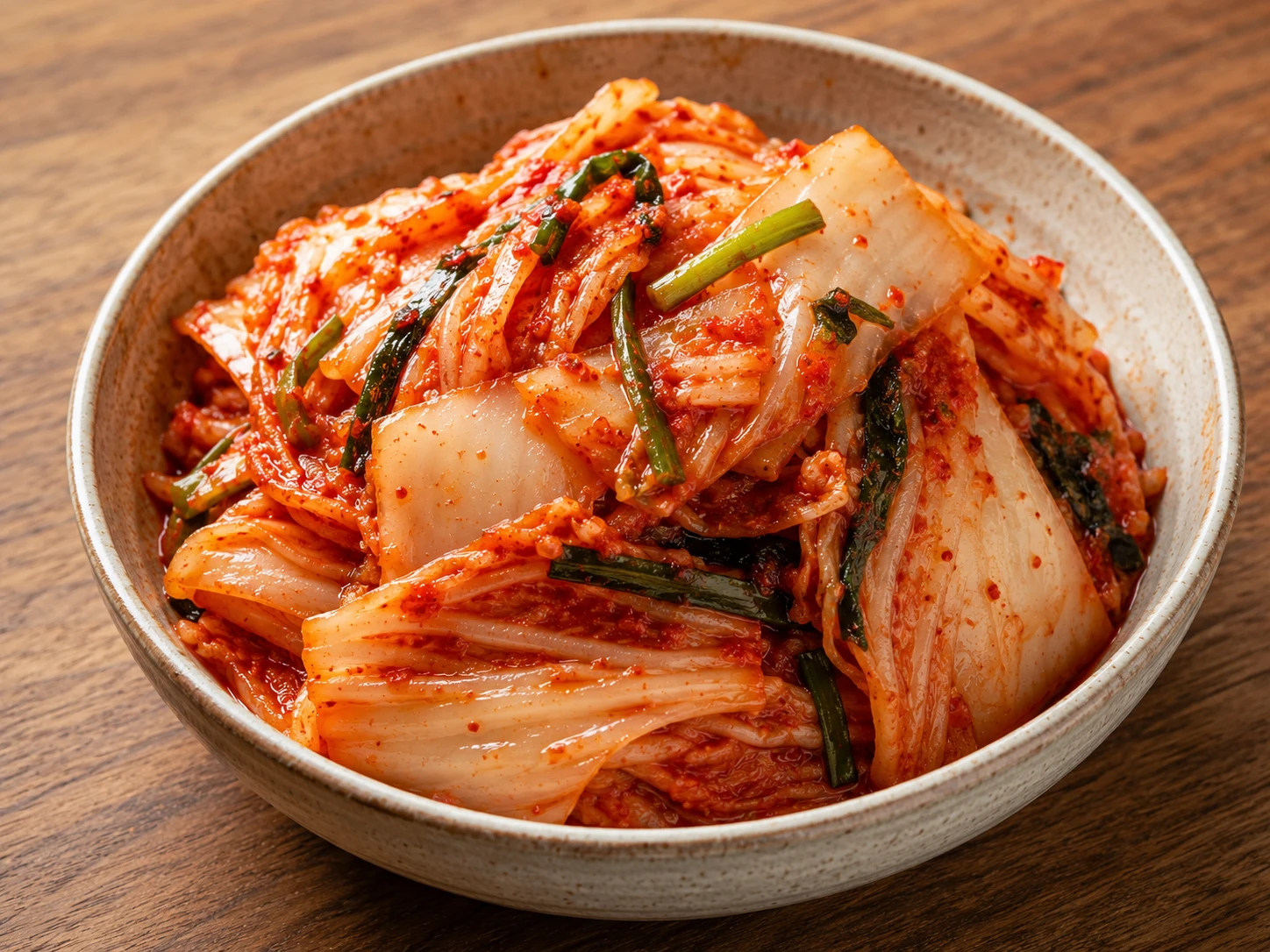
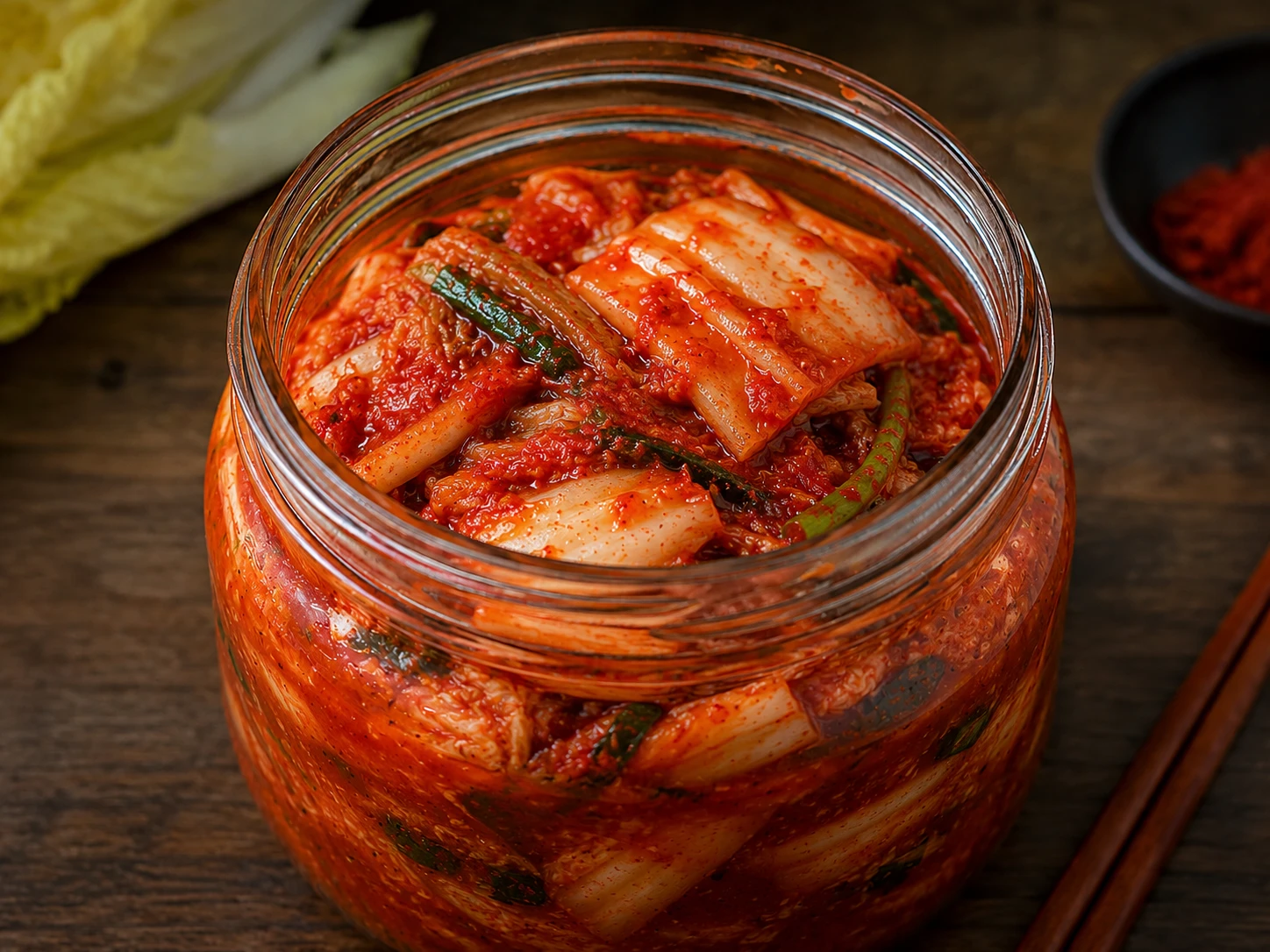
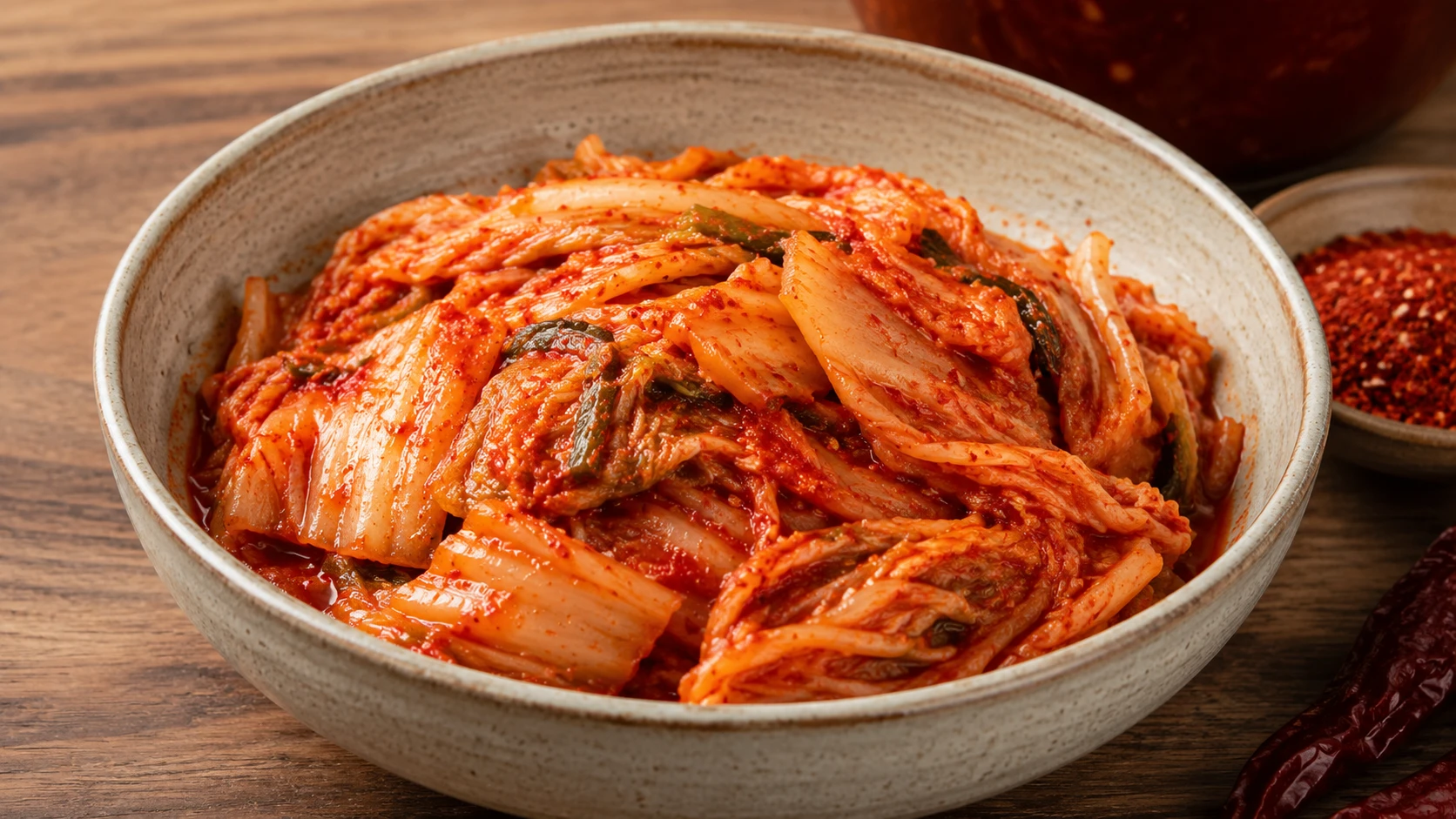
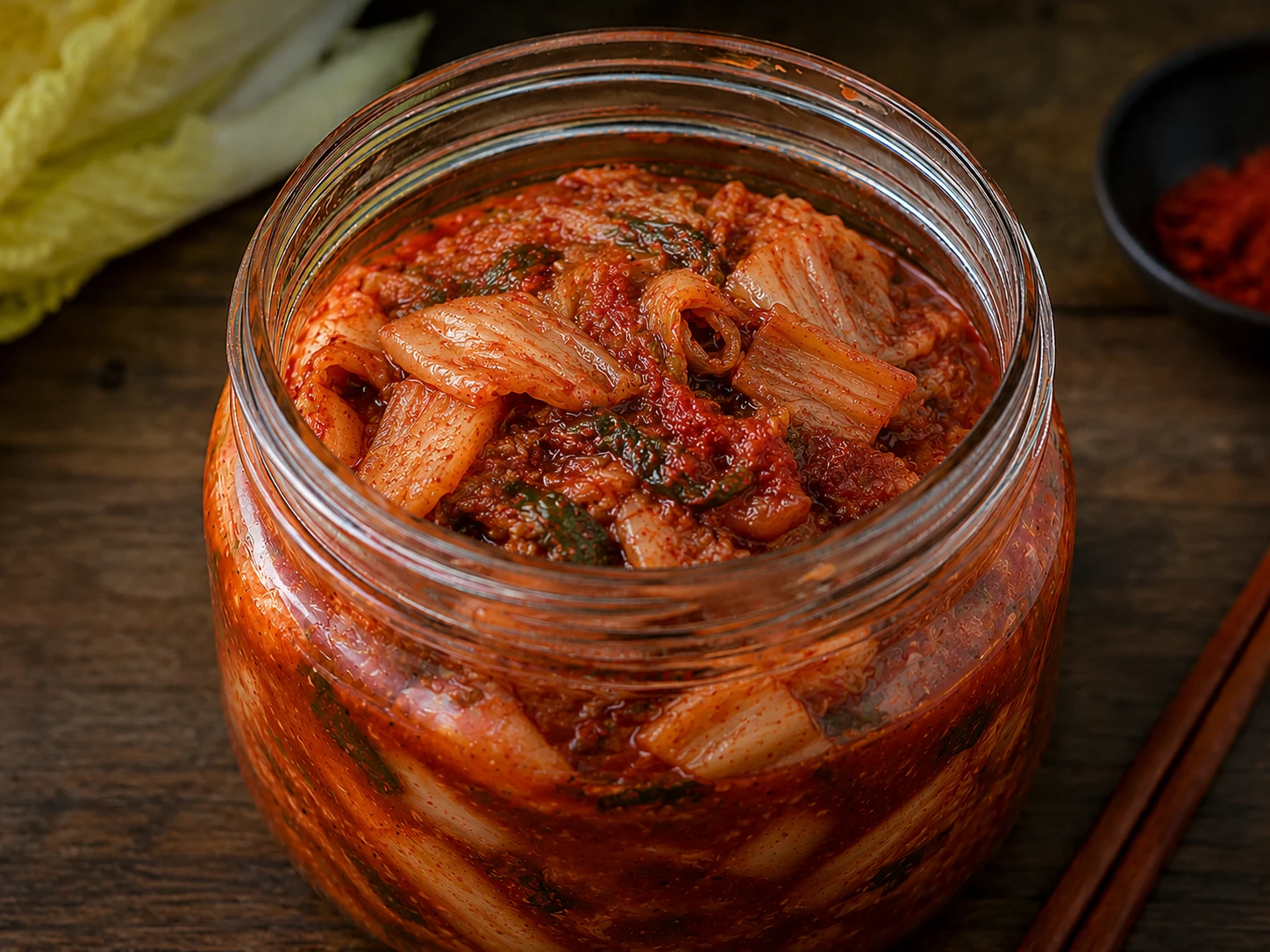
Modern Fusion TouchWhich Kimchi Stage to Use — Vegetarian Version Guide
Fermentation stage and protein choice are independent variables — Stage 3 remains the correct default here, just like every other recipe in the family. The variable that actually changes for this version is checking your kimchi is jeotgal-free.
Seasonal Adjustments — Summer vs Winter
The core recipe doesn’t change by season, but two things worth adjusting do: how your kimchi is fermenting, and how much mushroom versus tofu you lean on.
- Kimchi ferments noticeably faster in summer heat — check it 3-5 days earlier than the timeline in the kimchi-stage guide above suggests
- Leaning more on tofu and less on mushroom keeps the dish lighter for warm-weather eating
- A shorter simmer keeps the broth from feeling too heavy in warm weather
Result: The recipe stays the same — only your kimchi timeline and tofu-to-mushroom ratio shift.
- Kimchi ferments more slowly in cold storage — Stage 3 (3-6 weeks) is a reliable timeline, and over-ripe Stage 4 kimchi is far more commonly on hand in winter households
- Extra mushroom, and a fully set (rather than jammy) egg, suit winter better — more body and a heartier bite
- Winter is traditionally when jjigae is eaten most often in Korean households, precisely because well-aged kimchi is naturally more available
Result: Winter is genuinely the recipe’s home season — well-fermented kimchi is easiest to source, and the dish is at its best.
How Difficult Is the Vegetarian Version?
Still beginner-to-easy — the only extra skills versus a from-scratch stock recipe are browning the mushrooms properly and timing the egg to your preferred doneness.
Equipment — Ttukbaegi vs Regular Pot vs Instant Pot
You don’t need a traditional stone pot to make this well, but it does change the eating experience — here’s how the three most common options compare. See the full Ttukbaegi Buying Guide for sizing and care details if you’re considering buying one.
| Equipment | Heat Retention | Serving Style | Best For |
|---|---|---|---|
| Ttukbaegi (뚝배기) ⭐ | Excellent — stays bubbling at the table for 10+ minutes, which also keeps the egg gently cooking after serving | Serve directly in the pot, communal-style | Authentic texture and presentation; worth the investment if you cook Korean stews often |
| Stainless Steel or Enamelled Pot | Good, but cools noticeably faster than clay | Ladle into individual bowls to serve | Most households — performs the recipe identically, just loses the tableside bubbling |
| Instant Pot / Electric Pressure Cooker | N/A — used for the stock and sauté stage only, not final serving | Transfer to a pot or bowl to serve | Building the kelp-shiitake stock quickly; sauté function works well for browning the mushrooms too |
Ingredients + Scaler
Jeotgal-free kimchi, a kelp-shiitake stock, and a proper mushroom sear are the non-negotiables. Everything else follows the same base kimchi jjigae logic as the classic recipe.

Substitutions & Allergen Notes
The single most important note in this whole recipe is the first one below — everything else is a straightforward swap.
Sourcing Guide — Finding Ingredients Outside Korea
Most ingredients here are easy mainstream-supermarket finds — the one item worth real care is the kimchi itself.
How to Make Vegetarian Kimchi Jjigae — 5 Steps
Five steps. The key difference from a straight simmer-everything-together approach: the mushrooms are seared separately first, exactly like meat would be in the other jjigae versions, and the egg goes in last rather than at the start.

Pat sliced mushrooms dry and sear in a little oil over medium-high heat, 3-4 minutes, until golden and any released liquid has cooked off. Remove and set aside.
Don’t crowd the pot during this step — if the mushroom pieces are touching, they’ll steam in their own released liquid rather than sear, and you’ll miss the fond that gives the broth its depth later. Work in two batches if your pot isn’t large enough to give each piece breathing room.

In the same pot, using the residual oil, saute the chopped kimchi for 2-3 minutes to deepen its flavour, scraping up any browned bits left by the mushrooms.
This scraping step (deglazing, in cooking terms) is where the fond from step 1 actually integrates into the dish — use your spatula’s edge to work the browned bits loose as the kimchi releases its own liquid. You should see the pot bottom go from crusted to clean as the kimchi cooks.

Add stock, kimchi brine, gochugaru, gochujang, garlic, ginger, and onion. Return the seared mushrooms to the pot. Simmer for 10 minutes to let the flavours come together.
This stage is doing double duty — building the broth’s flavour while the mushrooms continue to release their umami into the liquid. Unlike meat, there’s no undercooking risk here, so this simmer time is mainly about flavour development rather than food safety.

Add the cubed tofu and simmer a further 3-4 minutes until heated through.
This stage is mainly about warming the tofu through and letting it absorb some of the broth’s flavour. Stir gently to avoid breaking the tofu cubes apart.

Crack the egg directly into the broth, cover, and simmer 2-3 minutes for a jammy set or 5 minutes for fully set. Remove from heat, drizzle with sesame oil, taste and adjust salt, and scatter spring onions on top. Serve hot with rice.
This is the one step where timing genuinely comes down to personal preference — use the Egg Timing Tool below to track it, and don’t worry about getting it “wrong,” since both jammy and fully set are correct depending on what you like.
What We Tested for the Vegetarian Version
Three variables decide whether this recipe tastes like a proper jjigae or a thin vegetable soup with kimchi in it. Here’s what we found.
Every other jjigae in this family gets a meaningful umami boost from its protein — pork fat, chicken fond, seafood liquor. Without any of that, this version leans harder on the stock than any other recipe in the silo. Skipping the dried shiitake step is the single most common way this recipe goes wrong.
Troubleshooting — Common Mistakes & How to Fix Them
Most problems with this recipe trace back to one of four issues below — here’s what causes them and how to correct course.

Vegetarian Kimchi Jjigae (채식 김치찌개)
Sear-first method · Stage 3 kimchi · 30 min · ~220 calories, 13g protein
- 4 cups kelp-and-dried-shiitake stock (or vegetable stock)
- 1.5 cups aged, jeotgal-free kimchi (Stage 3), chopped
- 3 tbsp kimchi brine
- 1 tbsp gochugaru
- 1 tbsp gochujang
- 3 cloves garlic, minced
- 1 tsp ginger, minced
- ½ onion, sliced
- 150g mixed mushrooms (shiitake + king oyster), sliced
- 200g firm tofu, cubed
- 1 large egg (omit for vegan)
- 2 spring onions, sesame oil, salt to taste
- Sear mushrooms 3-4 min until golden. Remove, set aside.
- Saute kimchi in same pot 2-3 min, scraping up browned bits.
- Add stock, brine, gochugaru, gochujang, garlic, ginger, onion. Return mushrooms. Simmer 10 min.
- Add tofu, simmer 3-4 min.
- Crack in egg, cover, simmer 2-5 min to preferred doneness. Drizzle sesame oil, season, top with spring onions. Serve hot with rice.
The Kimchi Jjigae Family — 13 Variations
This is page 5 of a growing 13-recipe family, all built on the same aged-kimchi base. The Kimchi Jjigae Ultimate Guide → compares every variation as it’s published.


Pairing Guide — Vegetarian Version
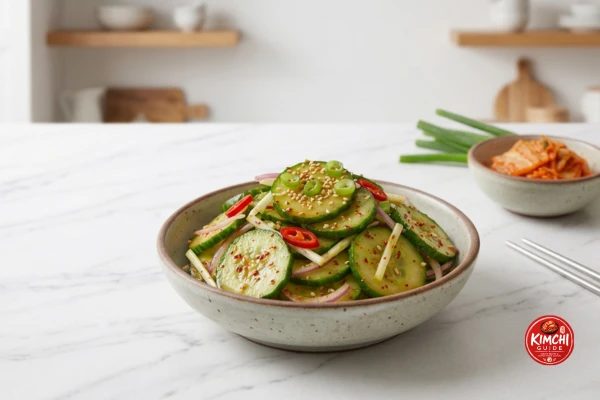
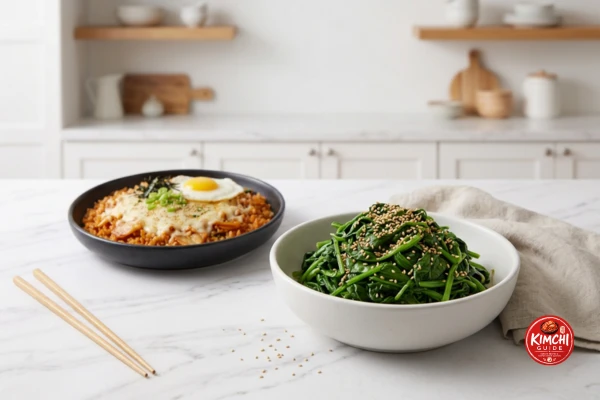
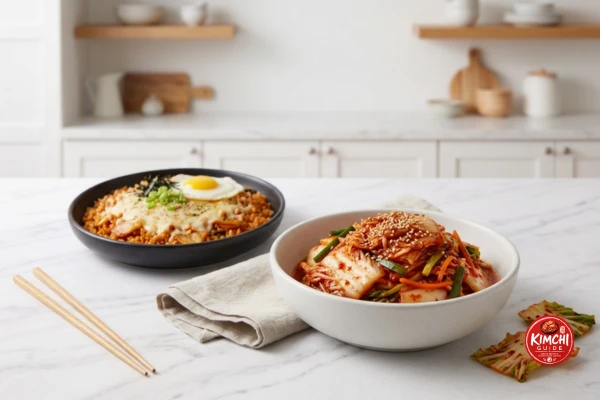
Because this version leans on mushroom and egg rather than meat, pairings that add a little extra protein or brightness round the meal out nicely.

Restaurant vs Homemade Vegetarian Kimchi Jjigae
This is a rarer menu item than the pork or seafood versions, and homemade has one advantage restaurant kitchens genuinely can’t match: certainty about what’s actually in the kimchi.
| Factor | Restaurant Version | This Homemade Recipe |
|---|---|---|
| Kimchi Verified Vegetarian | Rarely confirmed — most kitchens use one shared kimchi batch across all dishes, jeotgal included | You control and check the kimchi label yourself |
| Broth Base | Frequently the same anchovy-kelp stock used for every jjigae on the menu, regardless of the dish’s labeling | Genuinely anchovy-free kelp-and-shiitake stock, built specifically for this recipe |
| Egg Doneness | Usually one standard doneness, not adjustable | Adjustable to your preference with the Egg Timing Tool above |
| Sodium Level | Typically higher — restaurant broths are seasoned assertively for immediate impact | Adjustable to taste; nutrition figures above reflect a moderate seasoning level |
| Cost per Serving | $10-16 per bowl in most Western cities | Roughly $2-3 per serving when made at home |
Storage & Reheating — Vegetarian Version
The mushroom-tofu base stores well; the egg is the one component that needs separate handling.
Meal Prep — Batch-Cooking This Recipe for the Week
The base batches well for the week — just plan to add a fresh egg per portion rather than batching that part.
Detailed Nutrition Comparison — Vegetarian Version
A complete per-serving breakdown, reviewed by Dr. Sarah Mitchell RD, PhD, alongside how this recipe compares to the rest of the kimchi jjigae family.
Nutrition Facts
Per serving — recipe makes 4 servings
How Vegetarian Compares to the Rest of the Family
| Variation | Calories | Protein | Sat. Fat | Best For |
|---|---|---|---|---|
| Kimchi Guk | 130 | 9g | 1g | Lightest, lowest-sodium option in the family |
| Vegetarian ← This page | 220 | 13g | 2.5g | Meatless without going fully vegan, still gets complete protein from egg |
| Seafood Jjigae | 210 | 20g | 1.5g | Leanest jjigae-format option with meat/seafood |
| Chicken | 280 | 25g | 3g | Highest protein, significantly leaner than pork |
| Classic (Pork) | ~320 | 18g | ~7g | Coming soon — the family’s pillar recipe |
Sources & Further Reading
The food-science and nutrition claims on this page are cross-checked against the following references.
Vegetarian Kimchi Jjigae FAQ — 18 Questions
Not automatically — most commercial kimchi is seasoned with jeotgal (salted fermented shrimp or fish sauce), which makes it unsuitable for a strict vegetarian or vegan diet. Look for kimchi specifically labeled ‘vegetarian’ or ‘vegan’ on the package, or check the ingredient list for shrimp, anchovy, or fish sauce.
This recipe allows egg and dairy — the egg cracked in at the end is what sets it apart. The Vegan version (coming soon to the silo) omits egg entirely and relies solely on mushroom and tofu for richness and protein. Both versions need the same jeotgal-free kimchi.
No — it’s easy to omit for a fully plant-based result, though you’ll lose some richness and protein. If you’re leaving it out, see the Vegan Kimchi Jjigae version for a recipe built around that from the start.
A kelp-and-dried-shiitake stock, simmered the same way as the classic anchovy-kelp stock but with dried shiitake mushrooms replacing the anchovies. Plain vegetable stock also works but delivers noticeably less umami depth.
A mix of shiitake and king oyster (eryngii) gives the best combination of umami and meaty chew. Shiitake alone is a solid single-mushroom option; plain white or button mushrooms are too mild and are not recommended on their own.
Most mainstream gochujang brands are vegetarian — the base is fermented soybean, rice, and chili, with no meat or fish products. It’s still worth a quick label check on unfamiliar brands, since formulations can vary.
Cover the pot after cracking the egg in. Roughly 2-3 minutes gives a jammy, soft-set yolk similar to soondubu jjigae; 5 minutes gives a fully set egg. Use the Egg Timing Tool above to track it precisely.
Stage 3 aged kimchi (3-6 weeks, pH approximately 4.2) is correct for this recipe, same as the classic pork version and most other variations in the kimchi jjigae family — just confirm it’s a jeotgal-free brand.
Moderately, from the standard gochugaru and gochujang combination. Reduce gochugaru to 2 teaspoons for a milder result, or increase for more heat.
It can be — use a gluten-free gochujang brand and confirm your kimchi doesn’t contain wheat-based ingredients. Mushrooms, tofu, stock, and egg are all naturally gluten-free.
Yes — this recipe as written contains no dairy at all. The ‘egg/dairy OK’ framing simply means both are allowed if you want them, not that either is required; a small pat of butter stirred in at the end is an optional, non-traditional richness boost some households add.
The mushroom-tofu base holds and reheats well for 3-4 days. For best texture, add a freshly cracked egg to each portion when reheating rather than storing it already cooked into the batch.
The stock, mushrooms, and tofu freeze well for up to 2 months. Freeze before adding the egg, then crack a fresh egg in when you reheat — pre-cooked egg turns rubbery after freezing and thawing.
Approximately 13g of protein per serving, from a combination of tofu, egg, and mushrooms — noticeably less than the chicken or pork versions, but a genuine step up from a purely vegetable-based stew.
Yes — zucchini, Napa cabbage, or bean sprouts added alongside the tofu in step 4 all work well and are common home additions without changing the core technique.
No — Soondubu Jjigae is built on silken, uncurdled tofu and traditionally includes seafood or meat with an egg cracked in at the table. This recipe uses firm, cubed tofu and is deliberately built to be meat-free from the start.
No — this is a home-style vegetarian version, not a temple (sachal eumsik) recipe, so garlic and onion are both included as usual. Traditional Buddhist temple cooking in Korea does typically exclude alliums entirely; that’s a stricter, separate style than what’s written here.
Read the ingredient list for ‘fish sauce,’ ‘anchovy,’ or ‘salted shrimp’ (saewoojeot) — any of these mean it isn’t vegetarian, regardless of front-of-package marketing. When in doubt, a brand explicitly labeled ‘vegan kimchi’ is the safest choice, since vegan by definition excludes all of these.
Questions & Comments
Jammy or fully set egg? Leave a question below — Ji-Young reads and responds to every comment.
Your email will not be published. All comments are reviewed before appearing.