Is Surasang Kimchi Good? The Full Review — Taste, Ingredients & Wang Food Explained (2026)
A standalone deep-dive on the kimchi brand you’ll spot at mainstream grocery chains like Albertsons and Meijer — taste, genuinely vegan ingredients, nutrition, who actually makes it, Halal/Kosher status, and an honestly mixed, tested verdict.
Is Surasang Kimchi Good?
It’s a solid, honest middle-of-the-pack option — not a top scorer. In our tasting, Surasang scored 6.8/10. It’s made under Samjin Globalnet, a Korean food exporter founded in 1970, with US retail tied to the Wang Food import label. Its standard Napa Cabbage and Sliced Kimchi lines are genuinely vegan, using a kelp-and-shiitake vegetable stock instead of fish sauce, and it’s noticeably lower in sodium than several bigger brands. The trade-off: independent reviewers and our own tasters found the flavor milder and the texture less crisp than category leaders like Jongga or Bibigo. It shines as a budget-friendly, easy-to-find, cook-with kimchi rather than a bold one to eat straight from the jar — and it’s unusually easy to find, stocked at mainstream chains like Albertsons, Jewel-Osco, and Meijer, not just Korean grocers.
🛒 Check Price on AmazonSurasang Kimchi — At a Glance
Here’s what actually matters before you decide whether to put a jar in your cart.
- Taste: mild, less crisp than category leaders — 6.8/10 overall.
- Made by: Samjin Globalnet (est. 1970), US-distributed under the Wang Food label.
- Ingredients: standard line is fish-free and vegan — but not every Surasang product is.
- Nutrition: ~10 kcal, 170mg sodium per 1.06oz (30g) serving — lower-sodium than most.
- Halal/Kosher: no formal certification found — check the package if this matters to you.
- Availability: unusually wide — Albertsons, Jewel-Osco, Meijer, World Market, plus Asian grocers and online.
Surasang Kimchi — Product Overview & Scorecard
Here’s how Surasang scored across our core taste-test criteria, tested with the same methodology we use across every brand on this site.

Who Makes Surasang Kimchi? Samjin Globalnet & Wang Food Explained
Surasang’s ownership story is less widely documented than Daesang’s or CJ CheilJedang’s, but it’s consistent enough across retail sources to piece together clearly.
Surasang is a brand under Samjin Globalnet, a South Korean company founded in 1970 that describes itself as dedicated to exporting traditional Korean foods internationally, with multiple brands and a wide product catalog beyond just kimchi. In US grocery listings — including Albertsons, Jewel-Osco, and Star Market product pages — Surasang’s packaging is tied to the website wangfood.com, and several online marketplaces list “Wang Korea” as the brand name for specific Surasang items. Taken together, the most accurate picture is that Wang Food / Wang Korea functions as the brand’s US import and distribution arm, while Samjin Globalnet is the Korean manufacturer and global brand owner. We’re presenting both names plainly here because sourcing on the exact corporate relationship is thinner than for the larger conglomerate-owned brands we’ve reviewed.
The name itself carries real heritage weight: in Korean, 수라상 (Surasang) refers to the royal court’s daily meal table from the Joseon dynasty — historically the king’s table, set with numerous elaborate side dishes. It’s a naming strategy similar in spirit to Jongga’s “head family house” branding: both signal tradition and craft rather than mass-market convenience, even though the companies behind them are very different in scale.

Unlike Daesang or CJ CheilJedang, which are large fermentation-focused conglomerates, Samjin Globalnet operates on a smaller scale with a wide catalog spanning kimchi, frozen dumplings, sauces, and snacks — a generalist Korean grocery exporter rather than a kimchi specialist.

Where Jongga’s strategy leaned on proving out traditional flavor before scaling internationally, Surasang’s real strength is showing up in the everyday grocery aisle — mainstream US chains most Korean brands haven’t reached — even if the flavor itself reads milder as a result.
Where Surasang Actually Fits — Product Range & Footprint
Surasang isn’t a kimchi-only brand, and it doesn’t have Daesang’s or CJ’s press machine — here’s what’s actually documented about its reach.
Surasang’s catalog extends well past jarred cabbage kimchi. Alongside Napa Cabbage Kimchi, Sliced Kimchi, Cut Cabbage Kimchi, and Mustard Leaf (Gat) Kimchi, the brand also sells frozen Kimchi Mandu (dumplings), kimchi buns, a Kimchi Hot Sauce made with real kimchi and gochugaru, Kimchi Ketchup, cold noodles, tteokbokki (Korean rice cakes, including a rosé variety), and a Korean fried chicken (yangnyeom) sauce. That range positions Surasang closer to a broad Korean pantry-and-freezer brand than a kimchi specialist — a meaningfully different profile than Jongga or Bibigo, which built their reputations specifically around fermentation expertise.
On distribution, Surasang has genuinely unusual reach for a smaller brand: it’s stocked at mainstream US grocery banners including Albertsons, Jewel-Osco, and Star Market (all part of Albertsons Companies), plus Meijer and World Market — chains that don’t typically carry harder-to-find Korean import brands. It’s also sold through Korean and Asian grocery stores, Amazon, and Weee! Asian Market online, and social media activity suggests international reach as well, including retailers like Hanaro Mart in Brisbane, Australia.
Key Terms — Surasang & Fermentation Entities
These terms explain what’s actually behind some of Surasang’s specific claims and positioning.
Taste & Texture — What Reviewers Actually Say
Surasang’s reputation is genuinely mixed, and we’re not going to pretend otherwise — this is where our tasting most clearly diverges from the top-scoring brands on this site.
The most consistent critical theme, echoed by our own tasting and by published third-party reviews such as Tasting Table’s ranked brand comparison, is that Surasang reads as noticeably milder than most Korean kimchi. It’s missing the pronounced chili heat that defines brands like Jongga, and tasters who specifically crave a bold, sinus-clearing spice level are likely to come away underwhelmed. Texture is the other consistent weak point: cabbage softens faster and doesn’t deliver the same crisp bite that higher-scoring brands hold onto for weeks after opening.
That said, mildness isn’t automatically a flaw — it depends entirely on what you’re looking for. For kimchi newcomers intimidated by more aggressive ferments, or for anyone specifically buying kimchi as an ingredient to fold into a soup or stew rather than eat as a standalone banchan, Surasang’s gentler profile is a genuine, honest upside rather than a shortcoming to apologize for. Reviewers have specifically noted it works better as a soup addition than as a crunchy side dish eaten straight from the jar.
It’s also worth being clear-eyed about what a 6.8 out of 10 means here: it isn’t a poor product, it’s an honestly average one, with real, specific strengths (genuinely vegan, low sodium, unusually easy to find) that sit alongside real, specific weaknesses (mild flavor, softer texture) rather than either extreme.
Real Ingredients Breakdown
Pulled directly from the retail ingredient panel for Surasang’s standard Napa Cabbage Kimchi — not a marketing summary.
| Ingredient | Role |
|---|---|
| Salted napa cabbage | Base vegetable |
| Vegetable stock (kelp, green onion, shiitake mushroom, squash) | Umami base — replaces fish sauce |
| Radish, radish extract | Traditional secondary vegetable / seasoning |
| Red pepper powder (gochugaru) | Color and heat |
| Garlic, onion, ginger | Aromatics |
| Apple puree, sugar, sorbitol | Sweetness and fermentation balance |
| Carrot, green onion | Texture and color |
| Ascorbic acid, xanthan gum | Stabilizers |
The absence of fish sauce and shrimp is the single biggest ingredient difference versus brands like Jongga and Bibigo, which rely on fermented seafood for traditional umami depth. Surasang compensates with a kelp-shiitake-squash vegetable stock instead — a legitimate umami-building technique, but one that produces a noticeably different, gentler flavor profile than the seafood-forward standard most Korean kimchi is built on. That trade-off is very likely the main driver behind both the brand’s genuinely vegan positioning and its milder taste-test results.
Pasteurized or live-culture? We could not confirm from the retail label or manufacturer info whether Surasang’s standard refrigerated jar is a live-culture (unpasteurized, still-fermenting) product or a pasteurized, shelf-stabilized one — most refrigerated Korean kimchi is live-culture by default, but Surasang doesn’t state this explicitly on current packaging the way some brands do. If this matters to you, check the specific jar for a “live culture” or “pasteurized” claim, or see our full pasteurized vs. live-culture kimchi brands guide for brands that do state it clearly.
Surasang Kimchi Nutrition Facts
Like most kimchi, Surasang is very low in calories — and it’s notably lighter on sodium than several competing brands.
| Product | Serving | Calories | Sodium |
|---|---|---|---|
| Surasang Napa Cabbage Kimchi | 1.06 oz (30g) | 10 kcal | 170mg |
| Surasang Sliced Kimchi | 60g | 20 kcal | N/A — check label |
| Surasang Kimchi Gyoza (dumplings) | 8 pieces (108g) | 210 kcal | 500mg |
| Surasang Kimchi Bun | 1 bun | 200 kcal | N/A — check label |
Plain Surasang kimchi is genuinely light: third-party nutrition databases put a 1.06oz (30g) serving of the standard Napa Cabbage line at roughly 10 calories, 0g fat, 2g carbohydrate, and under 1g protein. The standout figure is sodium — at around 170mg per 30g serving, it runs meaningfully lower than the 200-270mg per 28g serving reported for some bigger-name competitors, likely a byproduct of the milder, less aggressively seasoned recipe. As always, Surasang’s frozen and prepared items (dumplings, buns, cold noodles) carry substantially more calories and sodium per serving than the plain jarred kimchi, so don’t extrapolate the plain-kimchi numbers to the rest of the product line.
Surasang’s Vegan, Halal & Kosher Status
This is one of Surasang’s clearest strengths — and one area where we have to be upfront about what we couldn’t confirm.

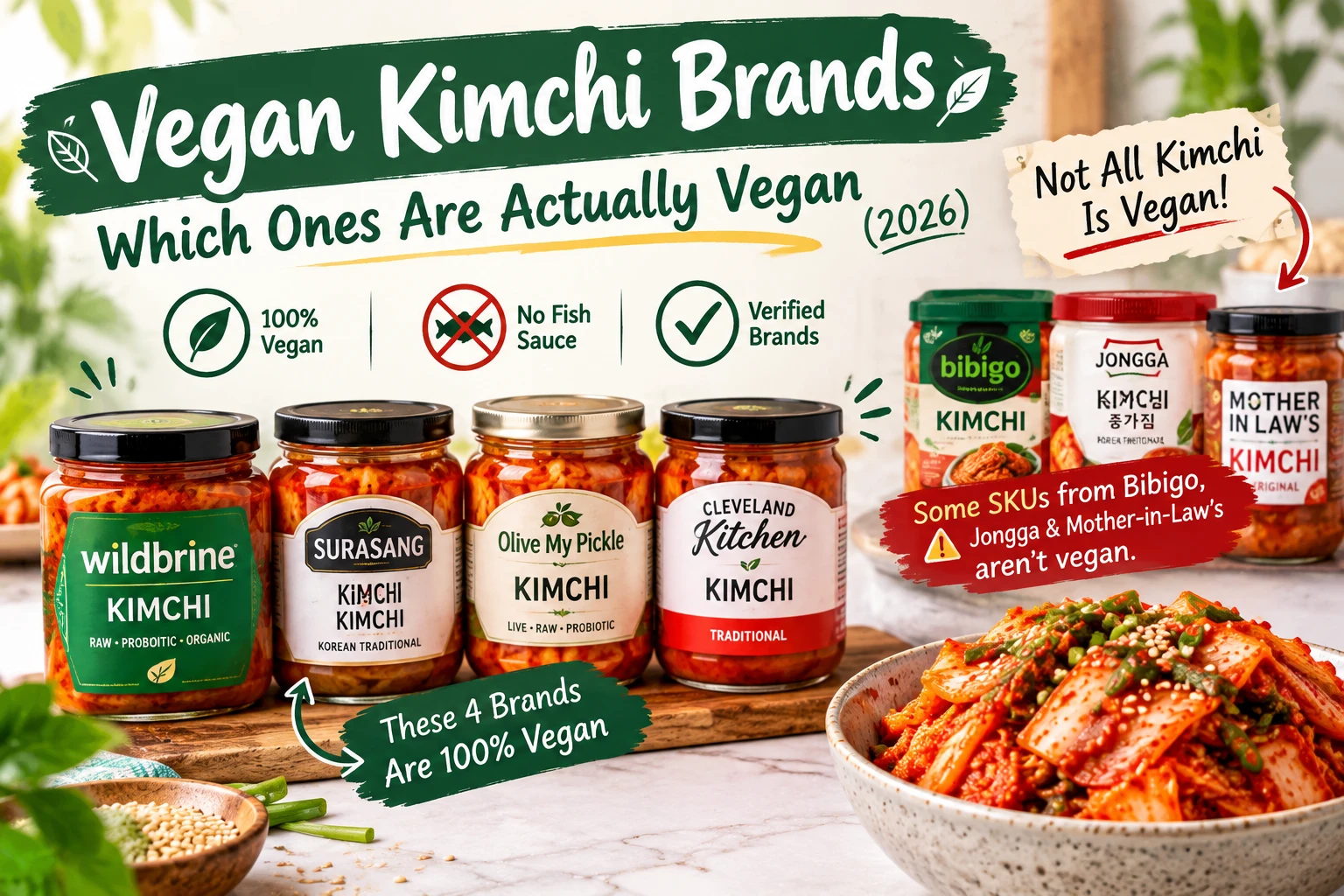
Unlike brands where “vegan” is a separate, smaller product line alongside a fish-sauce-based flagship, Surasang’s standard Napa Cabbage and Sliced Kimchi are vegan by default — the retail label states gluten-free, vegan, and no preservatives, and the ingredient panel backs that up with a kelp-shiitake vegetable stock in place of fish sauce. It’s also naturally gluten-free.

We found no evidence of a dated Halal or Kosher certification for Surasang products, unlike Jongga’s documented 2010/2014 certifications. That doesn’t necessarily mean the products contain disqualifying ingredients — the standard vegan line has no animal-derived ingredients at all — but without a formal certification mark, we can’t state Halal or Kosher status with confidence. See our full Halal & Kosher kimchi brands guide for brands that do carry documented certification.
Treat “vegan” as applying specifically to the standard cabbage and sliced kimchi lines, not the brand as a whole — the Mustard Leaf (Gat) Kimchi carries a shellfish allergen listing, and the frozen Kimchi Mandu has been independently reported to contain oyster. If plant-based eating is a firm requirement, stick to the plain jarred kimchi and check the label every time you buy, especially if you branch out into Surasang’s wider frozen and sauce lineup. See our full vegan kimchi brands guide for how Surasang’s standard line stacks up against every other brand’s plant-based options.
Safety & Quality Notes
Here’s what’s publicly documented — presented factually, without exaggeration.
Is Surasang Good for Cooking, or Best Eaten Raw?
Cooking is arguably Surasang’s strongest use case — and probably its best-kept secret.
Because Surasang’s flavor is milder and its texture softens faster, it doesn’t hold up as a standout raw side dish (banchan) the way a bolder, crunchier brand does — that’s the honest, consistent finding across both our tasting and published third-party reviews. But that same mildness becomes a genuine advantage once it’s cooked: milder, lower-sodium kimchi gives you more control over the final seasoning in dishes like kimchi jjigae or kimchi fried rice, letting you build heat and salt to your own preference with gochujang or gochugaru rather than fighting against an already-dominant base flavor.
Availability & Pricing
This is genuinely Surasang’s strongest category — wider mainstream reach than most Korean import brands of its size.
| Retail Channel | Availability |
|---|---|
| Albertsons, Jewel-Osco, Star Market | ✓ Reliably stocked |
| Meijer | ✓ Stocked |
| World Market | ✓ Stocked |
| Korean / Asian grocery stores | ✓ Full product range available |
| Weee! Asian Market (online) | ✓ Full range, competitive bulk pricing |
| Amazon | ✓ Available — kimchi, hot sauce, ketchup |
| Costco | ◐ Not commonly reported |
Surasang’s standard jars run notably budget-friendly: bulk pricing through Weee! Asian Market has been reported around $0.46-$0.49 per ounce for sliced and mustard-leaf varieties, while mainstream grocery chains typically stock smaller, more shelf-friendly jars (commonly around 7.58 oz). That’s competitive with or below several bigger-name brands, reinforcing Surasang’s positioning as an accessible, everyday option rather than a premium one.
🛒 Check Price on AmazonIf you don’t live near a Korean or Asian grocery store, Surasang is genuinely worth checking for at your regular mainstream supermarket first — its placement at Albertsons-family stores, Meijer, and World Market means it’s one of the few Korean kimchi brands realistically stockable on a standard weekly grocery run rather than requiring a special trip. Online ordering through Weee! or Amazon remains a solid fallback if it’s simply not carried near you.
How We Tested Surasang
This review draws on a dedicated tasting and label audit, using the same criteria we apply across every brand review on this site.

Related Guides
Naturally connected reading if you’re deciding on Surasang or want to put a jar to use.

Surasang Kimchi — 19 Questions Answered
Straight answers to what people actually search about Surasang kimchi.
It’s a solid, budget-friendly middle-of-the-road pick rather than a top-tier one. In our tasting, Surasang scored 6.8/10 — genuinely vegan on its standard line, low in sodium, and one of the easiest brands to find at mainstream US grocery chains, but noticeably milder in spice and less crisp in texture than category leaders like Jongga or Bibigo.
Surasang is a brand under Samjin Globalnet, a South Korean company founded in 1970 that exports traditional Korean foods internationally. In US retail listings, Surasang products are also tied to the “Wang Food” / “Wang Korea” import label (wangfood.com).
Surasang (수라상) refers to the traditional royal court table setting from the Joseon dynasty — the king’s daily meal table, historically laid with numerous elaborate side dishes. It’s a heritage-signaling name meant to evoke traditional, high-quality Korean home cooking.
The standard Napa Cabbage Kimchi and Sliced Kimchi lines are labeled vegan, gluten-free, and preservative-free, using a vegetable stock of kelp, shiitake mushroom, and squash for umami instead of fish sauce or shrimp. But not every Surasang product is vegan — its Mustard Leaf (Gat) Kimchi lists a shellfish allergen, and its frozen Kimchi Mandu has been reported to contain oyster. Always check the label on the specific product.
The standard Napa Cabbage and Sliced Kimchi lines do not, per their published ingredient lists. But the Mustard Leaf (Gat) Kimchi carries a shellfish allergen listing, and the Kimchi Mandu dumplings have been independently reported to contain oyster — so the brand is not uniformly fish/shellfish-free across its full range.
Per the retail ingredient panel: salted napa cabbage, water, vegetable stock (water, kelp, green onion, shiitake mushroom, squash, salt), kimchi sauce (radish extract, vegetable stock, red pepper powder, garlic, onion), radish, sorbitol, red pepper powder, sugar, garlic, onion, apple puree, carrot, green onion, salt, ginger, ascorbic acid, and xanthan gum.
We could not confirm from the retail label or manufacturer info whether Surasang’s standard refrigerated jar is live-culture (unpasteurized, still fermenting) or pasteurized. Most refrigerated Korean kimchi is live-culture by default, but Surasang doesn’t state this explicitly on current packaging. Check the specific jar for a stated claim, or see our full pasteurized vs. live-culture kimchi brands guide for brands that do specify.
We found no evidence of formal Halal or Kosher certification for Surasang products, unlike competitors such as Jongga, which holds dated certifications for specific lines. If Halal or Kosher status is a firm requirement, confirm directly with Samjin Globalnet/Wang Food or check your specific package for a certification mark.
Surasang reads as noticeably milder than most Korean kimchi brands, missing the pronounced spice level found in brands like Jongga, and with a softer texture that lacks the crisp crunch some kimchi fans specifically look for. It’s a reasonable pick if you want a gentler kimchi or plan to cook it into soup rather than eat it straight from the jar.
Yes, arguably its strongest use case. Surasang’s milder profile and lower sodium give you more control when building your own seasoning level in dishes like kimchi jjigae or kimchi fried rice, without the kimchi itself dominating the dish.
A 1.06oz (30g) serving of Surasang Napa Cabbage Kimchi contains about 10 calories, 0g fat, 170mg sodium, 2g carbohydrate, and under 1g protein — meaningfully lower in sodium than the 200-270mg per 28g serving reported for some competing brands.
We found no Surasang-specific FDA recall or safety alert on record as of this update. Undeclared-fish-allergen recalls are a recurring issue across the kimchi category generally, so it’s still worth checking your country’s official recall database for current status.
Surasang has unusually wide mainstream US grocery availability — it’s stocked at Albertsons, Jewel-Osco, and Star Market, as well as Meijer and World Market, alongside Korean and Asian grocery stores, Amazon, and Weee! Asian Market online. It’s also reported at Hanaro Mart in Australia.
They appear closely linked: Surasang is identified as a Samjin Globalnet brand, while several US grocery listings show wangfood.com as the associated website, and some marketplaces list “Wang Korea” as the brand for specific Surasang products. In practice, Wang Food/Wang Korea appears to function as the US import and distribution label for Surasang.
Yes — Surasang’s range extends to frozen kimchi mandu (dumplings), kimchi buns, kimchi hot sauce, kimchi ketchup, cold noodles, tteokbokki, and a Korean fried chicken (yangnyeom) sauce, positioning it as a broader Korean pantry and freezer brand rather than a kimchi specialist.
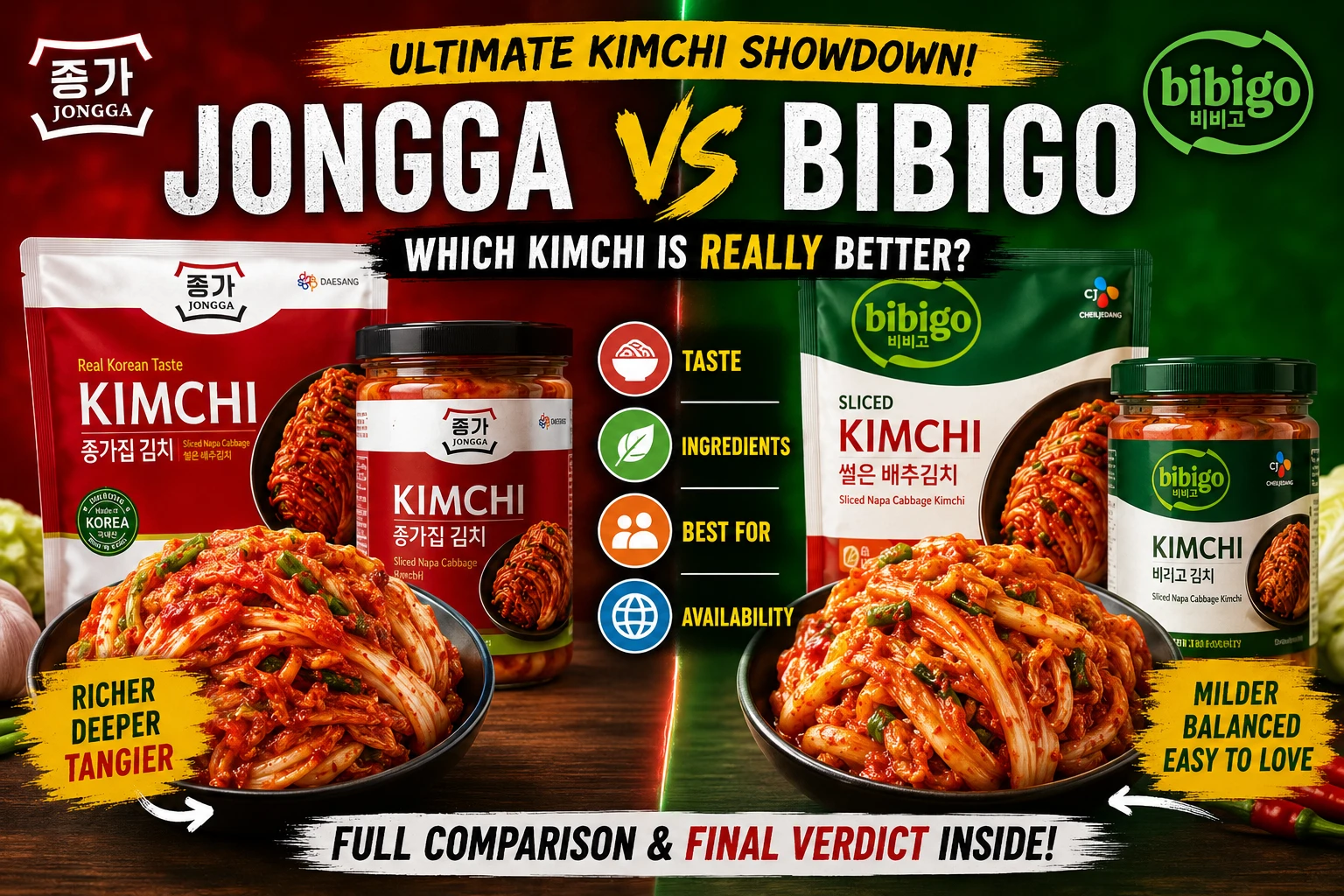
Surasang is milder, less crisp, and lower-scoring on flavor than our top-tested brands Jongga (9.4/10) and Bibigo (8.1/10), but it’s genuinely vegan on its standard line, lower in sodium, and competitively priced. See our full Jongga review or Bibigo review for comparison, or our Jongga vs Bibigo head-to-head if you’re deciding between those two specifically.
It’s made in Korea using traditional-style ingredients and a genuine royal-court-referencing brand name, but our panel and independent tasters found its flavor milder and less traditionally funky than higher-scoring brands, suggesting a formulation tuned for a gentler, more mainstream-friendly palate.
No — it’s generally one of the more budget-friendly Korean kimchi brands available, with online bulk pricing around $0.46-$0.49 per ounce reported through Weee! Asian Market, making it an accessible entry point for kimchi newcomers.
No, not based on independent reviews — Surasang’s Kimchi Mandu has been reported to contain oyster in the filling alongside textured tofu and glass noodles, so it isn’t suitable for vegetarians or vegans even though the standalone jarred kimchi line is.


💬 Leave a Comment
Tried Surasang kimchi? Tell us what you thought — taste, texture, or anything else.