Is Bibigo Kimchi Good? A US review of the regular and vegan jars (2026)
What is in each Bibigo jar sold in US stores, whether it is halal, vegan, MSG-free and live-culture, the sodium on the label, what it costs, and who should pick a different kimchi.
Disclosure: As an Amazon Associate I earn from qualifying purchases. Links marked “sponsored” are affiliate links and do not change our scores. Labels and prices were checked on September 19, 2026 and can change.
Is Bibigo kimchi good?
Yes, for most people. Bibigo scored 8.1 out of 10 in our 18-brand blind taste test: crunchy, mild, low in calories and easy to find at Walmart, Kroger-family stores, H Mart and Costco. It is not the most deeply fermented kimchi on the shelf, Jongga scores higher for flavor, and the regular jar contains fish sauce.
Is Bibigo a good brand? It is the global Korean food brand of CJ CheilJedang, a company founded in 1953, and CJ says it sells in around 80 countries (Asia Food Journal, June 2026). As a kimchi brand it is consistent and easy to find rather than the most traditional. The recalls we found involved other Bibigo products, not the kimchi jars (see safety).
Vegan, halal, MSG? The regular jar is not vegan; a separate vegan jar exists. Neither US jar states halal certification. Neither lists MSG. Details are in the table below.
Halal? Vegan? MSG? Live cultures? Sodium? Quick answers for the US jars
Both jars are 10 oz refrigerated jars sold in US stores. This table uses the ingredient lists and nutrition labels published by Bibigo USA and by Kroger’s Ralphs listings.
| Question | Regular 10 oz jar | Vegan 10 oz jar |
|---|---|---|
| Vegan? | No. Contains fish sauce (anchovy). The label says “Contains fish (anchovy).” | Yes, per the label. No animal-derived ingredients are listed and Bibigo sells it as “Vegan Kimchi.” We found no third-party vegan certification mentioned. |
| Halal? | Not stated. No halal claim on Bibigo USA’s page or Kroger’s listing. Do not assume. | Not stated. Same. A halal-certified Bibigo pouch exists in other markets, see halal. |
| MSG? | Not listed. It does contain sorbitol. | Not listed as MSG. It lists yeast extract, a natural source of glutamates. |
| Live cultures / pasteurized? | Sold refrigerated. Bibigo says the recipe ensures live and active cultures through shelf life. | Same claim from Bibigo, also refrigerated. |
| Allergens | Fish (anchovy). | Kroger’s listing shows none of the major allergens. Check your jar. |
| Sodium per 1 oz (30 g) | 260 mg (11% DV) | 270 mg (12% DV) |
| Calories per 1 oz (30 g) | 10 | 10 |
| Container | 10 oz plastic jar. Bibigo calls it a jar; Kroger’s listing calls it a bottle. | Same container. |

Bibigo kimchi in the US: versions, sizes and packaging
In US stores Bibigo kimchi is a refrigerated jar. We found three versions, and no US pouch.

Regular napa cabbage kimchi, 10 oz
The standard jar and the one we scored. Made with fish sauce.
Diet notes
Contains fish (anchovy). Not vegan or vegetarian.
Best for
An everyday side dish, fried rice, jjigae.
Source

Napa cabbage vegan kimchi, 10 oz
Same size, seasoned with a seaweed-and-yeast blend instead of fish sauce.
Diet notes
No animal ingredients listed. Halal not stated.
Best for
Vegan households and anyone avoiding fish (check the label).
Source

Sliced kimchi, 26.45 oz (Costco)
A large jar seen at select Costco warehouses. A price tracker lists $4.99 to $10.69 across locations (updated July 16, 2026).
Check first
We have not verified this jar’s label. Its ingredients can differ from the 10 oz jars.
Source
What about pouches?
Bibigo’s shelf-stable sliced kimchi pouches, such as a 150 g pouch, are sold in the UK, EU and Asia. We did not find them in US stores. Their recipes and labels are different, which is why the UK details live on our UK kimchi brands guide and not here.
Shopping outside the US?
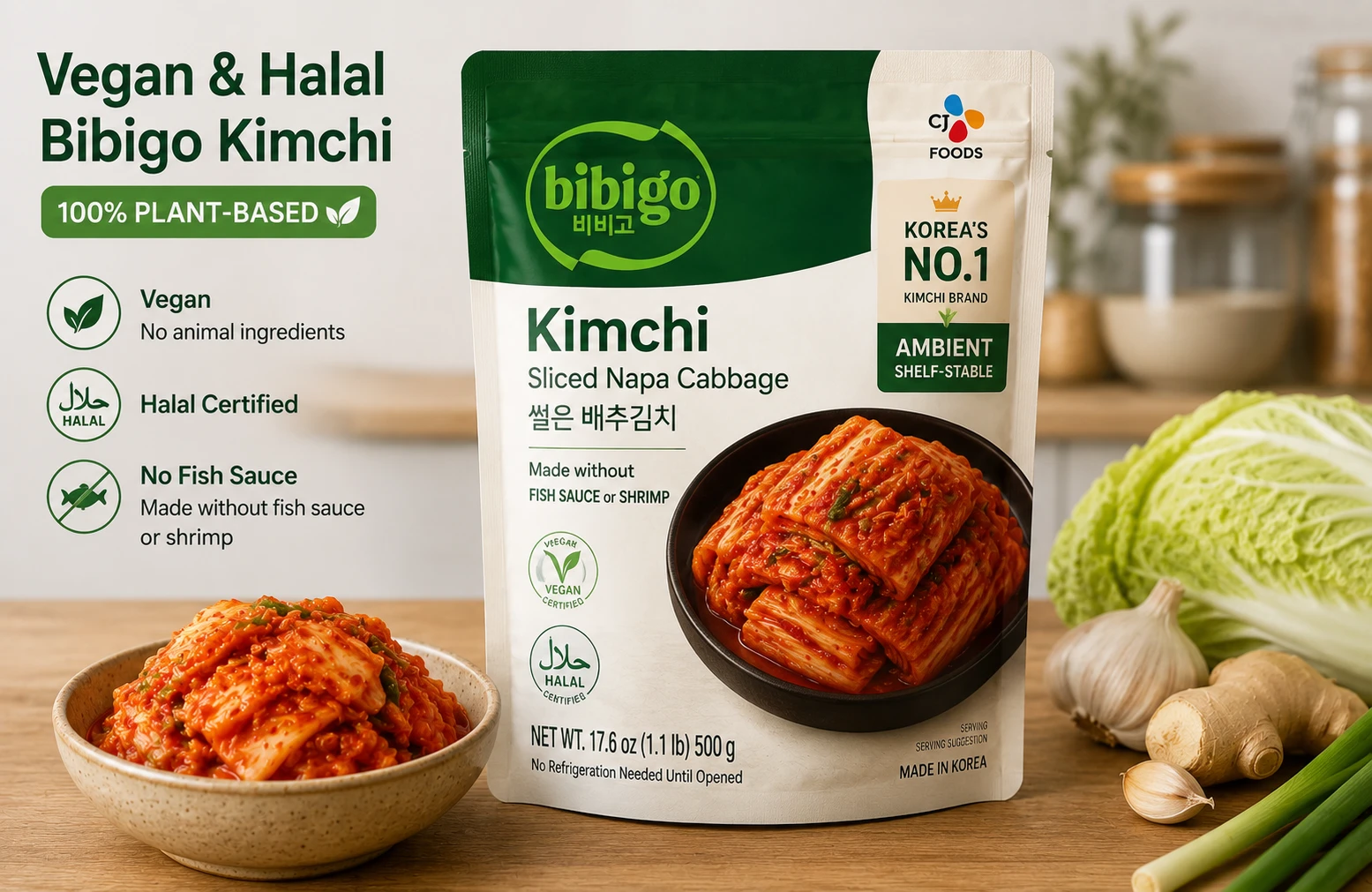
UK readers: Bibigo’s UK pouch and jar labels differ from the US jars above. Start with our UK guide, or search Bibigo kimchi on Amazon UK (sponsored link).
Who makes Bibigo kimchi, and what “CJ Foods” means
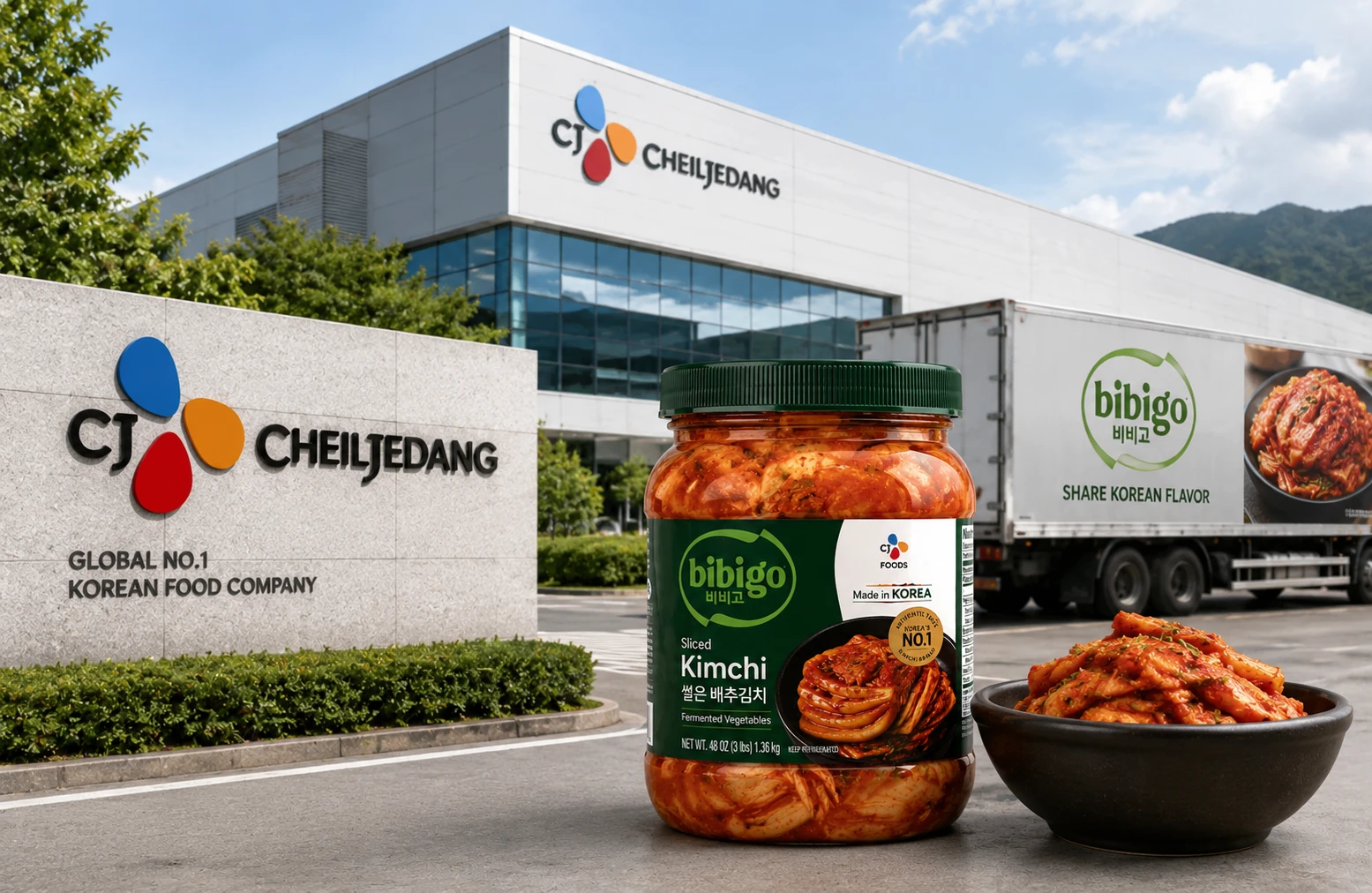
Bibigo is the global food brand of CJ CheilJedang, a South Korean company founded in 1953 that was once part of Samsung Group. CJ launched the brand in 2010 and says it now sells in around 80 countries (Asia Food Journal). CJ credits its own patented lactic acid bacteria for keeping Bibigo kimchi fresh and crunchy (CJ brand page). In the US, the Bibigo USA website is operated by Schwan’s Sales Co. and carries a CJ Schwan’s logo.
“CJ Foods” versus “Bibigo”: which is which
| Name | What it is |
|---|---|
| CJ CheilJedang | The parent company. |
| Bibigo | The consumer brand on the kimchi jars reviewed on this page. |
| CJ Foods | What CJ calls its food business unit, and the name of regional companies. In Australia, CJ Foods Oceania also sells a kimchi jar labeled “CJ Foods” (cjfoods.com.au). |
| Bibigo Stir-Fried Kimchi Rice Bowl | A microwave ready meal, not a kimchi jar, sold at Target, Amazon and, in select regions, Costco. See our Bibigo Stir-Fried Kimchi Rice Bowl review. |
What’s new in 2026

Taste, texture and cooking
Our tasting notes
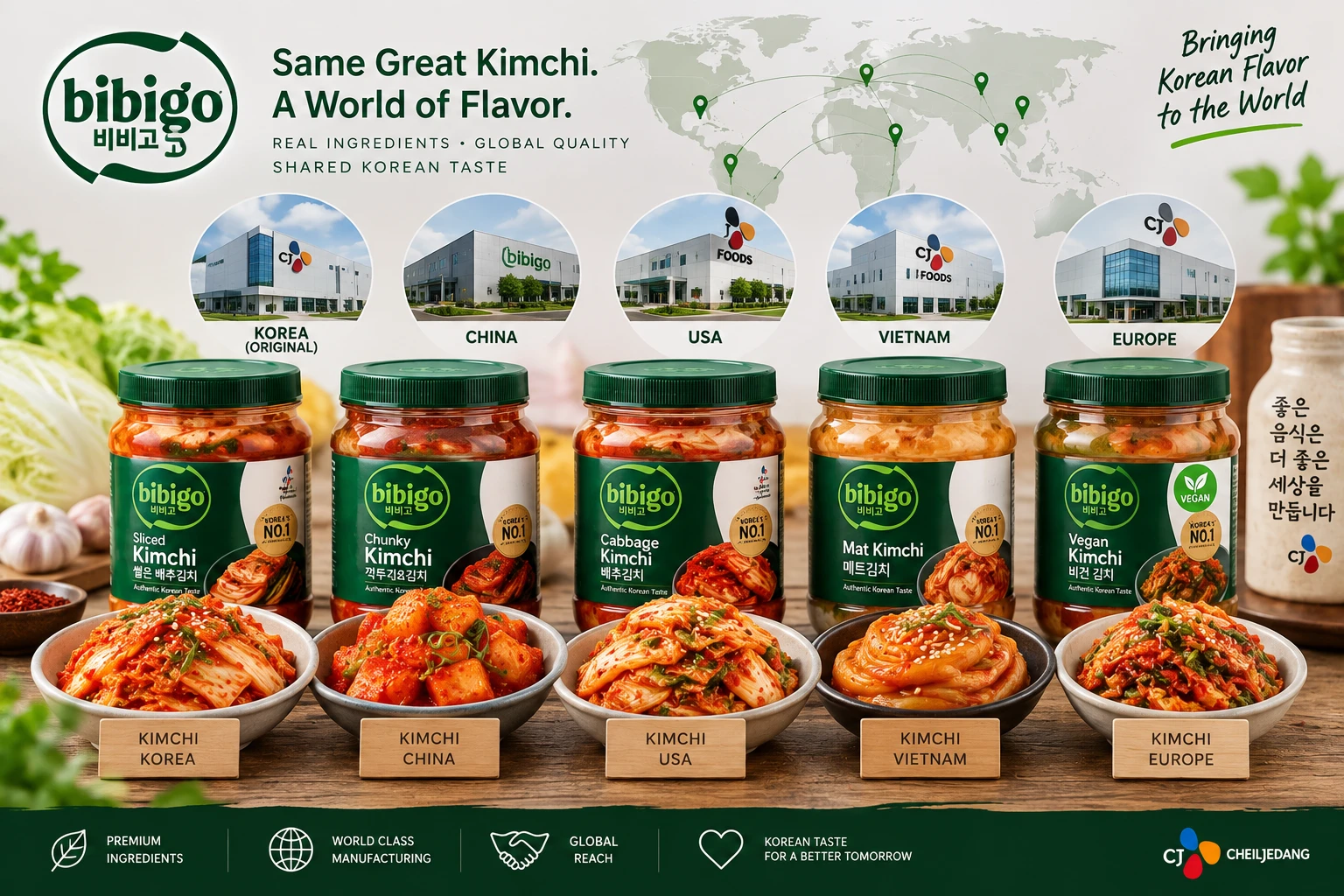
Bibigo sits on the mild side: medium heat, moderate tang and a crunch that holds. Next to a long-fermented kimchi like Jongga, it is less funky and less sour, which is why it scored lower on flavor and fermentation but well on texture. We noticed minor batch-to-batch variation when we bought a second jar.On opening, the jar smelled garlicky and the brine was clear red.
What other shoppers report
On Walmart.com the regular jar showed 4.1 out of 5 from 65 reviews and the vegan jar 3.8 out of 5 from 32 reviews when we checked (Walmart listings). A Weee! shopper called it saltier than other brands, which fits the sodium figures below (Weee!).
Cooking with it
Because it is mild, cooked dishes can taste flat. For kimchi fried rice or kimchi jjigae, add a spoon of gochujang or kimchi juice, or let the opened jar age 10 to 14 days in the fridge so it turns more sour. More sour kimchi caramelizes and flavors a dish better than a fresh, mild one.
Expert notes: what to expect from a jar like this
This is general fermentation guidance, not a description of our test results. Read it as a guide to judging your own jar.
Kimchi keeps changing in your fridge
Lactic acid bacteria keep turning sugars into lactic acid even when cold, only more slowly. A mild jar on day 1 usually turns more sour over the following weeks while the crunch softens gradually. That is why one jar can suit a fresh side dish early on and jjigae later. Our fermentation stages guide shows the stages.
Normal versus a problem jar
Normal
A little fizz when you open it, cloudy red brine, a sharp sour and garlicky smell, and pressure under a sealed lid. Open it over the sink the first time.
Not normal
Fuzzy or colored mold on the surface, a rotten or rancid smell, or a slimy texture with an off smell. Throw it out. Pressing the kimchi under the brine and using clean utensils helps prevent surface mold.
Taste it properly
- Let a spoonful sit out for about 10 minutes. Cold mutes flavor.
- Taste the leaf and the white stem separately: the leaf shows seasoning and heat, the stem shows crunch.
- Score sour, salty, sweet and heat separately instead of writing “good” or “bad.”
- Sip water between brands so one jar does not color the next.
- Taste again after cooking if you plan to cook with it.
Reading the label like a fermenter
“Kimchi cultures” on both labels means a starter culture is added, so fermentation is managed instead of left to chance. CJ says its patented lactic acid bacteria keep Bibigo kimchi fresh and crunchy. In our reading, managing fermentation for crispness tends to favor a milder, less sour jar than a traditionally aged one, which matches the mild profile described above.
On the vegan jar, expect savory depth to come from seaweed extract and yeast extract instead of fish sauce. That usually gives a cleaner, less “sea-funky” savoriness than the regular jar. Taste both side by side to see whether you agree.
Scorecard: how we got 8.1 out of 10
The score applies to the regular 10 oz jar and uses the same weights as every brand in our 18-brand blind test.
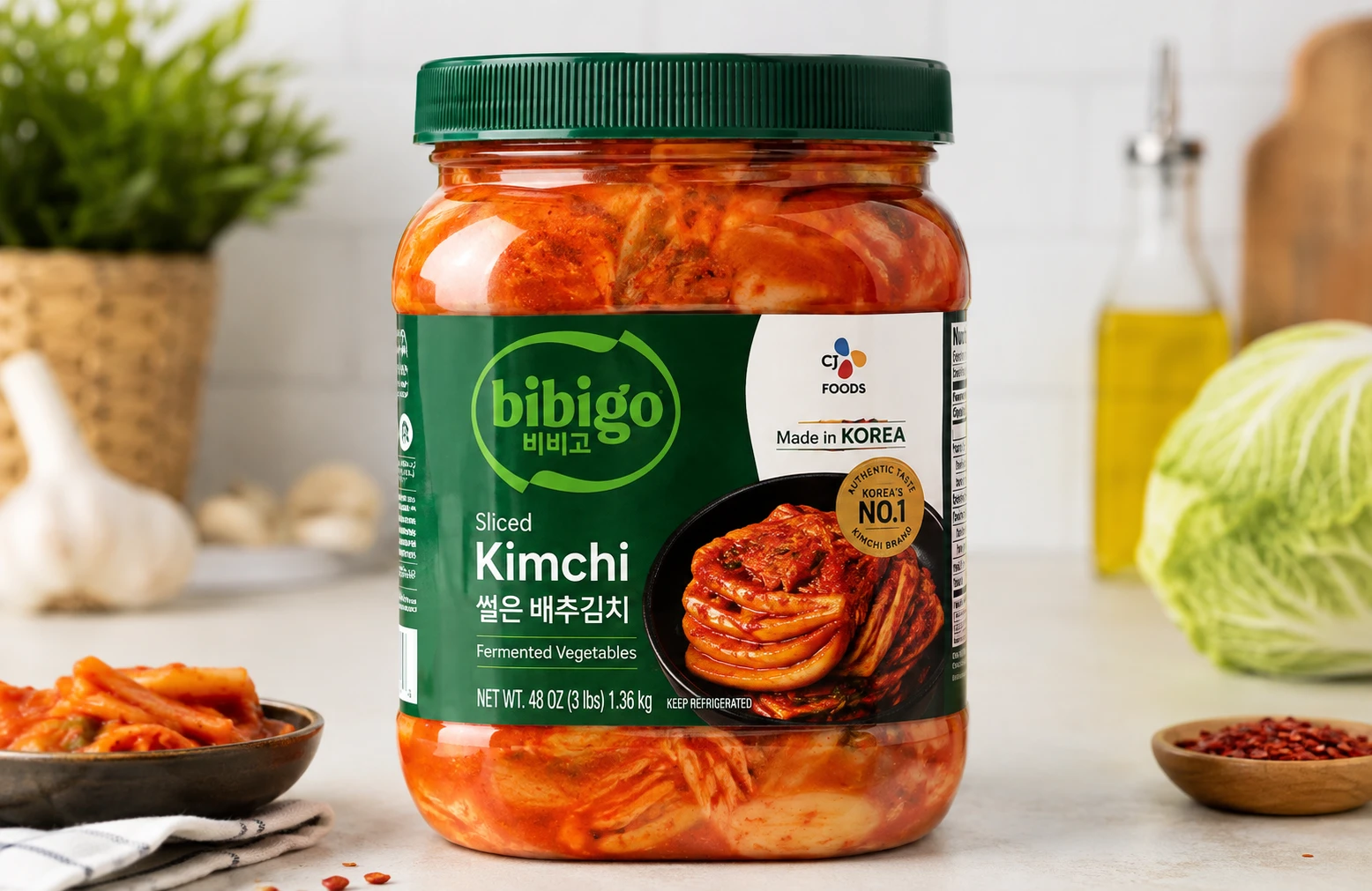
Bibigo regular kimchi, 10 oz
Weighted total: 0.4×7.6 + 0.2×8.5 + 0.2×7.4 + 0.1×9.6 + 0.1×8.8 = 8.06, rounded to 8.1. Availability and value are scored on US retail. ADD: vegan jar score, or delete this line if you have not scored it.
Pros, cons and who should skip it
Pros
- Easy to find at Walmart, Kroger-family stores, H Mart and Costco.
- Crunchy texture and mild heat suit beginners.
- Only 10 calories per 1 oz serving.
- A vegan jar with no animal ingredients listed.
- Bibigo states live and active cultures through shelf life.
- Low price at some retailers ($3.18 on Walmart.com in our check).
Cons
- Milder and less complex than Jongga.
- 260 to 270 mg sodium per 1 oz serving adds up.
- The regular jar has fish sauce, so it is not vegan and contains a fish allergen.
- Both jars contain sorbitol, a sugar alcohol that can upset some people’s stomachs in larger amounts.
- No halal certification is stated for the US jars.
- Prices vary widely ($3.18 to $9.49 in our checks) and we saw minor batch variation.
Buy it if you…
- are new to kimchi and want something mild.
- want a jar you can find in an ordinary supermarket.
- need a vegan jar from a mainstream brand.
- plan to cook with it and will add your own heat.
Skip it if you…
- want deeply sour, funky kimchi: try Jongga or Cosmos.
- avoid fish: choose the vegan jar, not the regular one, or see vegan kimchi brands.
- need a halal-certified product: see halal kimchi brands.
- watch sodium closely: see low-sodium kimchi brands.
- prefer a gentler, cheaper start: try Trader Joe’s kimchi.
Ingredients: regular vs vegan (US labels)
| Regular jar | Vegan jar |
|---|---|
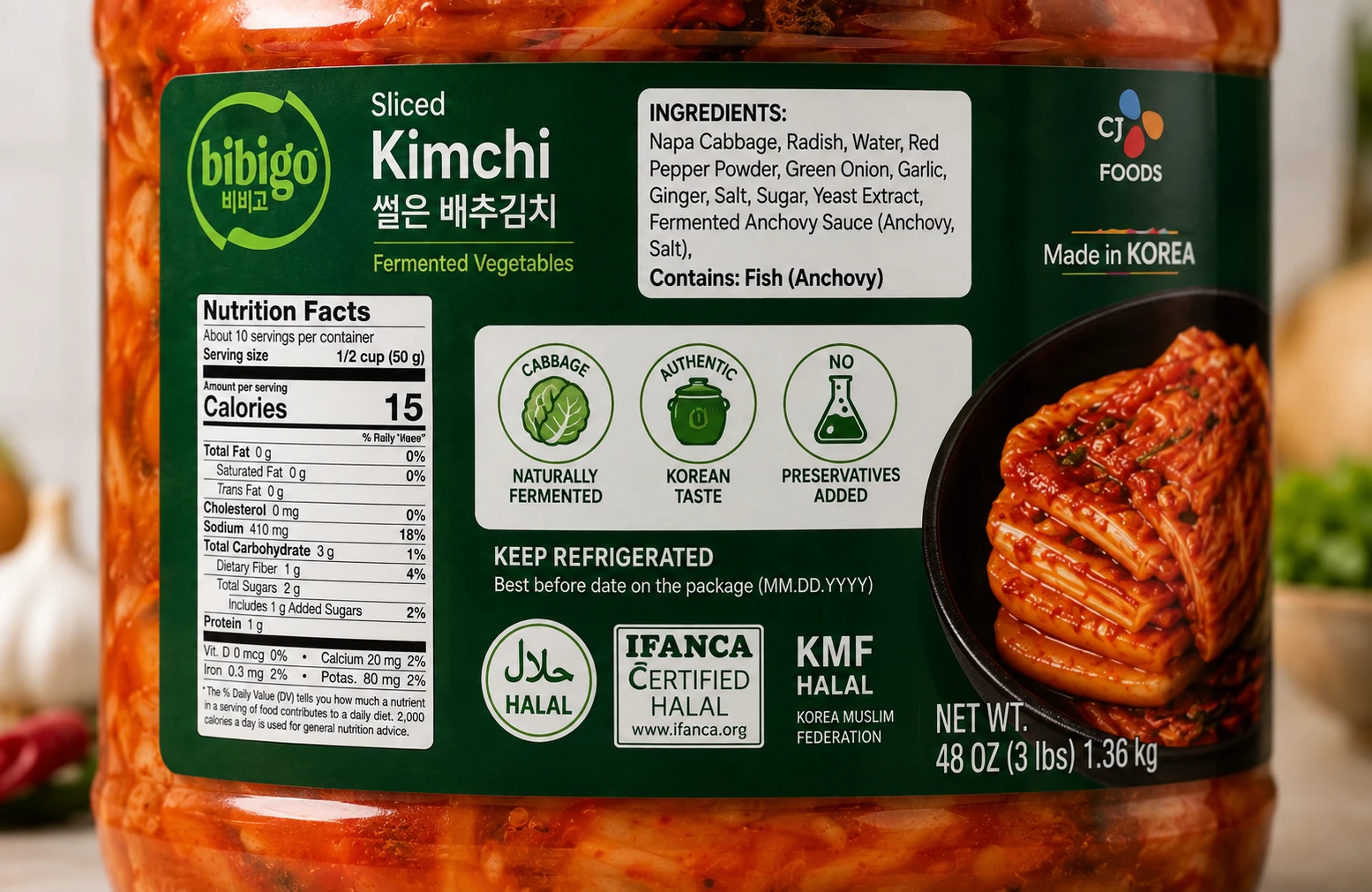
| Napa cabbage, radish, water, red pepper powder, sorbitol, salt, and 2% or less of: garlic, green onion, onion, fish sauce (anchovy, sea salt, salt water), ginger, calcium lactate, xanthan gum, kimchi cultures. Contains fish (anchovy). | Napa cabbage, radish, water, red pepper powder, sorbitol, salt, and 2% or less of: garlic, green onion, onion, seasoning (seaweed extract, maltose syrup, salt, sugar, yeast extract), ginger, onion powder, calcium lactate, xanthan gum, kimchi cultures. |

What the less familiar ingredients are
- Sorbitol: a sweetener (sugar alcohol) used for sweetness and texture.
- Calcium lactate and xanthan gum: a firming agent and a thickener.
- Kimchi cultures: the lactic acid bacteria used for fermentation.
- Yeast extract: a savory flavoring that naturally contains glutamates, which is why the vegan jar still tastes savory without fish sauce.
- Gochugaru: the red pepper powder. See our gochugaru guide.
Nutrition facts from the US label
These numbers come from the printed US nutrition labels as shown in Kroger’s listings, not from user-entered calorie databases.
| Per 1 oz (30 g) | Regular jar | Vegan jar |
|---|---|---|
| Calories | 10 | 10 |
| Total fat | 0 g | 0 g |
| Sodium | 260 mg (11% DV) | 270 mg (12% DV) |
| Total carbohydrate | 2 g | 2 g |
| Protein | 0 g | 0 g |
| Calcium | 30 mg (2% DV) | 30 mg (2% DV) |
| Sodium per 100 g (calculated) | about 870 mg | about 900 mg |


Halal: what we can and cannot confirm
The US jars
Neither Bibigo USA’s product pages nor Kroger’s listings mention halal certification for the 10 oz regular or vegan jars. Do not assume a certification. Look for a certifier’s mark on the jar you buy.
Where a certified Bibigo kimchi exists
A Bibigo no-fish-sauce sliced kimchi in a 150 g ambient pouch (Product of Korea, made at CJ CheilJedang’s Jincheon plant) is listed as halal-certified by IFANCA on a distributor’s product page (Dynamic Equo). That pouch is sold outside the US and is a different product from the US jars. We have not verified a Malaysian JAKIM entry for a Bibigo kimchi; check the certifier’s own directories: IFANCA and JAKIM.
“Not certified” is not the same as “not permitted”
The regular jar has no halal claim, and it contains fish sauce. Some Muslims accept fish-based ingredients and others look only for certification. We are not making a religious ruling: if you follow a strict standard, choose a certified product or ask your certifier. More brands are compared in our halal kimchi brands guide and the halal and kosher guide.
Is Bibigo kimchi vegan? It depends on the jar
- Regular US jar: no. It contains fish sauce made with anchovy.
- Vegan US jar: yes on the label. It uses a seaweed extract and yeast extract seasoning and lists no animal ingredients. We found no third-party vegan certification mentioned, so if you need a certified product, check the package.
- Other countries: formulas and formats differ. The UK sells shelf-stable pouches, so do not carry US label facts over. See the UK guide.
Compare more options in our vegan kimchi brands guide.
Safety and recalls
These are public records, listed without commentary. None of them involves a Bibigo kimchi jar.
- October 2024, Korea: the Ministry of Food and Drug Safety halted sales of one 400 g Bibigo kimchi dumpling product (expiration date June 23, 2025) after plastic was found. CJ said the recall was voluntary. Sources: Korea JoongAng Daily, Hong Kong Centre for Food Safety (PDF).
- March 2024, US: CJ Foods Manufacturing Beaumont recalled Trader Joe’s Steamed Chicken Soup Dumplings over hard plastic from a marker pen. Source: USDA FSIS.
Recall status changes. Check the FDA recalls page, Korea’s MFDS, and our kimchi recall tracker. Some packaged foods carry California Proposition 65 warnings; if you see one, OEHHA explains how to look up the chemical named on it.
Storage: keep the jar refrigerated and follow the date on the label. Throw it out if you see mold or smell something rotten rather than sour.
Where to buy Bibigo kimchi and what it costs (September 2026)
As an Amazon Associate I earn from qualifying purchases. Sponsored links are marked.
| Where | What we found | Price seen |
|---|---|---|
| Walmart | Regular and vegan 10 oz jars. Walmart listings | $3.18 each (31.8¢ per oz) |
| Ralphs (Kroger banner) | Regular and vegan 10 oz jars, pickup. Regular · Vegan | $9.49 each ($0.95 per oz) |
| H Mart | Bibigo kimchi on H Mart same-day delivery | Check listing |
| Costco | Sliced kimchi, 26.45 oz jar, select warehouses (unofficial tracker) | $4.99 to $10.69 across locations |
| Instacart | Vegan 10 oz jar | Varies by store |
| Store finder | Bibigo USA store locator. Distribution varies, so call ahead. | n/a |
| Amazon | Search results vary and refrigerated stock is inconsistent. If the results show only dumplings or dried goods, skip it. Search Bibigo kimchi on Amazon (sponsored) | Check listing |

More stores and brands: where to buy kimchi.
How we tested
Bibigo was one of 18 brands in our blind taste test. This section shows the method and the log, so you can see what was tested and when.
Method
| Step | What we did | What we looked at |
|---|---|---|
| 1. Blind tasting | Labels hidden, brands scored independently before names were revealed. | Flavor, texture, fermentation, value, availability. |
| 2. Cooked use | Used in kimchi jjigae and fried rice. | How the mild flavor held up under heat. |
| 3. Day 1 vs day 14 | Same jar tasted on opening and again after two weeks in the fridge. | Crunch and sourness over time. |
| 4. Second jar | Bought a second jar on a different date. | Batch consistency. |
| 5. Label and price audit | Checked labels against Bibigo USA and Kroger listings and recorded prices on September 19, 2026. | Ingredients, allergens, sodium, price. |


What we did not test: the Costco 26.45 oz jar and the UK and Asian pouches. Their labels can differ from the jars scored here.
Sources
Labels, prices and news were checked on September 19, 2026. We link each source so you can check it yourself.
Product labels and listings
- Bibigo USA: regular napa cabbage kimchi (ingredients, live cultures claim, 10 oz jar)
- Bibigo USA: napa cabbage vegan kimchi (ingredients)
- Ralphs: regular jar and vegan jar (nutrition facts, allergens, price)
- Walmart listings (price, ratings)
- Costco price tracker (unofficial; 26.45 oz jar)
Company and news
- CJ CheilJedang: Bibigo brand page (patented lactic acid bacteria)
- CJ CheilJedang on Wikipedia (founded 1953)
- Asia Food Journal (Bibigo founded 2010, about 80 countries, Crazy Hot launch)
- Seoul Economic Daily (Crazy Hot Kimchi)
- CJ Foods Oceania (Australian CJ Foods label)
Recalls and safety
- Korea JoongAng Daily and Hong Kong CFS notice
- USDA FSIS recall notice
- FDA recalls · Korea MFDS · OEHHA Proposition 65
Certification
Related guides
Compare Bibigo with other US brands, or check the topics people ask about most.



Bibigo kimchi FAQ
The basics
Yes, for most people. Bibigo scored 8.1/10 in our 18-brand blind taste test: crunchy, mild, low in calories and easy to find in US stores. It is less deeply fermented than Jongga, and the regular jar contains fish sauce, so it is not vegan.
Bibigo is the global Korean food brand of CJ CheilJedang, a food company founded in 1953. CJ says Bibigo is sold in around 80 countries. As a kimchi brand it is consistent and easy to find rather than the most traditional option. The recalls we found involved other products, such as dumplings, not the kimchi jars.
CJ CheilJedang, a South Korean food company founded in 1953. In the US, the Bibigo USA website is operated by Schwan’s Sales Co. and carries a CJ Schwan’s logo.
They are related names. CJ Foods is used for CJ CheilJedang’s food business and for regional companies. Bibigo is the consumer brand on the kimchi jars reviewed here. In Australia a kimchi jar is sold under the CJ Foods label. The US Stir-Fried Kimchi Rice Bowl is a Bibigo ready meal, not a kimchi jar.
Mild to medium heat, moderate tang and a crunchy bite. It is less funky and less sour than a long-fermented kimchi like Jongga.
Diet and nutrition
The regular US jar is not vegan because it contains fish sauce (anchovy). Bibigo also sells a Napa Cabbage Vegan Kimchi jar in the US whose ingredient list has no animal-derived ingredients. Formulas differ in other countries, so check the label.
We found no halal certification claim for the US 10 oz jars on Bibigo USA’s product pages or Kroger listings. A different Bibigo no-fish-sauce sliced kimchi pouch (150 g, Product of Korea) is listed as IFANCA halal-certified by a distributor. Certification is product-specific, so look for the mark on your package. See our halal kimchi brands guide.
Neither US jar lists MSG. The vegan jar lists yeast extract, which naturally contains glutamates. Some non-US Bibigo formulas list flavour enhancer E621 (MSG), so check the label on imports.
Bibigo says the recipe includes proprietary ingredients that ensure probiotics and live and active cultures throughout the shelf life, and both US jars are sold refrigerated. Shelf-stable pouches sold in other markets are a different product. See our pasteurized vs live-culture guide.
The regular jar label shows 260 mg per 1 oz (30 g) serving, 11% of the daily value. The vegan jar shows 270 mg (12%). That works out to roughly 870 to 900 mg per 100 g.
Both US jars list 10 calories per 1 oz (30 g) serving, with about 9 servings in a 10 oz jar.
Kroger lists the regular jar as gluten free, and neither US ingredient list contains wheat. If you have celiac disease, check the label on your jar.
Buying and storing
Walmart, Kroger-family stores such as Ralphs, H Mart, and some Costco warehouses (a larger 26.45 oz sliced jar). Use the Bibigo USA store locator to check stock. Amazon availability varies.
In our September 2026 checks, Walmart.com listed the 10 oz jars at $3.18 while Ralphs listed them at $9.49. Prices vary by store and region, so check your local listing.
No. UK and Asian pouches use different recipes and formats, for example a shelf-stable vegan sliced kimchi pouch. Do not assume US and UK labels match. See our UK guide.
Keep the jar refrigerated and follow the date on the label. Throw it out if you see mold or smell something rotten rather than sour.
Safety and comparisons
We found recalls of other CJ and Bibigo products, such as a 2024 Korean recall of Bibigo kimchi dumplings over plastic fragments and a 2024 US recall of Trader Joe’s chicken soup dumplings made at a CJ Foods plant, but did not find one naming the US kimchi jars. Check the FDA recall database for current status, or our kimchi recall tracker.
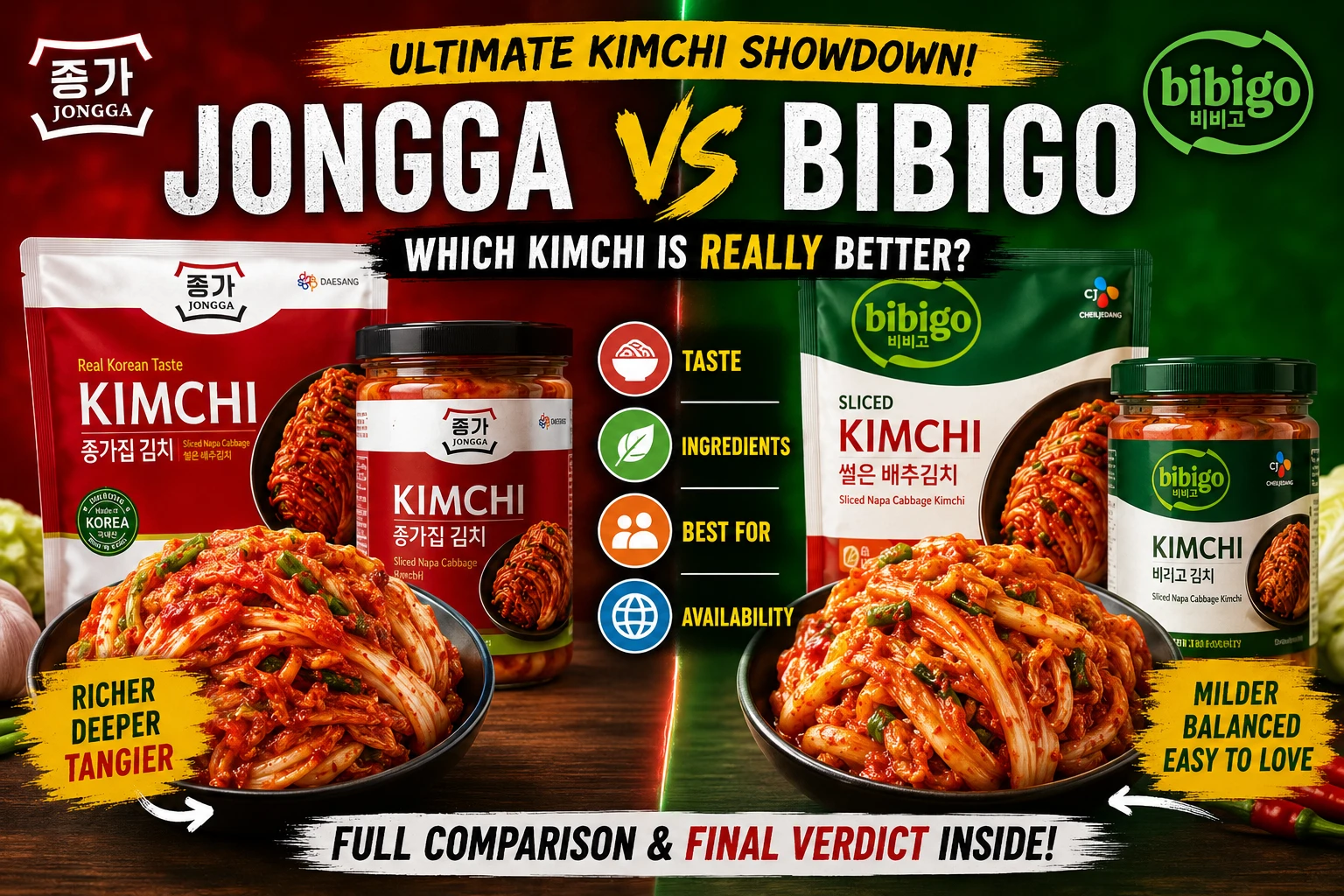
Jongga scored 9.4/10 against Bibigo’s 8.1/10 in our blind test. Jongga is more deeply fermented; Bibigo is milder and easier to find. See the full Jongga vs Bibigo comparison.
Yes. Because it is mild, add a little extra gochujang or kimchi juice, or let the opened jar age 10 to 14 days in the fridge for a deeper sour flavor before cooking.

Ji-Young Park ran the 18-brand blind taste test behind KimchiGuide’s brand rankings and updated this review in September 2026 to cover the US regular and vegan jars.
Full profile
Dr. Sarah Mitchell reviewed the ingredient, nutrition and sodium statements in this review against the printed US labels.
Full profile