Is Sunja’s Kimchi Good? The Full Review — Taste, Ingredients & All 3 Varieties Tested (2026)
A standalone deep-dive on the Vermont brand that bends the rules with green cabbage instead of napa — the honest taste verdict, real ingredients across Medium Spicy, Mild White, and Radish, sodium, certifications, and why this is one of the best-reviewed brands we’ve covered.
Is Sunja’s Kimchi Good?
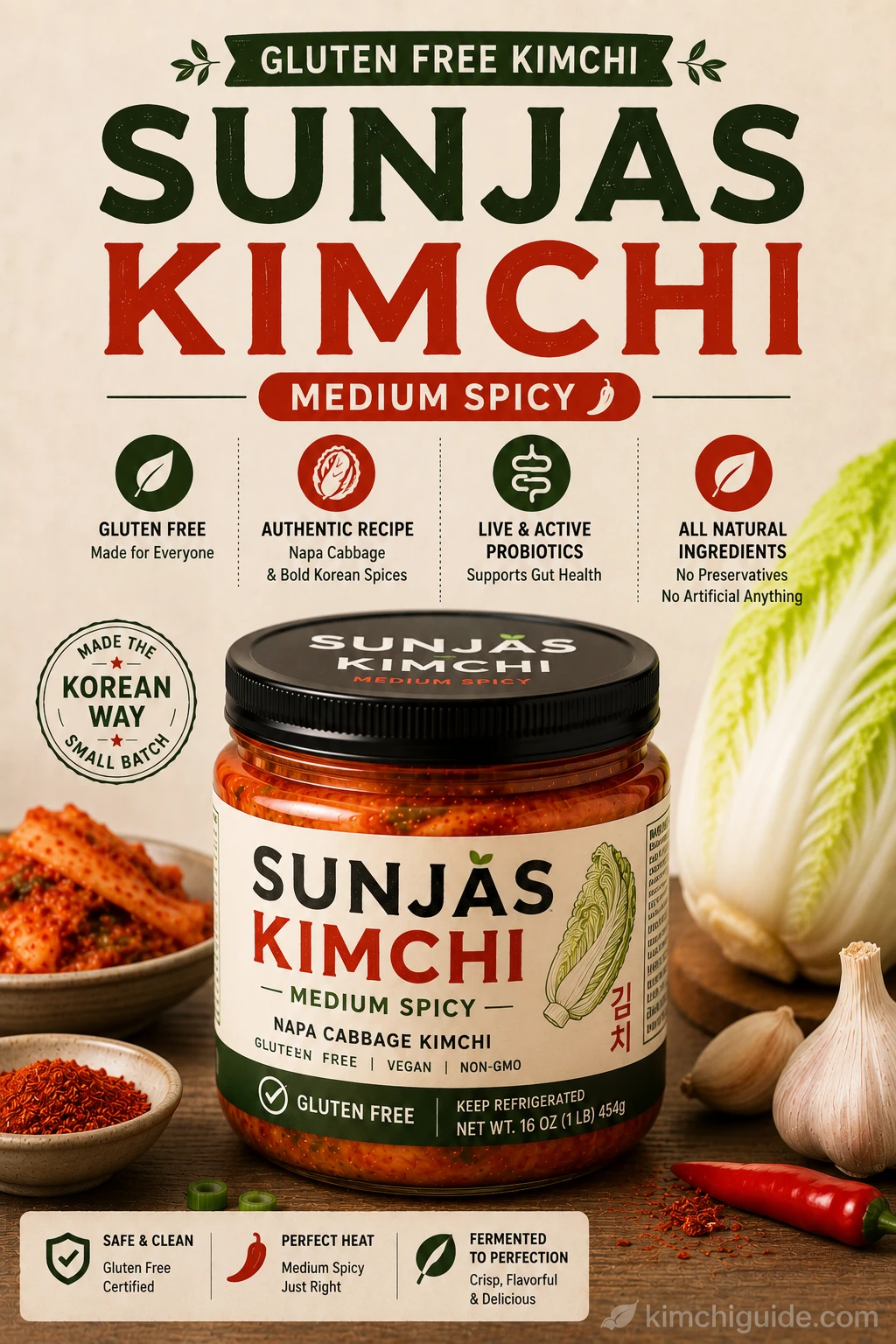
Yes — genuinely one of the better-reviewed brands we’ve covered. In our 18-brand blind taste test, Sunja’s scored 8.3 out of 10. Founded in 1994 by Sunja Hayden in Vermont, the brand’s standout feature is that it uses green cabbage instead of the traditional napa cabbage — as far as we can find, the only brand in our full ranking that does this. Every current variety (Medium Spicy, Mild White, and Radish) is 100% vegan, always has been, and is naturally fermented, raw, and never pasteurized. Independent reviewers agree: Tasting Table named it the best-textured kimchi of everything they tried, and it shows up constantly in organic, unprompted TikTok reviews.
🛒 Check Price on AmazonSunja’s Kimchi — At a Glance
Here’s what actually matters before you decide whether to put a jar in your cart.
- Taste: unusually consistently praised — best texture in a Tasting Table roundup.
- Made by: founder Sunja Hayden, Vermont, since 1994 — over 32 years running.
- Unique recipe: green cabbage instead of napa — the only brand in our ranking that does this.
- Ingredients: always 100% vegan, no fish sauce ever, across every variety.
- Sodium: genuinely lower than most competitors (90-150mg per serving).
- No Kosher/Halal certification found — otherwise fully Non-GMO, Gluten-Free verified.
Sunja’s Kimchi — Product Overview & Scorecard
Here’s how Sunja’s scored across our core taste-test criteria, from the same 18-brand blind test used for our full brand ranking.
Who Makes It? Sunja Hayden & the Vermont Story
One of the longest-running founder stories in this entire ranking — over three decades and counting.
Sunja Hayden planted the seed for what would become Sunja’s Oriental Foods, LLC in 1993, when she began offering Korean cooking classes in her small community of Northfield, Vermont. Participants couldn’t get enough of her traditional, healthy Korean cooking, and the demand pushed her to start producing food for retail. She founded the company in 1994, in her own words, “because of my affection for healthy eating and a desire to serve my family and friends good, real, healthy food” — a mission that quickly grew beyond her local community to tables across the country.
In the company’s early years, Sunja sold far more than kimchi — sushi, dumplings, sauces, spring rolls, and more, all under the umbrella of “oriental” cuisine. Over time, the business narrowed its focus to what it’s known for today: kimchi and fermented, gut-healthy foods. The company is now based in Waterbury, Vermont, and by 2021 reporting was producing roughly 7,000 pounds of cabbage a week to keep up with nationwide demand, sourcing from Vermont farms where possible and other American farms when needed. Korea itself has recognized Sunja’s contribution to popularizing kimchi abroad, awarding her honors for her work over more than two decades as a businesswoman in the category.

Unlike several brands in our ranking that have been acquired by larger food conglomerates in recent years, Sunja’s remains an independent, family-run Vermont company — the same core mission Sunja started with in 1993 is still what drives the business today.

Few brands in this category can trace their origin as directly to hands-on cooking instruction as Sunja’s can — the recipes taught in a small Vermont classroom in 1993 are, in essence, the same recipes now sold nationwide through Whole Foods and other major natural-foods retailers.
Sunja’s in 2026 — Online Shop Relaunched
A genuine, recent update worth knowing if you’ve had trouble finding Sunja’s near you.
Green Cabbage, Not Napa — Why It Matters
This is the single most distinctive thing about Sunja’s, and as far as we could find, no other brand in our 18-brand ranking does this.
Virtually every packaged kimchi brand — from Jongga and Bibigo to every small-batch US producer we’ve reviewed — builds its recipe around napa cabbage, the tall, pale, ruffle-leafed cabbage traditionally used in Korean kimchi. Sunja’s does something different: it uses green cabbage instead, the same round, tightly-packed variety more commonly associated with coleslaw or sauerkraut in Western cooking. The brand describes this directly on its own site as “bending the rules” in pursuit of a fresher, crisper take on the traditional dish.

The practical effect shows up directly in the eating experience: green cabbage is generally denser and holds its crunch differently than the more delicate, water-rich leaves of napa cabbage, which likely contributes to the standout texture that reviewers — including Tasting Table’s independent test — consistently single out. It’s a genuine point of difference rather than a marketing spin: if you’ve tried several kimchi brands and found them all tasting fairly similar, Sunja’s greener, crunchier base is a legitimately different eating experience worth trying.
Medium Spicy, Mild White & Radish — All 3 Reviewed
Sunja’s currently sells three varieties through its own relaunched online shop — here’s how each one differs.
| Variety | Heat Level | Notes | Amazon |
|---|---|---|---|
| Medium Spicy Cabbage Kimchi | 🌶️🌶️ Medium | The brand’s best-seller and the variety most reviewers (including Tasting Table) tested. Red chili pepper gives real but approachable heat. | 🛒 Shop |
| Mild White Kimchi | No heat | Skips the red chili pepper entirely — a genuinely non-spicy option, good for beginners, kids, or anyone avoiding heat while still wanting the tang and crunch. | 🛒 Shop |
| Radish Kimchi | 🌶️ Mild-Medium | Built around radish rather than cabbage as the primary vegetable — a different texture profile, closer to Korean kkakdugi-style kimchi. | 🛒 Shop |

Taste & Texture — Why Reviewers Love This Brand
This is genuinely one of the more consistently well-reviewed brands we’ve covered — worth explaining why.
Tasting Table‘s independent taste test of multiple store-bought brands specifically singled out Sunja’s Medium Spicy Kimchi for having the best texture of everything they tried — “all the pieces of cabbage were actively crunchy, which makes for an undeniably enjoyable textural experience.” The reviewer also noted an intense fizz on first opening the jar, more pronounced than other brands tested, which they correctly identified as a sign of longer, more active fermentation rather than spoilage.
That positive read is echoed consistently in less formal, unprompted reviews too. Sunja’s shows up regularly in organic TikTok content — food creators posting genuine reactions rather than sponsored content, describing it as “crunchy and SO good,” “the most amazing kimchi I have ever tasted,” and specifically calling out the fresh, crisp quality that likely comes from its green-cabbage base. We did not find a clearly negative third-party review of Sunja’s during this research pass — worth noting honestly as the absence of criticism we found, not a guarantee that literally every customer has loved every jar.
Real Ingredients Breakdown
Pulled directly from official retailer ingredient panels (Whole Foods, Amazon, Instacart) for the two most common varieties.
| Medium Spicy Cabbage Kimchi | Mild White Kimchi |
|---|---|
| Cabbage (green, not napa) | Cabbage (green, not napa) |
| Water | Water |
| Carrots | Carrots |
| Green onion | Green onion |
| Red chili pepper | (not present) |
| Garlic | Garlic |
| Red bell peppers | Red bell peppers |
| Salt | Salt |
| Leeks | Leeks |
| Ginger root | Ginger root |

Sunja’s Kimchi Nutrition & Sodium Facts
Genuinely low-calorie and comparatively low-sodium — backed by official retailer nutrition panels, not just brand marketing.
| Variety | Serving | Calories | Sodium |
|---|---|---|---|
| Medium Spicy Kimchi | 1oz (28g) | 10 kcal | 90mg |
| Mild White Kimchi | 2oz (57g) | 15 kcal | 150mg |
| Radish Kimchi | 2oz (57g) | ~15 kcal | Not independently confirmed |

Both confirmed figures sit meaningfully below the category average — for comparison, several other brands in our ranking run closer to 300-400mg of sodium per similarly-sized serving. We weren’t able to independently confirm a full official nutrition panel for the Radish variety specifically, so we’re presenting its calorie estimate from a third-party aggregator rather than asserting an unconfirmed sodium figure. See our full low-sodium kimchi brands ranking for exactly how Sunja’s compares against all 18 brands we’ve tested.
Certifications — Non-GMO, Gluten-Free & More
A genuinely clean certification picture, with one specific gap worth knowing.

Sunja’s own FAQ page directly displays four certification badges: GMO Free, Gluten Free, Vegan/Raw, and Probiotic. Unlike several other brands we’ve reviewed, these apply across the entire product range — there’s no single “check which line” caveat needed, since every current variety meets all four. See our vegan kimchi brands guide for how this compares to brands that only offer one fish-sauce-free SKU.
As of this writing, we found no Kosher or Halal certification listed anywhere on Sunja’s official site or on any retailer listing — a real gap compared to Jongga or Lucky Foods’ Seoul Vegan Kimchi, both of which hold Kosher certification. If either certification is a hard requirement for you, this brand currently doesn’t offer it. See our Halal & Kosher kimchi brands guide for which brands do.
Safety, Shelf Life & Storage
Here’s what’s publicly documented — presented factually, including a brand mix-up worth clearing up.
Is Sunja’s Good for Cooking, or Best Eaten Raw?
Both — with each variety suiting a slightly different use case.
Given its genuinely crunchy texture and active fermentation, Sunja’s Medium Spicy holds up well both raw as a side dish and cooked into dishes like kimchi fried rice or kimchi jjigae, especially once it’s had a few extra weeks to sour further in the fridge — see our kimchi fermentation stages guide or fresh vs. aged kimchi guide for exactly what changes as it ages. Mild White is a good pick when you want kimchi’s tang and crunch in a dish without adding heat — try it in a nori roll, sandwich, or alongside eggs. Radish Kimchi works well as a lighter, crunchier side dish, closer to a pickle than the cabbage varieties.
Availability & Price
A real natural-foods-channel staple, now with direct shipping back online too.
| Retail Channel | Availability |
|---|---|
| Whole Foods Market | ✓ Widely stocked |
| The Fresh Market | ✓ Stocked |
| Winn-Dixie | ✓ Stocked |
| MOM’s Organic Market | ✓ Stocked |
| Natural-food co-ops (NCG network) | ✓ Widely stocked |
| Amazon | ✓ Available — “900+ bought in past month” |
| Direct via sunjaskimchi.com | ✓ Relaunched 2026, Bundle Builder available |
Sunja’s is generally priced in line with other mainstream natural-foods-channel kimchi brands sold at Whole Foods and similar retailers. Exact pricing varies by retailer, region, and variety — check current pricing at your specific store, on Amazon, or directly through sunjaskimchi.com. If it’s not stocked near you, our where to buy kimchi guide covers other channels worth checking, and Sunja’s own store locator can confirm the nearest stocked retailer.
🛒 Check Price on AmazonHow We Tested Sunja’s
This review draws on our broader 18-brand blind taste test, with all three current varieties tasted individually.

Related Guides
Naturally connected reading if you’re deciding on Sunja’s or comparing it against the rest of the ranking.



Is Sunja’s Kimchi Good? FAQ — 20 Questions
Yes — in our blind taste test Sunja’s scored 8.3/10, among the higher-scoring brands we’ve reviewed. Tasting Table’s independent roundup specifically called it the best-textured kimchi of everything they tried, citing an intense, pleasant fizz on opening and crunchy cabbage pieces. Reviewer sentiment we found elsewhere, including a steady stream of organic TikTok reviews, was unusually consistently positive.
Sunja’s Kimchi is made by Sunja’s Oriental Foods, LLC, founded in 1994 by Sunja Hayden, who began offering Korean cooking classes in Northfield, Vermont, in 1993 before turning her recipes into a retail business. The company is now based in Waterbury, Vermont, and is over 32 years old.
Medium Spicy Cabbage Kimchi lists cabbage, water, carrots, green onion, red chili pepper, garlic, red bell peppers, salt, leeks, and ginger root. Mild White Kimchi uses the same base without the red chili pepper. None of Sunja’s products contain fish sauce, shrimp paste, or any animal-derived ingredient.
Yes, all of it. Unlike most kimchi brands, which split into a fish-sauce-based line and a separate vegan line, Sunja’s has never used fish sauce, shrimp paste, or fish extract in any of its products since the company started in 1994. Every current variety is vegan by ingredient list.
No — this is Sunja’s most distinctive feature. Rather than napa cabbage, Sunja’s uses green cabbage as its base, a deliberate departure the brand describes on its own site as “bending the rules” for a fresher, crisper take on traditional kimchi. As far as we could find, Sunja’s is the only brand in our full 18-brand ranking that does this.
No. Sunja’s states plainly on its own site that its products are “always preserved raw, and never pasteurized or cooked.” The brand does not add any starter cultures either — the live probiotics come entirely from natural fermentation of the vegetables themselves.
No third-party Kosher or Halal certification appears on Sunja’s official site or on any retailer listing we checked. The brand’s confirmed certifications are Non-GMO Project Verified, Gluten-Free, and a Vegan/Raw designation — none of which is the same claim as formal religious certification.
As of this writing, Sunja’s currently sells three varieties: Medium Spicy Cabbage Kimchi (the best-seller), Mild White Kimchi, and Radish Kimchi. Older third-party listings mention additional items, but these do not appear on the brand’s current official product line as of 2026.
Reviews are unusually consistently positive. Tasting Table’s independent test named it the best-textured kimchi of everything tried, describing an intense fizz on opening and a satisfying ratio of crunchy cabbage pieces. Because it uses green cabbage rather than napa, the flavor and texture read a bit fresher and crisper than more traditional brands.
Medium Spicy Kimchi runs about 10 calories per 1oz serving. Mild White Kimchi runs about 15 calories per 2oz serving. Radish Kimchi is reported at roughly 15 calories per 2oz serving via third-party databases. All three are very low-calorie, consistent with kimchi generally.
Yes, comparatively. Medium Spicy Kimchi is listed at 90mg of sodium per 1oz serving, and Mild White Kimchi at 150mg per 2oz serving — both meaningfully lower than many competing brands. See our full low-sodium kimchi brands ranking for how it compares directly.
Sunja’s is sold at Whole Foods Market, The Fresh Market, Winn-Dixie, MOM’s Organic Market, and various natural-food co-ops, plus directly from sunjaskimchi.com, which relaunched online ordering in 2026, and on Amazon.
No FDA recall was found under the Sunja’s brand name. Don’t confuse this with an unrelated December 2023 recall of “Melissa’s Kimchi Hot” by a completely different company, World Variety Produce, Inc. — that has nothing to do with Sunja’s.
Sunja’s doesn’t publish an exact day count, but confirms products should be refrigerated immediately and that bubbling is normal, ongoing fermentation. As a general guide, unopened jars typically keep 8 months to a year past the best-by date, and opened jars stay good for roughly 3-6 months refrigerated.
Yes. Because it’s never pasteurized or cooked and no starter cultures are added, all of the probiotic content comes from natural fermentation of the vegetables themselves — a genuinely strong claim compared to some competitors’ shelf-stable formats.
Yes — Gluten-Free is one of the certifications Sunja’s displays directly on its own FAQ page, alongside Non-GMO Verified and a Vegan/Raw designation.
Sunja’s is generally priced in line with other mainstream natural-foods-channel kimchi brands sold at Whole Foods and similar retailers. Exact pricing varies by retailer, region, and variety.
Yes — Medium Spicy holds up well in kimchi fried rice or jjigae, especially once aged further, and its green-cabbage base handles cooking without going as mushy as some napa-based brands. Mild White and Radish work well as lighter, crunchy sides.
All three are small, founder-led US brands, but Sunja’s is the outlier: entirely vegan across its whole range since 1994, built around a distinctive green-cabbage recipe, with unusually consistent positive reviews on texture and fermentation specifically, compared to the more genuinely mixed reviews for the other two.
Yes — it’s a genuine, long-running, founder-led small-batch brand (over 32 years) with a real point of difference in its green-cabbage recipe, consistently strong reviews on texture and fermentation, verifiably lower sodium than many competitors, and a fully vegan product range with no exceptions to track. The one gap is the lack of Kosher or Halal certification.


💬 Leave a Comment
Tried Sunja’s kimchi? Tell us which variety you bought and what you thought.