Is Mama O’s Kimchi Good? The Full Review — Taste, Ingredients & the Shark Tank Story (2026)
A standalone deep-dive on the Brooklyn-made brand that went viral after “Shark Tank” — the honest, mixed taste verdict, real ingredients across the Original, Vegan, and Super Spicy lines, nutrition, and what actually happened after the Sharks passed.
Is Mama O’s Kimchi Good?
It’s a solid, approachable choice — just don’t expect universal agreement on it. In our 18-brand blind taste test, Mama O’s scored 7.2 out of 10. Founded in 2009 by Kheedim Oh in Brooklyn, based on his mother’s recipe, the brand became widely known after appearing on Shark Tank Season 14 in October 2022 (no deal was made, but the exposure drove real growth). Reviewer opinion on the actual kimchi is genuinely more split than most brands we’ve tested: some reviewers praise its balanced flavor, while others — including a couple of independent 2026 reviews — describe it as running watery with less funk than more traditional brands. Three main kimchi lines are sold (Original, Vegan, Super Spicy), plus a kimchi paste range the brand says it invented.
🛒 Check Price on AmazonMama O’s Kimchi — At a Glance
Here’s what actually matters before you decide whether to put a jar in your cart.
- Taste: genuinely mixed — some love the balance, others find it watery/flat.
- Made by: founder Kheedim Oh, based on his mother’s (Mama O’s) Brooklyn recipe.
- Fame: appeared on Shark Tank Season 14 (2022) — no deal, but real sales growth followed.
- Ingredients: Original has fish sauce; Vegan & Super Spicy don’t.
- Best for: beginners who want a milder, less funky kimchi.
- Availability: Whole Foods, Walmart, Safeway, Albertsons, Amazon.
Mama O’s Kimchi — Product Overview & Scorecard
Here’s how Mama O’s scored across our core taste-test criteria, from the same 18-brand blind test used for our full brand ranking.
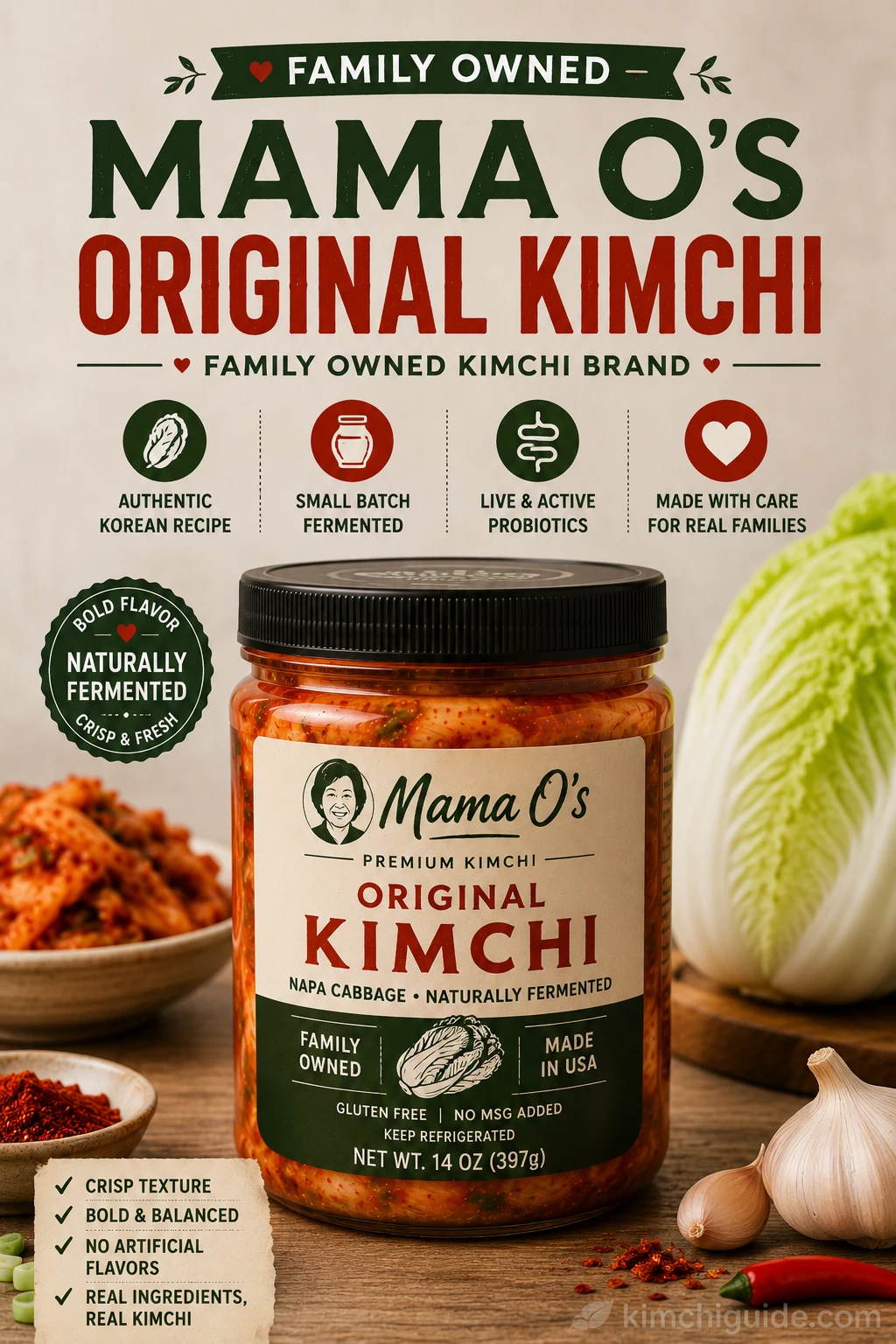
Who Makes It? Kheedim Oh & the Mama O Story
A genuinely accidental business, before it became a Shark Tank fixture.
Kheedim Oh founded Mama O’s Premium Kimchi in 2009. Living in New York City with no food-industry background — he’d spent years working as a DJ and concert planner — Oh couldn’t find kimchi in the city that matched his mother’s homemade version. Rather than settle, he began taking the bus from NYC to his parents’ home outside the city, making batches with his mother, Myung Oh (whom he calls “Mama O”), and hauling the finished kimchi back on the bus — reportedly rolling it home on a skateboard when he couldn’t afford a taxi.
What started as personal supply became a business almost by accident: friends who tasted the kimchi kept asking for more, a local butcher placed an order, and Oh eventually turned the recipe into a proper company, teaching himself the production side while his mother taught him the recipe. Mama O’s now describes itself as making kimchi “by hand the traditional way in Brooklyn,” and the company considers itself America’s first “premium” kimchi brand — a claim tied to its early positioning in specialty grocers like Whole Foods rather than mass-market retail.

Unlike brands built around a single founder’s recipe alone, Mama O’s leans directly into the mother-son partnership — Myung Oh appeared alongside her son on Shark Tank, and her involvement in developing and teaching the recipe remains central to the brand’s identity and marketing.

Beyond the three main kimchi lines, Mama O’s sells kimchi paste (a jarred seasoning blend the brand says it invented), a “Kimchili” hot sauce, dried kimchi seasoning, and complete DIY kimchi-making kits — a notably broader product range than most other brands in our ranking.
The Shark Tank Story — What Actually Happened
This is almost certainly why you’ve heard of this brand, so let’s cover it properly rather than in passing.
Kheedim Oh and his mother, Myung Oh, appeared on Shark Tank Season 14, Episode 3, which aired in October 2022. They asked the Sharks for $250,000 in exchange for 10% equity, implying a $2.5 million valuation (a smaller number of secondary sources instead report a $200,000/$2 million ask — we’re going with the more consistently repeated $250K figure, but it’s worth flagging that not every source agrees). At the time of filming, the company had reported roughly $815,000 in 2021 revenue, with $1 million projected for 2022.

Despite leaving without a deal, the appearance turned into real business momentum. Retailers that already stocked Mama O’s reported a sales bump, and the company expanded into Walmart, Safeway, and Albertsons in the years that followed, on top of its existing presence at Whole Foods and Williams Sonoma. Reported annual revenue reached roughly $1.6 million by mid-2024 — nearly double the 2021 figure discussed on the show. Speaking to The Chosun Daily afterward, Oh reflected that the Shark Tank appearance ended up being the highest-ROI marketing event in the company’s history, deal or no deal.
Original, Vegan & Super Spicy — Which Jar Is Which
Most reviews of this brand only cover the Original jar — the range is actually much wider.
| Product Line | Vegan? | Notes | Amazon |
|---|---|---|---|
| Original Kimchi | ✗ Not Vegan | Contains fish sauce (anchovy-based) — the classic, most widely reviewed line. | 🛒 Shop |
| Vegan Kimchi | ✓ Vegan | No fish sauce, gluten-free verified. A “great alternative to the OG,” per retailer H-E-B. | 🛒 Shop |
| Super Spicy Kimchi | ✓ Vegan | Uses bhut jolokia (ghost pepper) powder for extra heat. Also vegan and gluten-free. | 🛒 Shop |
| Kimchi Paste (Original, Vegan & Super Spicy) | ⚠️ Varies | A jarred seasoning blend for making kimchi at home — not a ready-to-eat kimchi itself. Shelf-stable. | 🛒 Shop |
Taste & Texture — The Genuinely Mixed Reviews
Reviewer opinion is more split on this brand than almost any other we’ve covered — worth presenting plainly rather than smoothing over.
On the positive side, Eat This, Not That!‘s side-by-side test of the Original line described “a well-balanced kimchi with a satisfying thickness and bite,” praising the interplay between the sweetness of cane sugar and the umami of anchovies, and specifically noting it “isn’t too salty.” Cozymeal‘s roundup made a similar point, though it noted the texture “could do with a bit more crunch.” Business Strategy Hub went further, describing the brand’s flavor as “strong” and “pronounced” — a notably different read than some other sources below.
On the critical side, Thingtesting‘s review of a Mama O’s kimchi was considerably harsher, describing it as “very salty and kinda flat without the umami, brightness and layers of flavor of great kimchi,” and flagging the price as high for the portion size. Separately, a 2026 roundup from K-Kitchen and the same Business Strategy Hub piece mentioned above both independently flagged the kimchi as running watery, with K-Kitchen adding that the texture is “softer than ideal” and that it doesn’t have “enough funk or heat for experienced kimchi eaters” — explicitly positioning it as a beginner pick rather than a top-tier one.
It’s also genuinely useful context that multiple reviewers — including our own testing — land on the same overall framing even when they disagree on the details: Mama O’s reads as a milder, more approachable, less funky kimchi than deeply fermented traditional brands, which is either a strength or a weakness depending entirely on what you’re looking for.
Real Ingredients Breakdown
Pulled directly from retail and USDA-linked ingredient panels (Amazon, Whole Foods, OpenFoodFacts) across the three main lines.
| Original Kimchi (not vegan) | Vegan Kimchi | Super Spicy Kimchi (vegan) |
|---|---|---|
| Napa cabbage | Napa cabbage | Napa cabbage |
| Chili peppers | Chili peppers | Red pepper flakes |
| Garlic | Garlic | Garlic |
| Ginger juice | Ginger juice | Ginger |
| Lime juice | Lime juice | Lime juice |
| Sugar | Organic cane sugar | Sugar |
| Onion | Onion | Scallions, cilantro |
| Fish sauce (water, salt, fish) | (not present) | (not present) |
| Cilantro, scallions | Korean daikon, cilantro, scallions | Bhut jolokia (ghost pepper) powder |

Mama O’s Kimchi Nutrition & Sodium Facts
Genuinely low-calorie across every line — sodium data is reported inconsistently across sources, which we’re flagging rather than papering over.
| Product | Serving | Calories | Carbs |
|---|---|---|---|
| Original / Vegan Kimchi | ~2oz | ~10 kcal | 2-3g |
| Super Spicy Kimchi | ~2oz | ~15 kcal | 3g |

Sodium figures for this brand are genuinely inconsistent across third-party nutrition databases we checked — some list roughly 150mg per serving, while others show figures that appear to be simple data-entry errors (sodium reported in grams rather than milligrams, or listed as 0mg, which is implausible for any fermented, salted kimchi). Rather than presenting a single number with false confidence, we’d rather flag this clearly: treat any specific sodium figure you see for this brand with some skepticism until you check the current label on your actual jar. See our low-sodium kimchi brands ranking for brands where we do have confident, consistent sodium data.
Certifications — Gluten-Free, Vegan & More
Real certifications exist on specific lines — but, as with the other brands we’ve reviewed, they don’t apply brand-wide.

At least one major retailer (H-E-B) specifically labels Mama O’s Vegan Kimchi as gluten-free verified, and the Super Spicy line’s published ingredients similarly contain nothing gluten-based. There’s no specific indication the Original line contains gluten either, but always check the current label of the exact jar you’re buying. See our vegan kimchi hub if you’d rather make a fish-sauce-free batch yourself.

As of this writing, we found no publicly listed Kosher or Halal certification for any Mama O’s product — a real difference from brands like Jongga or Lucky Foods’ Seoul Vegan Kimchi. The Vegan and Super Spicy lines are free of fish, shellfish, and other animal products by their ingredient lists, but that is not the same claim as formal religious certification. See our Halal & Kosher kimchi brands guide for the full certification picture across all 18 brands.
Safety & Quality Notes
Here’s what’s publicly documented — presented factually, without exaggeration.
Because Mama O’s produces in small, hand-made batches rather than on a fully automated line, it’s worth repeating the point from the taste section above: some of the texture inconsistency reviewers report (watery batches, softer-than-expected cabbage) is more plausibly explained by batch-to-batch variation typical of small-batch fermentation than by any documented safety issue. If a specific jar seems off compared to what you remember, that’s a quality-consistency note worth keeping in mind, not a safety red flag on its own — though mold, an off smell beyond normal kimchi sourness, or discoloration are always reasons to discard any kimchi, regardless of brand.
Is Mama O’s Good for Cooking, or Best Eaten Raw?
Both — with the kimchi paste line specifically built for cooking flexibility.
Given its milder profile and the “watery” texture some reviewers report, Mama O’s Original or Vegan jarred kimchi works well as a straightforward raw side dish, but may benefit from being cooked down slightly or paired with a bit of extra seasoning in dishes like kimchi fried rice or kimchi jjigae, similar to how we’d recommend using other milder brands. If you specifically want a cooking-focused product rather than a ready-to-eat kimchi, Mama O’s kimchi paste line is arguably a better fit — it’s designed to be stirred into marinades, stir-fries, or used to season proteins directly, without needing to account for a jarred kimchi’s existing brine ratio at all. See our kimchi fermentation stages guide or fresh vs. aged kimchi guide for how letting a jar age further changes its cooking behavior.
Availability & Price
Genuinely wider retail reach since the Shark Tank appearance — one of the brand’s clearest post-2022 wins.
| Retail Channel | Availability |
|---|---|
| Whole Foods Market | ✓ Widely stocked |
| Williams Sonoma | ✓ Stocked (select lines) |
| Walmart, Safeway, Albertsons | ✓ Added post-Shark Tank |
| Central Market | ✓ Stocked (regional) |
| Amazon & kimchirules.com (brand site) | ✓ Full range, multiple SKUs |
Mama O’s sits at a genuine premium price point — reviewers have cited around $9.99 at Central Market for a standard bag, and Thingtesting specifically flagged $13 for a small bag as expensive for the portion size in a separate purchase. Kimchi paste and DIY kit pricing varies by size and retailer. If it’s not stocked near you, our where to buy kimchi guide covers other channels worth checking.
🛒 Check Price on AmazonHow We Tested Mama O’s
This review draws on our broader 18-brand blind taste test, cross-referenced against independent third-party reviews of the brand’s other product lines.

Related Guides
Naturally connected reading if you’re deciding on Mama O’s or comparing it against the rest of the ranking.



Is Mama O’s Kimchi Good? FAQ — 20 Questions
It’s a solid, approachable choice, especially for people newer to kimchi — in our blind taste test it scored 7.2/10. Reviewer opinion is genuinely more split than most brands we’ve tested: some reviewers praise its balanced flavor and thick, satisfying cabbage cut, while others describe it as watery or a bit flat compared to more traditionally fermented brands.
Mama O’s Premium Kimchi was founded in 2009 by Kheedim Oh in Brooklyn, New York, based on the recipe of his mother, Myung Oh (whom he calls “Mama O”). Unable to find kimchi he liked in New York City, Oh began taking buses to his parents’ home to make batches with his mother, eventually turning the recipe into a business.
Yes. Kheedim Oh and his mother, Myung Oh, appeared on Shark Tank Season 14, Episode 3, which aired in October 2022. They asked for $250,000 in exchange for 10% equity, implying a $2.5 million valuation. None of the Sharks made an offer.
Each Shark cited a different reason. Mark Cuban felt not hiring a first employee in eight years signaled a lack of confidence to scale. Lori Greiner liked the product but didn’t find it investable. Kendra Scott said she wasn’t a kimchi person. Daymond John said he wasn’t “obsessed enough” with the product to invest. Despite no deal, the exposure led to real sales growth afterward.
The brand grew meaningfully. Retailers who already carried Mama O’s reported a sales uptick, and the company expanded into Walmart, Safeway, and Albertsons, in addition to its existing Whole Foods and Williams Sonoma presence. Reported annual revenue reached approximately $1.6 million by mid-2024, up from roughly $815,000 in 2021.
It depends on the line. Original Kimchi lists napa cabbage, kimchi paste (water, chili peppers, garlic, salt, sugar, ginger juice, lime juice, fish sauce), onion, cilantro, and scallions. Vegan Kimchi uses a vegan paste with no fish sauce, adding Korean daikon. Super Spicy Kimchi uses red pepper flakes, garlic, ginger, scallions, cilantro, lime juice, salt, sugar, and bhut jolokia (ghost pepper) powder, also without fish sauce.
Only some lines are. Original Kimchi contains fish sauce and is not vegan. Vegan Kimchi and Super Spicy Kimchi are both made without fish sauce or any animal products, and the Vegan line is specifically labeled gluten-free verified by at least one major retailer. Always check which specific jar is in front of you.
The Vegan line is specifically labeled gluten-free verified by at least one major retailer, and the Super Spicy line’s ingredient panel similarly lists no gluten-containing ingredients. There’s no indication the Original line contains gluten either, but always check the current label.
No third-party Kosher or Halal certification was found publicly listed for any Mama O’s product as of this writing, unlike brands such as Jongga or Lucky Foods’ Seoul Vegan Kimchi. The Vegan and Super Spicy lines are naturally free of animal products by ingredient list, but that is a different claim from formal religious certification.
Opinion is genuinely more split on this brand than most others we’ve reviewed. Positive reviews describe a well-balanced flavor with a satisfying cabbage cut. Critical reviews describe it as running watery, softer in texture than ideal, and lacking the funk or heat that more experienced kimchi eaters look for, positioning it instead as a good option for beginners.
Yes — multiple reviewers specifically recommend it as a beginner-friendly option because of its milder, cleaner, less funky flavor profile. If you already have an established taste for deeply fermented, funkier kimchi, you may find it less satisfying than a brand like Jongga or Cosmos.
Based on retail and USDA-linked nutrition databases, Mama O’s kimchi runs approximately 10-15 calories per 2oz serving depending on the line, with about 2-3g of carbohydrates — very low, consistent with kimchi generally.
Sodium figures are reported inconsistently across third-party nutrition databases for this brand, with some listing around 150mg per serving and others showing figures that appear to be data-entry errors. Treat kimchi generally as a flavorful condiment eaten in moderate portions rather than assuming any brand is automatically low-sodium.
Kimchi paste is a jarred, shelf-stable seasoning blend that lets you turn plain napa cabbage or other vegetables into kimchi at home. Mama O’s markets itself as having invented this product category, selling it in Original, Vegan, and Super Spicy versions, plus complete DIY kimchi-making kits built around it.
Mama O’s is sold at Whole Foods Market, Williams Sonoma, Walmart, Safeway, Albertsons, Central Market, and on Amazon, where the brand sells jarred kimchi, kimchi pastes, a Kimchili hot sauce, and DIY kimchi kits directly.
Mama O’s sits at a premium price point — reviewers have cited around $9.99 to $13 for a standard bag or jar, reflecting its small-batch, hand-made production in Brooklyn.
No FDA recall was found under the Mama O’s brand name as of this writing. Our own pillar ranking’s recall-disclosure box notes only one documented recall among all 18 brands we’ve ranked, and Mama O’s is not among the affected brands.
Some reviewers report this as a recurring complaint — a 2026 roundup and a separate business-focused profile both independently note that Mama O’s kimchi can run watery, with a higher brine-to-cabbage ratio and softer texture than some competitors. This isn’t universal, but it appears often enough across independent sources to be worth knowing before you buy.
Jongga and other top-ranked traditional brands generally score higher for deep, funky, well-fermented flavor. Mama O’s and Cleveland Kitchen are both frequently recommended as good starting points for beginners specifically because they’re milder and less intense — a different use case than reaching for the most authentic-tasting jar available.
It’s a genuine, founder-led small-batch brand with real Brooklyn hand-made production, an interesting Shark Tank story, and a broader product range than most competitors. It’s a strong beginner-friendly pick, though reviewer opinion on the jarred kimchi’s flavor and texture is more genuinely mixed than most other brands in our ranking.


💬 Leave a Comment
Tried Mama O’s kimchi? Tell us which line you bought and what you thought.