Is Lucky Foods Seoul Kimchi Good? The Full Review — Taste, Ingredients & the Daesang Connection (2026)
A standalone deep-dive on the budget-friendly Oregon brand ranked #1 by Chowhound — the honest taste verdict, real ingredients across the Original and Vegan lines, kosher and gluten-free certification, and the 2023 acquisition that quietly made it a sister brand to Jongga.
Is Lucky Foods Seoul Kimchi Good?
It’s a genuinely solid, budget-friendly choice — just not the most refined jar on the shelf. In our 18-brand blind taste test, Lucky Foods (Seoul Kimchi) scored 6.8 out of 10, ranking #14. But that number undersells how well-regarded it is elsewhere: Chowhound independently ranked it #1 of 6 store-bought brands tested — ahead of Bibigo — and a 2026 roundup named it “Best Budget Kimchi.” What most other coverage misses entirely: in June 2023, Lucky Foods was acquired by Daesang Corporation, the same Korean conglomerate that owns Jongga, our #1-ranked brand overall. Two lines are sold — Original (with fish sauce and shrimp) and Vegan (with neither) — and the Vegan line carries genuine Kosher certification.
🛒 Check Price on AmazonLucky Foods Seoul Kimchi — At a Glance
Here’s what actually matters before you decide whether to put a jar in your cart.
- Taste: genuinely well-reviewed elsewhere — #1 in an independent 6-brand test.
- Made by: Lucky Foods, LLC (Portland, OR) — now owned by Daesang, Jongga’s parent.
- Ingredients: Original has fish sauce & shrimp; Vegan line has neither.
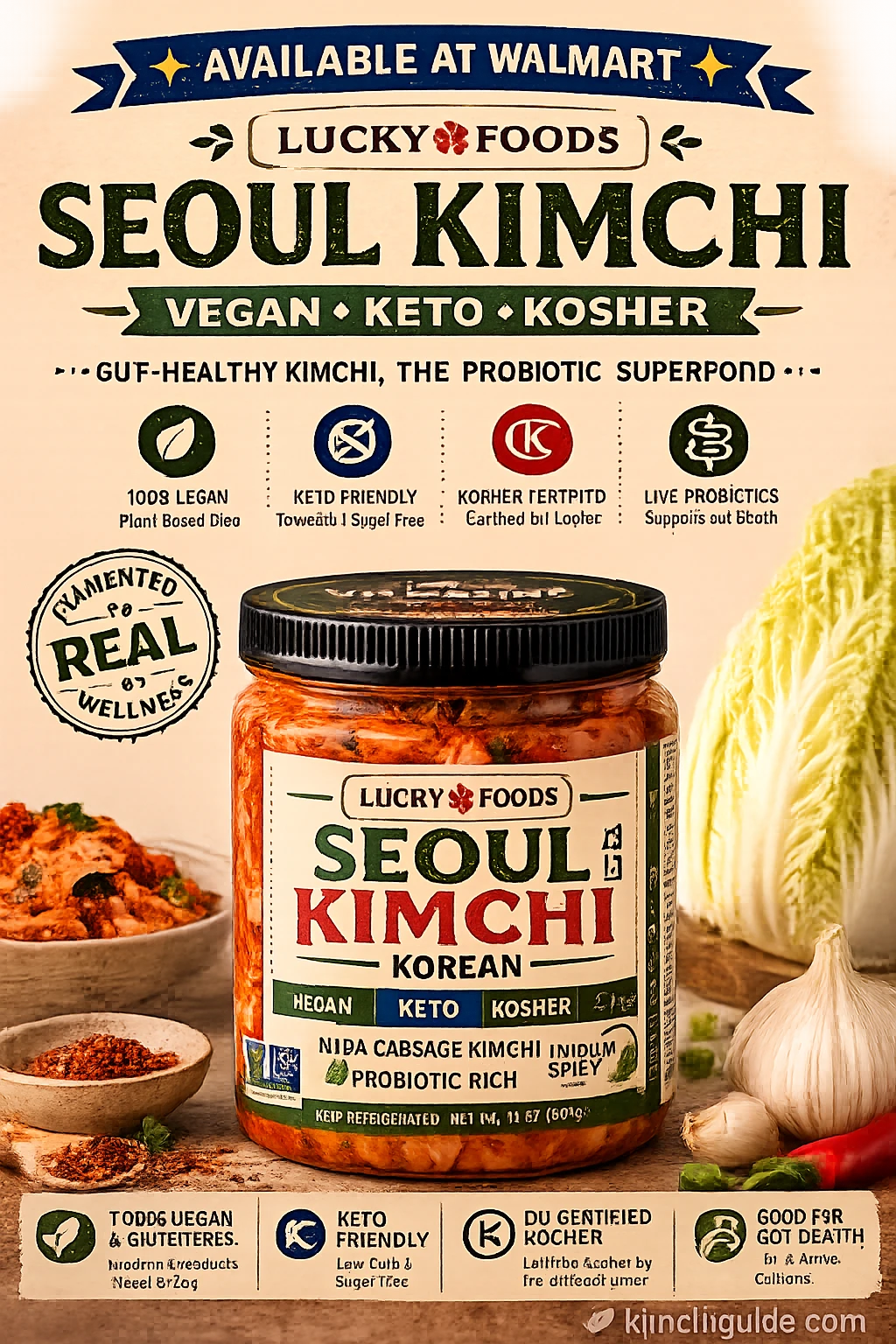
- Certifications: Kosher (Vegan line), gluten-free, non-GMO, keto-friendly.
- Value: repeatedly named “best budget kimchi” — great for everyday cooking.
- Availability: Walmart, Target, H Mart, Whole Foods, Costco (regional), Amazon.
Lucky Foods Seoul Kimchi — Product Overview & Scorecard
Here’s how Lucky Foods scored across our core taste-test criteria, from the same 18-brand blind test used for our full brand ranking.
Who Makes It? The Lucky Foods / Jo Family Story
A genuinely small, immigrant-founded origin story — before we get to the corporate twist.
Lucky Foods, LLC was founded in 2000 and is based in Portland, Oregon. Its roots go back further: the founding family arrived in the United States in the 1970s, and — speaking minimal English — the family’s grandmother supported the household by cooking and selling Asian dishes, eventually opening a small restaurant. What began as a single eatery grew into a manufacturing business built around the family’s Lucky Spring Rolls, which remains one of the company’s signature products today. The kimchi line came later, launched under the separate Seoul brand name to carry the family’s Korean recipes specifically.
Lucky Foods describes itself as a minority, woman-owned company, and its marketing leans heavily on the “grandma’s recipe” framing — the Seoul Kimchi ingredient list and preparation method are presented as a multi-generational family recipe rather than a corporate R&D formulation, similar in spirit to Mother-in-Law’s origin story, though Lucky Foods built a considerably larger retail footprint (Walmart, Target, and Costco distribution) well before any acquisition.

Unlike some brands that age kimchi before shipping, Lucky Foods packs Seoul Kimchi fresh and lets fermentation happen in the jar after purchase — meaning the buyer controls how mild or bold the final flavor gets, simply by choosing when to eat it.

Beyond the two kimchi lines, Lucky Foods also sells a Kimchi Hot Sauce, gluten-free egg rolls, Korean sauces (including a Seoul Gochujang), and spring rolls — diversifying well beyond the original restaurant menu while keeping kimchi as roughly two-thirds of the overall business.
Who Owns Lucky Foods Now? The Daesang/Jongga Connection
This is the single most underreported fact about this brand, and it changes how you should read every other review of it, including this one.
In June 2023, Daesang Corporation — South Korea’s biggest kimchi exporter and the parent company of Jongga, our #1-ranked brand in this entire 18-brand ranking — acquired 100% of Lucky Foods’ shares and facilities for roughly 38 billion won (about $29.7 million USD), funded through a paid-in capital increase. The stated goal was explicit: accelerate Daesang’s US kimchi expansion by using Lucky Foods’ existing Oregon infrastructure, with plans to double Seoul Kimchi’s production capacity and strengthen marketing and R&D in the American market.

Practically, this means Lucky Foods (Seoul Kimchi) and Jongga are now sister brands under the same parent company, even though they continue to operate as separate, independently branded products — Jongga remains Daesang’s flagship Korean-made export, while Seoul Kimchi stays a US-made, Oregon-produced line. It’s a genuinely different situation from Bibigo’s relationship to CJ CheilJedang, where the parent company built the consumer brand from scratch — here, Daesang bought an already-established American company and is investing to scale it further, rather than launching a new brand. See our Jongga vs Bibigo comparison for how Daesang’s flagship brand stacks up against its biggest rival — now, in a sense, against its own newly acquired sibling too.
Original vs. Vegan — Which Jar Is Which
Most reviews of this brand don’t specify which line they tasted — and the two are genuinely different products.
| Product Line | Vegan? | Kosher? | Notes | Amazon |
|---|---|---|---|---|
| Seoul Original Kimchi | ✗ Not Vegan | Not confirmed | Contains anchovy-based fish sauce and salted baby shrimp — the traditional umami combination. | 🛒 Shop |
| Seoul Vegan Kimchi (Chowhound’s #1 pick) | ✓ Vegan | ✓ Kosher | No seafood at all — same core vegetables and spices, seafood-free umami. Also sold in a Spicy variant. | 🛒 Shop |
| Seoul Kimchi Hot Sauce | ✓ Vegan | Not confirmed | A bottled version of the kimchi flavor — for dipping, glazing, or seasoning, not a jarred kimchi itself. | 🛒 Shop |
Taste & Texture — What Reviewers Actually Say
Genuinely well-regarded by independent reviewers, with a couple of real caveats worth knowing.
The strongest praise for this brand comes from outside our own testing: Chowhound’s independent taste test ranked Seoul Vegan Original Kimchi #1 of 6 store-bought brands, beating out Bibigo (which placed #4 in that same test). The reviewer specifically called out a pleasant textural contrast between crunchy and softer cabbage pieces, and described the fermentation as genuinely lively — noting bubbling liquid in the jar as a sign of active lacto-fermentation rather than a flaw. A separate student-run publication ranking similarly placed Lucky Foods’ Seoul Vegan Kimchi in second place among locally available brands, praising its moderate spice and more vinegar-forward tang from skipping fish sauce.
A 2026 roundup focused specifically on value struck a more mixed note: it called the brand “good enough for everyday cooking at the best price” and praised its fermentation and reasonable spice level, but flagged that seasoning “can lean salty” and that the product “can be inconsistent — some jars are great, others are just okay.” One individual Amazon customer review of the Original 56oz line went further, describing a taste they attributed to MSG (despite the brand’s official no-MSG ingredient claim) and finding the “spicy” labeling milder than expected.
Real Ingredients Breakdown
Pulled directly from retail ingredient panels (ShopRite, Instacart, Fred Meyer, Kroger) for both lines.
| Seoul Original Kimchi (not vegan) | Seoul Vegan Kimchi |
|---|---|
| Napa cabbage | Napa cabbage |
| Chili pepper | Chili pepper |
| Carrot | Carrot |
| Garlic | Garlic |
| Green onion | Green onion |
| Cane sugar | Cane sugar |
| Onion | Onion |
| Salted baby shrimp | (not present) |
| Sea salt | Sea salt |
| Ginger | Ginger |
| Anchovy extract (fish sauce) | (not present) |

Lucky Foods Seoul Kimchi Nutrition & Sodium Facts
Genuinely low-calorie, and marketed specifically around a lower-sodium positioning.
| Product | Calories | Carbs | Sugar |
|---|---|---|---|
| Seoul Original Kimchi | ~15 kcal | 3g | 1g |

Multiple third-party reviews specifically highlight the brand’s “low-sodium” positioning as a selling point — Chowhound’s review noted the label declaring the product “low-sodium” among its other health-food attributes, and Lucky Foods additionally sells a dedicated Original Low Sodium variant for buyers who want to cut back even further while keeping the same core flavor. See our full low-sodium kimchi brands ranking for exactly how Lucky Foods compares against all 18 brands we’ve tested on this specific metric.
Certifications — Kosher, Gluten-Free & More
Lucky Foods carries more third-party certifications than most brands in our ranking — but they apply most fully to the Vegan line specifically.

Seoul Vegan Kimchi carries Kosher certification, confirmed across multiple major retailer listings (Kroger, QFC, King Soopers, Ralphs). That makes Lucky Foods one of only two brands in our entire 18-brand ranking — alongside Jongga — to carry Kosher certification on any of its lines, a genuinely useful distinction for Kosher-keeping shoppers who have limited packaged kimchi options.

Both the Original and Vegan lines are labeled gluten-free, and the Vegan line additionally carries Non-GMO Project Verified and keto-friendly labeling. No Halal certification was found publicly for either line as of this writing — a real gap compared to Jongga (Halal-certified since 2010) and Bibigo’s fish-sauce-free lines. See our Halal & Kosher kimchi brands guide for the full certification picture across all 18 brands, or our vegan kimchi hub if you’d rather make a seafood-free batch at home.
Safety & Quality Notes
Here’s what’s publicly documented — presented factually, including a mix-up worth clearing up explicitly.
It’s also worth repeating the allergen point from the ingredients section: Seoul Original Kimchi’s own allergen panel explicitly states “Contains: shrimp, fish.” If you or someone you’re cooking for has a shellfish or fish allergy, that’s a hard no on the Original line specifically — reach for the Vegan line instead, and still check the label, since formulations can change.
Is Lucky Foods Good for Cooking, or Best Eaten Raw?
This is genuinely one of the brand’s strongest use cases, according to multiple independent reviewers.
A 2026 kimchi-brand roundup specifically named Lucky Foods the “best budget kimchi” for cooking, noting it’s “good for cooking in large quantities without feeling like you are burning money” — a real practical advantage when a recipe calls for a full cup or more of kimchi, such as kimchi fried rice or a big batch of kimchi jjigae. Because Lucky Foods packs its kimchi fresh and lets fermentation continue in the jar, buyers can also let a jar sit in the fridge for a couple of extra weeks before cooking with it to build a deeper, more sour flavor — see our kimchi fermentation stages guide or fresh vs. aged kimchi guide for exactly what changes as it sours further.
Availability & Price
Genuinely wide mainstream distribution for a brand of this size — one of its real strengths.
| Retail Channel | Availability |
|---|---|
| Walmart | ✓ Widely stocked |
| Target | ✓ Widely stocked |
| H Mart & Korean/Asian grocery stores | ✓ Widely stocked |
| Whole Foods, Costco | ✓ Stocked (regional) |
| Kroger family (Kroger, Ralphs, QFC, King Soopers, Fred Meyer) | ✓ Widely stocked (Vegan line) |
| Amazon | ✓ Multiple SKUs, sold by Lucky Foods, LLC |
Lucky Foods is consistently reviewed as one of the more affordable, best-value options in this category — multiple 2026 roundups specifically name it the “best value” or “best budget” kimchi brand. Exact pricing varies by retailer, jar size (14oz and 56oz sizes are both common), and region. If it’s not stocked near you, our where to buy kimchi guide covers other channels worth checking.
🛒 Check Price on AmazonHow We Tested Lucky Foods
This review draws on our broader 18-brand blind taste test, cross-referenced against independent third-party reviews of the brand’s other product lines.

Related Guides
Naturally connected reading if you’re deciding on Lucky Foods or comparing it against the rest of the ranking.


Is Lucky Foods Seoul Kimchi Good? FAQ — 20 Questions
It’s a solid, budget-friendly choice rather than the most refined jar on the shelf. In our blind taste test it scored 6.8/10, ranking #14 of 18 brands. Independently, Chowhound ranked the Seoul Vegan Original line #1 out of 6 store-bought brands tested, and a 2026 roundup named it “Best Budget Kimchi.” Other reviewers note some batch inconsistency and seasoning that can lean salty. It’s a genuinely good value pick, especially for cooking.
Seoul Kimchi is made by Lucky Foods, LLC, an Asian food company founded in 2000 and based in Portland, Oregon. The company was started by a Korean immigrant family (the Jo family) who arrived in the US in the 1970s, beginning with a restaurant and later a spring-roll manufacturing business before expanding into kimchi under the Seoul brand name.
Yes. In June 2023, Daesang Corporation — the South Korean food conglomerate that owns Jongga, Korea’s leading kimchi brand — acquired 100% of Lucky Foods’ shares and facilities for approximately 38 billion won (about $29.7 million USD), as part of Daesang’s plan to expand its kimchi business in the US and double Seoul Kimchi’s production capacity.
Not the same brand, but as of June 2023, the same parent company: Daesang Corporation. Jongga remains Daesang’s flagship Korean-made kimchi export brand, while Lucky Foods (Seoul Kimchi) continues operating as a separate, US-based brand and production facility in Oregon.
It depends on the line. Seoul Original Kimchi lists napa cabbage, chili pepper, carrot, garlic, green onion, cane sugar, onion, salted baby shrimp, sea salt, ginger, and anchovy extract (fish sauce). Seoul Vegan Kimchi lists the same core vegetables and spices but no seafood at all.
Only the Vegan line is. Seoul Original Kimchi contains salted baby shrimp and anchovy-derived fish sauce, so it is not vegan or vegetarian. Seoul Vegan Kimchi is made without any seafood and is labeled vegan, vegetarian, and pescatarian-friendly by multiple retailers.
Yes — the Seoul Vegan Kimchi line carries Kosher certification, confirmed on multiple retailer listings including Kroger, QFC, King Soopers, and Ralphs. This makes Lucky Foods one of only two brands in our 18-brand ranking (alongside Jongga) that carries Kosher certification on any of its lines.
No Halal certification was found publicly listed for any Lucky Foods Seoul Kimchi product as of this writing, unlike Jongga or Bibigo’s fish-sauce-free lines. The Vegan line’s ingredient list is naturally free of animal products, but that is a different claim from formal Halal certification.
Yes — both the Original and Vegan lines are labeled gluten-free by Lucky Foods and confirmed across multiple retailer listings, based on their published ingredient panels.
Reviewer opinion is generally positive but not unanimous. Chowhound praised the Seoul Vegan Original’s tangy, well-fermented flavor, ranking it #1 of 6 brands tested. Other reviewers noted seasoning that “can lean salty” and some inconsistency between jars. One Amazon customer review of the Original line described tasting MSG despite the brand’s official no-MSG claim.
Based on retail nutrition data for the Original line, Seoul Kimchi runs approximately 15 calories per serving, with about 3g of carbohydrates and 1g of sugar — very low, consistent with kimchi generally.
It’s marketed and reviewed as comparatively low in sodium — multiple third-party reviews specifically call out the brand’s “low-sodium” labeling, and Lucky Foods also sells a dedicated Original Low Sodium variant. See our low-sodium kimchi brands ranking for exactly how it compares across all 18 brands.
Seoul Kimchi is sold at Walmart, Target, H Mart, Whole Foods, and Costco (regionally), plus on Amazon, where Lucky Foods, LLC sells the Original 56oz jar, Vegan Spicy 28oz jar, and Kimchi Hot Sauce directly.
Lucky Foods is consistently reviewed as one of the more affordable options in its category — multiple 2026 roundups specifically name it the “best value” or “best budget” kimchi brand. Exact pricing varies by retailer, jar size, and region.
No FDA recall was found under the Lucky Foods or Seoul Kimchi brand name as of this writing. Don’t confuse this with a separate, unrelated 2026 recall by a different company, Ocinet, Inc., for its “…And Kimchi” branded sliced kimchi over undeclared fish — that recall does not involve Lucky Foods or Seoul Kimchi.
According to Lucky Foods’ own published ingredient panels and company claims, no — the brand states its products contain no MSG, GMOs, added colors, or preservatives. That said, at least one Amazon customer review of the Original line reported tasting what they believed was MSG, which we present as an anecdotal impression rather than a documented ingredient fact.
Yes — multiple reviewers specifically recommend it for everyday cooking use, calling it good value for making large batches of kimchi fried rice or kimchi jjigae without feeling wasteful.
Jongga (our #1-ranked brand) and Bibigo both score meaningfully higher for depth and complexity of flavor in our broader 18-brand comparison. Interestingly, Lucky Foods outranked Bibigo (placing #1 vs. Bibigo’s #4) in an independent Chowhound test of just 6 brands. As of June 2023, Lucky Foods and Jongga also share the same parent company, Daesang Corporation, though they remain separate, independently operated brands.
It’s a legitimate, now Daesang-backed brand with real kosher, gluten-free, and non-GMO certifications, and it’s consistently praised as one of the best value picks in the category. It isn’t the most artisan or deeply complex option in our ranking, and a few reviewers note batch inconsistency, so go in expecting reliable, affordable, everyday kimchi rather than the single most refined jar on the shelf.


💬 Leave a Comment
Tried Lucky Foods Seoul Kimchi? Tell us which line you bought and what you thought.