Is Cosmos Kimchi Good? Full Review of Our #2 Overall Pick
Cosmos scored 9.1 out of 10 in our blind taste test of 18 brands — practically neck-and-neck with our #1 pick. Here’s exactly why, what it’s actually made of (including a correction on MSG), where you can really buy it (including whether Amazon is an option), and the genuine company history behind the jar.
Is Cosmos Kimchi Good?
Yes — Cosmos ranked #2 out of 18 brands in our blind taste test, scoring 9.1/10, just behind Jongga. It has a large cabbage cut and a deep, complex tang that some tasters actually preferred (though at least one independent roundup describes the texture as softer than average — more on that below). Two things worth knowing up front: Cosmos is not made in Korea — it’s produced in the USA by Cosmos Food Co., a company operating since 1971 — and it’s not only sold at Korean grocery stores; it’s also confirmed at Costco and Kroger-family supermarkets, though unlike Jongga and Bibigo, it isn’t a reliable Amazon purchase. Full breakdown, real ingredients, nutrition, marketplace availability, and buying guide below.
Who Actually Makes Cosmos Kimchi (It’s Not What Most Articles Say)
Several kimchi-brand roundups online describe Cosmos as a Korean import, sold mainly through Korean grocery stores. The retail part is only half true — but the “made in Korea” part isn’t true at all, and the “Korean grocery stores only” part is also outdated.
Founded in 1971 by a Group of Women
Cosmos Food Co. began in 1971, founded by women serving Los Angeles’s then-small but growing Korean community. Three further owners came and went over the following decades as the company grew alongside LA’s Korean population.
David Kim Bought It in 2002 — and Took It Mainstream
Businessman David Kim acquired Cosmos in 2002. Under his ownership, the company’s business reportedly more than doubled, in large part because it moved beyond Korean grocery stores into mainstream retailers — Costco locations across California and Walmart stores nationwide, per a 2009 profile of the company. That mainstream expansion is still reflected in where Cosmos is sold today (see the buying section below), though notably it never became a big Amazon seller the way some competitors did.
It Has a Genuinely Notable Olympic History
During the 1984 Summer Olympics in Los Angeles, Cosmos Food supplied kimchi to a restaurant in the Olympic Village — the first time kimchi was ever served at the Olympics. It reportedly went over so well that it became a regular menu item there afterward.
It’s Grown Into a Major US Manufacturer — and a Private-Label Supplier
Cosmos describes itself as the largest manufacturer and distributor of kimchi in the United States, operating an SQF Level II, GMP, Organic, and Vegan-certified facility in City of Industry, CA. It has also manufactured private-label kimchi for other brands, including Josan and Frieda’s, according to the same 2009 reporting — a “who actually makes it” wrinkle similar to what we found researching Trader Joe’s private-label kimchi.
New in 2024: Acquired by Schwan’s — Now the Same Corporate Family as Bibigo
In April 2024, Cosmos Food Co. was acquired by Schwan’s Company (maker of Red Baron and Freschetta) and now operates as Schwan’s Cosmos Food, LLC, still based at the same City of Industry address. This matters more than a typical ownership footnote: Schwan’s has been majority-owned by South Korea’s CJ CheilJedang since 2019 — the same parent company behind the Bibigo brand. Trade press reported that CJ began producing Bibigo-branded kimchi through the Schwan’s Cosmos Food subsidiary shortly after the acquisition, meaning Cosmos’s own City of Industry facility may now also be involved in making Bibigo kimchi for the US market. Consumer packaging still says “Cosmos Food Co.” with no visible Schwan’s or CJ branding as of this update, so this is a background-ownership fact rather than something you’d notice on the shelf.
Cosmos Kimchi in 2026 — What’s New
Cosmos doesn’t move as fast as some larger competitors, but here’s what’s actually current.
Cosmos Kimchi — Taste Test Results
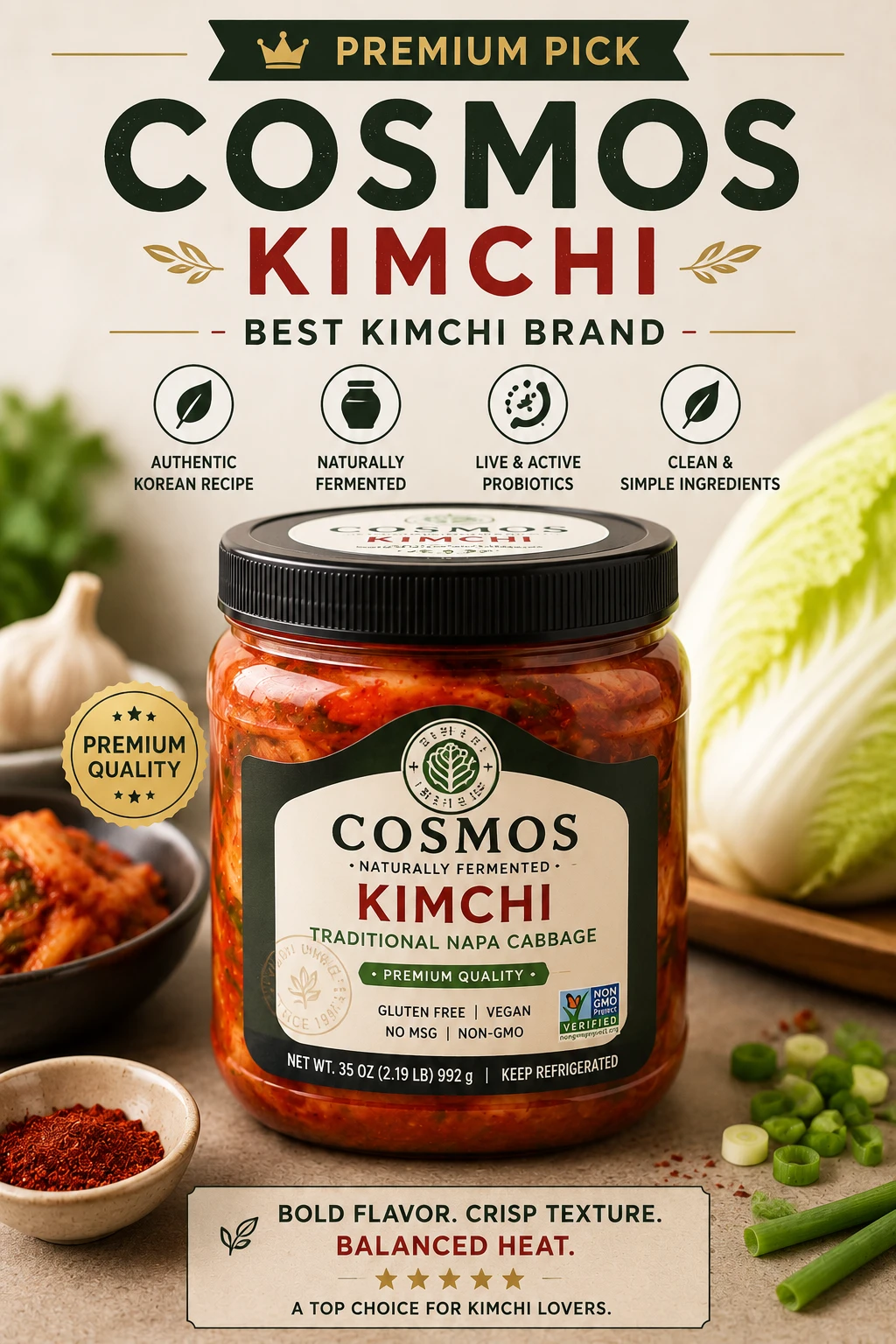
Neck-and-neck with Jongga in pure flavor — some tasters on our panel actually preferred Cosmos’s deeper, more complex tang. Our panel rated the cabbage cut as large and crunchy in the jars we tested — though see the texture debate section below, since not every reviewer agrees on this point.
Across our three-round methodology (fresh, 2 weeks open, 4 weeks open), the jars we tested held their crunch noticeably longer than most competitors — where brands like Trader Joe’s or Bibigo soften significantly by week 2, our Cosmos jar’s thick-cut cabbage was still distinctly crisp. Fermentation depth by week 4 was excellent, developing real complexity without turning harsh — see our kimchi fermentation stages guide if you want to understand what’s actually happening in the jar at each of those points, and our fresh vs. aged kimchi guide for how Cosmos specifically changes over that first month.
The Texture Debate — Crunchy or Soft?
Not every reviewer agrees with our own tasting notes here, and it’s worth surfacing that honestly rather than pretending there’s total consensus.
Cosmos’s Full Product Line
Most kimchi content treats Cosmos as a single product. In reality, the brand sells a genuinely wide range — worth knowing before you assume “Cosmos kimchi” means one specific thing.
| Product | Key Ingredients | Notes |
|---|---|---|
| Traditional Napa Cabbage (standard) | Napa cabbage, radish, fish sauce (anchovy), MSG | The jar scored in our ranking — contains MSG per retailer panels |
| Traditional — No-MSG variant | Same recipe, MSG omitted | Separate SKU per Cosmos’s own product listing |
| Traditional — Mild / Extra Hot variants | Same base recipe, adjusted gochugaru level | Heat-level options within the standard line |
| Organic Vegan Medley | Organic cabbage, kale, radish, carrot — no MSG, no fish | USDA Organic + Vegan Action certified |
| Radish Kimchi | Korean radish-based recipe | Separate product line from napa cabbage jars — see our types of kimchi guide for how this compares to kkakdugi-style radish kimchi |
| Cucumber Kimchi | Cucumber-based recipe | Featured in Cosmos’s own recipe/social content |
| Kimchi Sauce (bottled) | Seasoning sauce, not whole kimchi | Cosmos’s most consistently Amazon-available product — see the marketplace section below |
Ingredients — What’s Really in the Jar
Pulled directly from retailer ingredient panels (Kroger, Ralphs, Instacart) rather than marketing copy — this is the actual label on the standard jar sold at mainstream grocery stores.
| Ingredient | Role |
|---|---|
| Napa cabbage | Base vegetable |
| Radish | Traditional secondary vegetable |
| Red pepper | Color and heat (gochugaru) |
| Garlic, ginger, onion | Aromatics |
| Salt, sugar | Fermentation and balance |
| Fish sauce (anchovy extract, water, salt, sugar) | Umami — not vegan in the standard line |
| Monosodium Glutamate | Flavor enhancer — present in the standard jar; a no-MSG variant exists separately |
| Water | Brine base |
Listed allergens on retailer panels include fish and its derivatives, glutamate and its derivatives, and shellfish and its derivatives — worth a careful read if you’re managing a fish or shellfish allergy specifically, not just a general kimchi-caution. If you’re shopping by dietary restriction more broadly, our Halal & Kosher kimchi brands guide and pasteurized vs. live-culture kimchi guide cover how Cosmos and its competitors stack up on those specific criteria.
Nutrition Facts
Genuinely light, consistent with kimchi generally — sodium figures vary slightly depending on the source, so we’ve shown the range rather than picking one number.
| Nutrient | Per Serving | Notes |
|---|---|---|
| Calories | 15 | Per 1oz serving (Instacart/retailer data) — in line with most brands in our ranking |
| Carbohydrate | 2g | Retailer nutrition panel |
| Sugar | 1g | Low, typical for traditional-style kimchi |
| Fat | 0g | Consistent across all sources checked |
| Sodium | 300-340mg | 300mg per our original hub data; 340mg per Instacart’s retailer listing — shown as a range since sources differ slightly |
| Fiber | 1.6g | Slightly above average for this ranking |
| Vitamin C | 14% DV | One of the higher figures in our comparison |
This nutrition profile is for the standard traditional jar. The Organic Vegan Medley line has a somewhat different ingredient base (adding kale and carrot to the cabbage-and-radish mix), so its exact nutrition figures may differ slightly — check the specific package if you’re tracking macros precisely. See our full sodium comparison of all 18 brands for how Cosmos stacks up against lower-sodium options if that’s a priority.
Certifications Explained
Cosmos leans on its certifications in its own marketing — here’s what each one actually confirms.
Pros & Cons
- Deep, complex flavor that rivals our #1 pick, Jongga
- Naturally fermented with live active cultures
- Wide product range: traditional, no-MSG, organic vegan, radish, cucumber
- Genuinely available beyond Korean grocers — confirmed at Costco and Kroger/Ralphs
- Real food-safety and organic certifications (SQF Level II, CCOF, Vegan Action)
- Over 50 years of dedicated kimchi manufacturing, with genuine Olympic history
- Standard jar contains MSG — must seek out the no-MSG SKU to avoid it
- Standard jar is not vegan (contains fish sauce)
- Texture perception varies by reviewer — not everyone finds it as crunchy as we did
- Premium price ($8.99-14/jar depending on size and retailer) vs. some mainstream brands
- Not a reliable Amazon purchase — unlike Jongga or Bibigo, you can’t easily order the core jar online direct from the brand
- Often mislabeled online as “made in Korea” and “Korean grocery stores only”
Cosmos vs. Jongga — How Close Is It, Really?
Cosmos and Jongga are the two highest-scoring brands in our entire 18-brand ranking, just 0.3 points apart. Here’s the direct comparison — see our full Jongga review and our Jongga vs. Bibigo head-to-head for more detail on the #1 pick specifically.
| Cosmos | Jongga | |
|---|---|---|
| Overall score | 9.1/10 | 9.4/10 |
| Made in | USA (since 1971) | Korea + US/Poland/Vietnam facilities |
| Texture | Large cut per our test; softer per some other reviews | Consistent crunch, widely praised |
| Flavor | Deep, complex — some tasters preferred it | Most balanced overall |
| MSG | In standard jar; no-MSG variant available | In Korea-made standard jar; formulations vary by region |
| Availability | H Mart, Costco, Kroger, Ralphs — not reliably on Amazon | H Mart, Costco, Amazon, select Walmart |
| Price | ~$8.99-14/jar depending on size | ~$8-12/jar; ~$6/can shelf-stable on Amazon |
The honest takeaway: if you can only find one of the two, either is an excellent choice, and the gap between them is smaller than the gap between either one and the rest of our ranking. Jongga edges ahead slightly on overall balance, consistency, and how easy it is to order online; Cosmos wins on flavor complexity for many tasters and now matches Jongga fairly closely on mainstream in-store retail availability too, now that the “H Mart only” assumption about Cosmos has been corrected. The one place Jongga still clearly leads is marketplace shopping — see the next section for why. Worth knowing: Jongga is made by Daesang, a fully independent Korean food company, while Cosmos was acquired by Schwan’s (majority-owned by CJ CheilJedang, Bibigo’s parent) in April 2024 — so a Jongga-vs-Cosmos comparison is genuinely two separate companies, while Cosmos-vs-Bibigo increasingly is not.
Cosmos on Amazon — Can You Actually Order It Online?
This is a question we get asked a lot, since Jongga and Bibigo both show up reliably on Amazon and Walmart’s marketplace. We checked directly, and the honest answer for Cosmos is: barely, and not at a fair price.
| Brand | What shows up on Amazon | Typical price | Take |
|---|---|---|---|
| Cosmos | A third-party-resold 4-pack of the 14oz Extra Hot jar is the main listing we could verify, plus Cosmos’s bottled Kimchi Sauce | Noticeable markup over Costco/Kroger shelf price | Core refrigerated jars aren’t sold or fulfilled by the brand directly on Amazon |
| Jongga | Shelf-stable canned kimchi sold and fulfilled directly, plus large imported tubs | ~$6.08/can; ~$9-16 for larger tubs | Genuinely easy to order online, in a format built for shipping |
| Bibigo | Refrigerated cups listed on marketplace platforms (Walmart.com is the more consistent option vs. Amazon) | ~$3.18/10oz | Widely stocked and reviewed, but still leans on refrigerated grocery delivery over pure Amazon fulfillment |
The pattern here isn’t really a Cosmos-specific weakness — it’s a format issue. Cosmos’s flagship products are fresh, refrigerated, actively fermenting jars, which travel and fulfill worse through standard marketplace shipping than Jongga’s shelf-stable canned format does. That’s very likely why Cosmos has leaned on Costco, Kroger-family stores, and Korean grocers rather than building out Amazon as a sales channel, while Jongga has specifically developed a canned, shelf-stable product line that’s easier to sell online.
Safety Notes
Presented factually, without exaggeration.
Where to Buy Cosmos Kimchi & What It Costs
In practice: H Mart and other Korean grocery stores remain the most reliable place to find the widest range of Cosmos’s product line (traditional, radish, cucumber, organic vegan), since a specialty grocer will typically carry more SKUs than a mainstream supermarket. But if you’re shopping at Costco or a Kroger-family store, it’s genuinely worth checking the refrigerated international or produce section before assuming you need a special trip — Cosmos may already be there. Grocery delivery apps like Instacart also reliably carry Cosmos from those same stores, which is a better bet than Amazon if you want it shipped. Availability at any specific store location can still vary regionally, so check locally rather than assuming national stock. For a broader retailer-by-retailer breakdown across all major kimchi brands, see our where-to-buy kimchi guide.
Our Verdict
Cosmos is one of two brands in our 18-brand comparison that genuinely earns “restaurant-quality” — the flavor complexity is right there with Jongga, and the brand offers a genuinely wide product range from traditional to organic-vegan to radish and cucumber varieties. It’s an excellent choice for gifting, for cooking, or simply as one of the best jars you can buy — and unlike what most other kimchi content claims, you don’t necessarily need a special Korean-grocery trip to find it, since it’s also stocked at Costco and Kroger-family stores. Three things worth double-checking before you buy: the standard jar contains MSG and fish sauce, so seek out the no-MSG or vegan variants specifically if either matters to you; texture experience genuinely varies by reviewer, so don’t be surprised if your jar reads a little differently than ours did; and if you were planning to order it on Amazon the way you might with Jongga, plan on a store trip or Instacart order instead.
Cosmos Kimchi — FAQ
Yes. Cosmos ranked #2 overall out of 18 brands in our blind taste test, scoring 9.1/10 — just behind Jongga. It stood out for a large cabbage cut and a deep, complex tang, making it especially good for gifting or for anyone who wants restaurant-quality kimchi without making it from scratch.
No. Cosmos Kimchi is made in the USA by Cosmos Food Co., Inc., a Korean-American company founded in 1971 and based in City of Industry, California — not imported from Korea. It follows a traditional Korean recipe and technique, and the company has a notable history: it supplied kimchi to the 1984 Los Angeles Olympics Village, the first time kimchi was served at the Olympics.
Cosmos Food Co. was founded in 1971 by a group of women serving Los Angeles’s Korean community, and passed through several owners before businessman David Kim acquired it in 2002 and took it mainstream. In April 2024, Cosmos was acquired again — this time by Schwan’s Company, which now operates it as Schwan’s Cosmos Food, LLC. Schwan’s is itself majority-owned by CJ CheilJedang, the South Korean parent company of Bibigo.
Indirectly, yes, as of April 2024. Cosmos was acquired by Schwan’s Company, majority-owned by CJ CheilJedang since 2019 — the same conglomerate that owns Bibigo. Trade reporting indicates CJ began producing Bibigo-branded kimchi through the Schwan’s Cosmos Food subsidiary shortly after the deal closed. The two remain separate, competing consumer brands with unchanged packaging, but they now share a corporate parent.
The standard traditional Cosmos jar sold at retailers like Kroger and Ralphs does list Monosodium Glutamate on its ingredient panel, alongside fish sauce made from anchovy extract. However, Cosmos also produces a dedicated no-MSG variant of its classic napa cabbage recipe as a separate product — if you want to avoid MSG, look specifically for that labeling rather than assuming the standard jar is MSG-free.
The standard traditional Cosmos jar is not vegan — it contains fish sauce (anchovy extract), consistent with most traditional-style kimchi. However, Cosmos also makes a separate Organic Vegan Medley kimchi with organic cabbage, kale, radish, and carrot, confirmed free of MSG and animal products, and the company’s factory holds Vegan Action certification. Always check the specific product label.
They’re extremely close — Jongga scored 9.4/10 and Cosmos scored 9.1/10 in our testing. Cosmos has a larger cabbage cut, while Jongga is more widely available outside Korean grocery stores, including on Amazon in shelf-stable canned form, though Cosmos is also sold at Costco and Kroger-family stores. Both are among the most authentic-tasting options in our full ranking — see our full Jongga review for the details.
Cosmos is sold at H Mart and other Korean grocery stores, and is also confirmed available at Costco (as a 58 oz tub) and Kroger-family stores including Kroger and Ralphs (14 oz jar). Availability can vary by region and by store, so check locally. It is not reliably available through Amazon.
Not really as a primary channel. Searching Amazon mostly surfaces third-party-resold multi-packs of the 14oz jar at a markup over Costco or Kroger pricing, plus Cosmos’s bottled Kimchi Sauce. This differs from Jongga’s shelf-stable canned kimchi, which sells directly on Amazon, and Bibigo’s refrigerated cups, which are common on marketplace platforms. Cosmos’s core business runs through Korean grocers, Costco, and Kroger-family stores instead — Instacart is a more reliable way to get it delivered.
Cosmos sits at medium-to-medium-high heat in our testing, similar to Jongga, with a genuine gochugaru-based burn. The standard napa cabbage line is also sold in mild, regular, and extra hot versions, so heat level is adjustable by choosing the right variant.
Sodium figures vary slightly by source: retailer nutrition data (Instacart) lists 340mg per serving for the standard traditional line, while other sources cite figures closer to 300mg. Either way, it’s roughly in line with typical fermented kimchi.
Beyond the standard napa cabbage jar (mild, regular, extra hot, and no-MSG versions), Cosmos also makes an Organic Vegan Medley with kale, a radish kimchi, a cucumber kimchi, and a bottled Kimchi Sauce. Cosmos also manufactures private-label kimchi for other brands, including Josan and Frieda’s.
Cosmos’s City of Industry, California facility holds SQF Level II certification, CCOF Organic certification, and Vegan Action certification for its vegan lines. The company states it exceeds Safe Quality Food international standards.
We found no FDA recall specifically naming Cosmos Food Co. or Cosmos kimchi as of this article’s last update. Undeclared fish or shellfish allergens are a recurring issue at other brands in the broader kimchi category, which is useful context but not specific to Cosmos.
Yes — Cosmos’s refrigerated kimchi is naturally fermented, consistent with traditional Korean kimchi production. Cooking kimchi at high heat reduces live culture counts, so eat it cold if probiotic content matters most to you.
Reviewer opinion genuinely differs. Our own blind taste test rated Cosmos’s cabbage cut as the largest and crunchiest of any brand tested. An independent roundup (Cozymeal) describes it as comparatively softer with a more sour flavor. Both takes are presented honestly here — texture perception can vary by batch, freshness, and palate.
Retailer nutrition data for the standard Cosmos napa cabbage kimchi lists it as not gluten-free. Check the current label on the specific product and variant, since formulations can differ across the product line.
Yes — during the 1984 Summer Olympics in Los Angeles, Cosmos Food supplied kimchi to a restaurant in the Olympic Village, the first time kimchi was served at the Games. It reportedly became a regular menu item there afterward.
Yes. Its deep, well-fermented flavor holds up well in cooked dishes like kimchi jjigae, kimchi fried rice, and kimchi pancakes. If you prefer a softer texture for a dish like soondubu jjigae, Cosmos is a particularly good fit since the cabbage softens further during cooking.
The traditional line uses napa cabbage, radish, fish sauce, and (in the standard SKU) MSG. The Organic Vegan Medley uses USDA-certified organic green cabbage, kale, radish, and carrot, with no MSG and no animal products.
Cosmos describes itself as the largest manufacturer and distributor of kimchi in the United States. Third-party estimates put annual revenue in the low millions with roughly 45 employees, though exact figures aren’t independently confirmed by the company.
According to a 2009 profile of the company, Cosmos has produced private-label kimchi for other brands, including Josan and Frieda’s, in addition to its own Cosmos-branded line — a common arrangement in the packaged kimchi industry.
They serve different niches. Cleveland Kitchen is a US-founded, non-Korean-owned brand widely stocked at Walmart, Target, and on Amazon, and it’s a solid mainstream option. Cosmos is a Korean-American, family-founded manufacturer with over 50 years in the category and scored higher in our blind flavor testing, but it’s harder to find outside Costco, Kroger-family stores, and Korean grocers. See our full Cleveland Kitchen review for the direct comparison.
Yes — Cosmos is our #2 overall pick out of 18 brands, sits right behind Jongga on flavor, and is backed by more than 50 years of dedicated kimchi manufacturing and genuine food-safety and organic certifications. It’s a strong choice whether you’re shopping at a Korean grocery store, Costco, or a Kroger-family supermarket.

Ji-Young Park blind-tested Cosmos alongside 17 other brands across three tasting rounds, then returned to correct the record on where Cosmos is actually made, what’s really in the standard jar, where you can genuinely buy it, and whether Amazon is a realistic option.
View full author profile →
Dr. Sarah Mitchell reviewed the nutrition, MSG, and allergen claims in this article for accuracy, including the corrected ingredient information added in the August update and re-verified in this pass.
View full credentials →Was this Cosmos review helpful?
Let us know so we can keep improving it.