
Gluten-Free Kimchi Burger Recipe Tested GF Buns, Named Gochujang Brands & the Hidden-Wheat Checklist
Most “gluten-free burger” guides only swap the bun and stop there. This one goes further — testing which certified GF buns actually hold together under kimchi slaw and mayo, naming which gochujang and kimchi brands are genuinely GF-certified, and separating “gluten-free” from “Whole30/Paleo” and “Low-FODMAP,” three labels that get conflated constantly but mean very different things.

What Makes a Kimchi Burger Gluten-Free?
A gluten-free kimchi burger uses the exact same smash technique and toppings ratio as the classic build — a 150g beef patty, gochujang mayo and kimchi slaw — but swaps three ingredients that commonly hide wheat: a certified gluten-free bun, a certified gluten-free gochujang, and a kimchi whose fermentation paste is rice-flour-based rather than wheat-flour-based. The beef, cheese, cabbage, sesame oil and rice vinegar are naturally gluten-free already. Note that “gluten-free” is not the same thing as “Whole30” or “Paleo” — see the Beyond Gluten-Free section below for that distinction.
How to Make a Gluten-Free Kimchi Burger
A gluten-free kimchi burger takes 30 minutes: smash a beef patty, melt cheese on top, toss a quick kimchi slaw, gently toast a certified GF bun, and assemble with gochujang mayo.
- Verify: confirm the bun, gochujang and kimchi paste all carry GF certification.
- Portion: form cold 80/20 beef into a 150g ball per burger.
- Sauce: whisk Kewpie mayo, GF gochujang, sesame oil, rice vinegar.
- Slaw: squeeze the GF-verified kimchi, toss with napa cabbage.
- Smash & toast: smash the patty hot and fast; toast the GF bun low and gentle.
Gluten-Free Ingredient Check — What to Verify in Every Jar
A kimchi burger looks naturally gluten-free at a glance — beef, cabbage, cheese — but three ingredients in this build commonly carry hidden wheat or barley. Check these before you buy anything, and you can build the rest of the recipe with confidence.
| Ingredient | Named GF-Certified Options | What Makes Them GF |
|---|---|---|
| Gochujang | Chung Jung One O’Food Gluten-Free, Sempio Gluten-Free, Jinmi Gluten-Free | Barley malt syrup is replaced with rice syrup or tapioca syrup; explicitly labelled “Gluten Free” on the front of the jar. |
| Kimchi | Sinto Gourmet, Mother-in-Law’s Kimchi | Commonly cited as GF-certified by celiac-focused Korean-food resources — always re-check the specific jar, as formulations and suppliers can change. |
What Changes When You Go Gluten-Free
Beyond the ingredient swaps, going gluten-free changes a few small but important things about how you cook this burger — mostly around how the GF bun behaves under heat and moisture.
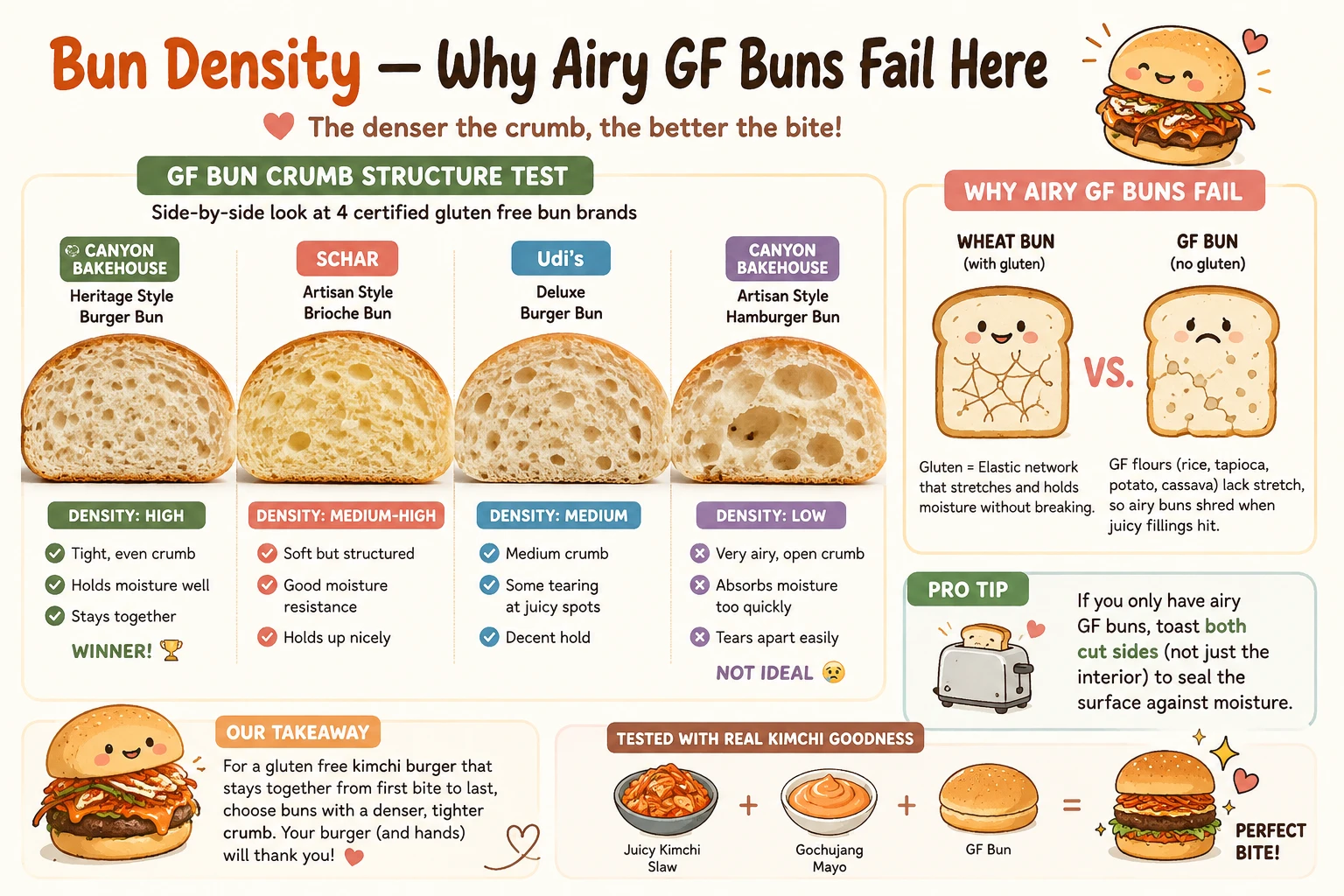
Wheat gluten forms an elastic protein network that lets a standard bun stretch and absorb moisture without falling apart. Gluten-free flour blends — typically rice flour, tapioca starch, potato starch, or a cassava base — lack that stretch, so a very light, high-rise GF bun tends to shred once gochujang mayo and kimchi slaw juice soak into the crumb. In side-by-side testing, denser brioche-style GF buns with a tighter crumb structure held together through the entire sandwich, while ultra-airy artisan-style GF rolls tore apart by the third bite. If your local store only stocks the airy style, briefly toasting both cut sides (not just the interior) helps seal the surface against moisture.
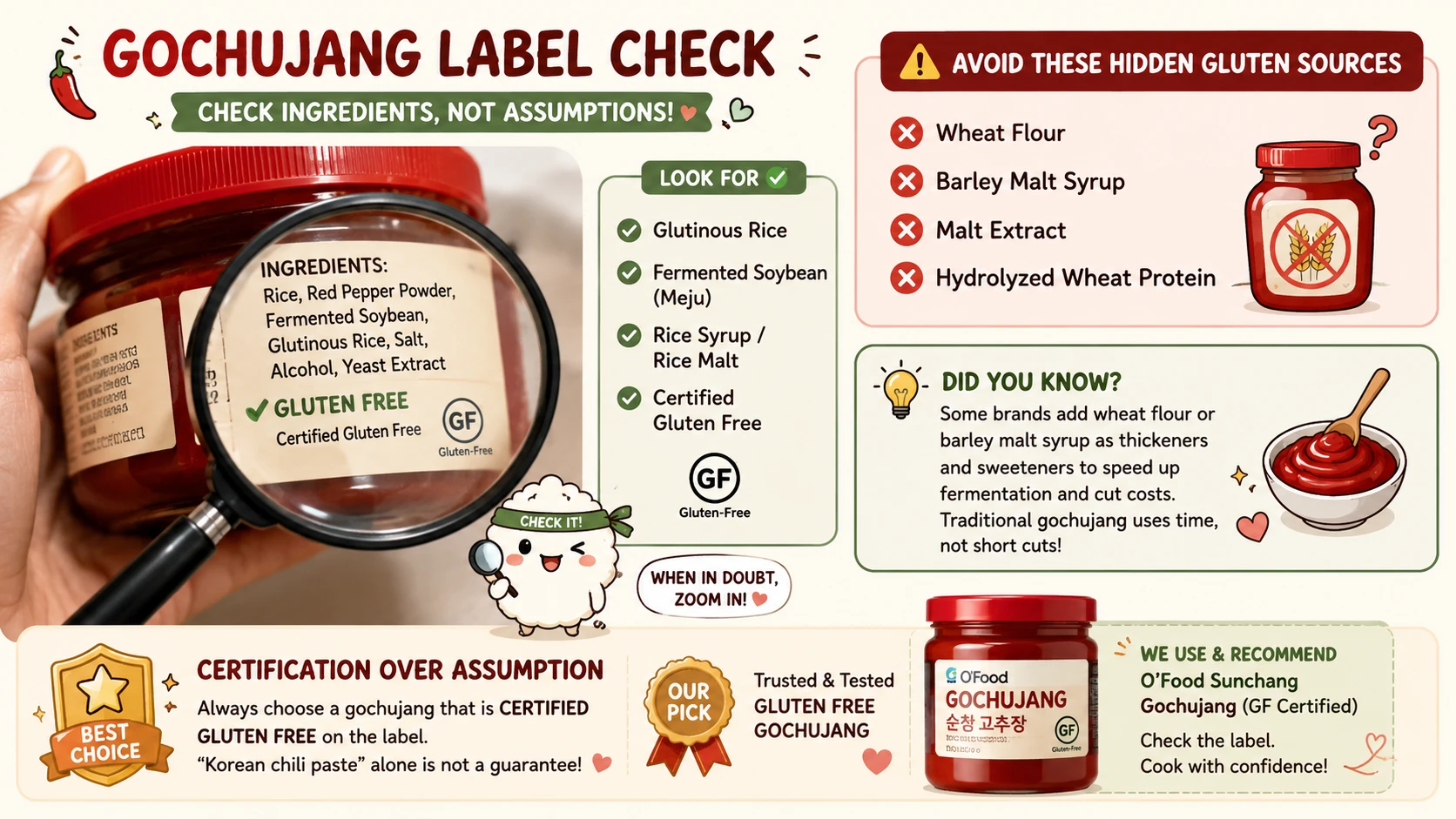
Because gochujang’s fermentation traditionally relies on glutinous rice and fermented soybean (meju), it’s easy to assume every jar is naturally gluten-free simply because it’s a Korean, rice-adjacent product. In practice, the majority of mass-market gochujang brands add barley malt syrup as a fermentation aid and sweetener, and barley is a gluten-containing grain regardless of how little ends up in the finished product. This recipe specifies a certified gluten-free gochujang by name — see the brand box above — rather than by category, since “Korean chili paste” alone isn’t a reliable gluten-free signal.
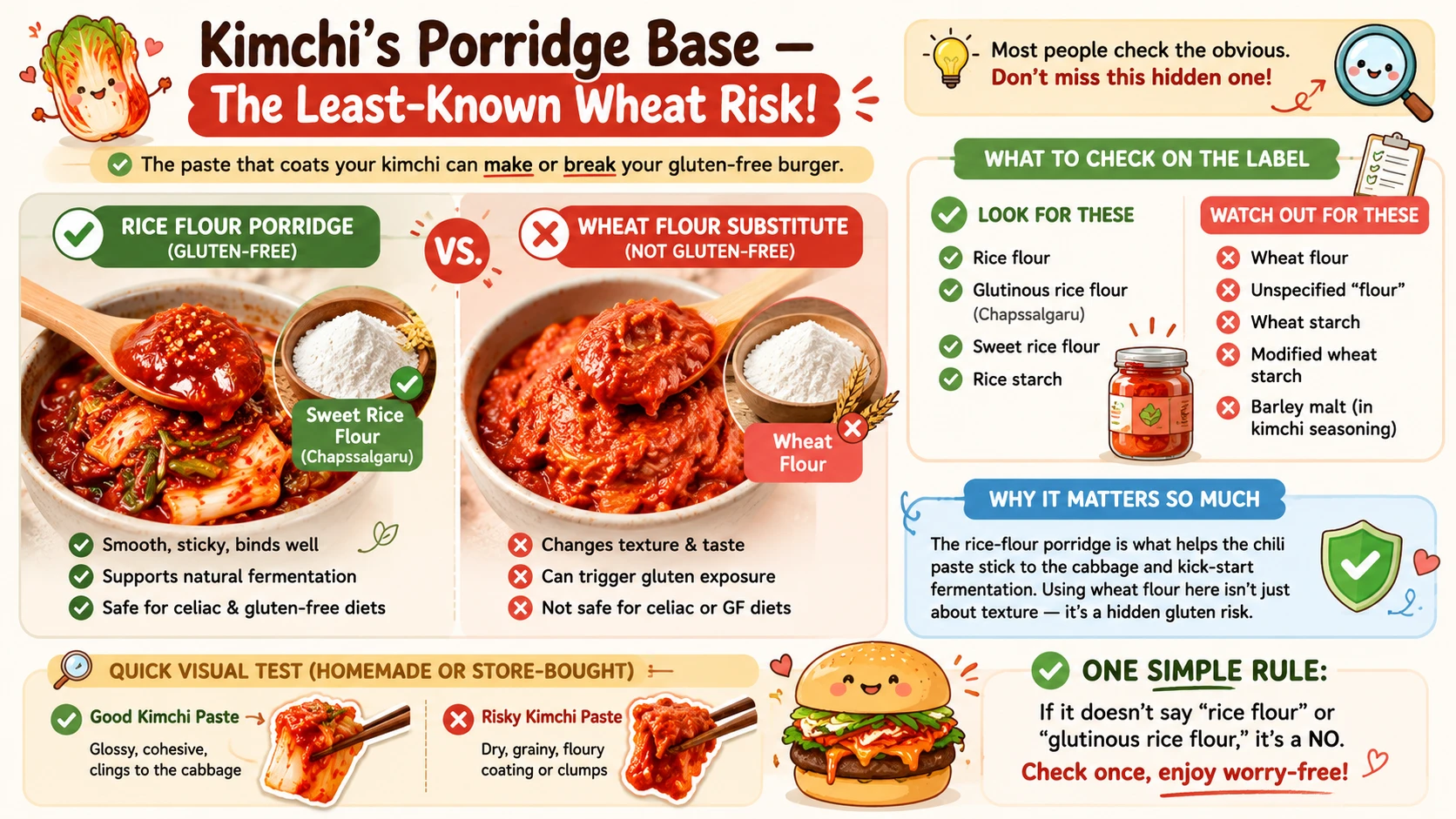
This is the ingredient most people never think to check. The rice-flour porridge used to bind kimchi’s chili paste to the cabbage and jump-start lacto-fermentation is traditionally made with sweet rice flour (chapssalgaru), which is gluten-free — but some producers substitute wheat flour for cost reasons, and homemade recipes copied from non-verified sources sometimes do the same. Reading the ingredient panel for “rice flour” or “glutinous rice flour” rather than an unspecified “flour” — and checking whether the brine includes a wheat-based soy sauce — are the two highest-value checks in this entire recipe for a strictly celiac-safe result.
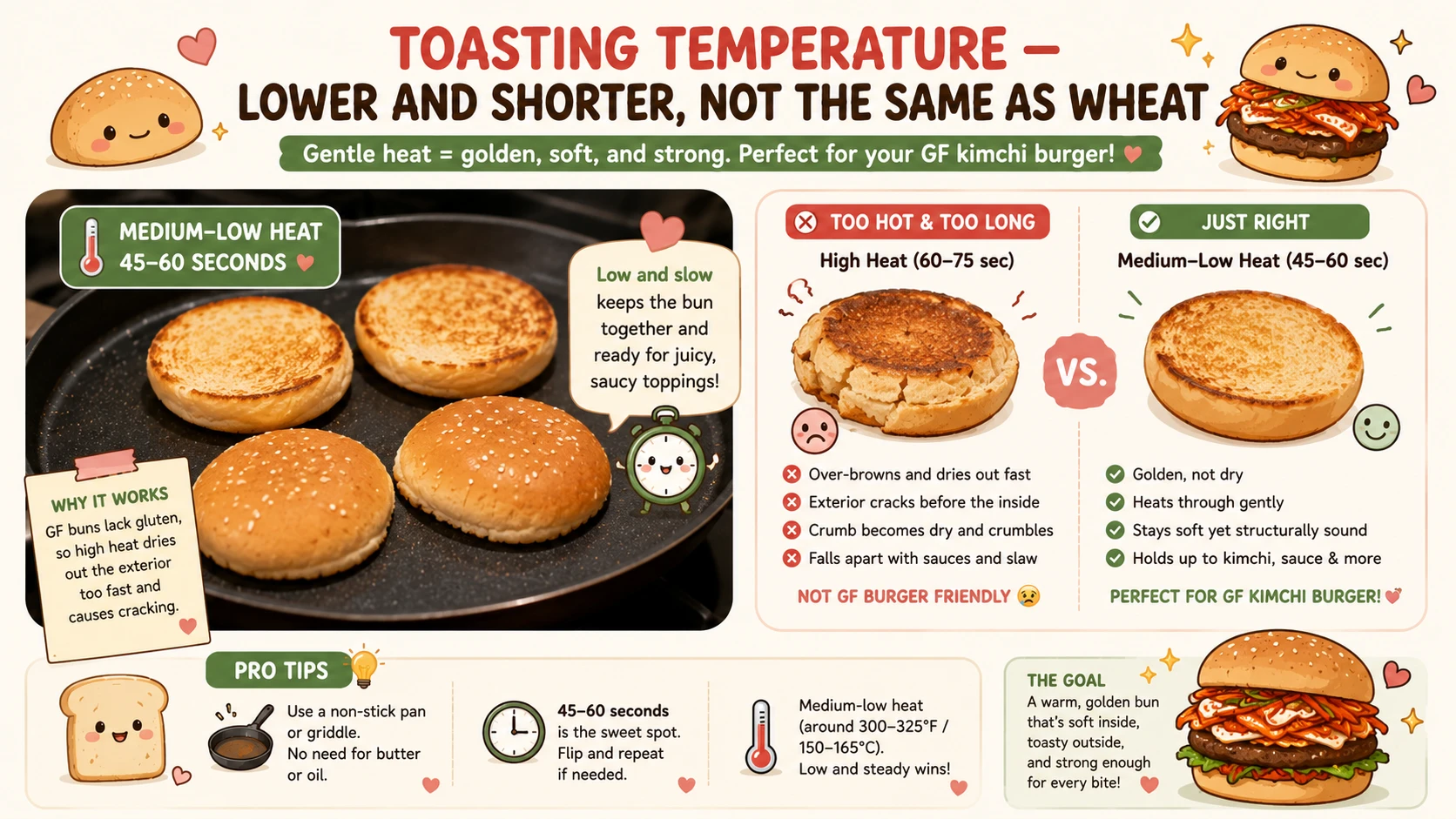
Toasting a GF bun exactly like a wheat brioche bun — high heat, 60–75 seconds — tends to over-brown and dry the exterior before the interior has warmed through, and a dry GF crumb cracks and crumbles far more readily than a dry wheat crumb because it has no gluten network holding the structure together. Dropping to medium-low heat and toasting for roughly 45–60 seconds gives a golden, structurally sound bun without the surface drying out ahead of the interior.
Beyond Gluten-Free: Whole30, Paleo & Low-FODMAP
“Gluten-free,” “Whole30,” “Paleo” and “Low-FODMAP” get used almost interchangeably in wellness content, but they’re four different rulebooks with four different lists of what’s allowed. Here’s where a gluten-free version of this burger does and doesn’t clear each one.
Key Terms — Gluten-Free & Food Science Entities
Understanding these terms clarifies exactly what “gluten-free” verification means for each component of this specific recipe.
How Difficult Is a Gluten-Free Kimchi Burger?
The cooking technique is identical to the classic single-patty build — the only new skill is reading three labels correctly and adjusting the bun-toasting heat down slightly.
← This Recipe
Which Kimchi Stage to Use — Visual Guide
Fermentation stage selection is identical to the classic build — Stage 3 remains the correct choice — but confirm the specific jar or batch you use is made with a gluten-free rice-flour paste base before relying on the stage guide below.
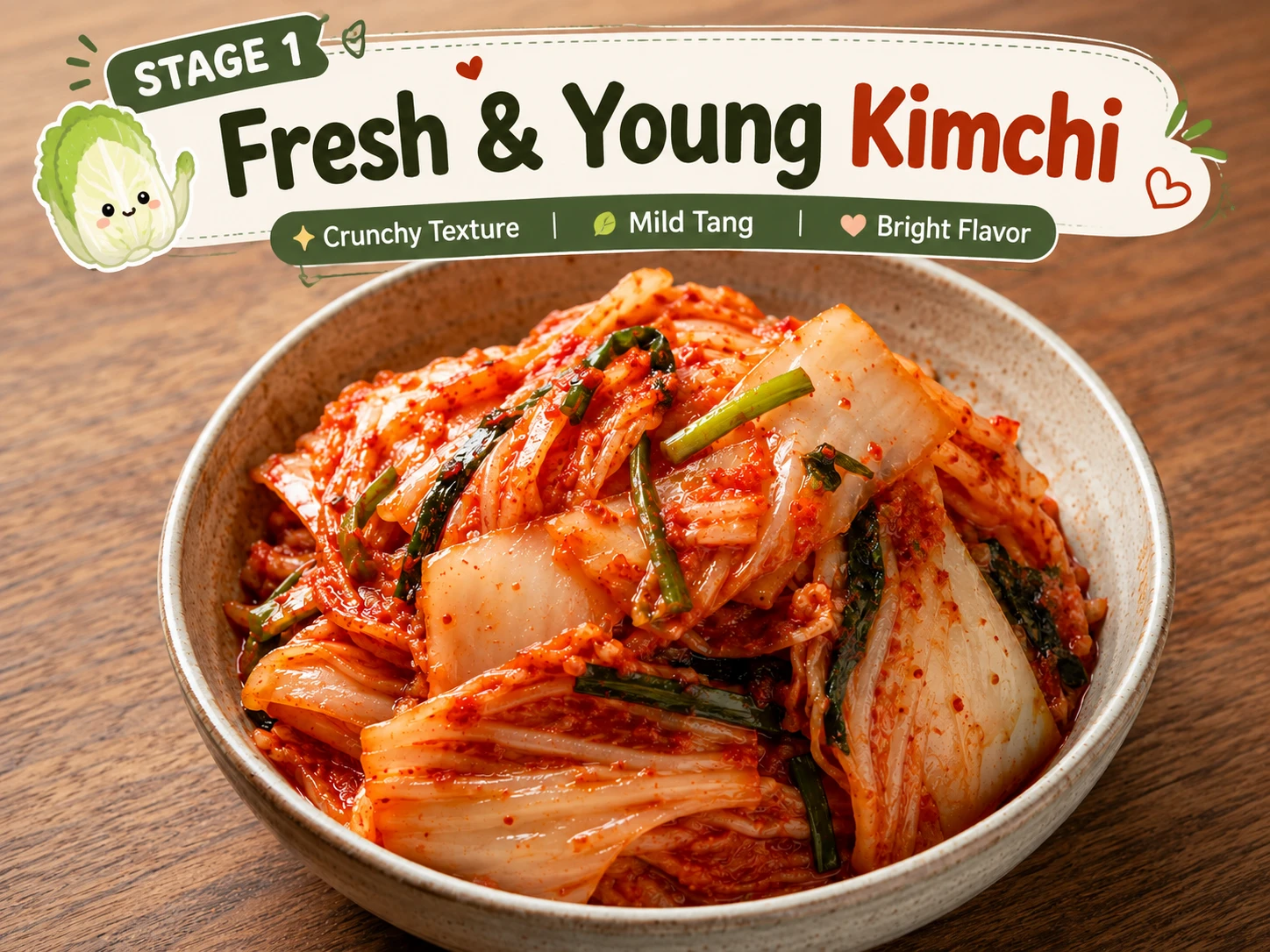
Tastes like spiced cabbage, with almost no acidity to cut through the richness of the mayo and cheese.
✗ Not Recommended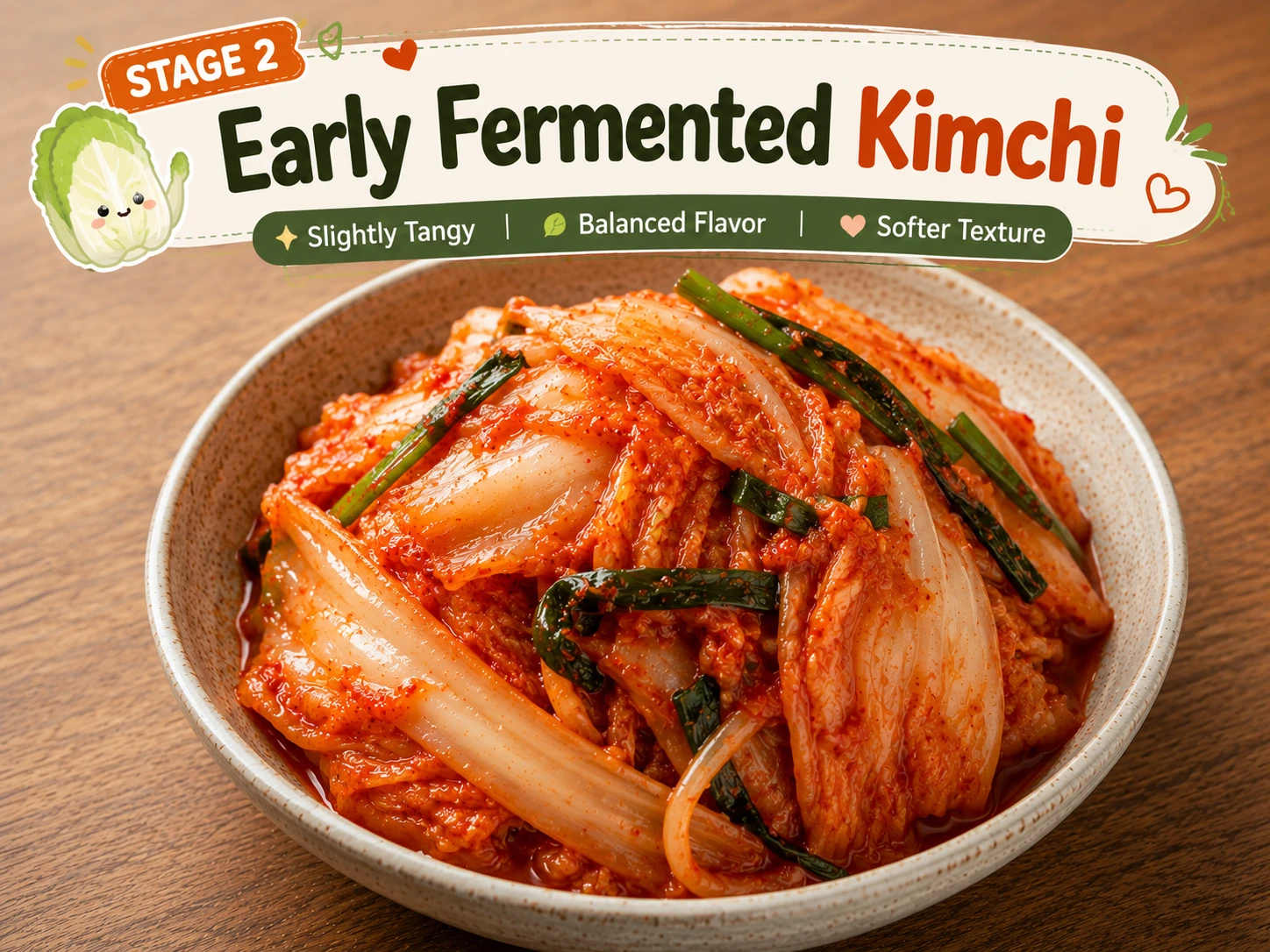
Acceptable if ripe kimchi is unavailable, though the flavour balance is noticeably milder than the tested build.
△ Acceptable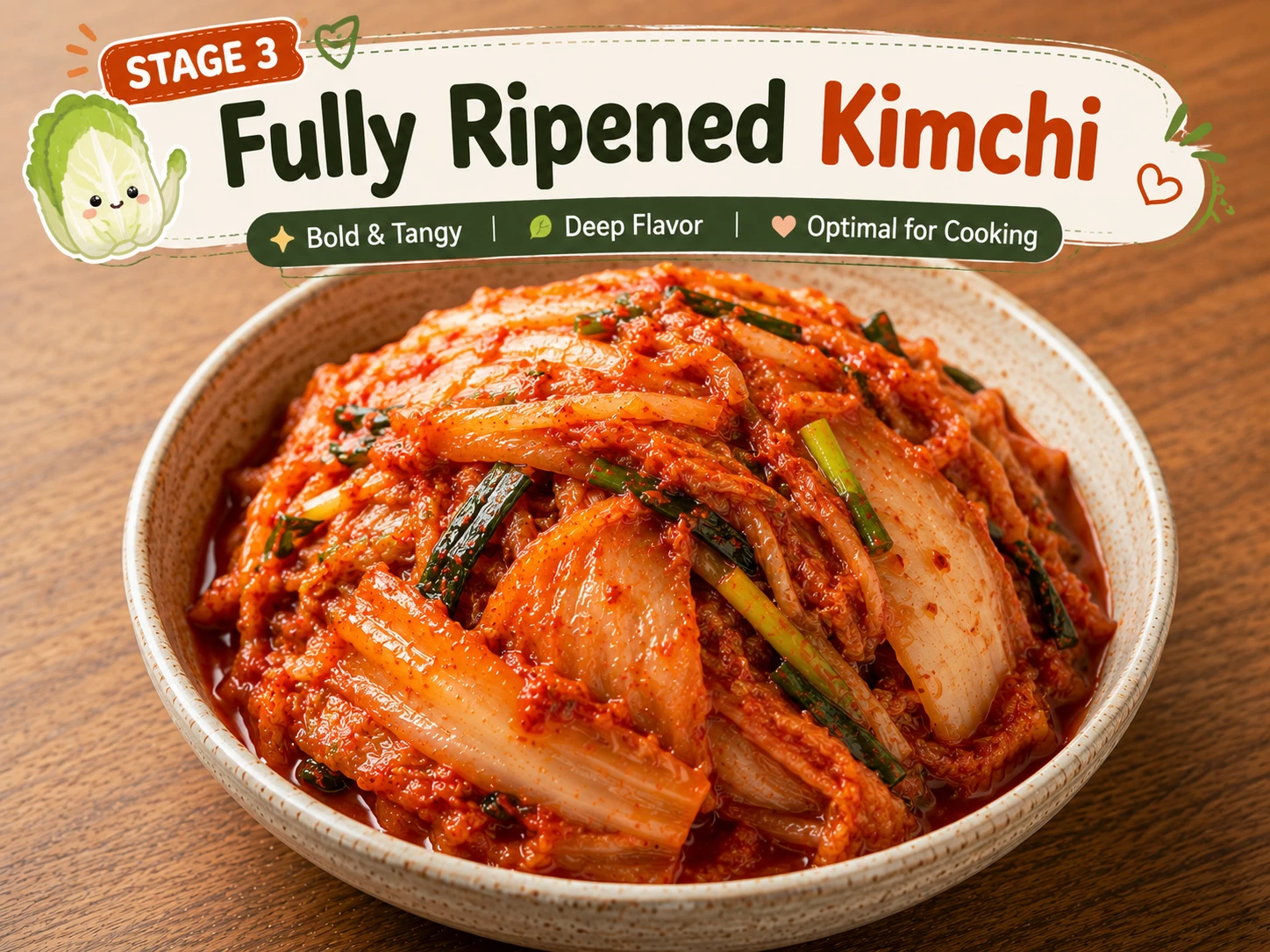
Full sour-umami complexity balances the beef, cheese and mayo — the only stage that delivers the tested flavour profile.
★ Correct — the only real choice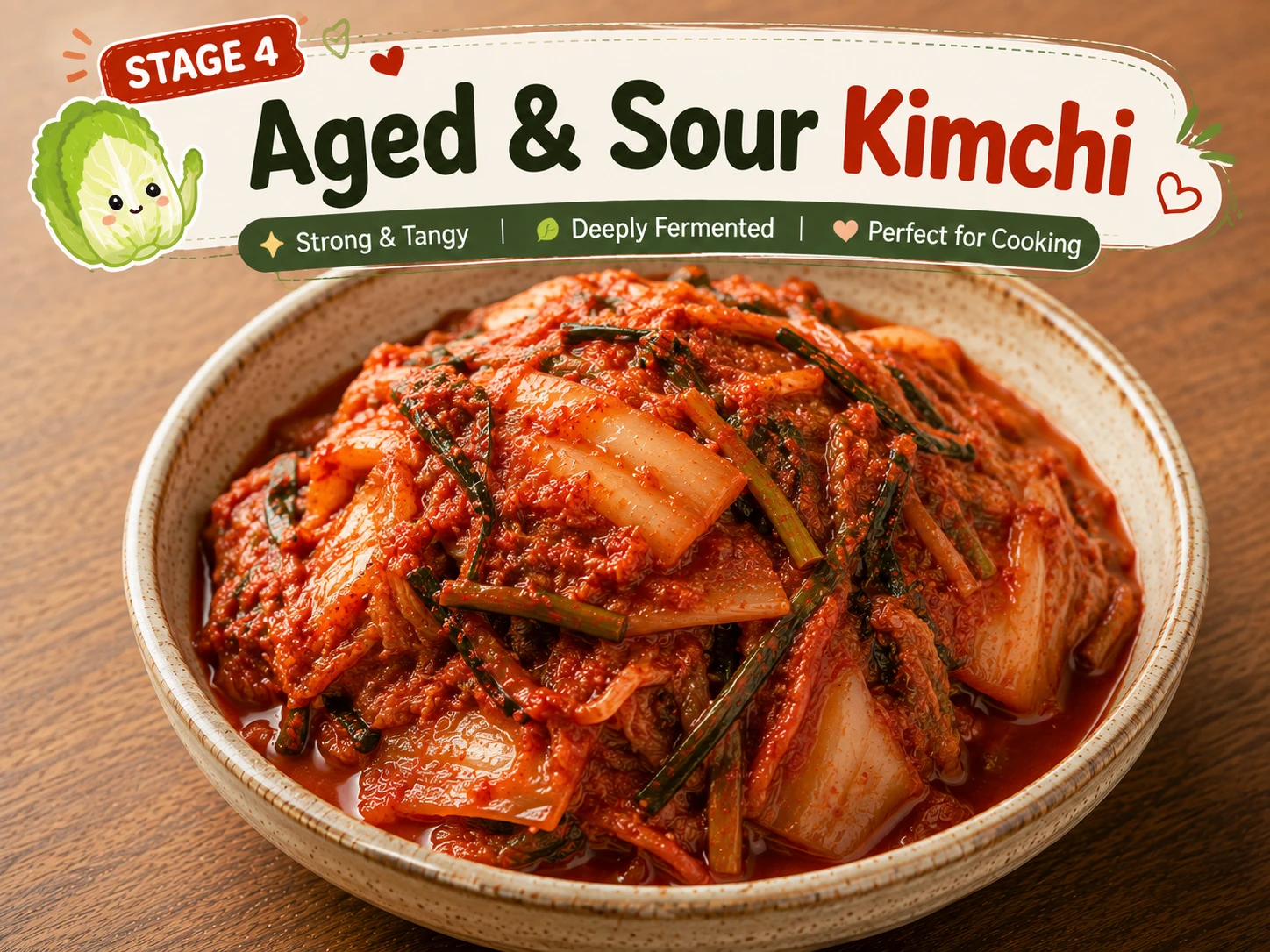
Can overpower the sandwich at full strength. Squeeze thoroughly and use sparingly, or blend with a younger batch — also the lowest-FODMAP stage, per the Beyond Gluten-Free section above.
△ Usable — squeeze firstIngredients
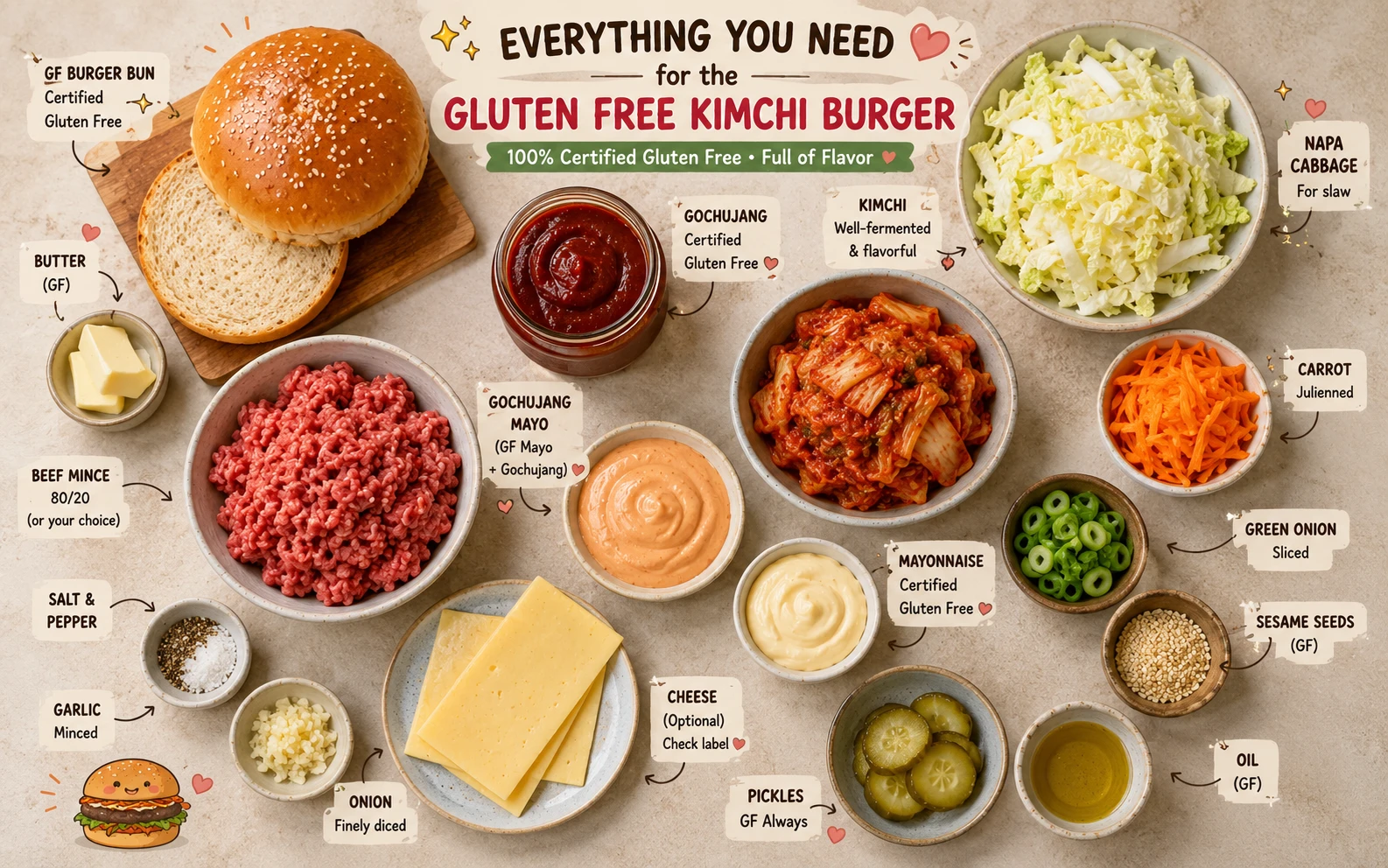
Substitution Guide — What Works, What Doesn’t
| Ingredient | Best Substitute | Ratio | Certified GF? | Taste/Texture Impact |
|---|---|---|---|---|
| Certified GF hamburger bun | Certified GF brioche-style bun, denser crumb | 1:1 | ✓ Check mark on packaging | Best structural match — holds together through the whole sandwich. |
| Certified GF hamburger bun (alt) | Lettuce wrap, no bun — also the Whole30/Paleo version | 2 large leaves | ✓ | Lower carb, clears Whole30/Paleo too, but loses the toasted-bun contrast entirely. |
| Certified GF gochujang | GF sriracha (2 parts) + white miso (1 part) | Per 1 tbsp | △ Check miso brand | Loses fermented sweetness and some depth, still workable. |
| GF-verified kimchi | Quick GF pickled napa cabbage + gochugaru + fish sauce | 1:1 | ✓ | No fermentation complexity, but avoids the paste-base question entirely. |
| American cheese | Certified GF mild cheddar slice | 1:1 | ✓ | Slightly less smooth melt than American, otherwise very close. |
| 80/20 beef mince | 85/15 + 1 tsp grated cold butter per patty | Per 150g portion | ✓ | Close match. Never go leaner than 85/15 for a smash patty. |

“The mistake I see most often isn’t a bad ingredient swap — it’s stopping at the bun, or assuming ‘gluten-free’ automatically means ‘Whole30-friendly.’ Wheat and barley can hide in a gochujang thickener or a kimchi porridge base just as easily as in bread, and a gluten-free grain is still a grain. Read every label, and be precise about which diet you’re actually building for.”
How to Make a Gluten-Free Kimchi Burger
Seven steps built around the same smash technique as the classic build. The only genuinely new skills are label-checking before you start and adjusting the toasting heat for the GF bun in Step 6.
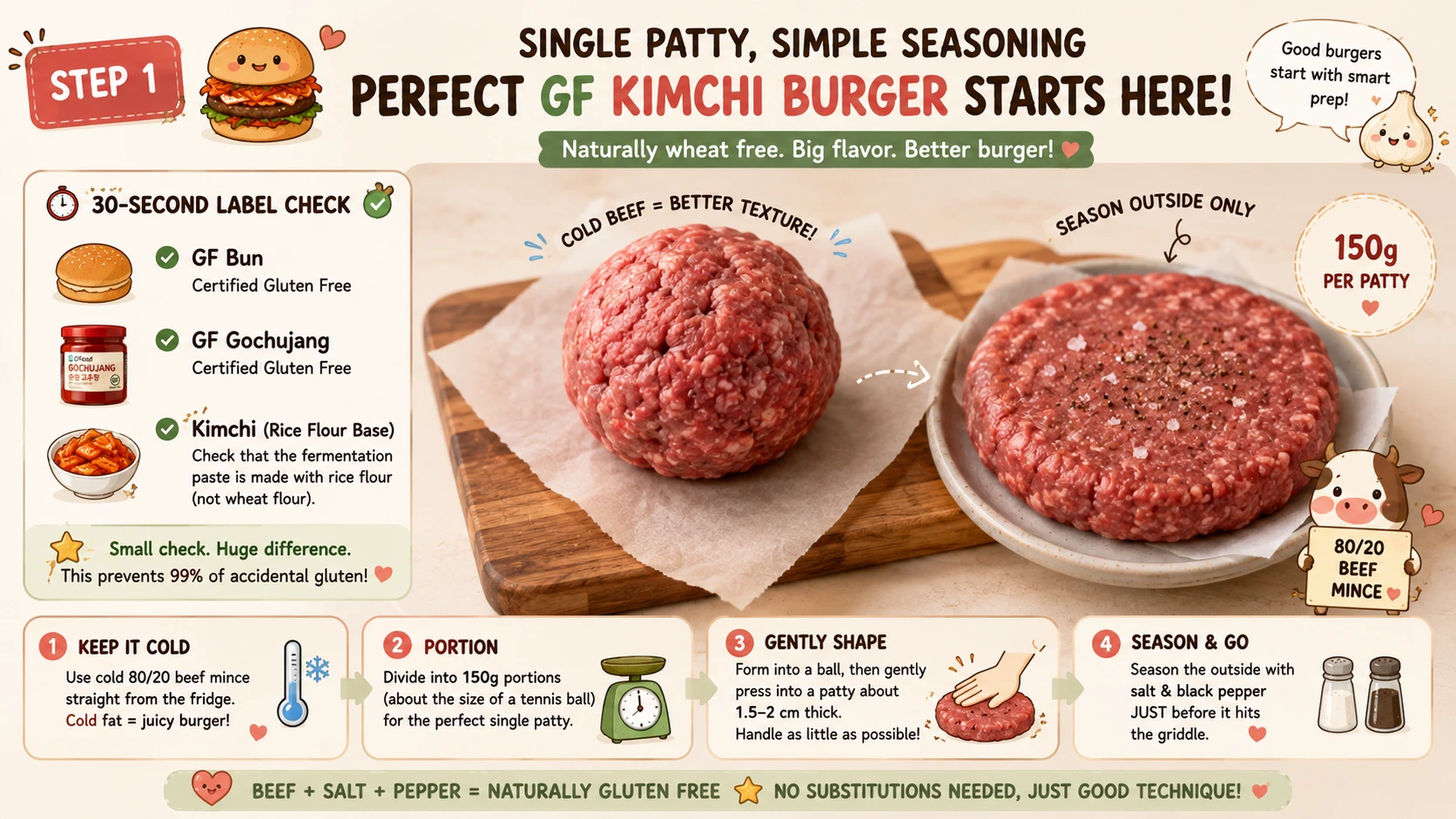
Before touching the beef, do a final check of your three label-sensitive ingredients: the certified GF bun, the certified GF gochujang (Chung Jung One O’Food GF, Sempio GF or Jinmi GF are all reliable starting points — see the brand box above), and a kimchi whose fermentation paste is confirmed rice-flour-based. This takes thirty seconds and eliminates the most common way a “gluten-free” kimchi burger accidentally isn’t.
Divide cold 80/20 beef mince into a single 150g ball per burger, handling it as little as possible to keep the fat from warming and smearing. Season the outside with salt and black pepper only just before it hits the griddle — beef, salt and pepper are all naturally gluten-free, so this step needs no substitution at all, just the same careful technique as the classic single-patty build.
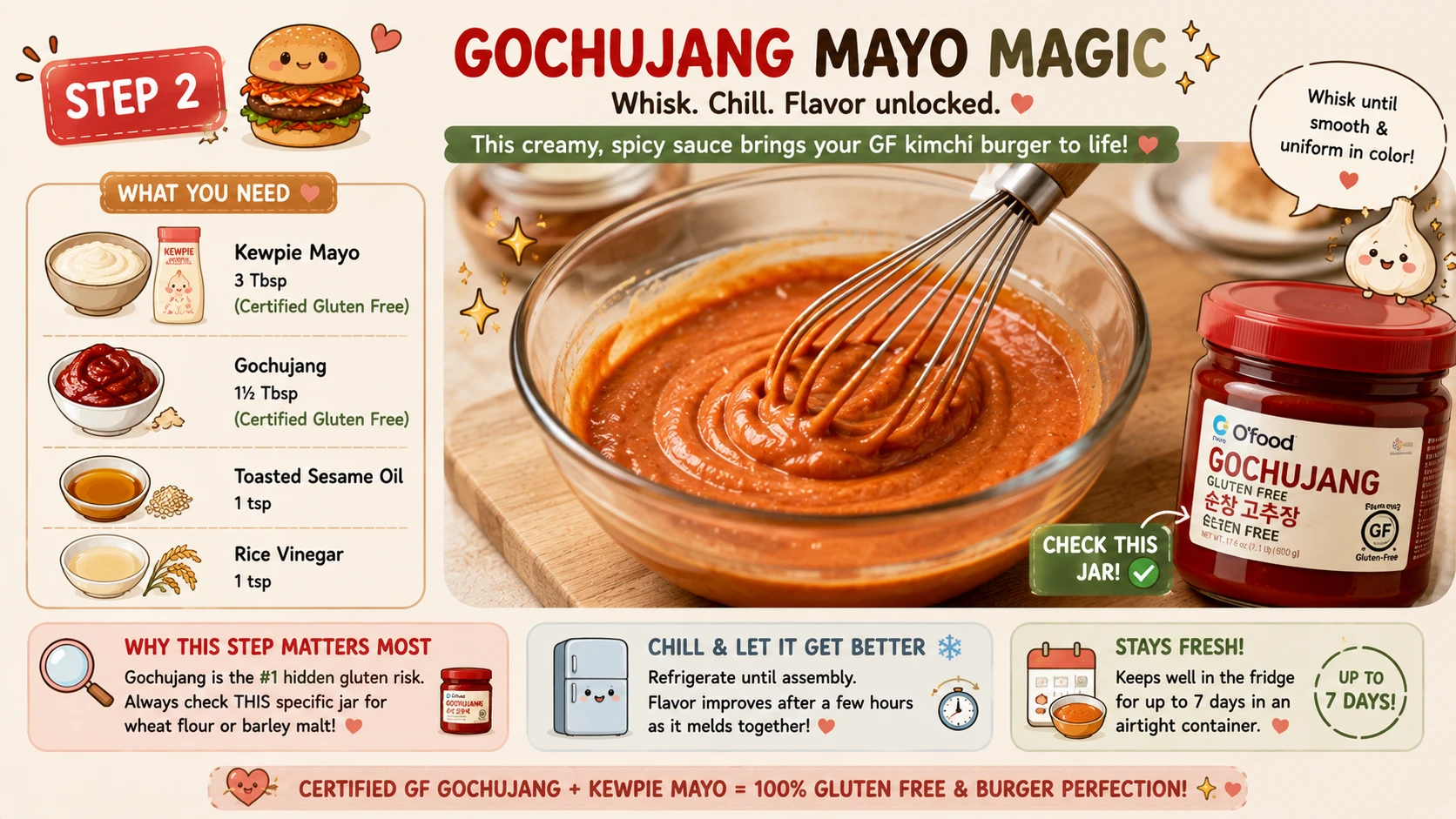
Whisk Kewpie mayo, your certified gluten-free gochujang, toasted sesame oil and rice vinegar until fully combined and uniform in colour. Because the gochujang is the ingredient most likely to carry a barley-malt or wheat thickener in this whole recipe, this is the step where double-checking the specific jar in your hand — not just the brand’s general reputation — matters most.
Refrigerate the finished mayo until assembly. Like the classic build, it improves slightly after a few hours as the gochujang’s fermented flavour melds fully into the mayo’s fat, and it keeps well for up to a week.
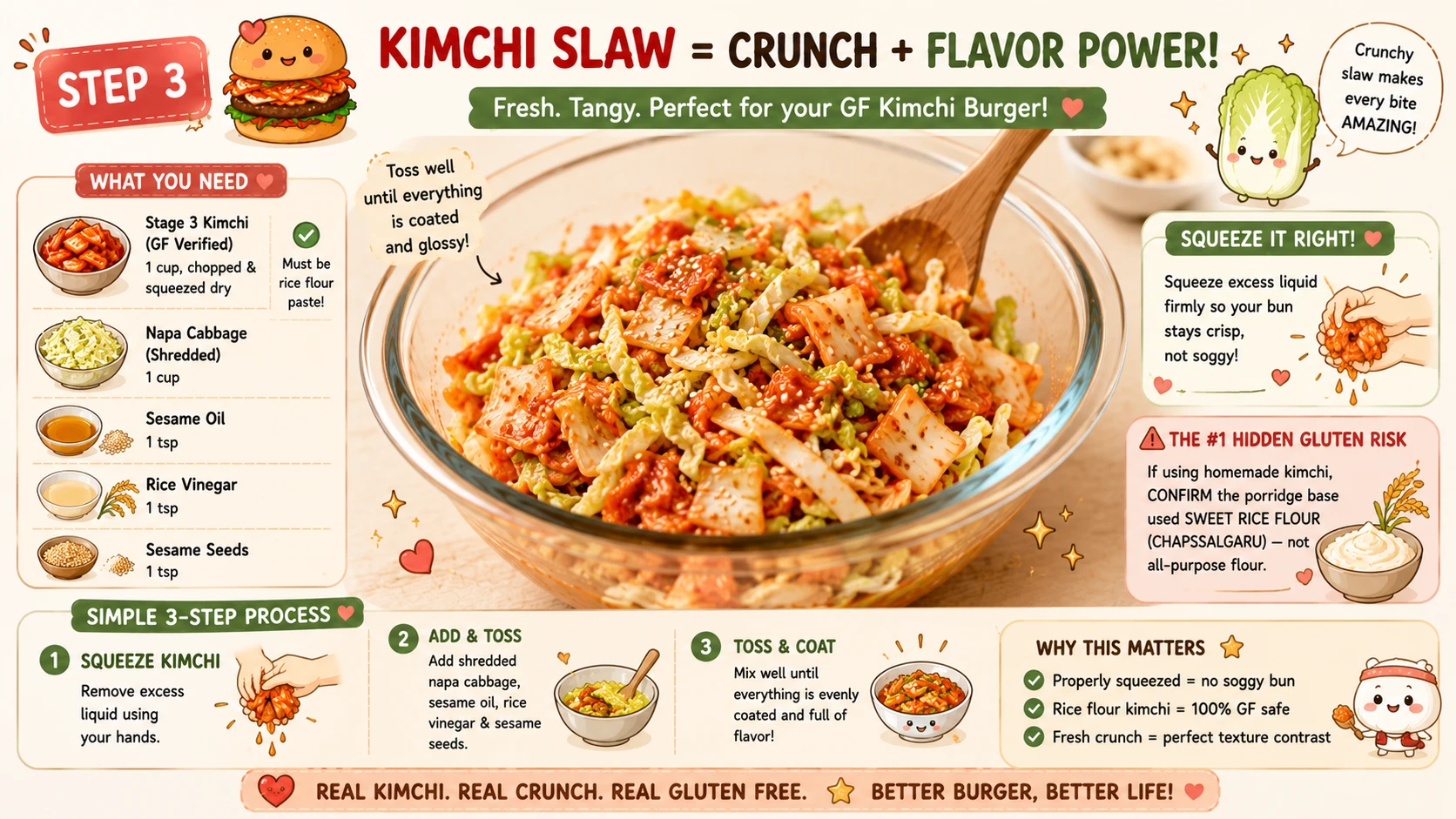
Squeeze excess liquid firmly from the chopped Stage 3 kimchi — the same technique as the classic build, so the slaw doesn’t waterlog the bun. Toss the squeezed kimchi with shredded napa cabbage, the remaining sesame oil, rice vinegar and sesame seeds.
If you’re using a homemade kimchi batch rather than a commercially certified jar like Sinto Gourmet or Mother-in-Law’s, confirm with whoever made the porridge base that it was built with sweet rice flour (chapssalgaru) rather than an unspecified all-purpose flour — this is the single easiest place for wheat to enter an otherwise entirely gluten-free recipe unnoticed.
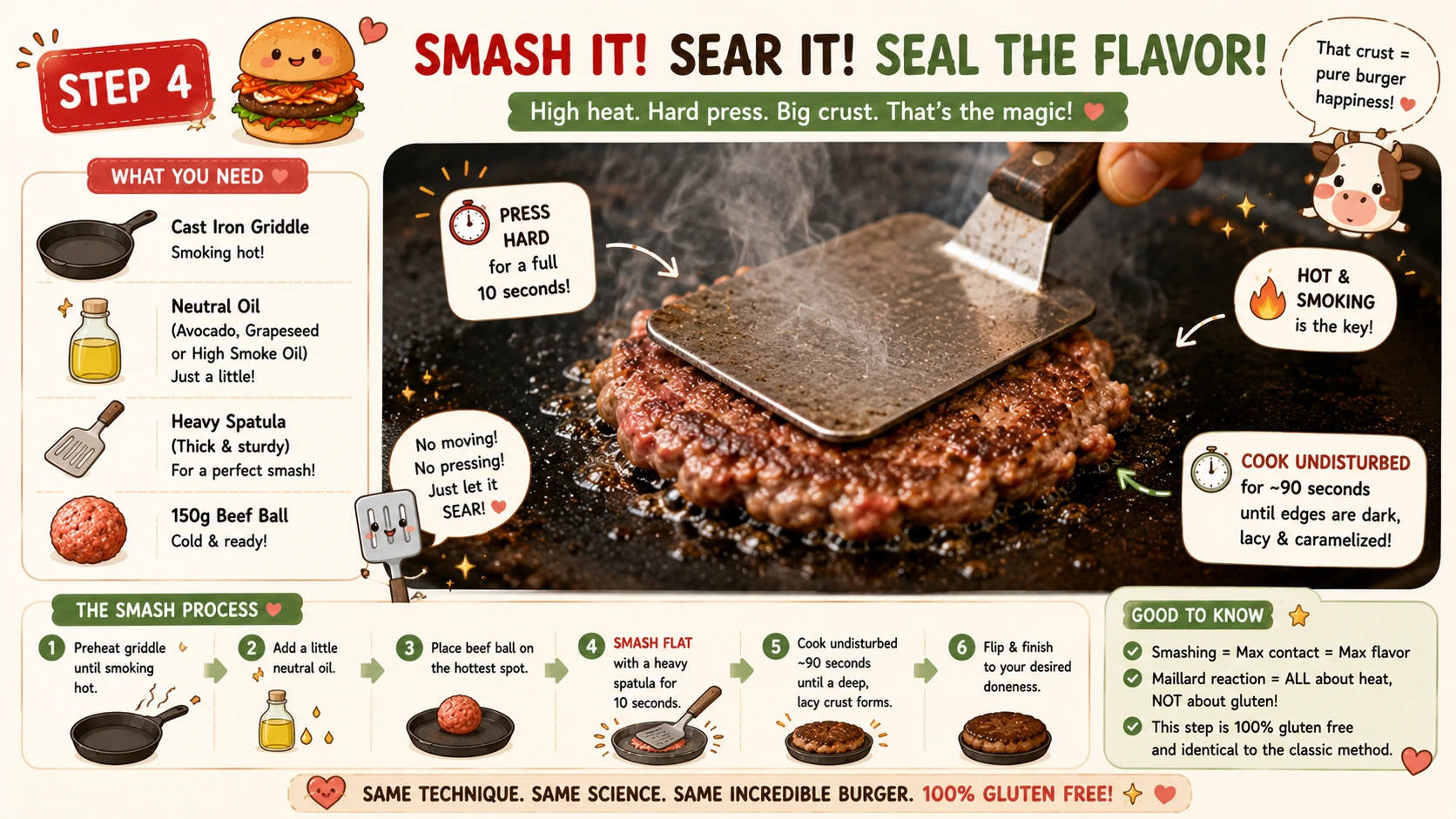
Heat a cast iron griddle until visibly smoking. Add a small amount of neutral oil, then place the beef ball on the hottest part of the surface and press it flat immediately with a heavy spatula for a full 10 seconds. Cook undisturbed for roughly 90 seconds, until the edges are dark, lacy and deeply caramelised.
Nothing about the smashing technique itself changes for a gluten-free build — the crust-forming Maillard reaction on the beef has nothing to do with wheat or gluten, so this step is identical to the classic single-patty recipe start to finish.
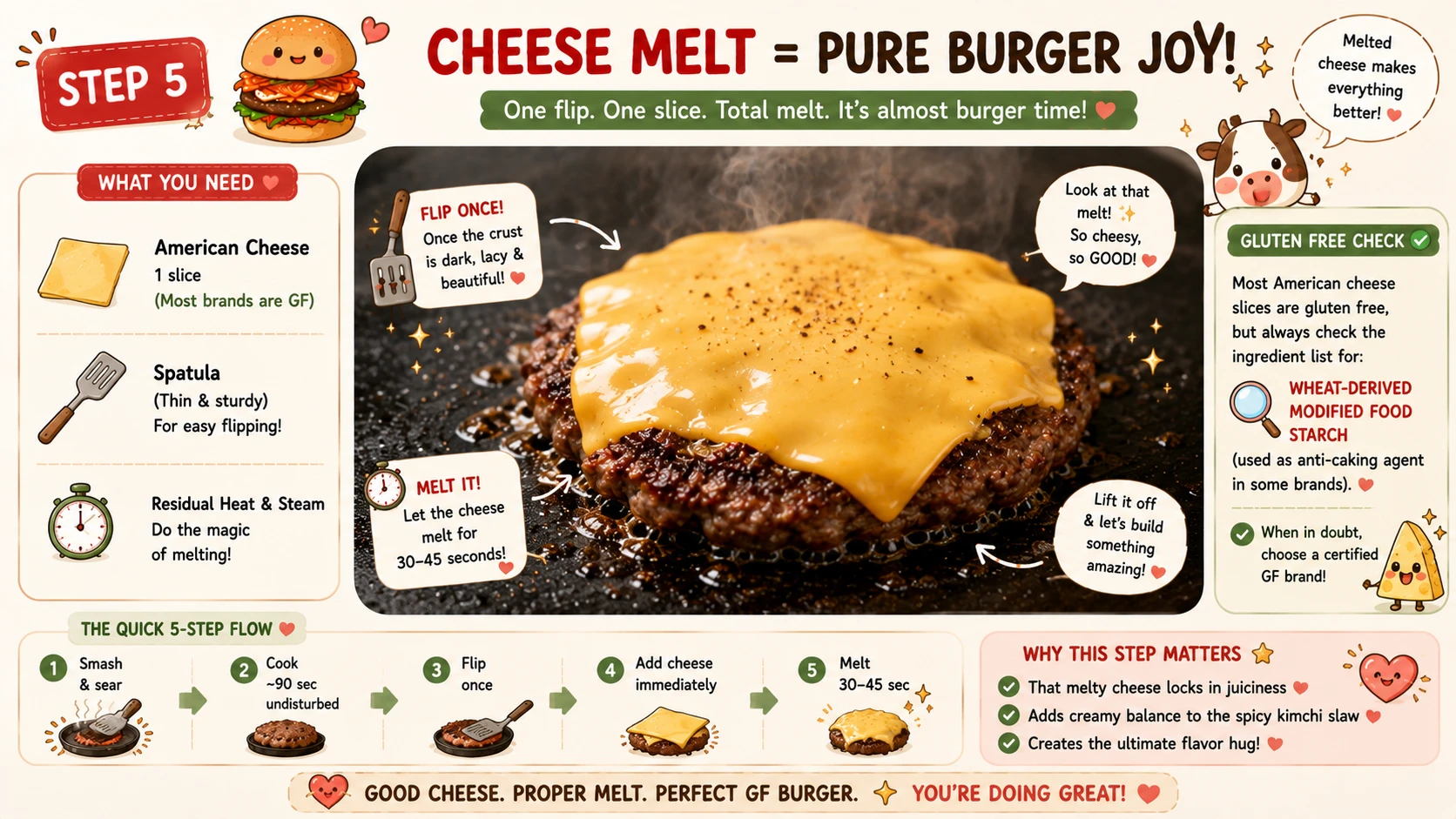
Flip the patty once it has developed a full crust, then immediately place a slice of American cheese on top. Let it melt fully — usually 30–45 seconds with residual griddle heat and steam — before lifting the patty off.
If you’re building for a strictly celiac-safe kitchen, double-check that the cheese slice’s ingredient list doesn’t include a wheat-derived modified food starch as an anti-caking agent; most brands are fine, but formulations do vary between manufacturers.
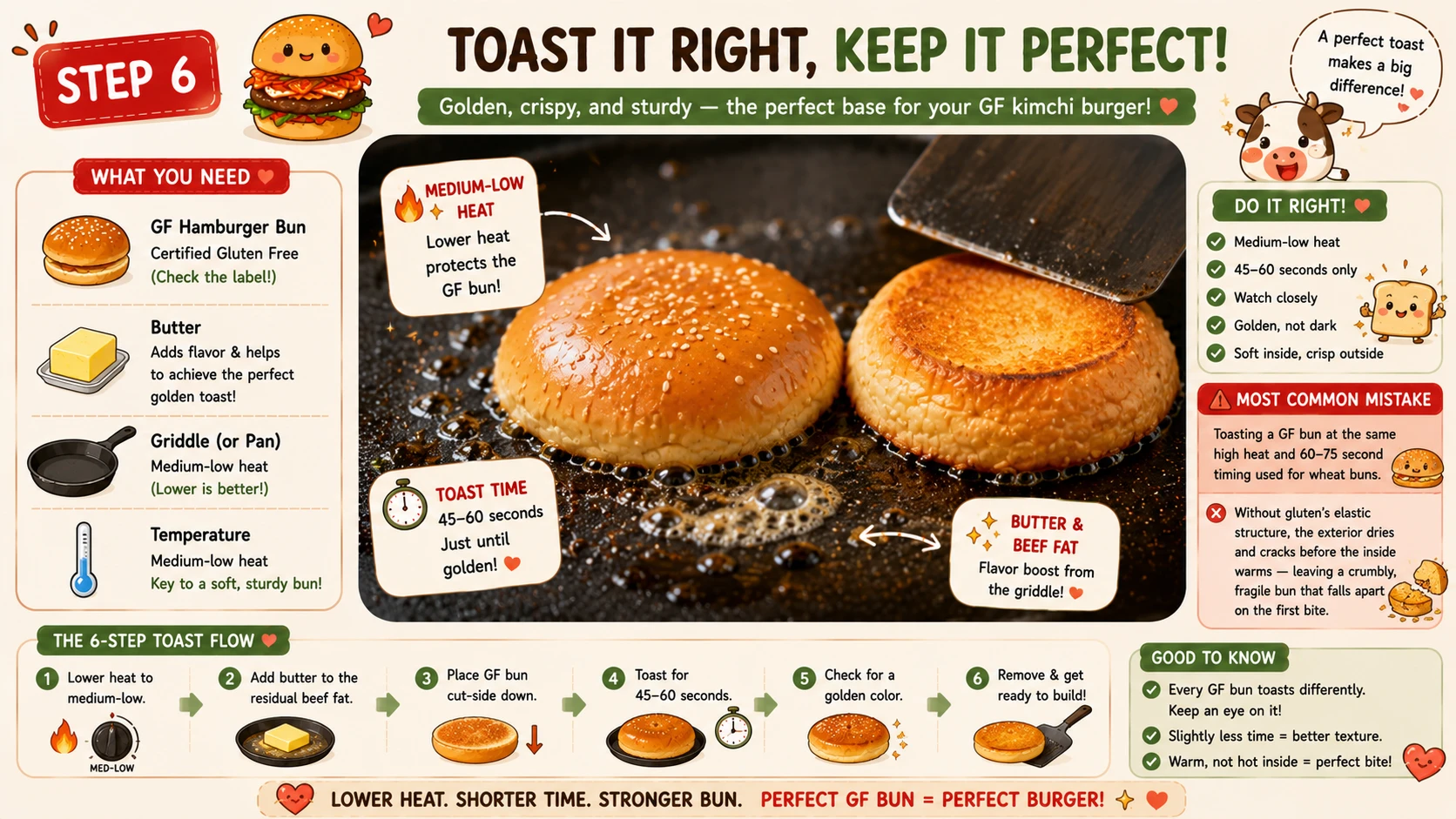
This is the one step that genuinely differs from the classic build. Reduce the griddle to medium-low heat — noticeably lower than you’d use for a wheat brioche bun — and add the butter to the residual beef fat. Toast the certified GF bun cut-side down for 45–60 seconds, watching closely, until golden.
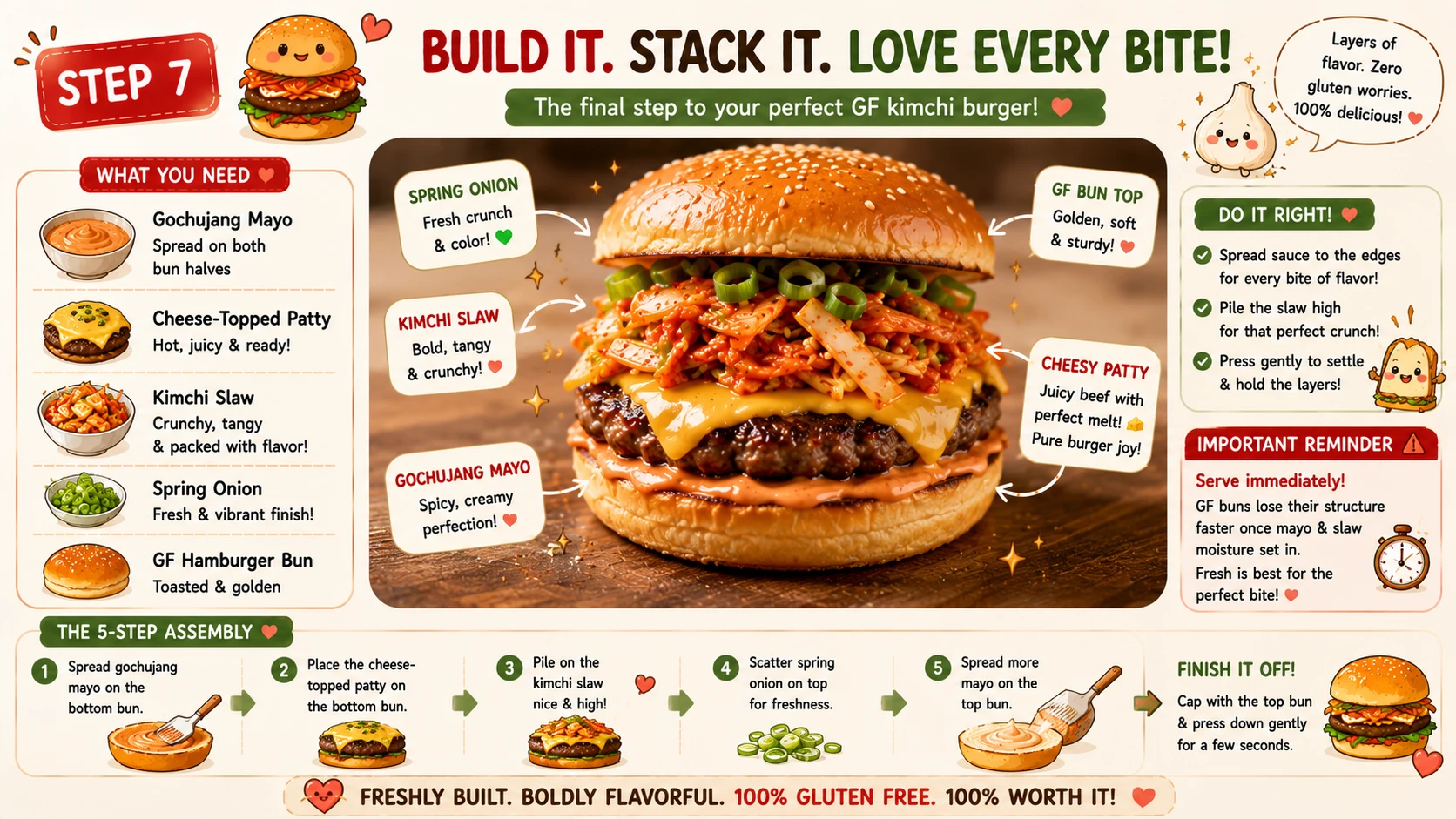
Spread gochujang mayo on both bun halves to the edges. Place the cheese-topped patty on the bottom bun, pile the kimchi slaw on top, and scatter spring onion. Cap with the top bun and press down gently for a few seconds to settle the layers.
Serve immediately — GF buns in particular lose their toasted structure faster than wheat buns once mayo and slaw moisture start soaking in, so this isn’t a build-ahead sandwich. Going Whole30 or Paleo instead? Skip Step 6 entirely and wrap the assembled filling in butter lettuce leaves — see the Beyond Gluten-Free section above.
Test Kitchen Results
Every variable was tested at least twice against a wheat-bun control batch. Here is what the data shows for building a kimchi burger gluten-free specifically.
Dense, brioche-style GF buns held together through the full sandwich. Ultra-airy, rustic-style GF rolls tore apart by the third bite once mayo and slaw moisture soaked in.
Choose a denser GF crumbHigh heat browned the GF bun’s exterior before the interior warmed, leaving a dry, cracking crumb. Medium-low heat for a shorter time browned evenly without drying the structure out.
Medium-low heat, 45–60 secondsThe majority of mainstream brands checked listed barley malt syrup or wheat flour as an ingredient; only brands explicitly marked gluten-free — such as Chung Jung One O’Food GF, Sempio GF and Jinmi GF — were free of both.
Always check for an explicit GF markFlavour and texture were indistinguishable between the two paste bases in a blind taste test — the difference is entirely about gluten content, not taste, confirming this is purely a label-reading issue.
Verify the label, not the flavourToasting a still-frozen GF bun dried the exterior before the centre had warmed at all, worsening the crumbling problem. Fully thawing at room temperature first solved it.
Thaw fully before toastingA griddle surface previously used for wheat buns without a full clean carried detectable crumb residue. A quick wipe-down or dedicated zone eliminated the risk entirely.
Clean surface or dedicated zoneDropping the bun entirely for butter lettuce cups clears Whole30 and Paleo outright, since a GF bun’s rice-flour or tapioca base is still a disqualifying grain under both frameworks.
Lettuce wrap for true grain-freeA gluten-free kimchi burger succeeds or fails on label-reading and bun-toasting temperature, not on any dramatic recipe change. Verify the bun, gochujang and kimchi paste base once before you shop, toast the bun 15–20 seconds shorter at lower heat than a wheat bun, and every other step is identical to the classic single-patty recipe — just remember gluten-free and grain-free are not the same claim.
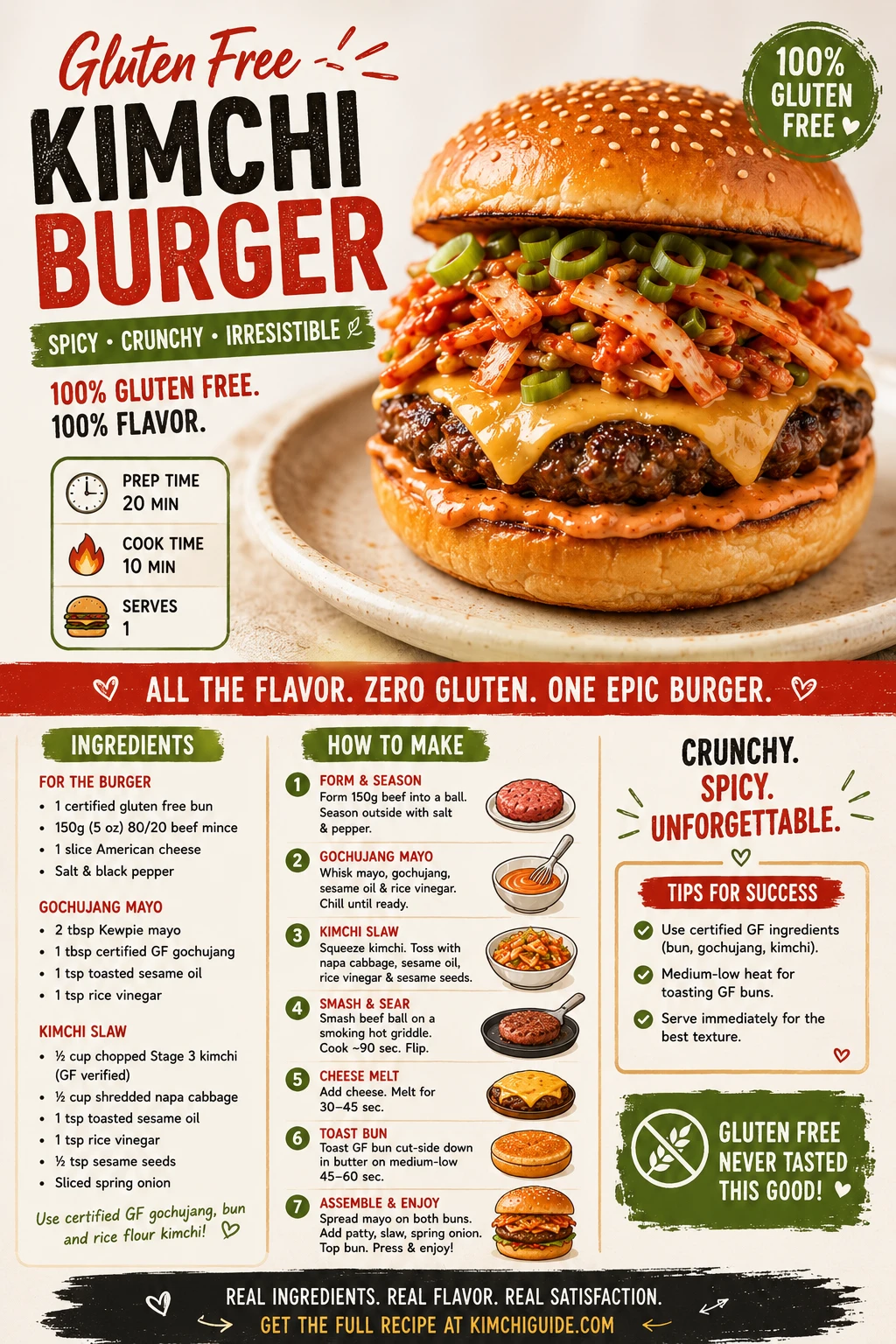
Gluten-Free Kimchi Burger
Certified GF bun · GF gochujang mayo · Kimchi slaw · 30 minutes
- 300g 80/20 beef mince, two 150g patties
- 150g Stage 3 kimchi, GF-verified, chopped + squeezed dry
- 2 certified gluten-free hamburger buns
- 2 slices American cheese
- 1 tbsp butter + 1 tbsp neutral oil
- 3 tbsp Kewpie mayo + 1 tbsp certified GF gochujang
- 2 tsp sesame oil + 2 tsp rice vinegar (split mayo/slaw)
- 80g napa cabbage, shredded
- 1 tsp sesame seeds; 2 spring onions, sliced
- Salt and black pepper
- 1Verify GF labels, then form a 150g beef ball per burger, cold.
- 2Whisk Kewpie mayo, GF gochujang, sesame oil, rice vinegar.
- 3Squeeze GF-verified kimchi dry, build slaw with cabbage.
- 4Smash patty hot and fast on smoking griddle, 10-sec press.
- 5Flip, add cheese, melt fully before removing from heat.
- 6Toast GF bun at medium-low heat, 45–60 sec, until golden.
- 7Spread mayo, add patty, pile slaw, scatter onion. Serve immediately.
Per serving (2 servings total). Reviewed by Dr. Sarah Mitchell RD, PhD · Updated August 24, 2026
Per serving (1 burger). Every ingredient is listed with an explicit value for every column — including 0g/0mg where an ingredient contributes nothing — so calorie-counters and diabetic readers can see exactly where every number comes from, not just the totals above.
| Ingredient (per serving) | Cal | Protein | Carbs | Fat | Fiber | Sugar | Sodium |
|---|---|---|---|---|---|---|---|
| 150g 80/20 beef patty, cooked | 210 | 24g | 0g | 12g | 0g | 0g | 40mg |
| 1 certified GF hamburger bun (~60g) | 130 | 3g | 31g | 2g | 2g | 3g | 200mg |
| 1 slice American cheese | 45 | 3g | 1g | 4g | 0g | 1g | 280mg |
| 75g Stage 3 kimchi, squeezed | 10 | 1g | 2g | 0g | 1g | 1g | 330mg |
| 1½ tbsp Kewpie mayo | 40 | 0g | 1g | 3g | 0g | 0g | 40mg |
| ½ tbsp certified GF gochujang | 12 | 0g | 3g | 0g | 0g | 1g | 150mg |
| 1 tsp toasted sesame oil | 15 | 0g | 0g | 1g | 0g | 0g | 0mg |
| 1 tsp rice vinegar | 1 | 0g | 0g | 0g | 0g | 0g | 0mg |
| ½ tbsp unsalted butter | 30 | 0g | 0g | 3g | 0g | 0g | 1mg |
| ½ tbsp neutral oil (griddle) | 12 | 0g | 0g | 1g | 0g | 0g | 0mg |
| 40g napa cabbage | 5 | 0g | 1g | 0g | 0g | 0g | 4mg |
| ½ tsp toasted sesame seeds | 8 | 0g | 0g | 1g | 0g | 0g | 0mg |
| 1 spring onion, sliced | 2 | 0g | 1g | 0g | 0g | 0g | 1mg |
| Salt & black pepper, to taste | 0 | 0g | 0g | 0g | 0g | 0g | 4mg |
| Total per serving | 520 | 31g | 40g | 27g | 3g | 6g | 1050mg |
Values are per-ingredient estimates rounded for readability; brand-specific products (GF bun, GF gochujang, cheese) will vary slightly — check your own packaging for exact figures if you are managing a strict calorie or sodium target. Building the Whole30/Paleo lettuce-wrap version removes the bun’s 130 calories and 31g carbs — see the Beyond Gluten-Free section above.
All 11 Kimchi Burger Builds
This is 1 of 11 builds in the KimchiGuide kimchi burger family. Classic recipe: Kimchi Burger Recipe →. Full comparison + origin story: Kimchi Burger Ultimate Guide →

The flagship. Smash patty, gochujang mayo, kimchi slaw. 520 cal.
Classic Recipe →
Two smashed patties, cheese glue, scaled toppings. 690 cal.
Double Smash →
Double-fried crispy fried thigh. Approx. 610 cal.
Chicken Burger →
Sweet soy bulgogi-marinated patty. Approx. 560 cal.
Bulgogi Burger →
Black bean patty, vegan mayo, jeotgal-free kimchi. 420 cal.
Vegan Burger →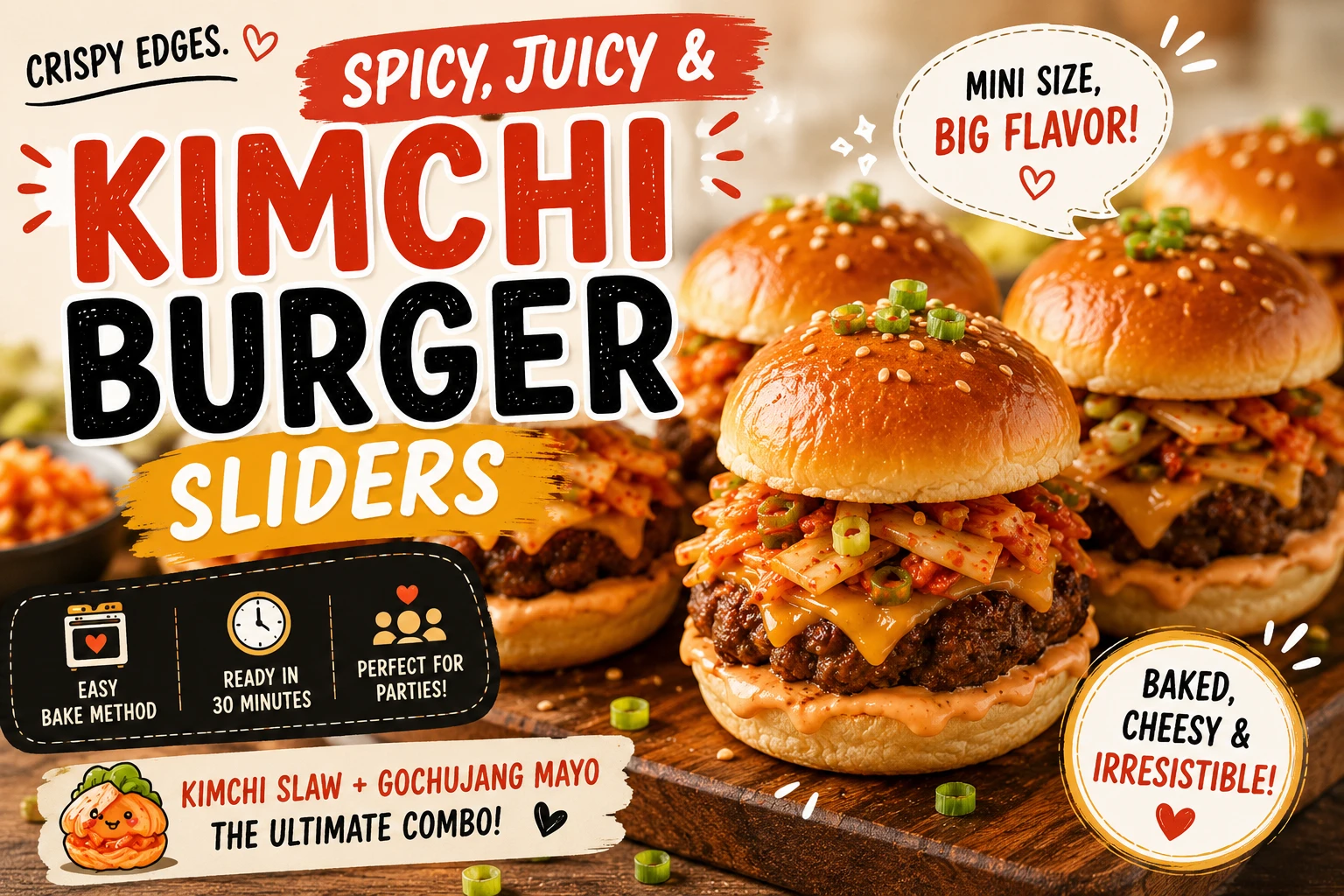
3-bite party format, same ratios. Approx. 210 cal each.
Sliders →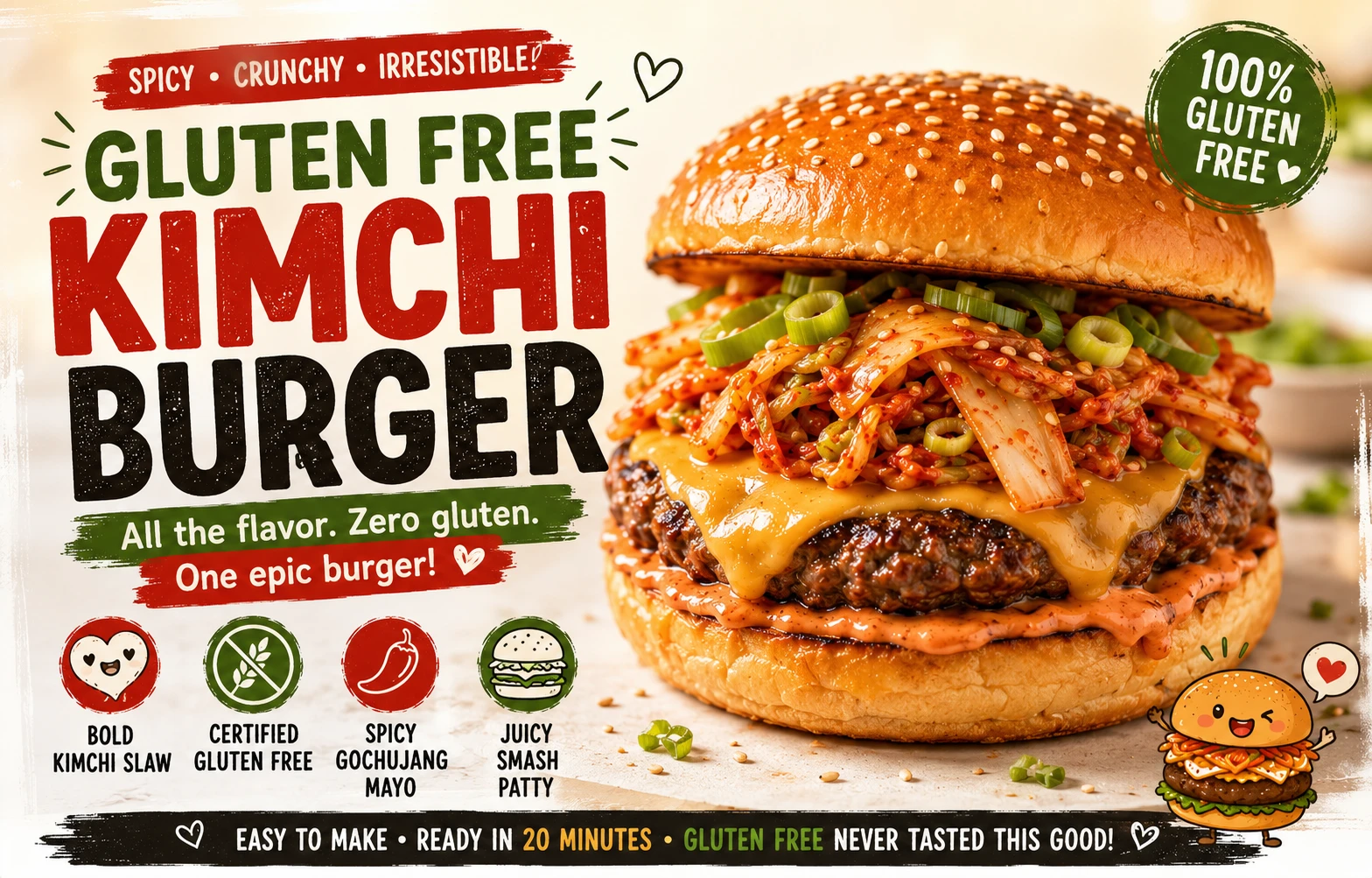
Certified GF bun, named GF brands, hidden-wheat checks. 520 cal.
Currently viewing
Lettuce-wrapped, no bun — naturally GF, and the Whole30/Paleo route. Approx. 340 cal.
Burger Bowl →
Pressed sticky rice patties instead of bread — naturally GF. Approx. 480 cal.
Rice Burger →
Bodega-style chopped beef and cheese, kimchi folded in off heat. Approx. 590 cal.
Chopped Cheese →
All 11 builds, comparison table, origin story, FAQs.
Full Guide →Gluten-Free Kimchi Burger — Pairing Guide
Keep sides gluten-free too, since fries and other fried sides are a common cross-contamination point in shared fryers. Homemade sides give you full control.

Naturally gluten-free and a cool, acidic contrast to the rich mayo and cheese.

Naturally GF at home — if ordering out, ask whether the fryer is shared with breaded items.

Naturally gluten-free and shares the same gochujang-mayo flavour profile as the burger.

Most rice-based Korean lagers are lower in gluten than barley-heavy beers, though not certified GF — check if you need a strict standard.
Storage and Reheating
Portion into a 150g ball, cover loosely, keep cold until cooking. Never bring to room temperature before smashing.
Sealed container, clean spoon each time. Do not freeze — the emulsion separates on thawing.
Softens within 30 minutes of dressing. Pre-shred cabbage and squeeze kimchi ahead, combine just before serving.
Pre-toasted GF buns dry out and crumble faster than wheat buns. Thaw fully first if frozen, and toast just before serving.
Where This Build Sits Among All 11 Kimchi Burgers
| Build | Calories | Protein | Vegan? | Best For |
|---|---|---|---|---|
| Kimchi Burger Bowl | 340 | 27g | No (beef) | Low-carb, lettuce wrap, Whole30/Paleo route |
| Vegan Black Bean | 420 | 18g | ✅ Fully vegan | Plant-based, egg-free |
| Kimchi Burger Sliders (each) | 210 | 13g | No | Portion control, parties |
| Kimchi Burger Recipe (Classic Smash) | 520 | 31g | No | The flagship recipe |
| Gluten-Free ← This page | 520 | 31g | No | Celiac-conscious, wheat-free |
| Kimchi Bulgogi Burger | 560 | 29g | No | Sweeter, caramelised profile |
| Kimchi Chicken Burger | 610 | 34g | No | Crispy fried texture |
| Double Smash | 690 | 42g | No | Bigger appetite, most protein |
Gluten-Free Kimchi Burger FAQ
Sourced from real reader search behaviour around gluten-free Korean food, answered with the detail of someone who actually checked the labels.
Not automatically. The beef patty and cheese are naturally gluten-free, but the bun almost always contains wheat, many gochujang brands use wheat or barley malt as a thickener, and some kimchi is made with a wheat-flour porridge base rather than rice flour. Each of those needs to be swapped or verified. See the Gluten-Free Ingredient Check above for the full breakdown.
Most mainstream brands do, from barley malt syrup used to saccharify the rice during fermentation, or from wheat flour used as a cheaper thickener. Certified gluten-free gochujang exists and performs the same in this recipe — check the label for an explicit GF certification rather than assuming.
For gochujang, Chung Jung One’s O’Food gluten-free line, Sempio’s gluten-free gochujang, and Jinmi’s gluten-free gochujang are all explicitly labeled GF and widely available online. For kimchi, Sinto Gourmet and Mother-in-Law’s Kimchi are commonly cited GF-certified options. Formulations and packaging change, so always re-check the specific jar in your hand rather than shopping from memory — see the named-brands box in the ingredient check above.
Not always. Some kimchi paste uses a wheat-flour porridge (mulgeondeungi) as a base rather than sweet rice flour, and some brands add soy sauce or fish sauce that itself contains wheat. Look for kimchi labelled gluten-free or made with a rice-flour porridge, or make a small batch at home with rice flour to be certain.
Kewpie’s standard recipe does not use wheat-derived ingredients, but formulations can vary by region and manufacturing run. Check the label on the specific bottle you buy rather than relying on general reputation.
A certified GF brioche-style or hamburger-style bun with some structural density performed best in testing — very light, airy GF buns broke apart under the mayo and kimchi slaw. Toast it gently, since GF buns dry out and crack faster than wheat buns.
GF flour blends lack gluten’s elastic protein network, so the crumb has less structural stretch. High heat toasting dries them out further and makes them crumble. Toasting at medium-low heat for a shorter time keeps them intact.
Most American cheese is gluten-free, but some processed slices use modified food starch or anti-caking agents that can be wheat-derived. Check the label for a gluten-free claim if you are strictly celiac-safe rather than just gluten-reduced.
Yes, with care. Use only ingredients carrying an explicit gluten-free certification (bun, gochujang, kimchi, cheese, mayo), and avoid cross-contact by using a clean griddle surface and utensils that haven’t touched wheat-containing bread.
Use a freshly cleaned griddle or a dedicated GF zone if you also cook regular buns in the same kitchen, use a separate spatula and cutting board for the GF bun, and keep the GF bun’s toaster or pan surface free of wheat-bread crumbs.
No. Plain 80/20 beef mince, salt and pepper are naturally gluten-free — the technique and seasoning are identical to the classic single-patty build.
Essentially none — approximately 520 calories and 31g protein per burger, matching the classic build. The GF bun swaps some of the carbohydrate source but the total macros land in the same range.
Stage 3, ripe kimchi aged 3–6 weeks, the same as the classic build — just verify the paste base is rice-flour or otherwise certified gluten-free before using it.
Yes. Thaw it fully at room temperature first — toasting a still-frozen GF bun dries the exterior before the inside has warmed, which makes the crumbling problem worse.
No, and this is the mistake most wellness content glosses over. Whole30 and Paleo exclude all grains, not just wheat — a certified GF bun is typically rice flour, tapioca starch or potato starch, all of which are still grains or grain-adjacent starches. For a Whole30 or Paleo version, skip the bun entirely and build this as a lettuce-wrapped burger instead; the site’s Kimchi Burger Bowl page uses the same lettuce-cup approach and includes its own Whole30/Paleo sauce swap table.
Partially, with a few adjustments. This build has no raw garlic or onion in the sauce itself, which helps, but kimchi’s fermentation paste is usually made with garlic and gets flagged as high-FODMAP in large servings. Using a smaller portion of kimchi, choosing a well-aged Stage 3 or Stage 4 batch (some of kimchi’s fermentable sugars break down further with age), and using only the green tops of the spring onion instead of the white base are the most practical adjustments; this isn’t a substitute for personalized advice from a dietitian familiar with your specific FODMAP tolerances.
Not in this specific build — there’s no soy sauce in the mayo, slaw or patty. If you see soy sauce or tamari in any bottled gochujang or kimchi brand’s ingredient list, check whether it’s the wheat-based or gluten-free tamari-style version.
The beef ball can be portioned and refrigerated up to 24 hours ahead, and the mayo keeps 7 days. Buy or toast the GF bun fresh on serving day — pre-toasted GF buns go stale and crumbly faster than wheat buns.
The base recipe is medium heat. Halve the certified GF gochujang in the mayo for milder, or add a thin layer of gochugaru (verify GF certification on that too) to the patty before flipping for more heat throughout.
Same beef patty, same smash technique, same toppings ratio — only the bun, gochujang and cheese are swapped for verified gluten-free versions. See the Kimchi Burger Recipe for the standard version.
It can be, provided every labelled ingredient (bun, gochujang, kimchi, cheese, mayo) carries an explicit gluten-free certification and cross-contact is avoided during cooking. This page is informational, not medical advice — anyone with celiac disease should verify labels themselves and consult their care team on any uncertainty.
Toasting them at the same high heat and duration as a wheat bun. GF buns brown faster on the outside while staying dry and crumbly inside — medium-low heat for a shorter time keeps them intact and pliable enough to hold the sandwich together.
Was this guide helpful?
Your feedback helps us improve KimchiGuide for everyone.
💬 Leave a Comment & Rating
Made this gluten-free kimchi burger? Tell us which GF bun brand you used and how it held up, and rate the recipe.