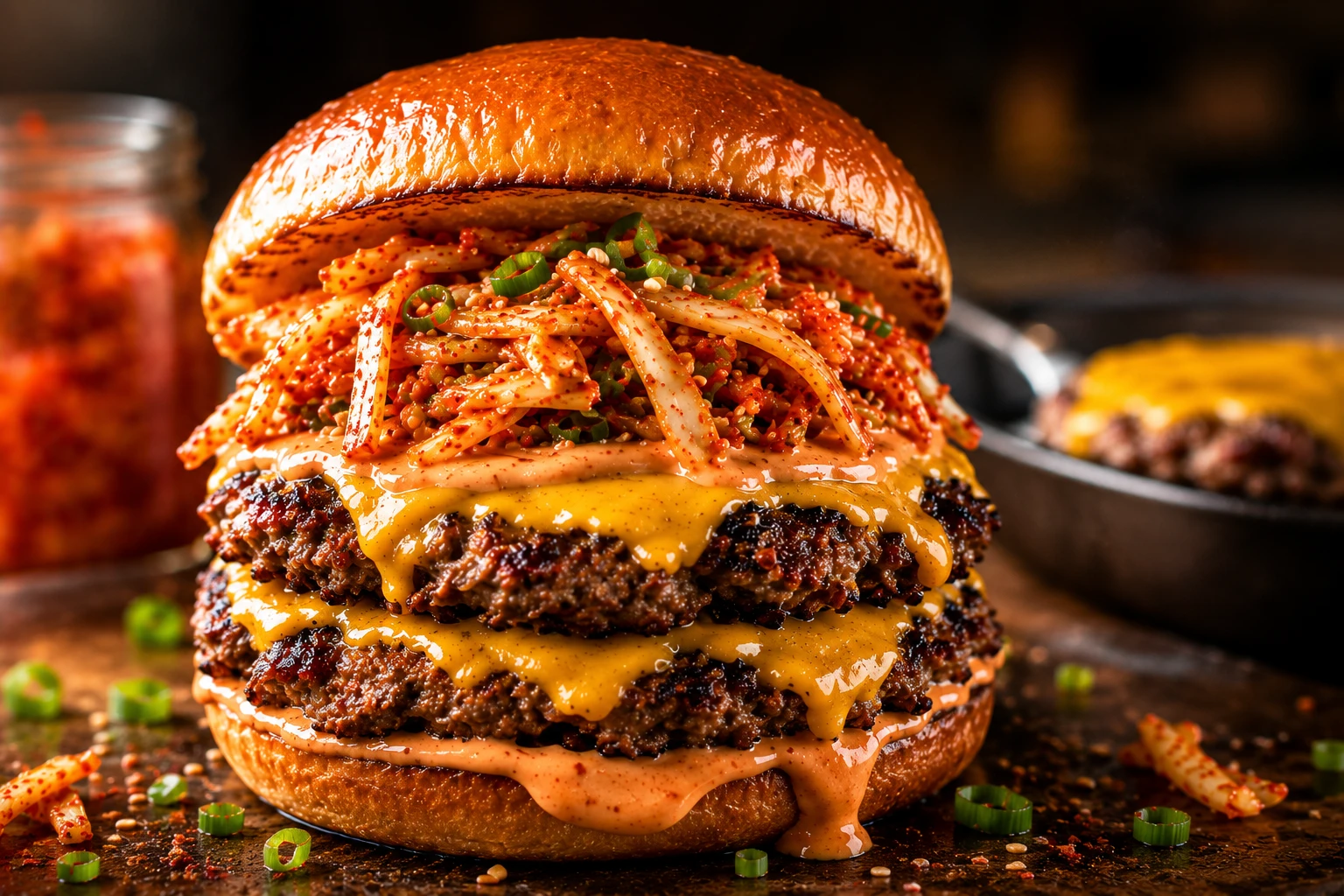
Double Smash Kimchi Burger Recipe The Cheese-Glue Trick That Holds the Stack Together
A few double-smash-plus-kimchi recipes exist online, but none test open-griddle cheese-glue stacking against the closed-lid steam-melt method most of them use, or work out exactly how much to scale the kimchi slaw and gochujang mayo for a taller stack. We tested all of it — plus an optional bacon mix-in.


What Is a Double Smash Kimchi Burger?
A double smash kimchi burger stacks two 110g smash patties glued together with melted American cheese on an open griddle, topped with a 30%-scaled kimchi slaw and gochujang mayo on a sturdier jumbo brioche bun. The three non-negotiables: stack the cheese-topped patties on the open griddle while the cheese is still actively melting rather than under a closed lid, scale the kimchi and mayo up rather than doubling them exactly, and use a jumbo bun that can structurally hold the taller stack. A bacon mix-in is a tested optional variant if you want it.
How to Make a Double Smash Kimchi Burger
A double smash kimchi burger takes 35 minutes: smash two beef balls per burger, melt cheese onto each, stack them together on the open griddle while the cheese is molten, then build the scaled kimchi slaw and mayo.
- Portion: divide cold 80/20 beef into four 110g balls (bacon mix-in optional).
- Sauce: whisk Kewpie mayo, gochujang, sesame oil, rice vinegar.
- Slaw: squeeze Stage 3 kimchi, scale the batch up about 30%.
- Smash: two patties per burger, hard press, cheese each one.
- Glue: stack the cheese-topped patties on the open griddle while molten — not under a lid.
What Every Double Smash Kimchi Burger Recipe Online Misses
We read the established double smash burger recipes — Valerio Burger Club, A Spicy Perspective, Chowhound, artisanalrecipes.com, Don’t Go Bacon My Heart, Carolyn’s Cooking, Natasha’s Kitchen, and Kamado Joe — plus, in this update, the double-smash-plus-kimchi recipes we’d initially missed: SBS Food/Tastemade’s galbi-marinated version, Zhuology, The Daley Plate, and sofiedumont.com. Here is the gap that remains even against that fuller picture.
| Feature / Information | Generic Double Smash Recipes | Double-Smash-Plus-Kimchi Recipes | This Guide |
|---|---|---|---|
| Open-griddle stacking vs closed-lid steam-melt tested | △ Some mention stacking, none test lid vs open | ✗ All use the closed-lid steam method, untested against the alternative | ✓ Both tested, open-griddle wins |
| Kimchi/mayo scaling ratio for a taller stack | ✗ Not applicable | △ Toppings included, ratio not reasoned through | ✓ Tested — 30%, not double |
| Bun structural failure specific to a taller stack | ✗ Not addressed | ✗ Not addressed | ✓ Jumbo vs standard bun tested |
| Patty size reasoning (110g × 2 vs 150g × 1) | △ Sizes given, not compared | △ Sizes given, not compared | ✓ Explained with crust-area logic |
| Bacon-in-patty variant tested against plain | ✗ Not applicable | △ One recipe uses it, doesn’t test without it | ✓ Tested both ways, kept optional |
| Test kitchen data (multiple batches compared) | ✗ None | ✗ None | ✓ Documented batch results |
| Recipe + FAQPage + ItemList schema together | ✗ None | ✗ None | ✓ All three, plus Article |
What Makes This Build Different
Five decisions separate a double smash kimchi burger that holds together from one that falls apart on the second bite.
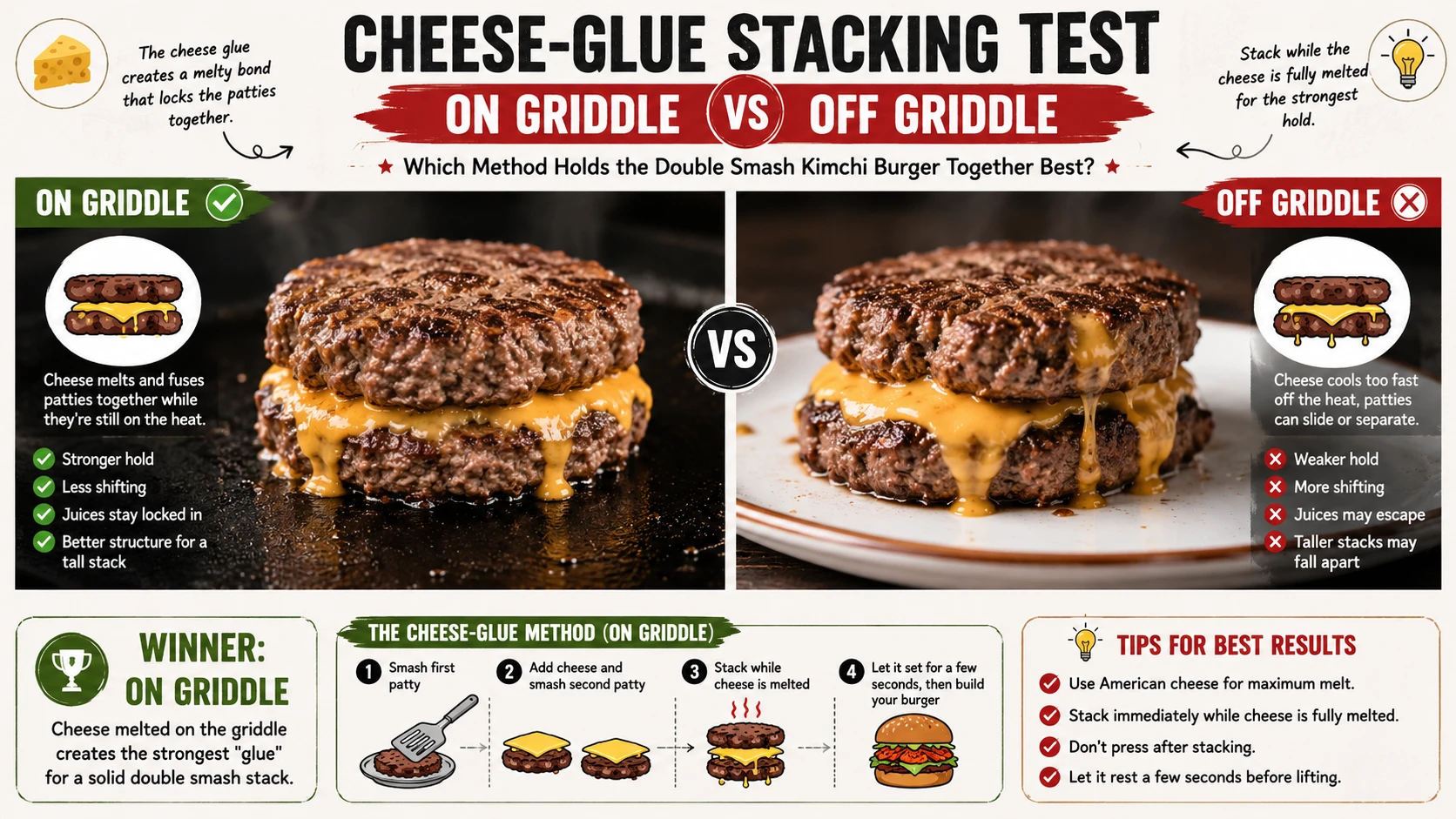
Stacking while the cheese is still actively melting on the griddle bonds the two patties firmly. Waiting until the patties cool even slightly gives a noticeably weaker bond.
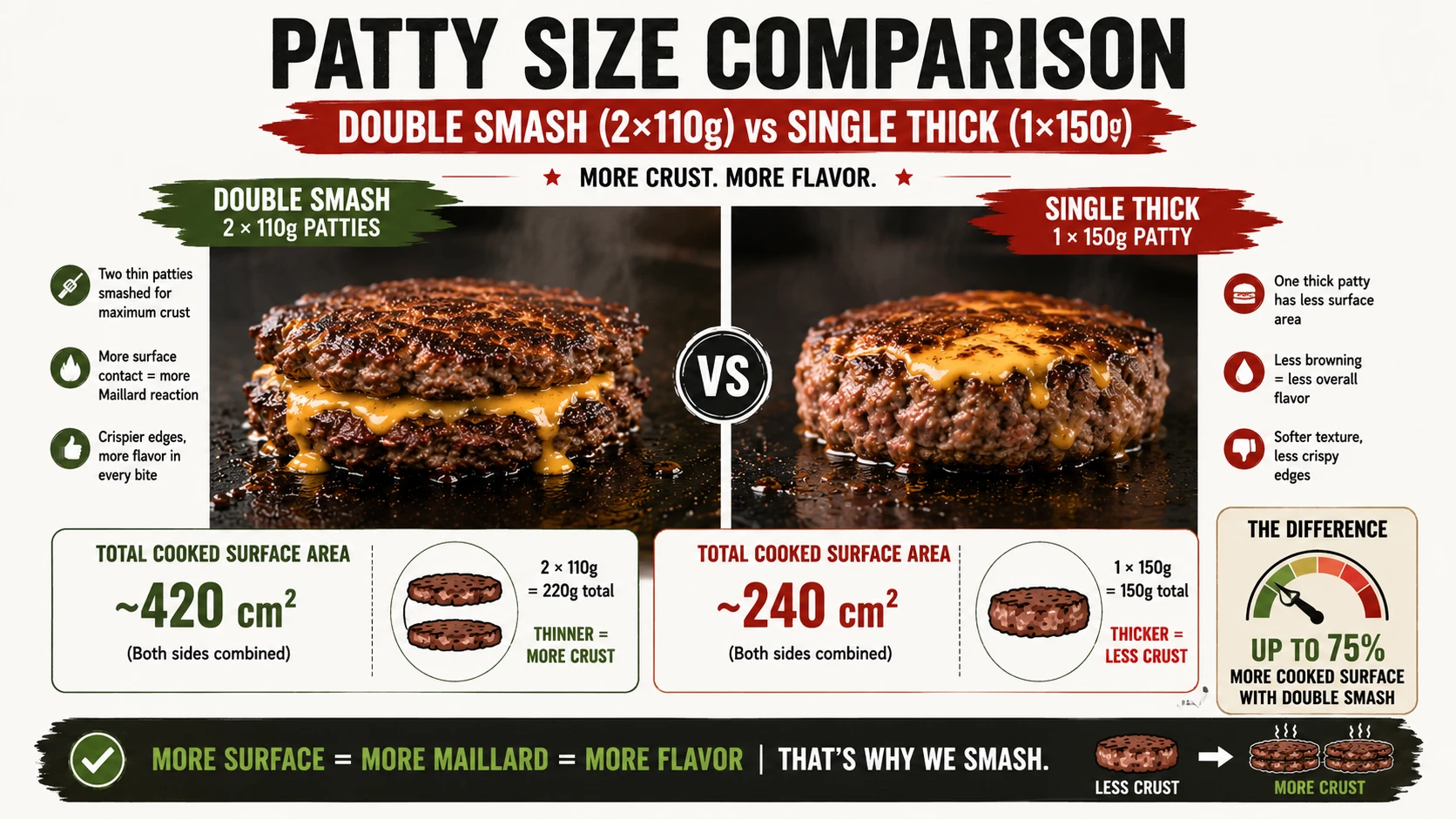
Two thinner patties create roughly double the caramelised crust of one thick patty of similar total weight, because each thin patty sears fully on both sides.
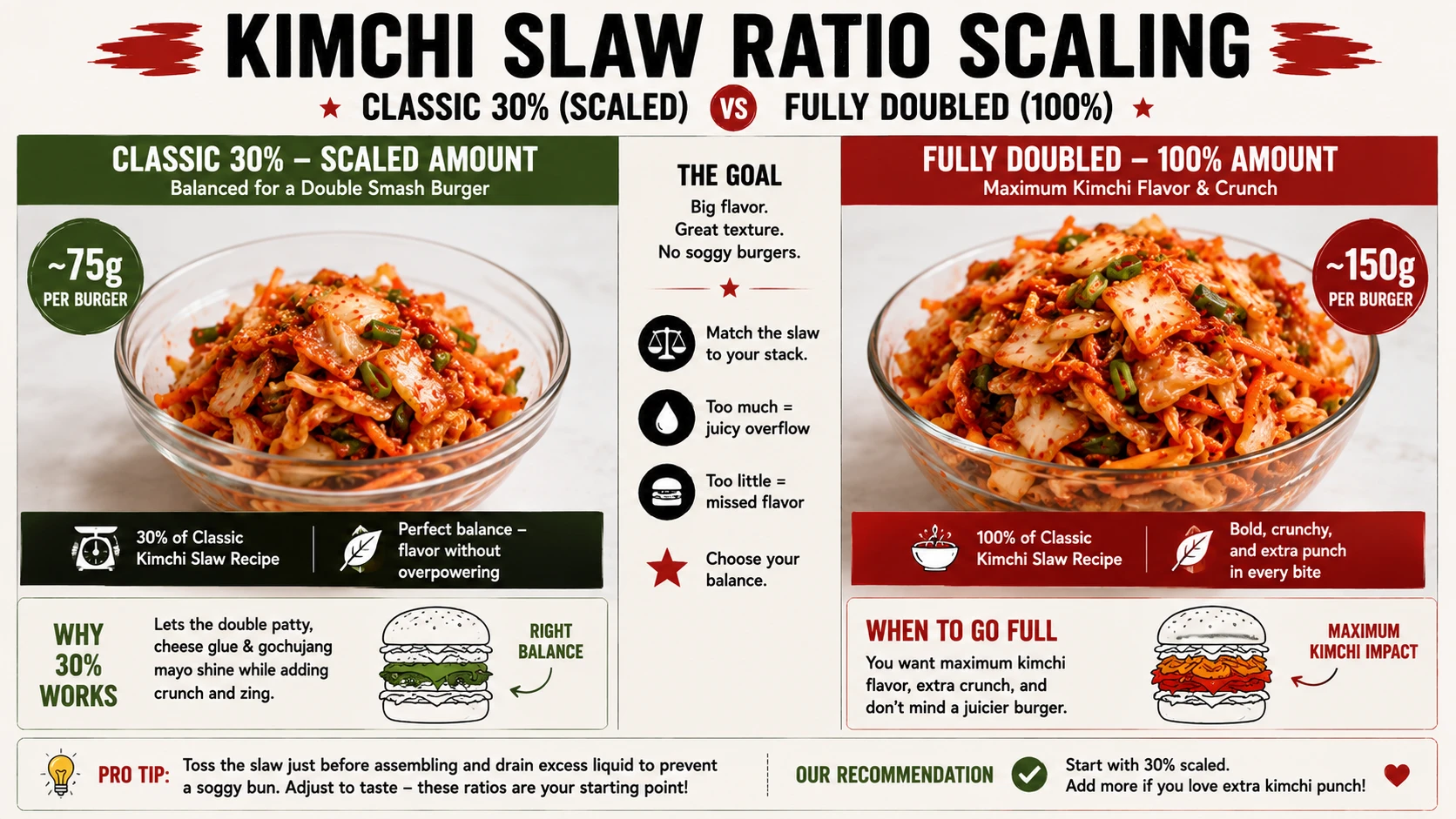
Doubling the slaw and mayo exactly overwhelmed the extra beef and made the sandwich unwieldy. A 30% increase kept the kimchi-to-beef ratio balanced.
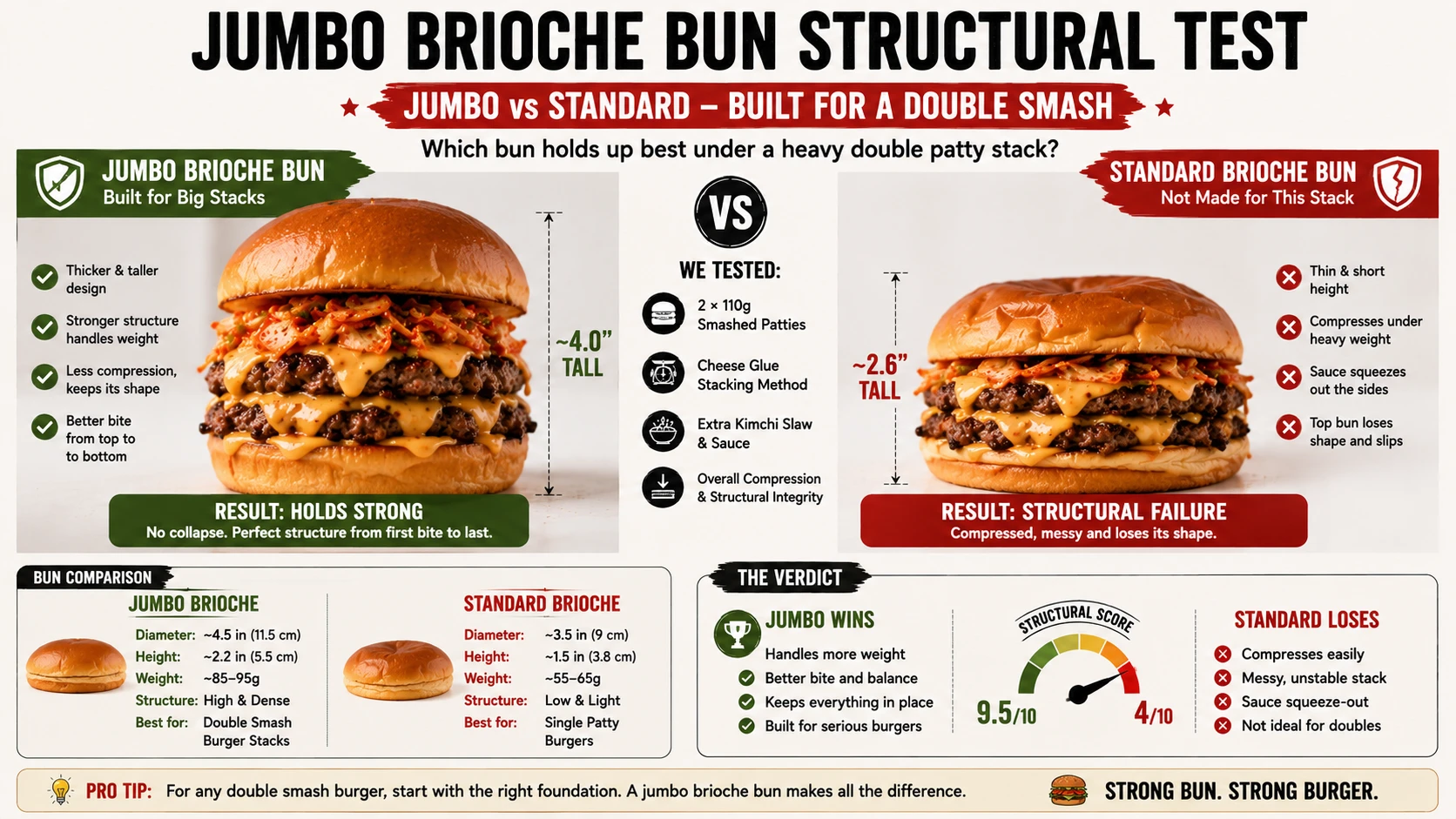
A standard-size brioche bun compressed and split under the taller stack’s weight. A jumbo bun held its shape through the full sandwich.

Most competitor double-smash-plus-kimchi recipes cover the patties with a lid to melt the cheese. That melts it, but doesn’t press the layers together while it’s still fluid — stacking directly on the open griddle bonded the patties more firmly in testing.
Key Terms — Language & Food Science Entities
Understanding these terms clarifies why each scaling and stacking decision matters for a double-patty build specifically.
How Difficult Is a Double Smash Kimchi Burger?
The technique is identical to the classic single-patty smash — the only new skill is timing the stack correctly on the open griddle while the cheese is still melting.
← This Recipe
Which Kimchi Stage to Use — Visual Guide
With more beef in the sandwich, the kimchi’s acidity has even more richness to cut through — Stage 3 is the correct choice here too.

Tastes like spiced cabbage — even less able to cut through double the beef fat than in the classic single-patty build.
✗ Not Recommended
Acceptable if ripe kimchi is unavailable, but won’t fully balance the richer, double-cheese, double-patty build.
△ Acceptable
Full sour-umami complexity cuts through the double beef and double cheese, keeping the whole stack balanced rather than one-note rich.
★ Correct — the only real choice
Can still overpower even the doubled beef if used at full strength. Squeeze hard and use sparingly, or blend with a younger batch.
△ Usable — squeeze firstIngredients
Substitution Guide — What Works, What Doesn’t
| Ingredient | Best Substitute | Ratio | Gluten-Free | Taste/Texture Impact |
|---|---|---|---|---|
| Jumbo brioche bun | Standard brioche, toasted extra firm | 1:1 | △ Check GF bun | Medium — noticeably more prone to splitting under the taller stack. |
| 80/20 beef mince | 85/15 + 1 tsp grated cold butter per patty | Per 110g portion | ✓ | Close match. Never go leaner than 85/15 for a smash patty. |
| Ground beef (protein swap) | Ground chicken/turkey + 1 tbsp cold butter per patty | 1:1 | ✓ | Noticeably lighter, needs the added fat to smash and crisp properly. |
| American cheese | Mild cheddar slice | 1:1 | ✓ | Slightly less smooth glue-layer melt than American. |
| Kewpie mayo | Hellmann’s + ½ tsp MSG + ½ tsp rice vinegar, per 3 tbsp portion | Scaled to 4 tbsp | ✓ | 60% match. Regular mayo alone reads flatter at this larger volume. |
| Gochujang | Sriracha (2 parts) + white miso (1 part) | Per 1½ tbsp | △ Check miso | Loses fermented sweetness, still good. |
| Bacon mix-in (new, optional) | Omit for the base recipe | 2 slices per 440g beef | ✓ | Adds a smoky note; makes the patties noticeably harder to smash thin and clean. |
How to Make a Double Smash Kimchi Burger
Seven steps built around the same smash technique as the classic build, doubled — plus the open-griddle cheese-glue stack that makes it hold together. Step 5, the stack itself, is the one genuinely new skill here.
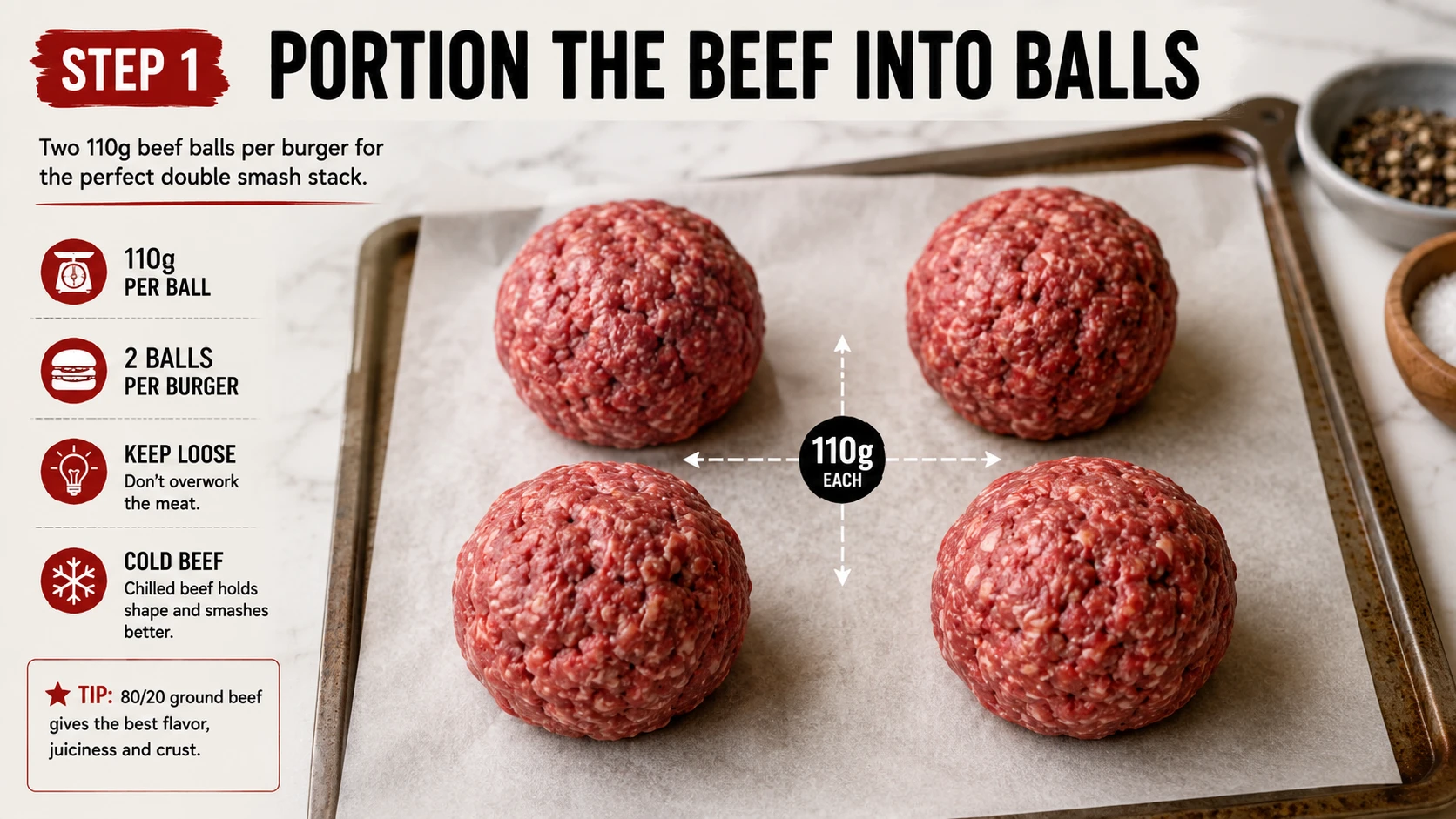
Divide cold 80/20 beef mince into four 110g balls — two per burger, not one larger 220g ball. If you’re adding the optional bacon, mix the finely chopped bacon into the mince before portioning. Roll each loosely, handling as little as possible, and season the outside with salt and pepper only just before cooking. Keep all four refrigerated until the griddle is fully heated.
Resist the temptation to save time by forming two bigger patties instead of four smaller ones. The entire premise of a double smash is maximising total crust surface area across two thin patties rather than getting one thicker patty with proportionally less sear — using fewer, larger balls defeats the purpose before you’ve even started cooking.
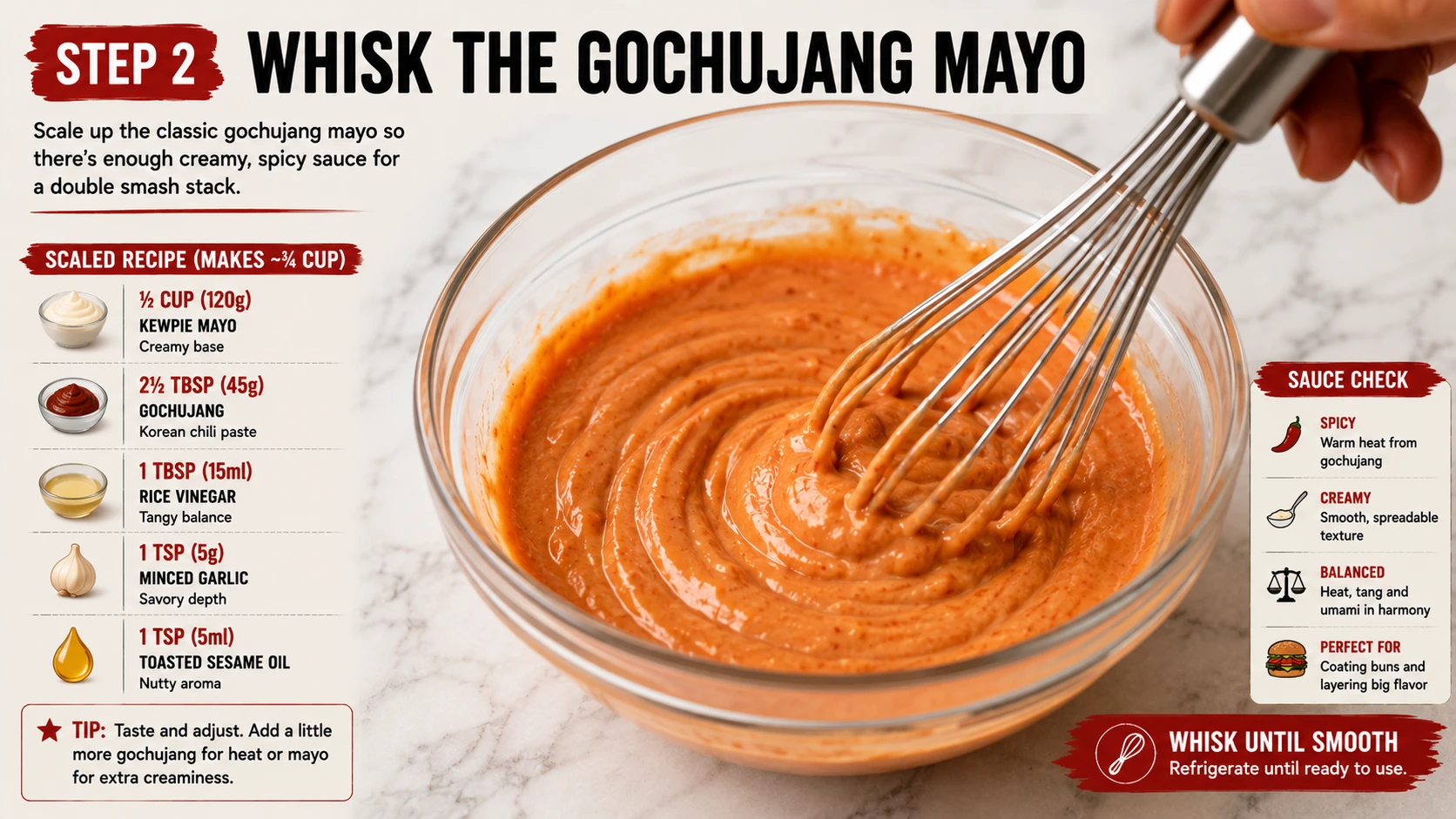
Whisk Kewpie mayo, gochujang, sesame oil and rice vinegar until fully combined and uniform in colour — this batch is scaled up from the classic single-patty build’s ratio to match the extra beef and cheese in this sandwich. Refrigerate until assembly; like the classic version, it improves slightly after a few hours as the flavours meld.
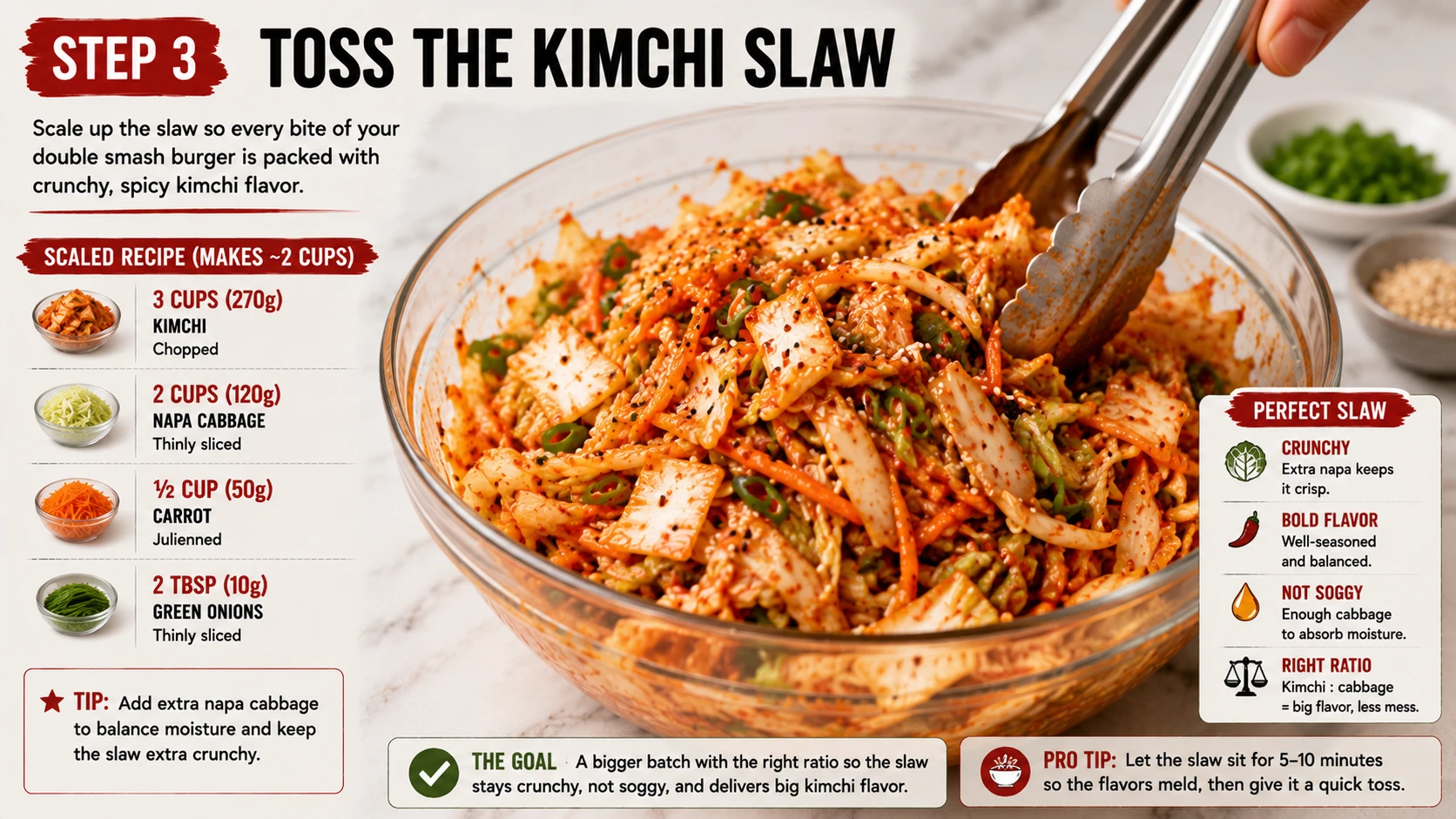
Squeeze excess liquid from the chopped Stage 3 kimchi, then toss with shredded napa cabbage, sesame oil, rice vinegar and sesame seeds. This batch is roughly 30% larger than the classic build’s — enough to balance the extra beef and cheese without burying it, based on side-by-side testing against a fully doubled batch that proved too much.
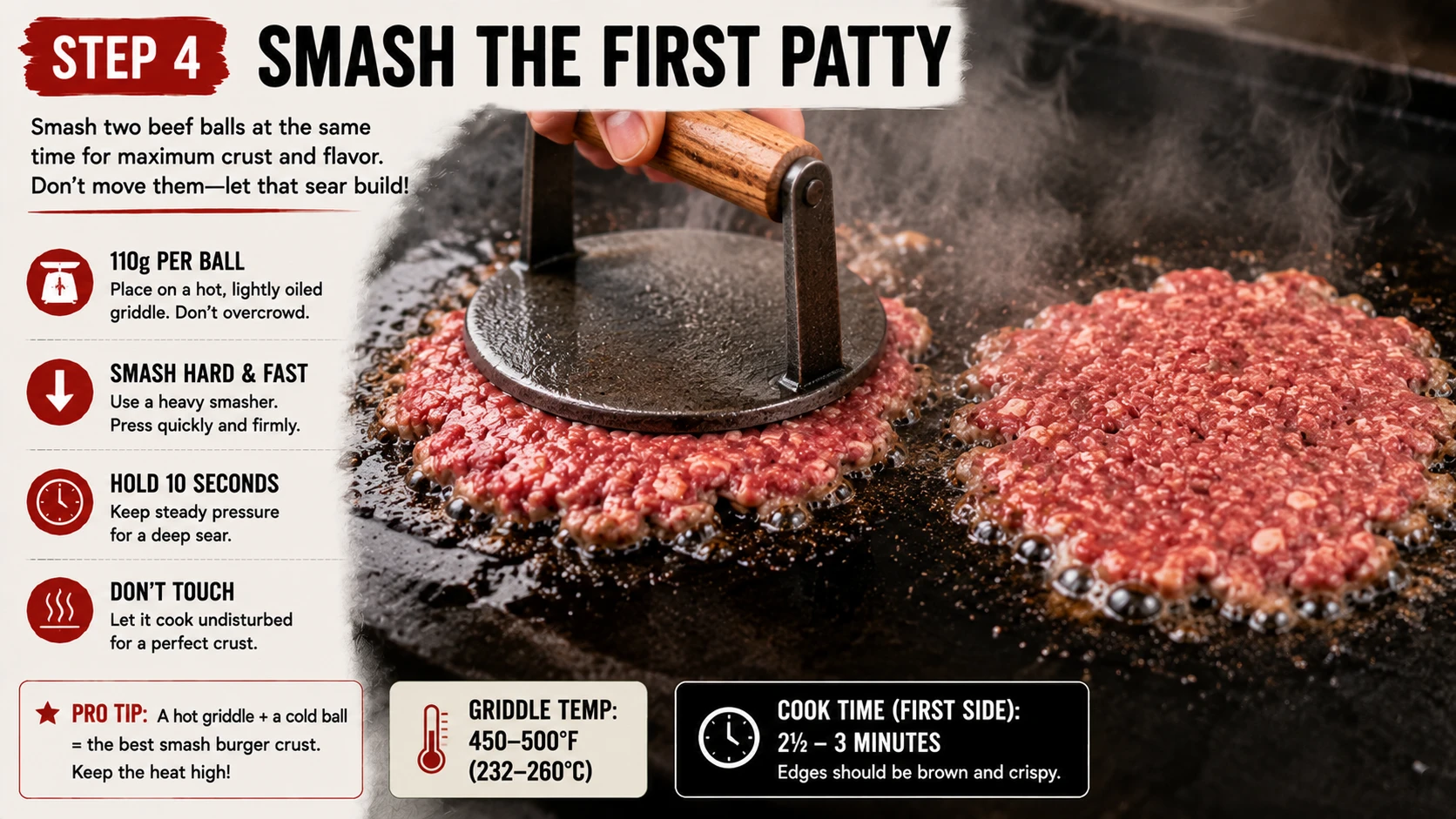
Heat a cast iron griddle until visibly smoking. Add a small amount of oil, then place two beef balls with enough space between them that smashing won’t merge them together. Press each flat immediately with a heavy spatula for a full 10 seconds, then cook undisturbed for 90 seconds until the edges are dark and lacy — exactly as in the classic single-patty build, just twice.
If you added the optional bacon, expect the patties to feel slightly greasier and a touch harder to smash into a clean, even round — the extra fat content makes them stick more and spread less predictably. Working with two patties at once on the same griddle also takes a bit more spatial awareness than a single patty; if your griddle isn’t large enough to comfortably fit two, work in batches of two rather than crowding all four on at once.
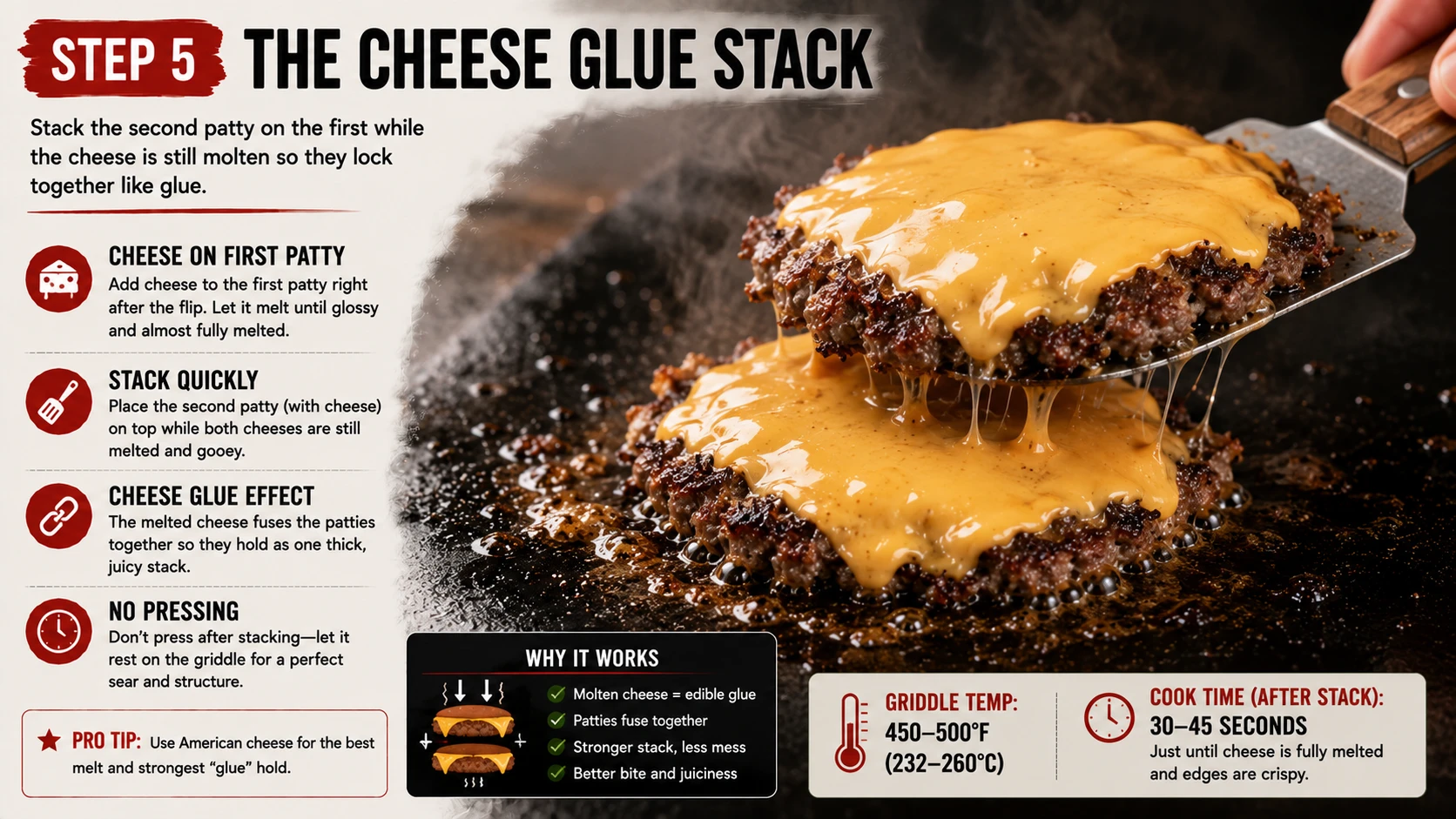
Flip both patties, and immediately place a slice of American cheese on each. As soon as the cheese is fully melted and glossy — usually 30–45 seconds — lift one cheese-topped patty and stack it directly on top of the other, both still on the open griddle. Press down gently for a few seconds to help the two melted cheese layers fuse into a single bonding layer between the patties.
Do not cover the pan with a lid to speed up the melt, even though several competitor kimchi-smash-burger recipes do exactly that. A lid steams the cheese into melting, but the patties sit apart the whole time, so there’s nothing pressing the two molten layers together — in side-by-side testing, that produced a noticeably weaker structural bond than stacking directly on the open, uncovered griddle. Repeat the smash, cheese, and stack sequence for the second burger’s patties.
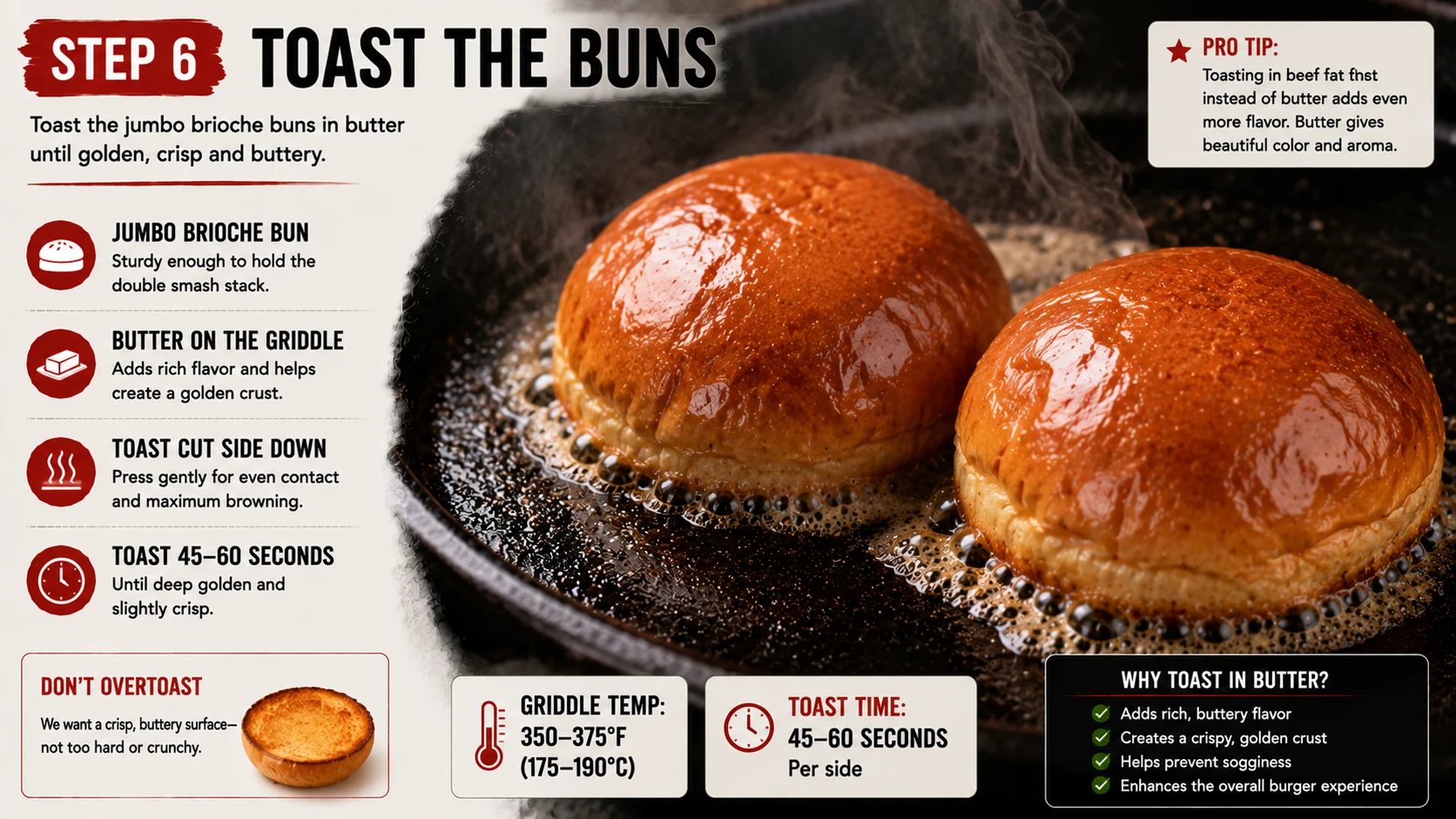
Reduce the griddle to medium heat. Add the butter to the residual beef fat and toast the jumbo brioche buns cut-side down for 60–75 seconds until deep golden. The jumbo size matters structurally here, not just for looks — a standard bun compressed and split under the combined weight and height of the stacked patties and scaled-up toppings in testing.
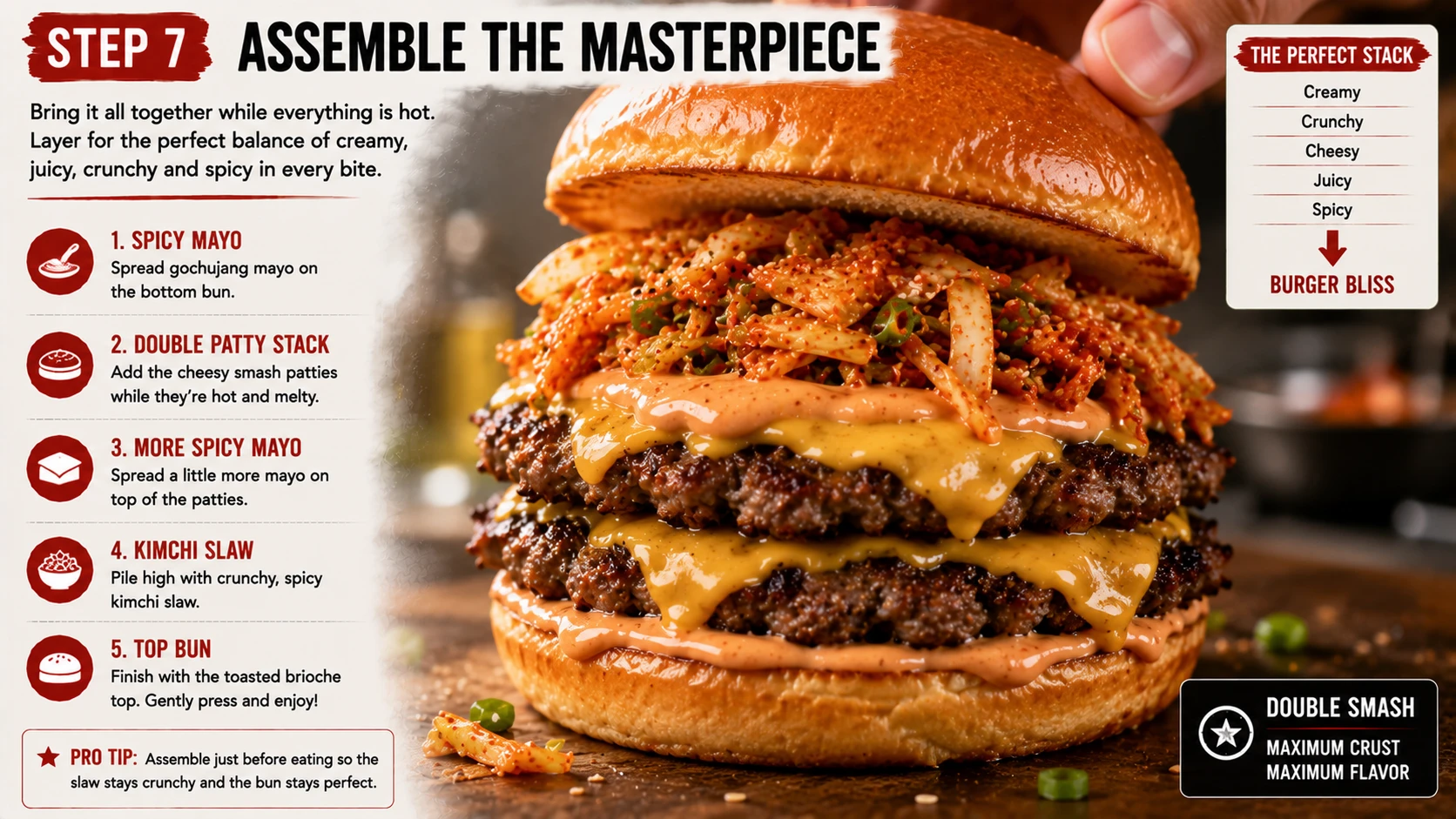
Spread gochujang mayo on both bun halves to the edges. Place the stacked double patty on the bottom bun, pile the scaled kimchi slaw on top, and scatter spring onion. Cap with the top bun and press down gently for a few seconds to compress the layers slightly before serving.
Serve immediately, and don’t be tempted to add extra kimchi slaw beyond what’s specified — the tested 30% scale-up is deliberately calibrated to keep the sandwich bite-able. More slaw than that, on top of an already-tall stack, makes the burger genuinely difficult to eat in one go.
Test Kitchen Results
Every variable was tested at least twice. Updated Aug 30, 2026 with two new batches comparing our method against what competitor kimchi-smash-burger recipes actually do.
On-griddle stacking bonded firmly and held through eating. Plated stacking, even after just a minute of cooling, produced a visibly weaker bond that separated more easily.
Stack on the griddle, immediatelyTwo thin patties produced substantially more total caramelised crust than one thicker patty of equivalent combined weight, since each thin patty sears fully on both sides.
110g × 2, not 220g × 1Classic amount got lost against the extra beef and cheese. Fully doubled overwhelmed the sandwich and made it unwieldy. 30% scaled was the balance point.
Scale kimchi/mayo ~30%, not 100%Standard brioche compressed and split at the seams under the stack’s combined height and weight. Jumbo brioche held its shape through the full sandwich.
Jumbo bun requiredCrowding all four patties onto a home-size griddle simultaneously dropped surface temperature enough to visibly weaken the crust on every patty.
Work in batches of 2 on a home griddleA single shared cheese slice melted unevenly across two patties and provided a noticeably weaker structural bond than one slice per patty.
1 slice per patty, alwaysSeveral competitor kimchi-smash-burger recipes cover the pan with a lid to melt the cheese. That melted it fine, but with the patties sitting apart, nothing pressed the molten layers together — the bond was noticeably weaker than stacking directly on the open griddle.
Open griddle, alwaysBacon added a smoky note several testers liked, but the extra fat made the patties noticeably stickier and harder to smash into a clean, even round.
Optional — plain beef is easier to work withA double smash kimchi burger succeeds or fails on timing and ratios, not on any single dramatic technique change. Stacking on the open griddle the moment the cheese is molten — not under a lid — scaling toppings by roughly 30% instead of doubling them, and switching to a jumbo bun are the adjustments that matter most. Skip any one and the difference between “restaurant-quality stack” and “burger that falls apart in your hands” becomes obvious within the first bite.
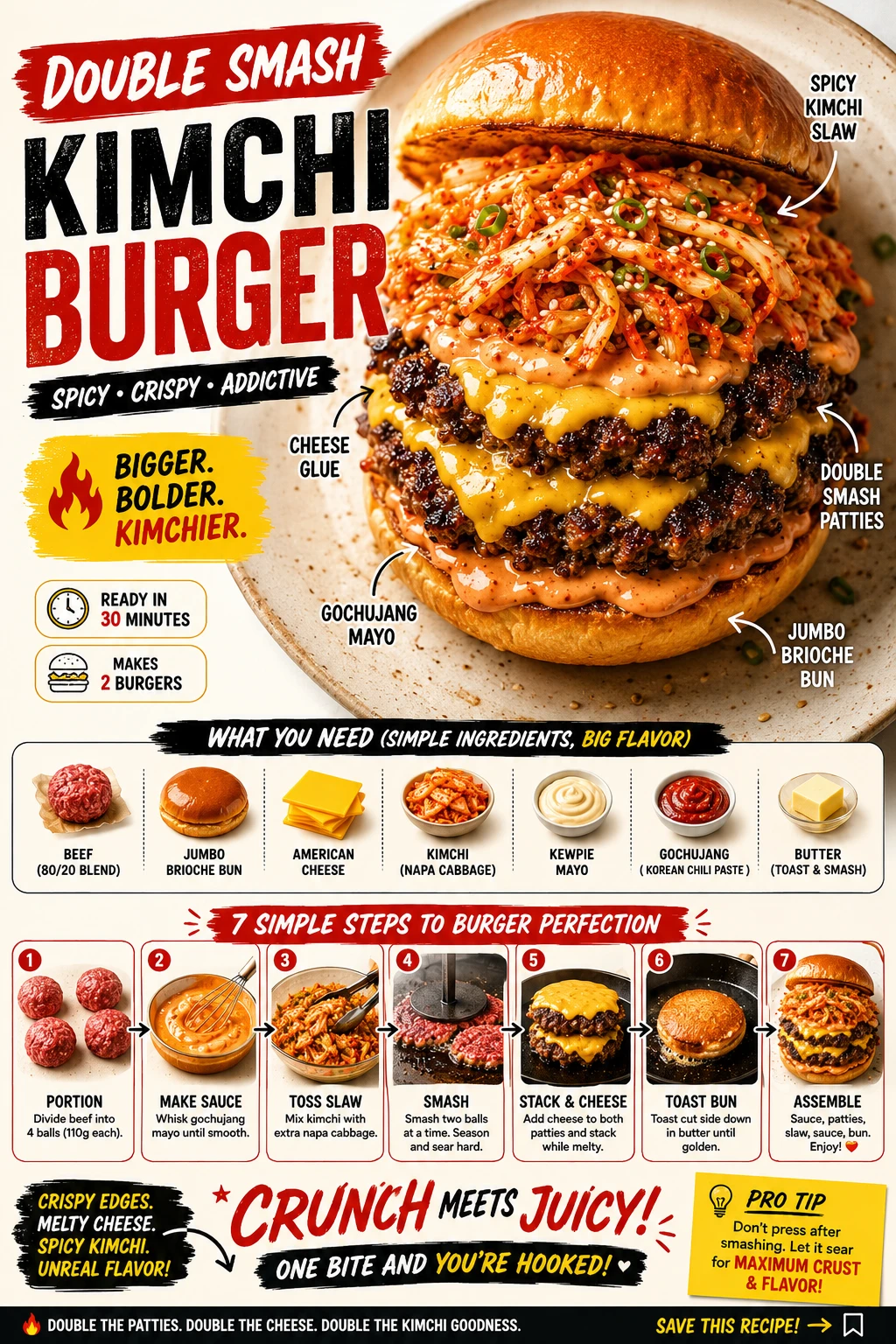
Double Smash Kimchi Burger
Two smashed patties · Open-griddle cheese glue · Scaled gochujang mayo & kimchi slaw · 35 minutes
- 440g 80/20 beef mince, four 110g balls
- 2 slices bacon, finely chopped, optional (new — mix-in)
- 195g Stage 3 kimchi (3–6 wks), chopped + squeezed dry
- 2 jumbo brioche burger buns
- 4 slices American cheese
- 1 tbsp butter + 1 tbsp neutral oil
- 4 tbsp Kewpie mayo + 1½ tbsp gochujang (mayo)
- 1½ tsp sesame oil + 1½ tsp rice vinegar (split mayo/slaw)
- 100g napa cabbage, shredded
- 1½ tsp sesame seeds; 3 spring onions, sliced
- Salt and black pepper
- 1Form four 110g beef balls, cold (mix in bacon here if using). Season just before cooking.
- 2Whisk scaled Kewpie mayo, gochujang, sesame oil, rice vinegar.
- 3Squeeze kimchi dry, build scaled slaw with cabbage and sesame oil.
- 4Smash two patties per burger on smoking griddle, 10-sec press each.
- 5Flip, cheese each patty, stack on the open griddle while cheese is molten — no lid.
- 6Toast jumbo buns in butter + beef fat, 60–75 sec until golden.
- 7Spread mayo, add stacked patty, pile slaw, scatter onion. Serve immediately.
Per serving (2 servings total), base recipe without optional bacon. Reviewed by Dr. Sarah Mitchell RD, PhD · Published July 16, 2026 · Updated August 30, 2026
All 11 Kimchi Burger Builds
This is 1 of 11 builds in the KimchiGuide kimchi burger family. Classic recipe: Kimchi Burger Recipe →. Full comparison + origin story: Kimchi Burger Ultimate Guide →

The flagship. Smash patty, gochujang mayo, kimchi slaw. 520 cal.
Classic Recipe →
Two smashed patties, open-griddle cheese glue, scaled toppings, optional bacon. 690 cal.
Currently viewing
Double-fried crispy fried thigh. Approx. 610 cal.
Chicken Burger →
Sweet soy bulgogi-marinated patty. Approx. 560 cal.
Bulgogi Burger →
Black bean patty, vegan mayo, jeotgal-free kimchi. 420 cal.
Vegan Burger →
3-bite party format, same ratios. Approx. 210 cal each.
Sliders →
Certified GF brioche-style bun + GF gochujang. 520 cal.
GF Burger →
Lettuce-wrapped, no bun. Approx. 340 cal.
Burger Bowl →
Pressed sticky rice patties instead of bread — naturally GF. Approx. 480 cal.
Rice Burger →
Bodega-style chopped beef and cheese, kimchi folded in off heat. Approx. 590 cal.
Chopped Cheese →
All 11 builds, comparison table, origin story, FAQs.
Full Guide →Double Smash Kimchi Burger — Pairing Guide
A double smash kimchi burger is a full meal on its own. Keep sides light and acidic to balance the richness rather than adding more heaviness.

Essential here more than on any other build — the cool, acidic crunch resets the palate between bites of this especially rich stack.

Natural sweetness mirrors the brioche without adding more heaviness to an already substantial meal.

Shares the gochujang-mayo flavour profile — best served as a shared side rather than a full individual portion given how rich the burger already is.

Cold carbonation is especially useful here, cutting through double the beef fat and cheese without fighting the kimchi.
Storage and Reheating
Portion into 110g balls (with bacon mixed in, if using), cover loosely, keep cold until cooking. Never bring to room temperature before smashing.
Sealed container, clean spoon each time. Do not freeze — the emulsion separates on thawing.
Softens within 30 minutes of dressing. Pre-shred cabbage and squeeze kimchi ahead, combine just before serving.
The cheese-glue bond weakens on reheating and the thin patties overcook quickly. Always cook and stack fresh — the whole process takes under 10 minutes.
Where This Build Sits Among All 11 Kimchi Burgers
| Build | Calories | Protein | Vegan? | Best For |
|---|---|---|---|---|
| Kimchi Burger Bowl | 340 | 27g | No (beef) | Low-carb, lettuce wrap |
| Vegan Black Bean | 420 | 18g | ✅ Fully vegan | Plant-based, egg-free |
| Kimchi Burger Sliders (each) | 210 | 13g | No | Portion control, parties |
| Kimchi Burger Recipe (Classic Smash) | 520 | 31g | No | The flagship recipe |
| Gluten-Free Version | 520 | 31g | No | Same build, GF bun/gochujang |
| Kimchi Bulgogi Burger | 560 | 29g | No | Sweeter, caramelised profile |
| Kimchi Chicken Burger | 610 | 34g | No | Crispy fried texture |
| Double Smash ← This page | 690 | 42g | No | Bigger appetite, most protein |
Double Smash Kimchi Burger FAQ
Sourced from real competitor gaps and reader search behaviour, answered with the detail of someone who actually tested the stacking timing. Updated Aug 30, 2026 with two new questions on the cheese-melt method and the bacon variant.
A few double-smash-plus-kimchi recipes do exist elsewhere online, including a galbi-marinated version and a couple of home-cook blog versions, but none of them test open-griddle cheese-glue stacking against the closed-lid steam-melt method most of them use, or work out how much to scale kimchi slaw and mayo for a taller stack. This recipe tests both. See the full Kimchi Burger Guide for all 11 builds.
Melted cheese acts as a structural glue, binding the two patties into one stable stack instead of two separate layers that slide apart when bitten. Without it, a double patty burger is noticeably messier to eat.
Open griddle, tested against the closed-lid steam method several competitor recipes use. Covering the patties with a lid melts the cheese but doesn’t press the two layers together while it’s still fluid; stacking directly on the open griddle while the cheese is actively molten produced a firmer bond in testing.
110g per patty, tested against the classic build’s single 150g patty. Two thinner 110g patties smash into a larger combined surface area than one thick patty, giving more crust without over-sizing the final sandwich.
Not quite double — about 30% more than the classic single-patty build. Doubling the toppings exactly overwhelmed the extra beef in testing; the 30% increase kept the kimchi-to-beef ratio balanced.
On the griddle, while the cheese is still actively melting. Stacking after both patties have cooled slightly gives a noticeably weaker cheese bond between the layers.
A jumbo brioche bun rather than a standard-size one. A standard bun compresses and can split under the added height and weight of two patties plus scaled-up toppings.
Roughly 170 calories more per burger — 690 calories versus the classic build’s 520 — from the extra 70g of beef and the second cheese slice.
Yes, it’s a tested optional variant — 2 slices of finely chopped bacon mixed into the 440g of beef before portioning. It adds a smoky note testers liked, but the fat content makes the patties noticeably harder to smash thin and clean, so it’s left out of the base recipe. See the Test Kitchen section for the side-by-side result.
The kimchi and gochujang mayo are toppings applied after cooking, not mixed into either patty, so both patties are identical plain smash patties regardless — the Korean flavour comes entirely from the mayo and slaw layered on top.
No. Two thin smashed patties create roughly double the caramelised crust surface area of one thick patty of the same total weight, because each thin patty gets its own full sear on both sides.
American cheese, for the same reason it wins on the classic single-patty build — it melts into a smooth, even layer that bonds firmly without becoming stringy or greasy.
Press down gently on the assembled burger for a few seconds before serving to compress the layers slightly, and don’t over-fill with kimchi slaw beyond the tested 30%-scaled amount — more than that makes the stack genuinely difficult to bite through.
Stage 3, ripe kimchi aged 3–6 weeks, the same as the classic build. With more beef in the sandwich, the kimchi’s acidity has even more richness to cut through.
Yes. Use a certified gluten-free jumbo-style bun and verify your gochujang brand carries a gluten-free certification. The beef, cheese, and kimchi are naturally gluten-free.
The beef balls can be portioned and refrigerated up to 24 hours ahead, and the mayo keeps 7 days. Smash and stack fresh — like the classic build, this should never be pre-cooked and reheated.
The base recipe is medium heat, scaled proportionally from the classic build. Halve the gochujang in the mayo for milder, or add a thin layer of gochugaru to the patties before flipping for more heat throughout.
Two smashed patties glued with cheese instead of one, with kimchi slaw and gochujang mayo scaled up roughly 30% to match. See the Kimchi Burger Recipe for the single-patty classic version.
Approximately 690 calories with 42g protein per burger — the highest-protein build in the kimchi burger family. Reviewed by Dr. Sarah Mitchell RD, PhD.
Ground chicken or turkey works with 1 tbsp grated cold butter mixed into each 110g portion to compensate for the missing fat, since lean poultry won’t render enough fat to smash and crisp the same way beef does.
Yes. Freeze the raw 110g portioned balls on a tray until solid, then bag for up to 3 months. Cook directly from frozen, adding about 30 seconds extra per side, rather than thawing first.
Stacking the patties after they’ve already cooled slightly, or melting the cheese under a lid instead of pressing the layers together on an open griddle, both of which weaken the cheese-glue bond. Piling on too much kimchi slaw without scaling it deliberately also makes the sandwich structurally unstable to eat.
Was this guide helpful?
Your feedback helps us improve KimchiGuide for everyone.
💬 Leave a Comment & Rating
Made this double smash kimchi burger? Tell us how the cheese-glue stack held up and rate the recipe.