Bossam KimchiWrapped Kimchi · 보쌈김치
Bossam kimchi — Korean wrapped kimchi — is the luxurious special-occasion dish from Gaeseong, wrapping cabbage leaves around seafood, fruit, and nuts. It’s not the same as the kimchi served at bossam pork restaurants — here’s the real history, a full recipe, and how it’s different.
What Is Bossam Kimchi?
Bossam kimchi (보쌈김치), or “wrapped kimchi,” is a luxurious kimchi from Gaeseong, the former capital of the Goryeo dynasty. Individual napa cabbage leaves are wrapped around a rich filling of radish, Asian pear, mustard greens, shrimp, chestnuts, pine nuts, and other ingredients, then formed into small parcels. Historically served on royal court tables, it’s meant as a special-occasion dish rather than an everyday side. Important: this isn’t the same kimchi commonly served at bossam pork restaurants today — that’s usually a quick, lightly seasoned cabbage-and-radish mix. Ready to eat in about 3 to 4 days, roughly 58 calories per serving of 3-4 parcels.
How to Make Bossam Kimchi
Bossam kimchi takes real prep time: salt whole cabbage leaves, prepare a dozen small filling components (julienned pear and radish, blanched shrimp, sliced mushrooms and chestnuts), mix them together, fill and wrap each leaf into a parcel, then rest at room temperature before refrigerating.
- Salt the leaves: separate cabbage into large leaves, salt both sides, rest ~5 hours.
- Prep the filling: julienne pear and radish, blanch shrimp, prep aromatics and nuts.
- Mix everything: combine all filling components with gochugaru and shrimp paste.
- Fill each leaf: rinse salted leaves, place filling in the center of each.
- Wrap & rest: fold into parcels, rest 24 hrs at room temp, then refrigerate 3-4 days.
The Two Bossam Kimchis
This is the single most important thing to understand before you search for or make bossam kimchi — the name covers two genuinely different dishes.

This is the dish covered in this guide — cabbage leaves wrapped around seafood, fruit, and nuts, historically served at the Goryeo and Joseon royal courts. It’s elaborate, takes real time to make, and isn’t something most households make casually.

What most people encounter today at bossam-and-pork restaurants is a quick, lightly brined cabbage mixed with fresh radish and seasoning — closer to a fresh kimchi salad meant to be eaten quickly, not the elaborate wrapped dish this page teaches.

Gaeseong’s access to varied seafood and produce meant this kimchi could include ingredients — shrimp, chestnuts, pine nuts, pear — that simply don’t appear in more everyday kimchi types. It was designed to impress.

Unlike most kimchi where everything is tossed together, bossam kimchi’s defining technique is wrapping — each leaf becomes its own small, self-contained package of filling.
Traditional vs. Restaurant-Style — Compared
If you’ve had “bossam kimchi” at a Korean restaurant, there’s a good chance it wasn’t this dish. Here’s how to tell them apart.
Side-by-Side Comparison
| Trait | Traditional Gaeseong Bossam Kimchi | Modern Restaurant-Style |
|---|---|---|
| Format | Whole cabbage leaves wrapped into parcels | Chopped cabbage and radish mixed together |
| Ingredients | Seafood, pear, nuts, mushrooms, multiple vegetables | Mainly cabbage, radish, and basic seasoning |
| Fermentation | 24 hrs room temp, then 3-4 days fridge | Very lightly fermented or eaten fresh, same day |
| Occasion | Special occasions, royal court tradition | Everyday side dish alongside boiled pork |
| This guide covers | ✓ Yes — the recipe below | Not covered here |
Key Terms & Gaeseong History
How Difficult Is This Recipe?
Let’s be honest — this is the most involved kimchi in our guide. No single step is hard, but there are many small components to prep before you even start wrapping.
Ingredients + Scaler
This recipe uses about 10-12 large individual cabbage leaves rather than a whole head, sized for a home batch rather than the traditional multi-head royal-banquet quantity.
Amounts scale automatically with the servings control above.
Common Substitutions
| Ingredient | Substitute | Notes |
|---|---|---|
| Shrimp + shrimp paste | Omit, add extra soy sauce/salt | Makes it shellfish-allergy-friendly — see FAQ below |
| Asian pear | Firm apple or Bosc pear | Denser texture, but similar sweetness |
| Chestnuts | Omit or substitute walnuts | Changes the texture but keeps some richness |
| Fresh shiitake | Dried shiitake, rehydrated | Soak in warm water 20 min before slicing |
How to Make Bossam Kimchi — 5 Steps
Salt, prep, mix, fill, wrap. The real time investment is in step 2 — there are a lot of small components to get through.

Separate the napa cabbage into individual large leaves. Rinse well, then sprinkle salt over both sides, lifting each leaf to salt evenly. Let stand about 5 hours at room temperature, turning every 30 minutes, until pliable enough to fold without cracking.
You’re salting whole leaves here rather than a whole head, which is why the timeline is shorter than full baechu kimchi — the salt only needs to soften individual leaves, not penetrate a dense, packed cabbage core.

Julienne the pear and daikon into thin, 1 to 1.5-inch strips. Cut the buchu and mustard leaf into 1-inch pieces. Slice the onion, shred the ginger, sliver the garlic and green onions, and thinly slice the shiitake mushrooms and chestnuts. Blanch the shrimp in boiling water for about 30 seconds until just pink, then cool and halve.
This is genuinely the longest step — budget real time for it. Laying every component out in small bowls before you start mixing makes the next step much faster and less chaotic.

In a large bowl, combine the julienned pear, daikon, buchu, mustard leaf, onion, shrimp, ginger, garlic, gochugaru, salted shrimp paste, green onions, shiitake, pine nuts, and chestnuts. Toss gently by hand until everything is evenly coated and distributed.
Taste the filling on its own at this stage and adjust — it’s much easier to add a little more gochugaru or shrimp paste now than after everything is already wrapped inside a leaf.

Rinse the salted cabbage leaves thoroughly in cold water and drain well. Lay each leaf flat and place 1 to 2 tablespoons of filling in the center — less for smaller leaves, more for larger ones.

Fold the sides and ends of each leaf up and over the filling to form a small, tight parcel. Arrange the parcels snugly in an airtight container. Let stand at room temperature for about 24 hours, then refrigerate. It’s ready to eat in 3 to 4 days.
Bossam Kimchi — Recipe Card
보쌈김치 · Special-Occasion Wrapped Kimchi · About 1 Hour Active. Save this to Pinterest, print it, or copy it straight to your notes app.

- 11 large napa cabbage leaves
- 1/4 cup kosher salt
- 1/2 Asian pear, julienned
- 225g daikon or Korean radish, julienned
- 1/4 onion, sliced
- Small handful buchu, cut 1-inch
- Small handful mustard leaf, cut 1-inch
- 115g small shrimp, blanched
- 1 tbsp ginger, shredded
- 4-5 cloves garlic, slivered
- 3 tbsp gochugaru
- 3 tbsp salted shrimp paste
- 2 green onions, slivered
- 2 shiitake mushrooms, sliced
- 2 tbsp pine nuts
- 4-5 chestnuts, sliced
- 1Salt cabbage leaves both sides, rest ~5 hrs, turning every 30 min.
- 2Julienne pear and radish; prep all remaining filling components.
- 3Mix all filling ingredients together by hand until evenly combined.
- 4Rinse salted leaves, place 1-2 tbsp filling in center of each.
- 5Fold into parcels, rest 24 hrs at room temp, then refrigerate 3-4 days.
Per serving (6 servings, ~3-4 parcels each). Reviewed by Dr. Sarah Mitchell RD, PhD · Updated August 15, 2026
Ingredient Notes — What Each One Does and Why
This recipe has more moving parts than most kimchi — here’s what each ingredient is actually contributing, and where it’s safe to swap.
Where Bossam Fits in the Kimchi Family
Bossam kimchi is one of 18+ varieties covered on our pillar guide — here’s how it compares to our other non-cabbage-chopped specialties.
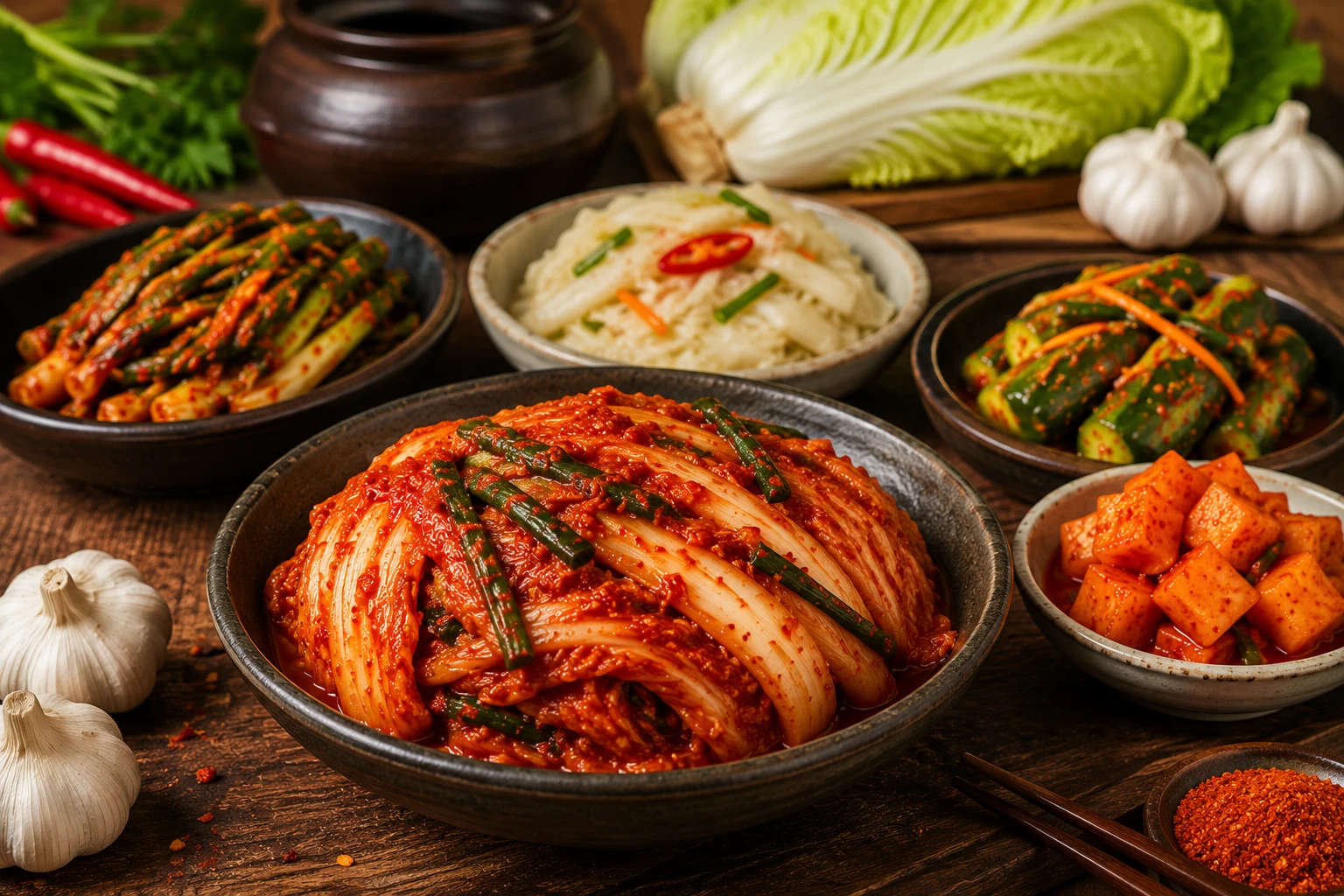


Serving Guide — Bossam Kimchi
This is a showcase dish, not a background side — plan the rest of the meal to let it stand out.


Storage & Shelf Life
How Bossam Kimchi Compares to Other Types
Figures below are drawn from our Types of Kimchi nutrition table, approximate per 100g serving.
| Variety | Calories | Sodium | Protein | Notes |
|---|---|---|---|---|
| Baechu Kimchi | ~15–23 kcal | ~450–750mg | ~1–1.5g | The most-studied variety in kimchi nutrition research. |
| Buchu Kimchi (fresh) | ~25–30 kcal | ~320–380mg | ~1g | Southern-Korean, non-cabbage type — see our full guide. |
| Gat Kimchi | ~18–24 kcal | ~440–520mg | ~1.5g | Dolsan Island specialty — see our full guide. |
| Bossam Kimchi ← This page | ~50–65 kcal | ~380–450mg | ~2.5–3g | Highest calories and protein of our covered types, due to shrimp, chestnuts, and pine nuts. |
Bossam Kimchi FAQ — 11 Questions
Not usually. The kimchi commonly served alongside boiled pork at bossam and jokbal restaurants today is typically a quick, lightly brined cabbage mixed with fresh radish and seasoning — closer to a fresh kimchi salad. The original bossam kimchi described in this guide is a more elaborate dish from Gaeseong, wrapping cabbage leaves around a filling of seafood, fruit, and nuts. Both share the name, but they’re genuinely different dishes.
Gaeseong, the former capital of the Goryeo dynasty, historically part of Gyeonggi Province and now located in North Korea. It was known as an elaborate, luxurious dish served on royal court tables during the Goryeo and later Joseon dynasties.
Bossam kimchi was historically a showcase dish, meant to display abundance and craftsmanship for royal or high-status tables. Gaeseong’s access to varied seafood and produce made it possible to include ingredients like shrimp, pear, chestnuts, and pine nuts that wouldn’t appear in more everyday kimchi types.
Yes. Leave out the shrimp entirely and substitute the salted shrimp paste with extra soy sauce or a bit more salt to taste. The flavor will be less savory-briny, but the dish still works — the vegetables, fruit, and nuts remain the heart of the filling.
It’s meant to be eaten relatively quickly — within about a week of refrigerating, since it contains fresh seafood and produce rather than being a long-fermentation kimchi. Check the smell before eating if it’s been stored for a while; if anything smells off rather than pleasantly sour, discard it.
Yes, honestly — it’s the most involved kimchi in our guide. There’s no single hard step, but there are many small components to prep (julienning pear and radish, blanching shrimp, slicing mushrooms and chestnuts) before the actual wrapping begins. Budget real time for it, and consider it a project rather than a quick weeknight side.
Yes. Omit the shrimp and salted shrimp paste, and replace with a little extra soy sauce and salt for savoriness. It won’t be strictly traditional, but the wrapped format and the fruit-and-vegetable filling still make a genuine bossam-style kimchi.
A firm, slightly sweet apple works in a pinch, though the texture will be a bit denser than the crisp, juicy bite of Asian pear. Bosc pear is another reasonable substitute if Asian pear isn’t available.
No — this recipe uses about 10 to 12 large individual leaves rather than a whole head, which is easier for a home-sized batch. If you’re already making baechu kimchi, it’s worth setting aside a few extra outer leaves specifically for a small batch of bossam kimchi.
Mild and fresh compared to long-fermented kimchi, with sweetness from the pear, crunch from the radish, savory depth from the shrimp and salted shrimp paste, and pops of richness from the pine nuts and chestnuts. It’s closer to a composed salad wrapped in kimchi-seasoned cabbage than a sharply sour pickle.
Traditionally served with steamed rice as part of a full Korean meal, often alongside other special-occasion dishes. It’s meant to be a standout side rather than an everyday banchan, so it pairs well with a more festive spread.
Was this guide helpful?
Your feedback helps us improve KimchiGuide for everyone.
Explore More
More guides and recipes from KimchiGuide.
See how bossam kimchi fits among 18+ other varieties.
Read the guide →An easier, everyday non-cabbage kimchi from Dolsan Island.
Get the recipe →
No pre-salting needed — the fastest kimchi in our guide.
Get the recipe →How to choose and use Korean chili flakes.
Read the guide →
Ways to use kimchi once it’s fully aged.
Read the guide →In a hurry? See what’s actually worth buying.
Read the guide →About the Author & Reviewer

Ji-Young Park
12 years writing about Korean home cooking, with 200+ kimchi batches tested for KimchiGuide, including regional and heritage varieties like bossam, gat, and buchu kimchi.
View Full Bio →
Dr. Sarah Mitchell
Registered dietitian specializing in fermented foods and gut health, reviewing nutrition and food-safety claims across KimchiGuide’s kimchi guides.
View Full Bio →
Made This for a Special Occasion?
We’d love to hear how your bossam kimchi turned out, or which substitutions you tried.