Eaten Alive Kimchi Review — Is It Good? (2026)
This Eaten Alive kimchi review breaks down the taste, real ingredients, its Great Taste Award credentials, the live-culture and unpasteurised claims, and where to actually buy it.
Eaten Alive Kimchi Review — Quick Verdict
This Eaten Alive kimchi review comes down clearly positive on credentials. It’s the most award-decorated kimchi brand in our entire UK cluster, winning 2 Stars at the Great Taste Awards 2018. Founded in 2016 by chefs Pat Bingley and Glyn Gordon and made in Battersea, London, it’s genuinely raw, vegan, and unpasteurised, fermented for around 3 weeks before sale. The range includes Classic, Spicy, and Golden (lemon and turmeric) Kimchi. We couldn’t find a public aggregate customer star rating for the kimchi specifically, and its mainstream UK supermarket footprint is less certain than some other brands in our guide — so treat this Eaten Alive kimchi review as credential- and ingredient-led rather than crowd-rated.
Who Makes Eaten Alive Kimchi?
One of the longer-established artisan fermenters in the UK kimchi scene.
Eaten Alive was founded in 2016 by chefs Pat Bingley and Glyn Gordon, and is made in Battersea, London. That founding date makes it one of the earlier dedicated kimchi producers among the UK brands we’ve reviewed — several others in our cluster (The Cultured Collective, Mrs Elswood’s kimchi range) launched or expanded years later. A chef-founder background is also worth noting: it suggests a flavour-first approach to product development, consistent with the brand’s award history covered below.
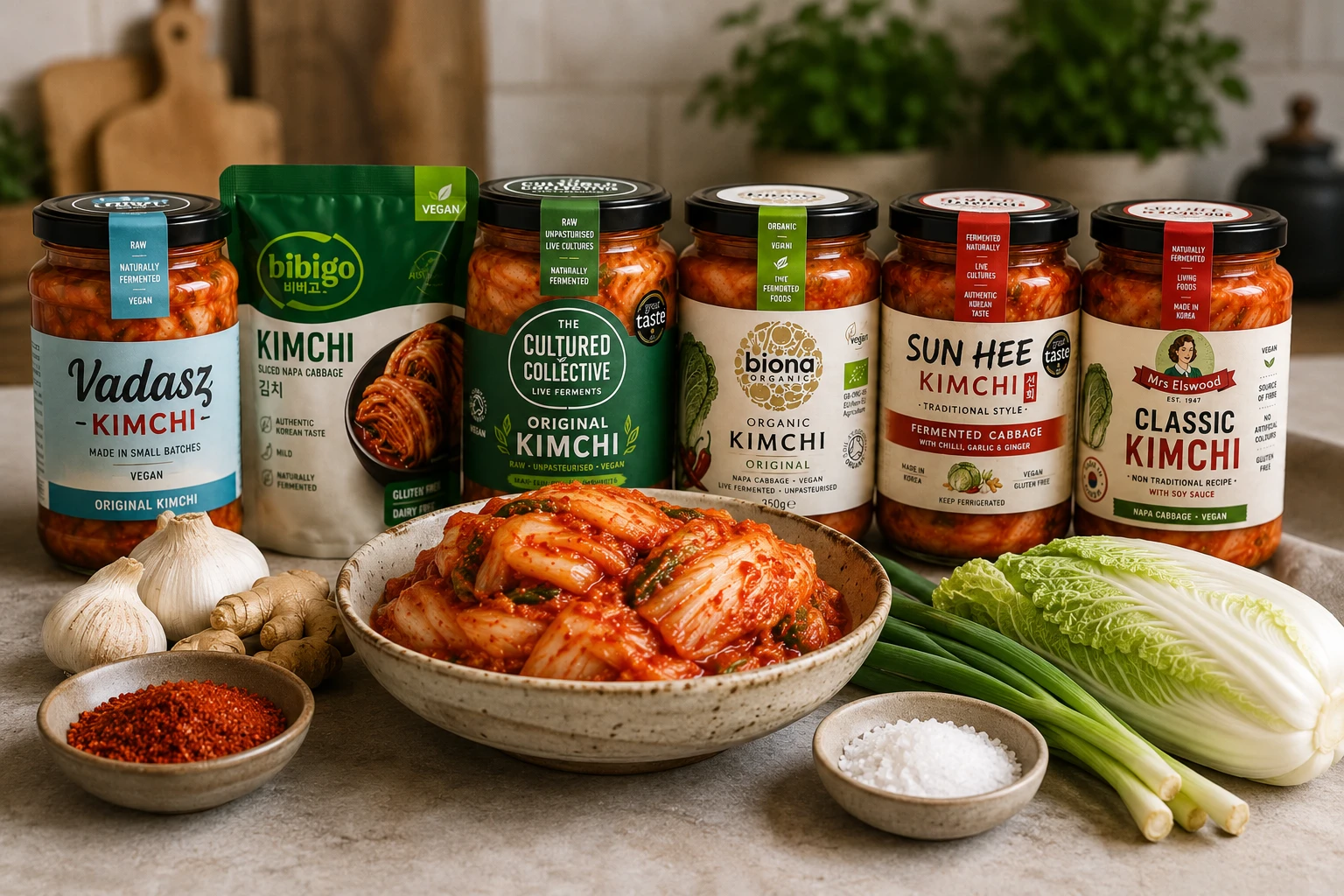
Beyond kimchi, Eaten Alive also produces sauerkraut and a range of fermented hot sauces, positioning itself as a broader fermentation specialist rather than a single-product kimchi brand — similar in structure to Vadasz and The Cultured Collective, both of which also sell beyond kimchi alone.
The Great Taste Award — What It Means
This is genuinely the standout fact in this Eaten Alive kimchi review.
Eaten Alive’s kimchi won 2 Stars at the Great Taste Awards 2018, run by the Guild of Fine Food — a respected, independently judged UK food industry accolade based on blind tasting by a panel of specialist food critics, chefs, and producers. Among every UK kimchi brand covered in our guide, this is the strongest third-party quality credential we’ve found — stronger than Vadasz’s single-star 2018 award, and a more rigorous, judged accolade than a retailer star rating like Mrs Elswood’s or Biona’s.
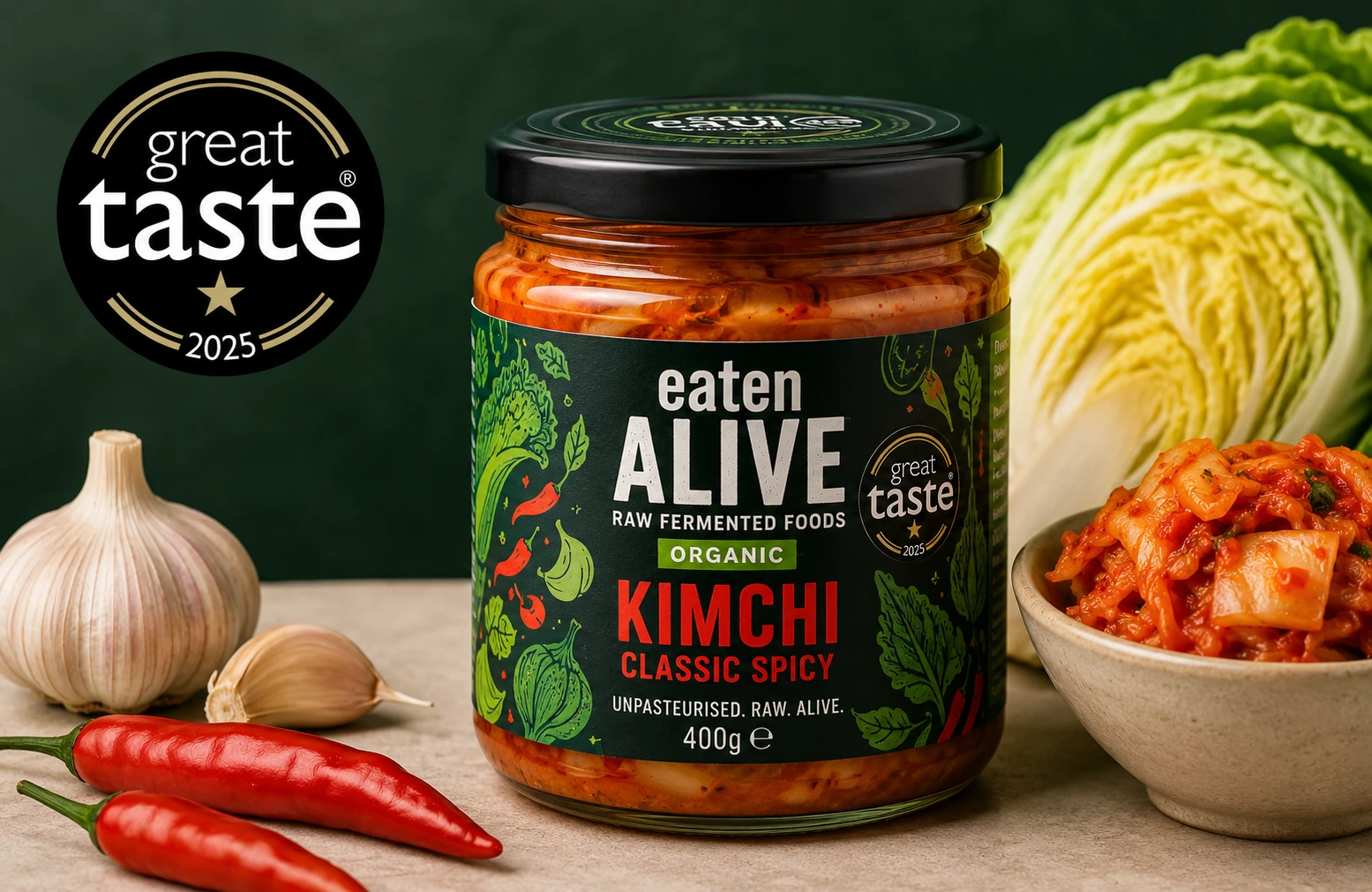
Great Taste Awards are judged blind, purely on flavour, by a rotating panel — not on packaging, branding, or marketing story. A 2-star result specifically means the judging panel considered it to have “above and beyond” delicious flavour, a genuinely meaningful signal for a fermented product.
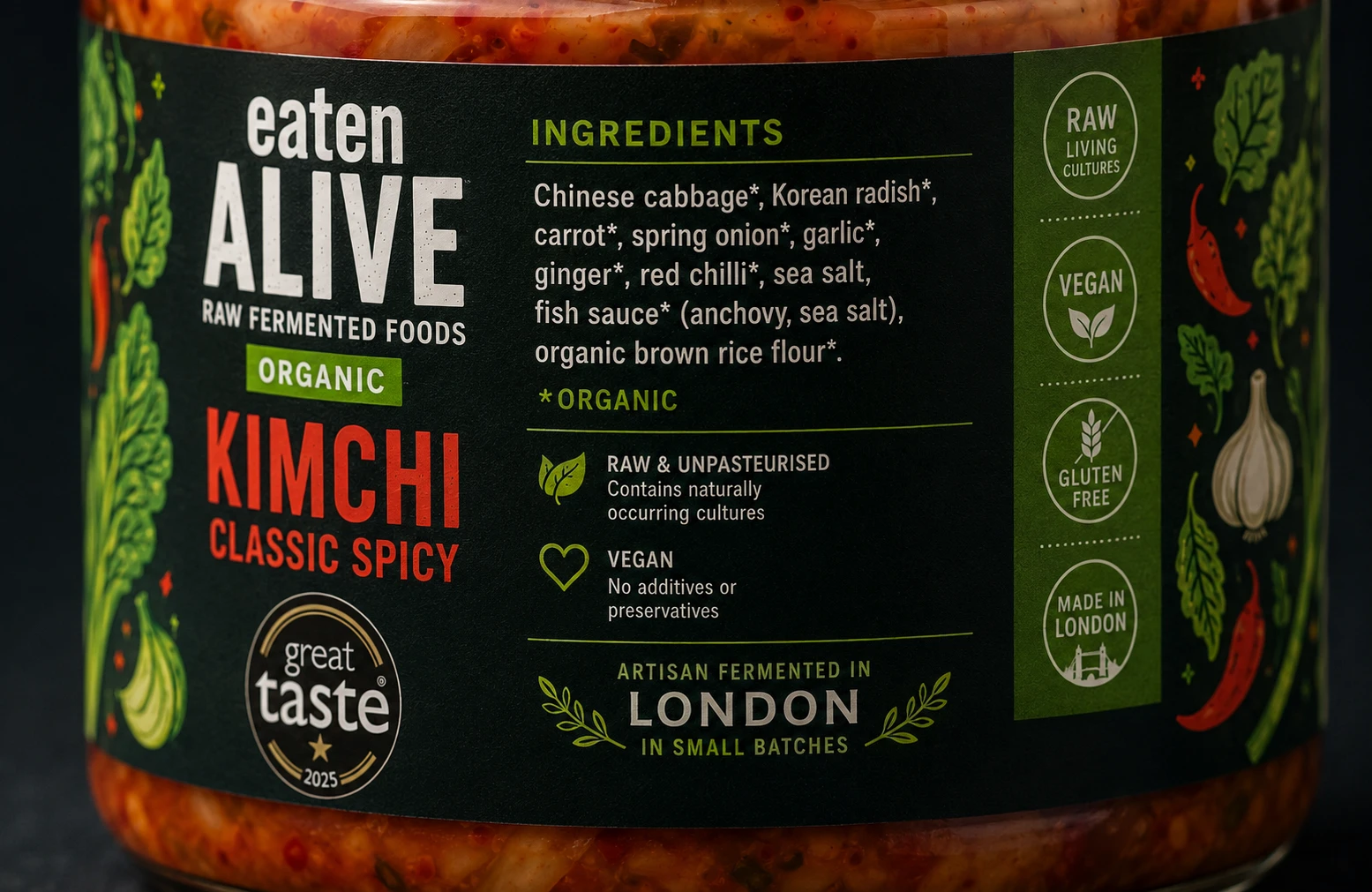
The award dates to 2018 — genuinely still meaningful, but worth noting it’s not a current-year result. We couldn’t confirm whether the exact recipe judged in 2018 is identical to what’s sold today, which is common for small-batch producers that refine recipes over time.
Real Ingredients Breakdown
Pulled from the brand’s own product descriptions.
| Ingredient | Role |
|---|---|
| Chinese leaf cabbage (hand-cut) | Base vegetable |
| Daikon radish | Traditional secondary vegetable |
| Carrot | Sweetness and colour |
| Spring onion | Aromatic |
| Soy sauce | Umami — non-traditional substitute for fish sauce |
| Chilli flakes | Heat and colour |
| Garlic | Aromatic |
| Ginger | Aromatic |
Taste & Live Cultures
A genuinely live product, backed by a real award rather than just marketing language.
Eaten Alive describes its kimchi as raw, vegan, and never heat-treated, fermented for roughly 3 weeks before it reaches a jar — a genuinely traditional fermentation timeline, longer than some competitors disclose. Combined with the 2018 Great Taste 2-star result, this is a strong signal of real flavour depth from live fermentation rather than added acidity or shortcuts. We could not locate a large, independent body of customer reviews specifically for the kimchi (as distinct from the brand’s other products) at the time of writing.
The Flavour Range
Three genuinely different kimchi styles, not just a single SKU.
| Variant | Notes |
|---|---|
| Classic Kimchi | The base recipe covered above |
| Spicy Kimchi | A hotter version of the classic recipe |
| Golden Kimchi | Made with lemon and turmeric — a lighter, brighter flavour profile |
This three-flavour structure mirrors what we’ve seen from other UK artisan brands (Vadasz’s Super Green line, Mrs Elswood’s Turmeric and Beetroot variants) — a genuine pattern across the UK market of kimchi brands diversifying beyond a single traditional recipe fairly quickly after launch.
Where to Buy Eaten Alive Kimchi — Honestly
This is the one area where Eaten Alive is less certain than some other brands in our guide, and we’d rather say so plainly.
This is a genuine trade-off against brands like Vadasz or Sun Hee, which have confirmed listings across multiple major supermarkets — Eaten Alive trades some convenience for its stronger artisan and award credentials. See our full where to buy kimchi in the UK guide for how this compares to every other brand we’ve checked.
Eaten Alive vs. The Cultured Collective
The UK’s two confirmed raw, unpasteurised kimchi brands, compared directly.
| Eaten Alive | The Cultured Collective | |
|---|---|---|
| Founded | 2016 | Founder started on market stalls, brand grew through the 2020s |
| Fermentation | Raw, unpasteurised (~3 weeks) | Raw, unpasteurised |
| Award | Great Taste Awards 2018 — 2 Stars | None found as of this update |
| Mainstream supermarket footprint | Uncertain for kimchi specifically | 183 Sainsbury’s stores (2025) |
Related Guides


Eaten Alive Kimchi Review — FAQ
By most measures, yes — it’s the most award-credentialed UK kimchi brand we’ve reviewed, winning 2 Stars at the Great Taste Awards 2018. It’s genuinely raw, vegan, and unpasteurised, fermented for around 3 weeks before sale. We could not locate a public aggregate customer rating for the kimchi specifically, so treat this as an ingredient- and credential-led verdict.
Eaten Alive was founded in 2016 by chefs Pat Bingley and Glyn Gordon, and is made in Battersea, London.
Yes — it won 2 Stars at the Great Taste Awards 2018, a respected UK food industry accolade run by the Guild of Fine Food. This is the strongest award credential of any UK kimchi brand in our cluster.
Yes — the brand describes its kimchi as raw, vegan, and never heat-treated, fermented for approximately 3 weeks before sale, meaning it retains live cultures.
Hand-cut Chinese leaf cabbage, daikon radish, carrot, spring onion, soy sauce, chilli flakes, garlic, and ginger — no fish sauce or shrimp paste.
Yes — Eaten Alive markets its kimchi explicitly as vegan, with no animal-derived ingredients in the published recipe.
Classic Kimchi, Spicy Kimchi, and Golden Kimchi (made with lemon and turmeric) — plus a separate sauerkraut and hot sauce range.
Primarily through the brand’s own website and specialist independent health-food retailers. A Sainsbury’s listing was confirmed for the hot sauce range specifically, but we could not confirm the kimchi shares that listing — check current in-store availability directly.
Both are genuinely raw, unpasteurised UK kimchi brands. Eaten Alive is older (founded 2016) and holds a Great Taste Award, while The Cultured Collective has wider mainstream supermarket access via its 2025 Sainsbury’s listing.